













Cataracts
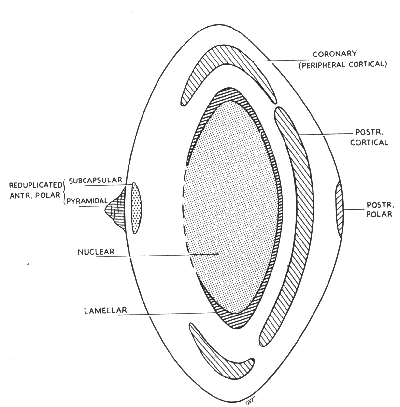
and Cataract Surgery in Small Animals CATARACT WHAT IS A CATARACT? The lens is a unique living ocular tissue that is usually clear or transparent and is referred to as 'the crystalline lens' by doctors. The normal lens focuses light on the light-sensitive nervous tissue located in the back of the eye which is known as the retina. A cataract is an opacity (or cloudy change) of the lens that scatters light and looks gray or white. The word cataract literally means "to break down." The word applies to waterfalls and rapids as well as to the lens. Cataractous changes of the lens may appear as small insignificant dots, microscopic blisters, a cracked-glass appearance, a diffuse haze, a "pearl-like" sheen, white streaks or a completely white lens. The cataract usually starts as small dots or microscopic blisters and progresses to involve larger areas of the lens. The rate of progression is difficult to predict and may be very slow or quite rapid. At times the cataract appears to worsen overnight. Cataracts may develop in one or in both eyes. If a large portion of the lens becomes white, it prevents formed images from reaching the retina and blurred vision results. When a light is shined into the eye of a patient with a complete cataract, the patient only sees a white light and no images can be seen. WHAT SHOULD YOU DO IF A CATARACT IS SUSPECTED? The first thing to do if your veterinarian indicates your pet has a cataract is to have your pet examined by a veterinary ophthalmologist. The lens is an important link of the total visual system, yet the health of the entire eye should be evaluated before the lens develops a complete cataract. Early evaluation of the eye with a cataract sometimes permits examination of the retina. If the cataract is complete and 'mature', the retina cannot be directly examined and an ultrasound or an electroretinogram examinations, or both may be needed to assess the health of the retina. At the time of the initial examination, the cataract may sometimes be identified as to cause, area of involvement and stage of progression. Not all cataracts lead to blindness. "Incomplete" cataracts may not impair vision significantly. If your pet has a cataract and has shown some visual loss, evaluation will include the consideration of and benefit of cataract surgery. HOW DO YOU KNOW IF YOUR PET HAS A VISION PROBLEM? Animals are creatures of habit and pets love to please their owners. If vision loss develops slowly over a long period of time, your pet may adjust to your home and yard. Pets in familiar surroundings may readily move about even when almost blind because they have learned where all objects are. Signs such as bumping into objects, failing to retrieve favorite toys and fear of being left alone may be signs of vision loss. These are especially significant if they occur within the pet's home or yard. WHAT CAUSES CATARACTS? The cause of cataracts is an area continually being studied. Cataracts may result from injuries to the eye, inflammation within the eye (uveitis), internal diseases that have an effect on the eye such as diabetes mellitus and some cataracts are inherited. Although it may be difficult to name the specific cause of a cataract, cataracts that develop in eyes free of signs of ocular disease are assumed to be inherited. Inheritance is the major cause of cataracts in dogs and cats. ARE THERE TYPES OF CATARACTS? The type of cataract may not be important for deciding whether surgery may be performed. Cataracts may be classified by age of onset (congenital, acquired or juvenile, or senile), physical appearance of the cataract (location in the lens -see below), state of development of the cataract (incipient, immature, mature, hypermature or morgagnian), or cause (traumatic, diabetic, inherited). |
|
 |
|
|
WHAT IS THE TREATMENT FOR CATARACTS? There is no medical treatment known to slow the progression of, prevent the formation of or reverse the changes of cataracts. Surgery to remove the cataractous lens is the only known treatment in animals and man. Successful surgery can provide a return of vision. SHOULD MY PET HAVE CATARACT SURGERY? Cataract surgery is generally restricted to those patients who have developed a cataract in both eyes. If one eye has a blinding cataract and the other eye has a rapidly developing cataract or if rapidly developing cataracts are present in both eyes, surgery is recommended so the patient will not completely lose vision. It is also important to consider whether the patient is a good candidate for anesthesia. With continued improvements in veterinary medicine and anesthesia, age alone does not a limit the possibility of surgery. With the use of modern anesthetic agents, successful surgery is performed on dogs and cats 17-18 years of age and older. The over-all health of the patient needs to be assessed before surgery. This may include chest x-rays, EKGs, blood chemistry or other procedures as recommended by your veterinarian. Cataracts may be removed from one or both eyes during the same surgery. Finally, you are the one who hears all the information and decides if surgery will be performed to restore vision for your pet. IS MY PET A GOOD CANDIDATE FOR CATARACT SURGERY? Cataract surgery involves a period of intense pre- and post-operative care followed by an extended period of low level therapy. If you are unable to provide this treatment, surgery is not recommended. Alternatively, if your pet will not or cannot be treated as required, he/she is not a good surgical candidate. Animals who bite the hand that feeds it don't do well after surgery. WHAT WILL MY PET BE ABLE TO SEE AFTER SURGERY? Patients benefit from cataract surgery because it will allow them to be able to move about without the fear of bumping into objects. As in people, the loss of the lens causes a loss of up-close visual acuity or sharpness. Without a lens, a pet may not have completely normal vision after surgery, but they do regain some vision. The image they see will be slightly larger and only partially focused so that the images will be much less distinct. Although our pets don't drive, play golf or tennis they need sharp vision yet it is not as necessary as for humans. Most veterinary patients are handicapped without a lens yet others do not show significant vision loss. Veterinary ophthalmology has learned much from the ophthalmic physician and we know that most dogs will see much better when an artificial lens is implanted inside the lens capsule. We do this procedure when the client requests it and the surgery allows it to be done. The estimate you receive before the surgical procedure will have the option of lens implantation. |
|
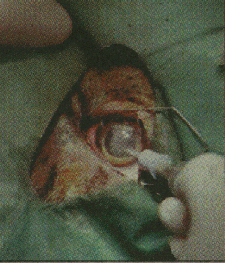
WHAT DOES CATARACT SURGERY INVOLVE? Cataract surgery is performed on an outpatient basis by many veterinary ophthalmologists, while others will admit the patient for one or two days. The patient is admitted to the hospital the morning of surgery and an intravenous catheter is placed to facilitate the administration of drugs. Drops are placed in the eyes at specific intervals before surgery. General anesthetic is induced using the most modern agents. An ultrasound may be performed to examine structures inside the eye that cannot be visually seen. An electroretinogram [ERG] is performed to determine that there is a reasonable chance for vision following surgery. This procedure is used if the cataract has progressed to the point that the ophthalmologist cannot assess the retina during the initial examination. If the ERG indicates that vision is not possible, then surgery is not performed and the patient is awakened. If the ERG shows that vision is possible, the patient is prepared for surgery and moved to the surgical center. During the surgical procedure, the pet's respiration and heart rate will be monitored by the surgical technician. An EKG will be attached to your pet so that the heart can be assessed while the patient is undergoing surgery. Surgery is performed using an operating microscope and sophisticated microsurgical instruments. The actual surgical procedure may last 30-40 minutes and general anesthetic is normally for 60-120 minutes. The cataract is removed by a technique known as phacoemulsification. The eye is entered with a small incision, the lens capsule is carefully opened in a technique called capsulotomy, and the lens is removed by the phaco instrument which emulsifies the lens into a mulch with ultrasonic waves, and aspirates the remnants. This is the same technique that is used in human cataract surgery. Although lasers are not involved in this procedure, it has become common lingo amongst people who have had cataract surgery by phacoemulsification to say that their cataract was removed by the laser. |
 |
|
During recovery, your pet will be closely monitored. An Elizabethan collar (E-collar) is placed on the pet so they will not injure their own eyes during the first 7 to 14 days following surgery. Postoperative medications are used to reduce inflammation and preventing infection and are given every 6 hours for the first 24 hours. The first postoperative examination is scheduled for the afternoon the day following surgery. During that examination, the pressure within the eye will be examined, the eye is evaluated for inflammation and determination of possibility of infection will be made. WHAT ARE THE COMPLICATIONS OF CATARACT SURGERY? The success rate in cataract surgery has improved markedly in the recent years with the advent of newer medications and microsurgical techniques. Although the success rate has risen dramatically, there are still several complications that need to be anticipated to prevent them. Intraocular bleeding, elevation of intraocular pressures [glaucoma], extreme postoperative inflammatory response, retinal detachment, adhesions and self-trauma are possible complications. The risk of anesthesia is extremely minimal. The risk associated with surgery will be explained to you before the surgery being scheduled. |
|
| Source: Eyevet Consulting Services | |
|
ARTICLES 
|
 |
No material may be reproduced in any manner whatsoever without written permission from the CKCSsg.