













| CAVALIER
KING CHARLES SPANIEL Toy Group American Kennel Club(AKC) Breed Standard
The Cavalier King Charles Spaniel is an active, graceful, well-balanced toy spaniel, very gay and free in action; fearless and sporting in character, yet at the same time gentle and affectionate. It is this typical gay temperament, combined with true elegance and royal appearance which are of paramount importance in the breed. Natural appearance with no trimming, sculpting or artificial alteration is essential to breed type.
Size - Height 12 to 13 inches
at the withers; weight proportionate to height, between 13 and 18
pounds. A small, well balanced dog within these weights is desirable,
but these are ideal heights and weights and slight variations are
permissible.
Proportionate to size of dog,
appearing neither too large nor too small for the body. NECK, TOPLINE, BODY Neck - Fairly long, without
throatiness, well enough muscled to form a slight arch at the crest.
Set smoothly into nicely sloping shoulders to give an elegant look.
FOREQUARTERS Shoulders well laid back. Forelegs straight and well under the dog with elbows close to the sides. Pasterns strong and feet compact with well-cushioned pads. Dewclaws may be removed. HINDQUARTERS The hindquarters construction should come down from a good broad pelvis, moderately muscled; stifles well turned and hocks well let down. The hindlegs when viewed from the rear should parallel each other from hock to heel. Faults: cow or sickle hocks. COAT Of moderate length, silky, free from curl. Slight wave permissible. Feathering on ears, chest, legs and tail should be long, and the feathering on the feet is a feature of the breed. No trimming of the dog is permitted. Specimens where the coat has been altered by trimming, clipping, or by artificial means shall be so severly penalized as to be effectively eliminated from competition. Hair growing between the pads on the underside of the feet may be trimmed. |
||
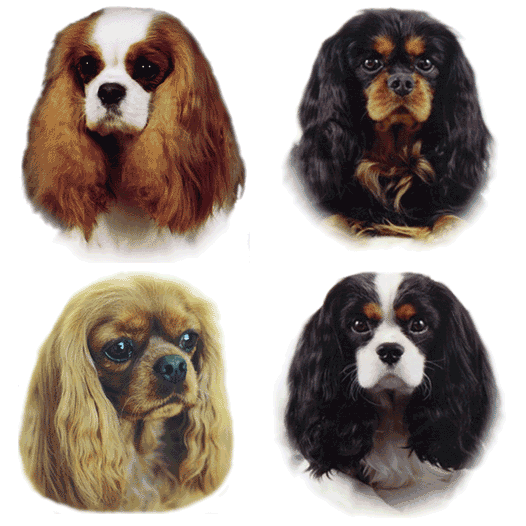
COLOR Blenheim - Rich chestnut markings
well broken up on a clear, pearly white ground. The ears must be
chestnut and the color evenly spaced on the head and surrounding
both eyes, with a white blaze between the eyes and ears, in the
center of which may be the lozenge or "Blenheim spot".
The lozenge is a unique and desirable, though not essential, characteristic
of the Blenheim. |
Picture: Cavalier King Charles Spaniel Club (USA). |
|
GAIT Free moving and elegant in action, with good reach in front and sound, driving rear action. When viewed from the side, the movement exhibits a good length of stride, and viewed from front and rear it is straight and true, resulting from straight-boned fronts and properly made and muscled hindquarters. TEMPERAMENT Gay, friendly, non-aggressive with no tendency towards nervousness or shyness. Bad temper, shyness, and meanness are not to be tolerated and are to be severely penalized as to effectively remove the specimen from competition Approved Date: January 10,
1995 * Source: Cavalier King Charles Spaniel Club (USA). |
||
ALL
ABOUT CKCS  |
 |
No material may be reproduced in any manner whatsoever without written permission from the CKCSsg.