













| Cavaliers Through the Centuries | |
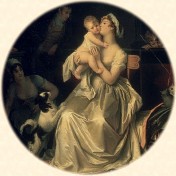
Laydyes Puppees The origins of our Cavaliers are lost in the mists of time. Various theories suggest that they have developed from a red and white spaniel indigenous to Malta or Italy which was crossed with a spaniel type from the far East in the 13th century. Another popular theory is that all spaniels originated in Spain (deriving their name from espagnol = spanish) and that the black truffle dog probably contributed to the original curly coated black and tan Cavalier blood line. Miniature or Toy Spaniels have regularly been portrayed both on canvas and on tapestries belonging to the aristocracy in Britain and Europe down through the centuries, thus showing that these dogs have been around for many hundreds of years in one form or another. Some of them are hardly recognisable as the Cavaliers we know today, but others would certainly fit the present breed standard!! These early Toy Spaniels were small, flat headed, with a pointed nose, feathery coat, and probably weighed between ten and twelve pounds. Two of the earliest sightings of these dogs are in Titian's (1477-1576) portrait of the Venus of Urbino, and in a fifteenth century Arras tapestry, 'The Offering of the Heart' which depicts a spaniel very much like our current Cavaliers. And in 1486 Dame Juliana Berners produced 'The Boke of St Albans' - a treatise on hunting, which gave a list of breeds including 'small laydyes puppees that beare away the flees and dyvers small fowles'. Then in 1570, Dr Johannes Caius, physician in chief to Elizabeth I, wrote a treatise in Latin entitled 'De Canibus Britannicus', in which all known dogs were divided into five categories. The third of these was devoted to the 'spaniell gentle or comforter' - a delicate, neat and pretty kid of dog'. The ladies of the time kept them on their laps to keep themselves cosy against the draughts in their cold houses and carriages. Nothing has changed: these little dogs still love to sit on our laps as much as we love to have them there. And they are still as faithful as the dog owned by Mary Queen of Scots - at her execution in 1587, a little black and white dog, claimed to be a spaniel, was found hiding beneath her petticoats. According to Lord Burghley's description of the event, this poor faithful creature had to be pulled by force from her clothes, and even then would not leave its dead mistress. Then in 1648, as a fugitive in Carisbrooke Castle, King Charles I was accompanied by his little spaniel, Rogue. After the King's execution, the dog was taken by a Roundhead and paraded round the city; we do not know if his fate was similar to that of his late master. Hopefully not! |
 |
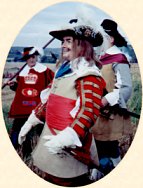
Charlies Darlings The Cavalier is particularly associated with King Charles II after the Restoration, and there is a wealth of contemporary written and pictorial evidence which give an indication of the role they led in the Royal Court. Love of these little dogs appeared to run in the family, as in 1665, Henrietta d'Orleans, the favourite youngest sister of Charles, was painted by Mignard with her red and white Toy Spaniel. The day after Charles returned to England after his exile (25 May 1660), Samuel Pepys records in his diary:'The King was rowed ashore in the admirals barge, while I followed in a smaller boat with Mr Mansell, one of the footmen, and a dog that the King loved'. His courtiers did not always appreciate the King's love of his pets, which went everywhere with him, and a verse from the wit Lord Rochester tells that: 'In all affaires of Church
and state And Pepys also records that the King paid more attention to his dogs than to business at a Privy Council meeting. However, others DID appreciate his love of his spaniels, and Hugh Dalziel writes in 1881, in his book 'British Dogs' that 'The Merry Monarch did many more foolish things than take under his Royal care and favour, and thereby raising to Court, the beautiful toy spaniel which still bears his name'. For which we all are truly thankful. Up till this time it seems that there were just three 'flavours' of Cavaliers, brown and white, black and white, and tricolour. The black spaniels depicted at this time were of a type known as a Gredin, but which were very like today's black and tans, having 'fire-marks' that is tan eyebrows, muzzles, throats and legs. James II was also a great lover of Cavaliers, and there is a story that during a very bad storm at sea, orders were given to abandon ship; James' command was to 'Save the dogs !!... and the Duke of Monmouth' - he knew where his priorities lay! It is known that they were also favourites with the European courts, but their popularity waned with the fall of the House of Stuart, as William and Mary's ascension to the throne brought their favourites, the pugs, into the limelight. However, although they had fallen from fashion, our Cavaliers did not disappear completely, and continued to mingle in both social and literary circles, as shown in Zoffany's painting 'The Garricks Entertaining Dr Johnson' where two of them supervised proceedings from under the table. |
 |
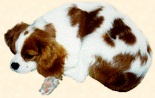
Dashing Cavaliers The Duke of Marlborough brought these small spaniels to the fore again in the early 1800s. His 'Marlborough Spaniels', which were slightly larger than present day Cavaliers, were used as shooting dogs. In the Sportsmans Review of 1820, they are described as 'very small or carpet spaniels, have exquisite noses and will hunt truly and pleasantly' and by another source as being 'red and white, with very long ears, short noses and black eyes...' It is believed that one of them was with the Duke at the Battle of Blenheim, which is how both our chestnut and white Cavaliers and the Duke's ancestral home acquired their name. And the Battle is apparently the cause of a very special feature of the Blenheim, the much prized chestnut lozenge on the centre of their heads! As the story goes, Sarah, the Duchess, was waiting for news of the battle with her pregnant bitch sitting in her lap. In her anxiety she pressed her thumb on the little dog's head, and when it later gave birth, it produced a whole litter of pups all marked with a chestnut thumb print on top of their heads!! Again Cavaliers came into favour with royalty. As a young girl Queen Victoria owned a tricolour called Dash, which she was so fond of that, after her Coronation in 1838, she went home and changed out of her robes to give her little dog its afternoon bath. There are several portraits of Victoria with Dash, and these show a small spaniel with high set long ears, and a pleasant expression. And Dash sitting royally on a tasselled cushion became a set piece for Victorian needlewomen to stitch, and many of these stitched pieces can still be found today. And it is in Victoria's reign that Rubies first appear: there is a portrait of the Duke and Duchess of Cumberland walking with a Ruby dog. It is believed that a Mr Risum owned the first Ruby, and in 1875 Mr Garwood won second prize at the Alexandra Palace show with his Ruby, Dandy. |
 |
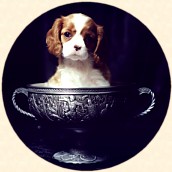
Cavaliers Transformed Sadly, during the late Victorian and early Edwardian eras the Cavalier again disappeared from favour and almost became extinct in England. Breeders began to think about breeding the Toy Spaniel to a desired type, and the original long nosed, flat headed dogs were replaced by the much shorter faced, domed head spaniel now known as the King Charles. It is thought that a short nosed breed, possibly the pug, was used to help bring about this change. The Toy Spaniel Club was founded in 1886, and in 1902 decided to change its name to the King Charles Spaniel Club. This change was opposed by the Kennel Club, but Edward VII intervened, and the new named was approved. After the closure of dog shows during the 1914-18 war, there was not a Cavalier to be seen! But fortunately, an American gentleman called Mr Roswell Eldridge, came to England in search of a pair of these dogs. He was greatly concerned to find that they had virtually disappeared off the face of the earth, and as a result, he endeavoured to rekindle interest in the breed by placing an advertisement in the catalogue for Crufts show in 1926 offering a prize of £25 for: ' the best dog and the Best bitch in a class for Blenheim Spaniels of the Old Type, as shown in the pictures of Charles II's time: long face, no stop, flat skull, not inclined to be "domed" - with spot on centre of skull.' The prizes were to be offered over a period five years. Although in the first year only a couple of entries were made, interest soon began to grow, and a small core of enthusiasts banded together and eventually in 1928 formed the Cavalier King Charles Spaniel Club, with Mrs Hewitt Pitt as their first secretary. At this meeting, the winner of the best dog prize for the years 1926 to 1929 (a beautiful little dog named Annes Son) was used to set down the standard for the breed. Sadly Mr Eldridge died before seeing the fruits of his efforts. Annes Son and five other dogs were the founding fathers of today's Cavaliers. Their owners had to fight hard, and suffer ridicule in order to get the breed back to its original form. After some difficult times during the second World War, dog shows started up again, and the Kennel Club eventually agreed in 1945 to separate registration for the Cavaliers, and granted them Challenge Certificates. The first Championship show was held at Alverston, Stratford-upon-Avon on 29th August 1946, and Best in Show was Belinda of Saxham, owned by a Mrs K.Eldred. |
 |
Crowning Glory Finally in 1973, came the crowning glory for Cavaliers: Messrs Hall and Evans' seventeen months old Alansmere Aquarius won a triple crown at Crufts: Best of Breed Cavalier, Best Toy, and Best in Show. And so Cavaliers became popular again with a vengeance! Everyone had to have one of these charming little dogs. Happily the qualities that have made our Cavaliers so special managed somehow to survive all this commercialism. Today these Royal little dogs still move in the highest circles: Princess Margaret kept a Cavalier, Rowley, Tigger was owned by Nigel Lawson, and a beautiful Blenheim shared the White House with the Reagans. And they are now popular all around the world, people in America, Canada, Norway, Sweden, Finland, Holland, France, Germany, Switzerland, Ireland, Australia, New Zealand, South Africa and Japan share with those of us in the UK a great love of Cavaliers. |
|
| * Source: Barnaby with written permission. |
ALL
ABOUT CKCS  |
 |
No material may be reproduced in any manner whatsoever without written permission from the CKCSsg.