













History of The Breed The Cavalier King Charles
Spaniel of today is the direct descendant of the small Toy Spaniels
seen in so many of the pictures of the 16th, 17th and 18th centuries.
Toy Spaniels were quite common as pets of the Court ladies in Tudor
times but in this country it was under the Stuarts that they were
given the Royal title of King Charles Spaniels. History tells us
that King Charles II was seldom seen without two or three or more
at his heels. In the early days there were no dog shows, and no recognised standard of points, so type and size were very varied. With little transport available, breeding was carried out in a haphazard fashion. In Queen Victoria's reign breeders started to hold shows and enthusiasts began to breed dogs seriously, and to a desired type. This brought a new fashion; dogs with a shorter face gradually evolving the flat face of the modern King Charles Spaniels. There were a lot of very able breeders at that stage, and they were successful in breeding dogs of the highest quality, with flat faces, high dome, and with very long ears set low. This type is still popular and a very lovely breed. Then Mr Roswell Eldridge, an American and a great lover of Toy Spaniels, came over to England and was unpleasantly surprised to find that there were none of the little nosey spaniels left. He immediately set about trying to right this by offering prizes at Crufts for three years (it was later extended to five years) - £25 for the best dog and best bitch, for dogs of the variety seen in King Charles II's time. The following is a quotation taken from Cruft's catalogue: "As shown in the pictures of King Charles II's time, long face, no stop; flat skull, not inclined to be domed and with the spot in the centre of the skull." The King Charles breeders did not take these classes very seriously. They had worked hard for years to do away with the long nose, so it was hardly a popular move. Gradually, as the big prizes came to an end, only a few enthusiasts were left to carry on the breeding experiment. Foremost amongst them was Mrs Hewitt Pitt. At the end of five years little had been achieved, as the Kennel Club considered that the dogs were not sufficiently numerous or standardised to merit a separate breed registration. |
||
| In 1928 a club was
founded, and the title "Cavalier King Charles Spaniel" was
chosen. At the first meeting, held the second day of Cruft's Dog Show,
1928, the standard of the breed was drawn up, and it was practically
the same as it is today. The live pattern on the table was Ann's Son,
the property of Miss Mostyn Walker. Members brought all the reproductions
of pictures of the 16th, 17th and 18th centuries that they could muster.
It was agreed that as far as possible the dog should be guarded from
fashion and there was to be no trimming. |
|
|
| For the next few
years progress was slow as Kennel Club recognition was still withheld,
and with no Challenge Certificates few people were sufficiently interested
to try to raise a breed with no sales value. The little band of pioneers
entered their dogs in Open classes at shows, and guaranteed classes
for their dogs at a few shows where the Show Secretaries were co-operative.
As a rule there was no financial reward, but the dogs were presented
to the public and gained in popularity. Gradually people became aware
that the movement had come to stay. |
||
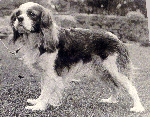 Ch. Daywell Roger |
In 1945 the Kennel Club granted separate registration, and the first set of Challenge Certificates followed a year later. The first Cavalier Champion was appropriately owned by Mrs Pitt's daughter Jane (now Mrs Bowdler). He was Ch. Daywell Roger and had been bred by Lt. Col. and Mrs Brierly. Very widely used at stud, Daywell Roger was a major contribution to the development of the breed in the middle of the Century. | |
| By 1960 annual Cavalier
registration at the Kennel Club had reached four figures and no less
than sixty Champions had been crowned. The breed was on its way and
this was emphasised in 1963 when Mrs Cryer's Blenheim Ch. Amelia of
Laguna won the Toy Group at Crufts. The first Club year book, covering
the activities of 1964 was published in 1965. It was a slim red volume
needing only a single page to list the prefixes and affixes of all
Club members. As registrations increased so did the number of Challenge
Certificates offered at Championship shows and so did the size of
classes. Exactly ten years after Amelia's triumph another Blenheim
went one better and became Supreme Best in Show at Crufts. When he
won this accolade Messrs. Hall & Evans' Alansmere Aquarius was
quite a young dog, not yet the Champion he quickly became. His success
focussed public attention still further on the breed both in Britain
and overseas. Cavalier Clubs were already well established in U.S.A..
Australia and New Zealand, and had recently been set up in Finland
and Sweden.
By the end of the Seventies interest in shows had swollen to such an extent that Cavaliers always headed the Toy Group entries at our Championship events. The Club celebrated its Golden jubilee in 1978 with a social function at Royal Leamington Spa and a Championship show which drew a huge entry at nearby Stoneleigh. Amice Pitt graced the occasion as President and it was the last time many members were to see her because this formidable and well-loved lady was not in good health and eventually died in December 1978. The Amice Pitt Rally held in turn each year by the various Cavalier Clubs is designed to keep fresh her memory and to acknowledge the debt which we all owe her. Early in the eighties registrations reached 10,000, and there emerged the need to have a separate judge for each sex at most of the Championship shows. This was not a welcome development, but it is generally recognised as inevitable in view of the large entries. That a Cavalier can win at top level was no longer in question, as was re-emphasised at Crufts in 1981 when Mr & Mrs Newton's Ch. Jia Laertes of Tonnew came into the big ring on the final day having won the Toy Group. Meanwhile regional clubs proliferated along with rescue organisations, to help individual Cavaliers which have fallen on bad times. In 1988, when the Club marked its Diamond Jubilee, the Championship show entry was 777 exhibits, and a total of 363 Champions had been crowned. In the 1990's, Cavaliers regularly topped the Toy Group entries at general Championship shows. A number of Cavaliers have been successful at Group level in recent years, and several went on to Reserve B.I.S. In 1993, Messrs. Hall & Evans' Ch. Spring Tide at Alansmere broke the breed C.C. record, set by Ch. Aloysius of Sunninghill in the 1960's, and finished the year on 23 C.C.'s. The record was subsequently broken again by Rix & Berry, with their Ch. Lymrey Royal Reflection, and in the bitches with Ch. Lymrey Top of the Pops. *
Source: The
Cavalier King Charles Spaniel Club (UK) with written permission. |
||
ALL
ABOUT CKCS  |
 |
No material may be reproduced in any manner whatsoever without written permission from the CKCSsg.