The N2O Rig
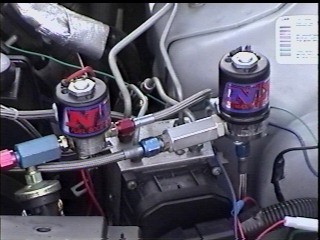
Okay. I'm sure many of you are just dying to know about my nitrous oxide set-up. Let me start by saying this. N2O is a safe an effective way of adding large amounts of power to your vehicle. It works by forcing more oxegen molecules into your engine, thus yielding more power. No it's not as simple as just strapping a big bottle to your car and cramming a hose into your intake. You need a sufficient amount of fuel for the magic juice to work properly amongst safety devices if you plan on keeping your engine. If you don't have enough fuel you will run lean and melt your engine internals! The hypereutectic pistons of the LS1 especially don't mix well with lean conditions. Instead of melting, they tend to crack and break into many pieces!!! One more thing. Please do not refer to nitrous oxide as NOS. If you ask me if I am running NOS I will simply tell you I am running Nitrous Express thank you very much. NOS is a company. (Nitrous Oxide Systems) Please use the term nitrous oxide or nitrous! Don't make yourself look like the fool who has watched The Fast and the Furious one too many times! Now on to the fun stuff.
I am running a Nitrous Express wet kit. Wet kit meaning that nitrous is injected into the intake along with fuel. A dry kit on the other hand relies either on the MAF to adjust fuel ratios via injector pulse or a seperate N2O line to the fuel pressure regulator to up injector pressure. Relying on the MAF to add fuel requires a really fast processing ECU, such as the LS1 ECUs. The later dry kit idea is not necesarily good for the injectors as added fuel pressure can cause them to seize and take engine parts with it. My kit is currently jetted for 100hp at the wheels. That's a #52 nitrous jet and a #33 fuel jet if you're wondering. The 150 pills will go in as soon as I get my new fuel pump installed along with some datalogging. The Nitrous Express kits are very accurate as far as HP measures are concerned. We'll validate that at the next trip to the dyno.
Currently, my N2O system is pretty basic. I swapped the stock plugs to NGK TR6s which are a heat range colder than stock. They're gapped at .036. On the fuel line I have a fuel pressure safety switch, commonly known as a hobbs switch. It can activate and deactivate electronic ciruits according to fuel pressure. In this case, if my fuel pressure drops beyond 60psi (idle pressure), the nitrous system will shut off. This is good since a lack of fuel while running nitrous can severely damage your engine as stated earlier. The system is activated via a main arming switch follwed by an electronic TPS voltage sensitive switch. At voltage equal or close to WOT the nitrous and fuel solenoids open and the fun begins. For added safety, an MSD RPM activated switch limits the nitrous and fuel flow to only activate between 3000 and 5800 RPMs.
The RPM switch prevents the nitrous ciruit from activating too low or too high in the RPM range. At too low of an RPM, a wet nitrous kit can puddle fuel in the intake manifold and cause an intake backfire. This can blow up your intake manifold and damage other parts as well. Shooting nitrous at too high of an RPM say after hitting the rev limiter may also cause intake backfire, due to lack of vacuum. Many other incodences may occour when hitting the rev limiter. Pushrods can be bent and pistons can be scorched. For further precaution, I will be working on a PCM program to optimize and safely control igntion timing to prevent any predetination issues via LS1 Edit.
In addition, the air/fuel ratio is monitored by an Autometer Phantom series Air/Fuel ratio guage. This guage however utilizes the stock oxegen sensors and is not a very accurate device for tuning. The only thing it really tells you is if your running lean, rich, or stoich (optimal air/fuel ratio). It's not very good at telling you how rich, how lean, etc. It will soon be replaced by an exhaust gas temperture gauge.
Well that's about it for the N2O. Hope you enjoyed!