|
Rolling Stone - December 6, 1984 Born
Again Kurt Loder |
|
Rolling Stone - December 6,
1984 Born
Again Kurt Loder
Bruce Springsteen: The Rolling Stone
Interview
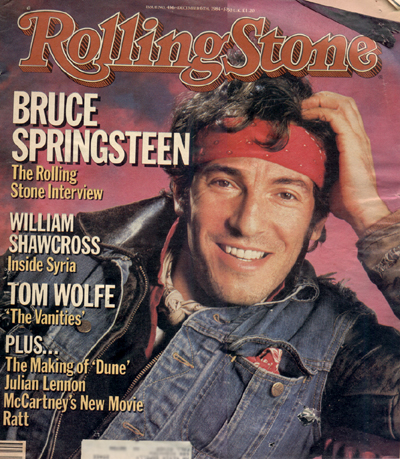
Seattle was the market, but Tacoma was Bruce Springsteen's kind of town. He and the E Street Band had flown in from Vancouver on the second leg of their Born in the U.S.A. tour, and immediately everybody got sick. Something in the air. "The Tacoma aroma," locals call it, a lung-raking stench of noxious lumber-milling fumes and other foul industrial emissions that imparted a green-gilled tinge to most members of the Springsteen tour party and made Bruce himself sick to his stomach. Nevertheless, his first, sold-out show at the 25,000-seat Tacoma Dome went on as scheduled. Bruce is nothing if not a trouper.
He could have played the Kingdome in Seattle, thirty miles away, where the air is clear and the ambiance more upscale. But the smaller Tacoma Dome has better acoustics, and anyway, Springsteen -- although he's something of an upscale guy himself these days -- maintains a well-known interest in the embattled world of the working class. Tacoma, in its bilious way, was perfect.
He really was sick, though -- white as a sheet when he took the stage and wiped out for sure when he left it four hours later. But he never let it show. He kicked off with a booming, boot-stomping "Born in the U.S.A." and then descended into several songs from his starkly brilliant Nebraska album, keeping the audience with him all the way. He's got his raps down on this tour, talking about "powerlessness" at one point and, at another, "blind faith -- whether it's in your girlfriend or the government." "This is 1984," he tells the howling crowds, "and people seem to be searchin' for something."
In Tacoma, before counting off the haunting "My Hometown," he delivered an extended plug for a community-action group called Washington Fair Share, which recently helped force the clean-up of an illegal landfill and is working to overturn Governor John Spellman's veto of a "right to know" law that would require local industries to inform employees of all toxic chemicals they're being exposed to on the job. "They think that people should come before profit, and the community before the corporation," Bruce announced. And then added, pointedly, "This is your hometown."
This is world-class rock & roll, all right, but something more besides. And in 1984, Bruce Springsteen has become something decidedly more than just another rock star with an album to flog. He is a national presence, his charisma co-opted by as unlikely an adherent as Ronald Reagan -- even as Springsteen himself pokes relentlessly through the withered and waterless cultural underbrush of the president's new American Eden. In pursuit of what can only be called his dream, Springsteen has been tenacious: dropping out of Ocean County College in his native New Jersey in 1968 to take his unlikely chances as a songwriting rock & roller and stubbornly waiting out a devastating, yearlong legal dispute with his then manager, Mike Appel, that prevented him from recording for nearly a year in the mid-Seventies. After selling 2 million copies of his 1980 double album, The River, he followed it up with Nebraska, a striking, guitar-and-voice meditation on various kinds of pain and craziness in the American hinterlands, and then followed that up with Born in the USA, which treats some of the same themes within a full-bore band context and has suddenly become his biggest album to date.
As the tour progressed, Springsteen sat down for interviews in Oakland, California -- where he plugged the Berkeley Emergency Food Project -- and in Los Angeles, where he maintains a house in the Hollywood Hills. Asked how he keeps his tightly structured stage show fresh down to the last mock-rambling anecdote, he said, "It's a matter of: Are you there at the moment? Are you living it?" It's a test he appears to pass both on and off the stage.
"Born in the U.S.A.," the title track of your current album, is one of those rare records: a rousing rock & roll song that also gives voice to the pain of forgotten people -- in this case, America's Vietnam veterans. How long have you been aware of the Vietnam vets' experience?
I don't know if anybody could imagine what their particular experience is like. I don't think I could, you know? I think you had to live through it. But when you think about all the young men and women that died in Vietnam, and how many died since they've been back -- surviving the war and coming back and not surviving -- you have think that, at the time, the country took advantage of their selflessness. There was a moment when they were just really generous with their lives.
What was your own experience with Vietnam?
I didn't really have one. There wasn't any kind of political consciousness down in Freehold in the late Sixties. It was a small town, and the war just seemed very distant. I mean, I was aware of it through some friend that went. The drummer in my first band was killed in Vietnam. He kind of signed up and joined the marines. Bart Hanes was his name. He was one of those guys that was jokin' all the time, always playin' the clown. He came over one day and said, "Well, I enlisted. I'm goin' to Vietnam." I remember he said he didn't know where it was. And that was it. He left and didn't come back. And the guys that did come back were not the same.
How did you manage to escape the draft?
I got a 4-F. I had a brain concussion from a motorcycle accident when I was seventeen. Plus, I did the basic Sixties rag, you know: fillin' out the forms all crazy, not takin' the tests. When I was nineteen, I wasn't ready to be that generous with my life. I was called for induction, and when I got on the bus to go take my physical, I thought one thing: I ain't goin'. I had tried to go to college, and I didn't really fit in. I went to a real narrow-minded school where people gave me a lot of trouble and I was hounded off the campus -- I just looked different and acted different, so I left school. And I remember bein' on that bus, me and a couple of guys in my band, and the rest of the bus was probably sixty, seventy percent black guys from Asbury Park. And I remember thinkin', like, what makes my life, or my friends lives, more expendable than that of somebody who's goin' to school? It didn't seem right. And it was funny, because my father, he was in World War II, and he was the type that was always sayin', "Wait till the army gets you. Man, they're gonna get that hair off of you. I can't wait. They gonna make a man outta you." We were really goin' at each other in those days. And I remember I was gone for three days, and when I came back, I went in the kitchen, and my folks were there, and they said, "Where you been?" And I said, "Well, I had to go take my physical." And they said, "What happened?" And I said, "Well, they didn't take me." And my father sat there, and he didn't look at me, he just looked straight ahead. And he said, "That's god." It was, uh...I'll never forget that. I'll never forget that.
Ironic, then, that today you're the toast of the political right, with conservative columnist George Will lauding your recent Washington D.C. concert and President Reagan invoking your name while campaigning in your home state, New Jersey.
I think what's happening now is people want to forget. There was Vietnam, there was Watergate, there was Iran -- we were beaten, we were hustled, and then we were humiliated. And I think people got a need to feel good about the country they live in. But what's happening, I think, is that need -- which is a good thing -- is getting' manipulated and exploited. And you see the Reagan reelection ads on TV -- you know: "It's morning in America." And you say, well, it's not morning in Pittsburgh. It's not morning about 125th Street in New York. It's midnight, and, like, there's a bad moon risin'. And that's why when Reagan mentioned my name in New Jersey, I felt it was another manipulation, and I had to disassociate myself from the president's kind words.
But didn't you play into the hands of professional patriots by releasing an election-year album called 'Born in the U.S.A., with the American flag bannered across the front?
Well, we had the flag on the cover because the first song was called "Born in the U.S.A.," and the theme of the record kind of follows from the themes I've been writing about for at least the last six or seven years. But the flag is a powerful image, and when you set that stuff loose, you don't know what's gonna be done with it.
Actually, I know one fan who infers from the rump shot on the album cover that you're actually pissing on the flag. Is there a message there?
No, no. That was unintentional. We took a lot of different types of pictures, and in the end, the picture of my ass looked better than the picture of my face, that's what went on the cover. I didn't have any secret message. I don't do that very much.
Well, what is your political stance? Election Day is two weeks away: are you registered to vote?
I'm registered, yeah. I'm not registered as one party or another. I don't generally think along those lines. I find it very difficult to relate to the whole electoral system as it stands. I don't really...I suppose if there was somebody who felt strong enough about at some point, some day, you know...
You don't think Mondale would be any better than Reagan?
I don't know. I think there are significant differences, but I don't know how significant. And it's very difficult to tell by reelection rhetoric. It seems to always change when they all of a sudden get in. That's why I don't feel a real connection to electoral politics right now -- it can't be the best way to find the best man to do the hardest job. I want to try an adjust work more directly with people; try to find some way that my band can tie into the communities that we come into. I guess that's a political action, a way to just bypass that whole electoral thing. Human politics. I think that people on their own can do a lot. I guess that's what I'm tryin' to figure out now: where do the aesthetic issues that you write about intersect with some sort of concrete action, some direct involvement, in the communities that your audience comes from? It seems to be an inevitable progression of what our band has been doin', of the idea that we got into this for. We wanted to play because we wanted to meet girls, we wanted to make a ton of dough, and we wanted to change the world a little bit, you know?
Have you ever voted?
I think I voted for McGovern in 1972.
What do you really think of Ronald Reagan?
Well, I don't know him. But I think he presents a very mythic, very seductive image, and it's an image that people want to believe in. I think there's always been a nostalgia for a mythical America, for some period in the past when everything was just right. And I think the president is the embodiment of that for a lot of people. He has a very mythical presidency. I don't know if he's a bad man. But I think there's a large group of people in this country whose dreams don't mean that much to him, that just get indiscriminately swept aside. I guess my view of America is of a real big-hearted country, real compassionate. But the difficult thing out there right now is that the social consciousness that was a part of the Sixties has become, like, old-fashioned or something. You go out, you get your job, and you try to make as much money as you can and have a good time on the weekend. And that's considered okay.
The state of the nation has weighed heavily, if sometimes subtly, on the characters depicted in your songs over the years. Do you see your albums as being connected by an evolving sociopolitical point of view?
I guess what I was always interested in was doing a body of work -- albums that would relate to and play off of each other. And I was always concerned with doin' albums, instead of, like, collections of songs. I guess I started with The Wild, the Innocent and the E Street Shuffle, in a funny way -- particularly the second side, which kind of syncs together. I was very concerned about gettin' a group of characters and followin' them through their lives a little bit. And so, on Born to Run, Darkness on the Edge of Town and The River I tried to hook things up. I guess in Born to Run, there's that searchin' thing; that record to me is like religiously based, in a funny kind of way. Not like orthodox religion, but it's about basic things, you know? That searchin', and faith, and the idea of hope. And then on Darkness, it was kind of like a collision that happens between this guy and the real world. He ends up very alone and real stripped down. Then, on The River, there was always that thing of the guy attemptin' to come back, to find some sort of community. It had more songs about relationships -- "Stolen Car," "The River," "I Wanna Marry You," "Drive All Night," even "Wreck on the Highway" - people tryin' to find some sort of consolation, some sort of comfort in each other. Before The River, there's almost no songs about relationships. Very few. Then, on Nebraska...I don't know what happened on that one. That kinda came out of the blue.
Wasn't the central inspiration Terrence Malick's 'Badlands,' the film about mass murderer Charles Starkweather and his girlfriend, Caril Fugate?
Well, I had already written "Mansion on the Hill" during the last tour. Then I went home -- I was living in a place called Colts Neck, New Jersey -- and I remember I saw Badlands, and I read this book about them, Caril, and it just seemed to be a mood that I was in at the time. I was renting a house on this reservoir, and I didn't go out much, and for some reason I just started to write. I wrote Nebraska, all those songs, in a couple of months. I was interested in writing kind of smaller than I had been, writing with just detail -- which I kind of began to do on The River. I guess my influences at the time were the movie and these stories I was reading by Flannery O'Connor -- she's just incredible.
Was there something about Starkweather that struck you as emblematic of the American condition?
I think you can get to a point where nihilism, if that's the right word, is overwhelming, and the basic laws that society has set up -- either religious or social laws -- become meaningless. Things just get really dark. You lose those constraints, and then anything goes. The forces that set that in motion, I don't know exactly what they'd be. I think just a lot of frustration, lack of findin' somethin' that you can hold on to, lack of contact with people, you know? That's one of the most dangerous things, I think -- isolation. Nebraska was about that American isolation: what happens to people when they're alienated from their friends and their community and their government and their job. Because those are the things that keep you sane, that give meaning to life in some fashion. And if they slip away, and you start to exist in some void where the basic constraints of society are a joke, then life becomes kind of a joke. And anything can happen.
Did the stark acoustic format you eventually chose for 'Nebraska' just seem the most appropriate setting for such dark material?
Well, initially, I was just doing songs for the next rock album, and I decided that what always took me so long in the studio was the writing. I would get in there, and I just wouldn't have the material written, or it wasn't written well enough, and so I'd record for a month, get a couple of things, go home write some more, record for another month -- it wasn't very efficient. So this time, I got a little Teac four-track cassette machine, and I said, I'm gonna record these songs, and if they sound good with just me doin' 'em, then I'll teach'em to the band. I could sing and play the guitar, and then I had two tracks to do somethin' else, like overdub a guitar or add a harmony. It was just gonna be a demo. Then I had a little Echoplex that I mixed through, and that was it. And that was the tape that became the record. It's amazing that it got there, 'cause I was carryin' that cassette around with me in my pocket without a case for a couple of week, just draggin' it around. Finally, we realized, "Uh-oh, that's the album." Technically, it was difficult to get it on a disc. The stuff was recorded so strangely, the needle would read a lot of distortion and wouldn't track in the wax. We almost had to release it as a cassette.
I understand "Born in the U.S.A." was actually written around the time of Nebraska; do any other songs on the new album date from that period?
Actually, half the Born in the U.S.A. album was recorded at the time of Nebraska. When we initially went in the studio to try to record Nebraska with the band, we recorded the first side of Born in the U.S.A., and the rest of the time I spent tryin' to come up with the second side -- "Bobby Jean," "My Hometown," almost all those songs. So if you look at the material, particularly on the first side, it's actually written very much like Nebraska -- the characters and the stories, the style of writing --except it's just in the rock-band setting.
You've certainly achieved mass-market success this year. The Born in the U.S.A. tour is selling out arenas across the country, and the album has sold over 5 million copies worldwide. Has becoming a rich man changed you at all?
Yeah, there's a change. It doesn't make living easier, but it does make certain aspects of your life easier. You don't have to worry about rent, you can buy things for your folks and help out your friends, and you can have a good time, you know? There were moments where it was very confusing, because I realized that I was a rich man, but I felt like a poor man inside.
In what way?
Just my outlook on things in general, because I guess it was formed when I was young. I didn't get to a situation where I had any dough in the bank till around the River tour. And this tour, we've been doin' great so far. But I don't know if money changes you. I guess I don't really think it does change you. It's an inanimate thing, a tool, a convenience. If you've got to have a problem, it's a good problem to have.
Obviously you don't spend your money on clothes. What do you do with it?
I'm just figuring that out right now. One of the things I can do is play benefits and help people out that need help, people that are strugglin', you know, tryin' to get somethin' goin' on their own. Money was kind of part of the dream when I started. I don't think...I never felt like I ever played a note for the money. I think if I did, people would know, and they'd throw you out of the joint. And you'd deserve to go. But at the same time, it was a part of the dream. Part of like...
The pink Cadillac?
Yeah, the pink Cadillac. Me and Steve [Van Zandt, his former guitarist] used to sit around and say, "Yeah, when we make it, we're gonna do this and that...."
What did you plan to do?
Mainly, we planned to be just like the Rolling Stones. They were the band we liked the best at the time. But you grow up, and when you finally put that suit of clothes on, sometimes they don't fit, or they fit differently, and you're a different person, and what you're gonna do is different, I guess. But in general, I do enjoy the success we've had and the fact that we have an audience, and I've enjoyed the financial success that I've had. It's helped me do some things I've wanted to do.
Would it be an exaggeration to say that you're a millionaire?
No, no. I definitely got that much.
Is it possible for you to have normal romantic attachments?
I guess so. I've had steady girlfriends in the past. I'm just not really lookin' to get married at this point. I've made a commitment to doin' my job right now, and that's basically what I do. Someday I'd like to have the whole nine yards --the wife, the kids.
I'm trying to picture Bruce Springsteen just asking a normal girl for a casual date.
You just do it. You're out in a bar or somethin', and you meet somebody -- you can't worry.
So you've never allowed yourself to become isolated, to slip into the Elvis Presley syndrome?
One of the things that was always on my mind to do was to maintain connections with the people I'd grown up with and the sense of the community where I came from. That's why I stayed in New Jersey. The danger of fame is in forgetting or being distracted. You see it happen to so many people. Elvis' case must have been tremendously difficult. Because, I mean, I feel the difference between selling a million records and selling 3 million records -- I can feel a difference out on the street. The type of fame that Elvis had and that I think Michael Jackson has, the pressure of it and the isolation that it seems to require has gotta be really painful. I wasn't gonna let that happen to me. I wasn't gonna get to a place where I said: "I can't go in here. I can't go to this bar. I can't go outside." For the most part, I do basically what I've always done. I'll walk into a club, and people will just say hi, and that's it. And I'll get up and play.
I believe that the life of a rock & roll band will last as long as you look down into the audience and can see yourself and your audience looks up at you and can see themselves -- and as long as those reflections are human, realistic ones. The biggest gift your fans can give you is just treatin' you like a human being, because anything else dehumanizes you. If the price of fame is that you have to be isolated from the people you write for, then that's too fuckin' high a price to pay.
You once tried to meet Elvis Presley by jumping over the wall at his mansion, Graceland. The attempt failed, but have you met most of your other idols in the music business?
Well, I'm real ambivalent about meetin' people I admire. You know the old saying: Trust the art, not the artist. I think that's true. I think somebody can do real good work and be a fool in a variety of ways. I think my music is probably better than I am. I mean, like, your music is your ideals a lot of times, and you don't live up to those ideals all the time. You try, but you fall short, and you disappoint yourself. With my idols, I just like their music. If the occasion comes up, I like to meet them, but I never really seek it out very much, because it's their music that I like in general. People always say they were disappointed by Elvis, they were let down. I'm not sure that's the right way to look at it. I don't think anybody was disappointed by his great records, you know?
You, at least, seem unlikely ever to emulate Elvis's drug problems. Is it true that after nearly twenty years in the rock & roll world, you've truly never so much as smoked a joint?
I never did any drugs. When I was at that age when it was popular, I wasn't really in a social scene a whole lot. I was practicing in my room with my guitar. So I didn't have the type of pressure that kids might have today. Plus, I was very concerned with being in control at the time. I drink a little bit now. There's nights when I'll go out and do it up. But not too much when we're touring, because the show is so physically demanding, and you gotta be so prepared.
There's also a notable lack -- in your songs, your stage show, your videos -- of any sort of exploitative sexual imagery of the kind that routinely spices, say, MTV.
I don't know. I think if you just try to have a basic respect for people's humanness, you just generally don' t want to do those things. I think it's difficult, because we were all brought up with sexist attitudes and racist attitudes. But hopefully, as you grow older, you get some sort of insight into that and -- I know it's corny -- try to treat other people the way you would want them to treat you.
I think that what happens is, when you're young, you feel powerless. If you're a child and you're lookin' up at the world, the world is frightening. Your house, no matter how small it is, it seems so big. Your parents seem huge. I don't believe this feeling ever quite leaves you. And I think what happens is, when you get around fifteen or sixteen, a lot of your fantasies are power fantasies. And I think that's one of the things that gets exploited by some of the more demeaning types of music. If you're a kid, you feel powerless, but you don't know how to channel that powerlessness. I was lucky; I was able to deal with it with the guitar. I said, well, I feel weak, but when I do this, when I feel this, when I hold it, I feel a little stronger. I feel like I've got some line on my life. I feel I have some control. That feelin' of weakness, of powerlessness, is there. And I think it gets exploited and misdirected.
One of the problems in the United States is that "united in our prejudices we stand," you know? What unites people, very often, is their fear. What unites white people in some places is their fear of black people. What unites guys is maybe a denigrating attitude toward women -- or sometimes maybe women have an attitude toward men. And these things are then in turn exploited by politicians, which turns into fear -- knee-jerk fear of the Russians or of whatever ism is out there. Or in a very subtle, kind of indirect way -- like some of our economic policies are a real indirect kind of racism in which the people that get affected most are black people who are at the lower end of the economic spectrum. And I think somewhere inside, people know this -- I really do. They don't fess up to it, but somewhere inside there's a real meanness in using things this way.
What keeps you going at age thirty-five?
I was lucky. I understood that it's the music that keeps me alive, and my relationships with my friends and my attachment to the people and the places I've known. That's my lifeblood. And to give that up for, like, the TV, the cars, the houses -- that's not the American dream. Those are the booby prizes. And if you fall for them -- if, when you achieve them, you believe that this is the end in and of itself -- then you've been suckered in. Because those are the consolation prizes, if you're not careful, for selling yourself out or lettin' the best of yourself slip away. So you gotta be vigilant. You gotta carry the idea you began with further. And you gotta hope that you're headed for higher ground.