|
|
|
|||
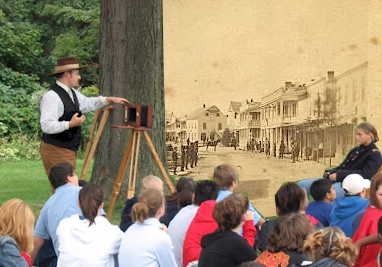 About
Jason Kladiva About
Jason KladivaRaised in St Charles, Illinois, Jason Kladiva's knowledge of the American Civil War began at an early age. His father--a Command Sergeant Major in the United States Army -- encouraged his son to read about the Civil War with help from Jason's grandfather. At age six, Jason's family received a complete first edition set of Miller's Photographic History of the Civil War (published in 1912) from his grandfather. This sparked Jason's interest in history and 19th century photography. At age 18, Jason began interpreting Civil War history at various sites around northern Illinois. By the time he was his early twenties, Jason had worked on numerous projects for A&E and the History Channel and TNT's Emmy Award-winning mini-series, Andersonville. In 1994, Jason teamed up with fellow interpreter Phil Lauricella to begin bringing 19th century history to Northern Illinois schools while continuing to work on projects for CBS Television and the National Park Service. While school was out of session in 2000 and 2001, Jason joined the staff at Fort Mackinac on Mackinac Island, MI to teach the history of that region. Jason's first book, Gleanings of Mackinac, appeared in bookstores during the spring of 2001 with his second, Journals of an American Traveler, already underway. A student of Ray Morgenweck of the Star Camera Company, Jason has taken on the techniques of early ambrotypists (mid-19th century photographers) and now brings this rarely seen art to students across the United States. In addition to single glass ambrotypes, Jason is also able to create the popular stereo views of the 19th century. Jason currently splits his year between Michigan, northern Illinois and New Orleans, Louisiana.
Early American Photography This program
takes the audience on an interactive journey through the mid-19th
century as the familiar images we recognize are viewed from a different
perspective--from behind the camera. Programs of 45, 60 and 90 minutes are available. For more information, to schedule one of Mr. Kladiva's programs or to schedule to have an ambrotype produced, please send a request to [email protected] .
|
||||
|
|
|
|||
