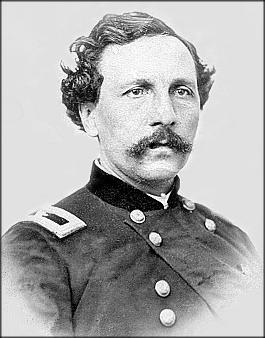
| Brigadier General Frederick Salomon |
 |
| Frederick Salomon was born on April 7, 1826 near Halberstadt, Prussia. After passing through school, he took a job as a government surveyor. He later became an artillery lieutenant. He was a student at the Berlin School of Architecture in 1848 when he became involved in the March Revolution, Marzrevolution, of 1848. In 1847 crop failures had led to famine, unemployment and hunger riots that were put down by the military. The French Revolution of February spread to Germany. An assembly of people in Mannheim demanded a bill of rights and other areas soon followed. The strong popular support forced rulers to give in to the demands in an attempt to save the monarchies. A national assembly was created but its acts were not recognized by the German states or by other countries. In the fall of 1848, the Prussian aristocrats regained power in Berlin. The discussions in the National Assembly continued and they offered King Friedrich Wilhelm IV the crown of Emperor under a new constitution. He was insulted by the offer and refused it. The German Revolution failed and the National Assembly dissolved slowly. Armed uprisings by workers, farmers and students were put down by local military. Leaders and participants, when caught, were sentenced to prison or executed. Frederick Salomon was compelled to leave. |
| Brig. Gen. Frederick Salomon |
 |
| photo permission of Kent Salomon |
| Salomon immigrated to the United States in 1849 and settled Manitowoc, Wisconsin. He was first a land surveyor and then became the county registrar of deeds for four years. From 1857-1859 he was a civil engineer for the Wisconsin-Manitowoc railway. In 1860 he moved to St. Louis. On May 4, 1861 he joined as a captain in his brother Carl's 5th Missouri Regiment. He served under Colonel Franz Sigel and was present at Wilson's Creek. Brig. Gen. Nathaniel Lyon's Army of the West, camped at Springfield, Missouri, was approached by Confederate forces under the command of Brig. Gen. Ben McCulloch. On the morning of August 10th, two federal columns attacked the Confederates at Wilson's Creek. One column was commanded by Lyon and the other was commanded by Col. Sigel. The Rebel Cavalry fell back but was then stabilized with reinforcements. The Confederate forces attacked three times but could not break the Union line. Brig. Gen. Lyon was killed during the battle and was replaced by Major Samuel Sturgis. Meanwhile, the Confederates had routed Col. Siegel's column. Sturgis knew that his men were exhausted and low on ammunition. He ordered a retreat to Springfield resulting in a Confederate victory. However, the Confederate forces were not equipped to pursue. When Salomon's three months' service expired, he was asked by Wisconsin Governor Randall to help organize the 9th Wisconsin Regiment. He was appointed Colonel on August 22, 1861. On the day before he departed from Manitowoc, the German citizens presented him with a charger that he used throughout the war. |
 |
 |
| photo permission of Kent Salomon |
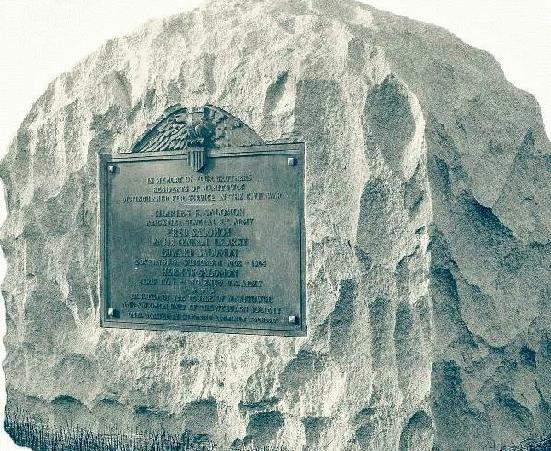
| Memorial in Manitowac, Wisconsin |
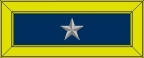
| Salomon was appointed brigadier general on July 16, 1862. The Army of the Frontier was reorganized under General Blunt. The 9th Regiment was placed in the First Brigade under the command of Salomon. They faced action at Newtonia Missouri on September 30th. After Newtonia, they marched to various points in Arkansas. The brigade occupied Rheas' Mills from November 29th until December 7th, when they joined the main force under General Blunt at Cane Hill, Arkansas. The 9th Infantry was ordered back to protect the trains. After the victory, the 9th returned to Rheas' Mill to make flour and supply bread. After winter quarters, they performed patrol duty at different points in Missouri until the fall of 1863. In September they moved to Helena, Arkansas then marched to Little Rock. In January of 1864, 230 members of the regiment re-enlisted. The unit was involved in a number of skirmishes from March until May including the Camden campaign and the battle of Jenkins Ferry. There were 47 casualties and 52 wounded during that period. After returning to Little Rock, they helped build forts around the town. Salomon was breveted major general on March 16, 1865 and mustered out in August. He moved to St. Charles, Missouri and served as a surveyor. By 1887 he moved to Salt Lake City, Utah. There he served as the U.S. Surveyor General of the Territory of Utah. At age 71, on March 8, 1897, he died and was buried at Mt. Olivet cemetery in Salt Lake. On October 1927, the city of Manitowoc dedicated a memorial to the Salomon brothers. |
 |
| The 9th Wisconsin traveled to Fort Scott, Kansas to take part in Lane's southwest expedition. After the expedition was abandoned, the unit moved to Baxter's Springs, Kansas. There were frequent expeditions against the rebels. They were reinforced by two Indian infantry regiments, two cavalry regiments and an artillery battery. They were all placed under the command of Colonel William Weer for an expedition toward Ft. Gibson in the Indian Territory. There were several skirmishes that resulted in Union victories. The intemperance of Col. Weer led to bad decisions; marching into Indian country without supplies. At the request of the subordinate officers, Colonel Salomon arrested Weer. On their return to Fort Scott in August, Colonel Weer charged Salomon with mutiny. After examining the charges, General Blunt dismissed the proceedings. |
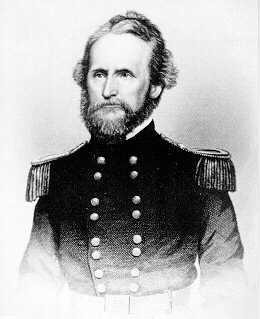 |
| Brig. Gen. Nathaniel Lyon |
| First Union General to die in battle in the Civil War |