-

-
-
-
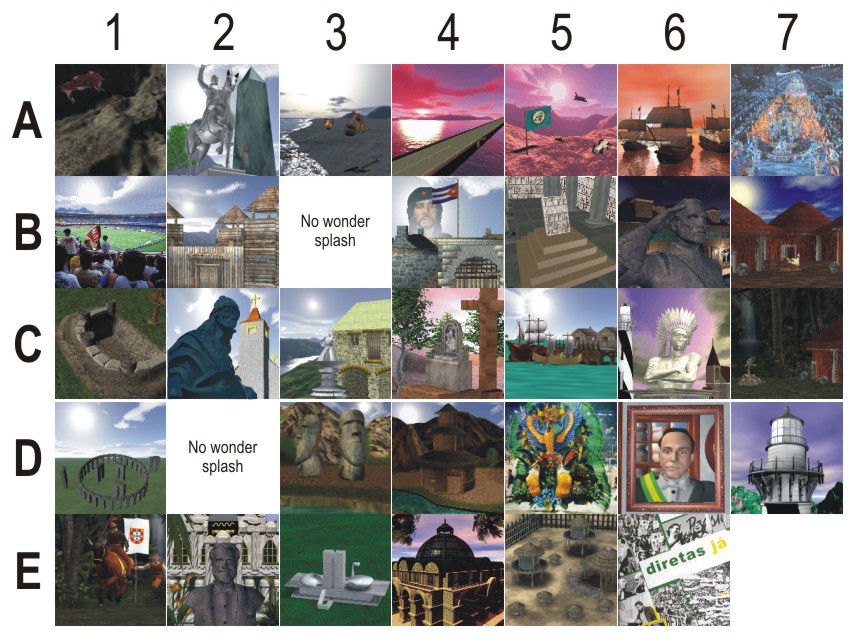
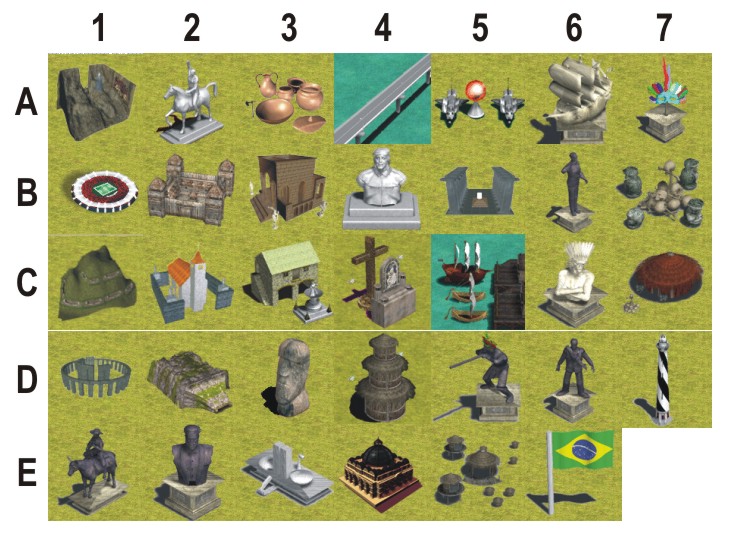
 Wonders and Improvements
-
 Academia Militar Duque de
Caxias
Academia Militar Duque de
Caxias
- - Code:
B6
- - Civilopedia entry:
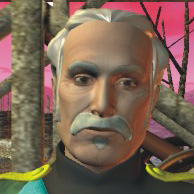
Duque de Caxias was one of the most important
military leaders of Brazil and he was the main
commandant of this country in the Paraguay War, training
great part of the national troops that didn't have any
military training.
Arte de Guerra do Cacique Cunhambebe
- Code:
C6
- Civilopedia entry:
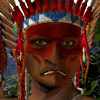
Tupi were a militaristic civilization that had
many of the best military leaders of Brazil in the time
pre-colonial and in the beginning of the colonization.
These leaders fought against the Portuguese and other
Europeans or backing them and fought among the rival
groups, the Tupinambá and Tupinikin were examples.
Cacique Cunhambebe was one of the main Tupi leaders, but
other great military leaders also exceed as Araribóia,
Aimberê, Pindobuçu, Coaquira, Jagoanharó, Araraí,
Parabuçu, Sepé-Tiaraju, Filipe Camarão, Zorobabê, Inácio
Abiaru and André Guacarari. One of the biggest victories
of a Tupi group was against the Portuguese, when
Cunhambebe forces using bows and canoes defeat a force
that uses powder weapons and caravels.
Biblioteca Dom Pedro II
- Code:
E2
- Civilopedia entry:
In the Kingdom of Dom Pedro II (1841-1889) the
Emperor stimulated the arts.
Bison of Altamira
- Code:
A1
- Civilopedia entry:
This
is one of the first drawing done by Humans, it was done
among 12.000 or 15.000 b.C in Altamira Cave, north
of present Spain. The pre historic men had inhabited
dark caves in this time and started drawn animals
present in your day by day, after had used abstracts
forms in theris creations. The bison and other animals
were drawn on the roof and the artist had few light to
see what he is dranwing. He used yellow, black and red
ochre (stones) to paint. This mural was discovered
in 1879 and this discovery helped the scientists get
more infos about the cave men.
Burial Mound
- Code:
D2
- Civilopedia entry:
NOT READY YET :(
Campañas Admirables
- Code:
A2
- Civilopedia entry:
The
Campañas Admirables (Admirable Campaings in Spanish) was
the name of the campaings of Simon Bolivar, one of the
Fathers of the libertation of Latin America countries.
Carnaval
- Code:
A7
- Civilopedia entry:
The Brazilians believe them Carnival is the
biggest party of all World: for one week the country
stops to dance the rhythmic of Samba in every city of
the entire nation. Rio de Janeiro, São Paulo, Salvador
and Recife are the main centers of this huge (and
sometimes unbelievable to foreign visitants) party. The
Carnival beginning in Europe and when it has been
brought to Brazil it incorporated elements of the
African and Native American cultures, resulting in this
big party that Brazil has today, every year next of
Western Holyday.
Cemitério Tupinambá
- Code:
B7
- Civilopedia entry:
The Tupi used to put into the earth them deaths
in the main circle of them tribes (settlements).
Centre of Bronze Works
- Code:
A3
- Civilopedia entry:
Evidence of the use of bronze, an alloy of copper and
tin, dates back to Thailand in 4500 BC. Several hundred
years later, bronze working was discovered in the Middle
East. Artifacts from this period show that bronze was
initially used for decorative purposes only. This is
because tin was not readily available. It wasn't until
approximately 2000 BC, when tin was regularly imported
from neighboring regions, that bronze replaced
copper in the construction of larger items. Bronze was
harder and less brittle than copper, and it held a
sharper edge. Tools, weapons, and armor made from
bronze were also cheaper to produce and more durable.
The period of time when bronze was the metal of
choice for such items was known as the Bronze Age. The
Bronze Age lasted until iron working became prevalent in
approximately 1200 BC.
Confederation Bridger
- Code:
A4
- Civilopedia entry:
The
design of the Confederation Bridge utilizes a multi-span
concrete box girder structure, its Construction started
in 1993 and was completed in 1997. It lies in
Canada and was built to join Prince Edward Island and
New Brunswick. It cost 1 billion dollars to be built and
its 12.9 kilometre do that the longest bridge over
ice-covered waters in the World.
Conquests of Mars
- Code:
A5
- Civilopedia entry:
Mars
is the second closer Planet from Earth, it lies
60.000.000 km of distance from us. It was observed
by humans since 1.800 b.C, when civilizations from
Mesopotamia and the Greeks have found it on the
sky. The natural conditions of this Planet is more close
to Earth than Venus ones, our closer neighbor: one day
in Mars runs almost the same in Earth, its atmosphere is
formed mainly by CO2, cold temperatures rule almost the
entire Planet and maybe the Planet has (or had) water.
Mars could be the first Planet to be inhabited by Homo
sapiens, after Earth, there is many scientific studies
in many countries about this possibility. Mars has the
biggest volcano of Solar System, the Olympus Mon, a
large canyon called Valles Marineris and won some
tourist guides wrote by humans studious, if someday you
visit Mars, do not forget to carry yours.
Construção de Brasília
- Code:
E3
- Civilopedia entry:
Brasília was built by the President Juscelino
Kubitschek, the construction has started in 1955 and
finished in 1960 and it was built to be the new capital
of Brazil. The reasons to move the capital to the "heart"
of the territory were to develop this region and in case
of war would be harder invade a capital in the center of
Brazil, protected by hills, then in the
coast, were lies the old capital Rio de Janeiro.
Brasília has the modern architecture of Oscar Niemeyer
and the "Plano Piloto" (Pilot Plan in Portuguese) does
the format of the city look like a airplane. Just two
capitals in the history of the World were built in 5
years or less: Brasília and Constantinople.
Diretas Já
- Code:
E6
- Civilopedia entry:
A good translation to the slogan "Diretas Já" is
"I want vote for President", a slogan created by the
opposition party MDB of the Military Dictatorship in
Brazil (1964-1986). The army has taken the power in
Brazil fearing a Communist Gulp backed by URSS and
started one of the bloodiest periods of the Brazilian
history. The climate of the Cold War did a hunt for
communists, but not only communists were murdered,
tortured or arrested in that time, but every one who
wanted to do opposition to this dictatorship or people
who was in the wrong place in the wrong time. At the
same time other dictatorships have started in Latin
America and rich countries of the Capitalist Side of the
Cold War supported these dictatorships with money,
intelligence work, military training and other stuffs
seeing them like an opportunity to stop the advance of
Communism in the continent. In 1986 the politician
pressure supported by the people mob around the country
marked the end of this bloody and not necessary period.
Expedição de Anhangüera
- Code:
E1
- Civilopedia entry:
The Bandeirante were explorers who had the
objectives to explore the virgin territories of the
colony, found cities, open roads, slave Native Americans,
find gold and other riches and work as mercenary when
necessary. They were from present São Paulo state, in
the Southeaster region of Brazil. The many expeditions
have explored the southern, western and northern regions,
killing many Native Americans and helping to mark the
boarders of the colony. Many roads and cities were
founded by these explorers. Many Bandeirante have become
famous, as Raposo Tavares, Fernão Dias and the two
Bartolomeu Bueno da Silva (father and son), the last two
ones with the nickname of Anhangüera. The father's
received this nickname of the Tupi tribes, which means "devil".
Anhangüera took fire in the cachaça (alcoholic liquid)
that looks like water and said he would take fire in
their rivers, he slaved and murdered entire tribes with
brutality and he was too ugly, for all these reasons he
received the nickname of Anhangüera ("devil"). His soon
also was a important Bandeirante who command the attack
to the Quilombo of Palmares, a group of villages in the
Northeaster region formed by scope slaves that resist by
decades of the several attacks of the government of the
colony.
Farol da Barra
- Code:
D7
- Civilopedia entry:
Farol da Barra is the most important Lighthouse
of Brazil. It lies is Salvador, former capital, and the
first version was built in 1583.
Festival de Parintins
- Code:
D5
- Civilopedia entry:
This local festival is one of the main ones of
the North region of Brazil and mix aspects of the
Europeans and Native American cultures.
Fort Bridger
- Code:
B2
- Civilopedia entry:
NOT READY YET :(
House of Arts
- Code:
B3
- Civilopedia entry:
The
house of the arts is one places who was able to exist
only from the moment the hunters and the collectors
brought enough, so creating an elite educated in the
arts and in the reflexion which had all the time needed
to perfect its knowledge while the others provided in
their need.
La Revolución Cubana
- Code:
B4
- Civilopedia entry:
La Revolución (The Revolutión in Spanish) is the wonder
of the Cuban Revolution in 1956 that has defeated the
dictador Batista and installed a new dictadorship. The
main leaders were Che Guevara and Fidel Castro, a man
who was not socialist and just has used this way
of production to challenge United States of America.
URSS, the main Socialist country in the World in that
time gave to Cuba millions of dollars to do Socialist
propaganda in the American continent, turn the country
one of the most advanced in Central America. The most
dramatic episodie that happened in Cold War Times was in
1962, when URSS has pointed Nuclear Missiles to USA
using Cuba like base. Today Cuba surfer a American trade
embargo, too many people try to escape from this island
and it is one of the oldest dictadorship in the World.
Leis Trabalhistas de Getúlio Vargas
- Code:
D6
- Civilopedia entry:
Getúlio Vargas was one of the most important
politician of the Brazilian history: between 1930 and
1955 he was Dictator, President or ruled temporary the
presidency. Under his administration Brazil took many
advances and many sectors as industrialization and
Worker's Laws ("leis trabalhistas" in Portuguese). The
Brazilian Legislature for workers in the Vargas Era was
one of the most advanced in the World, with the bases
that workers of your time have today in the advanced
countries, as the right to a descent salary, time limit
of 8/day hours for work, paid holydays, the right for
women and forbidden children to work.
Linear B Tabulate
- Code:
B5
- Civilopedia entry:
The
write type called Linear B was created by the Mycenians
among 1.400 until 1150 b.C, a civilization ruled by the
Greeks in them rise times. It was used to mathematics
applications in commerce, the tabulate shows 87
different signals that represent the name of the
products and them prices. This pottery tabulate was
found in a Mycenian Palace and it is the oldest type of
language ever found in the Greek “continent” and it has
been translated since the 50’.
Maiden Castle
- Code:
C1
- Civilopedia entry:
Maiden Castle is a Celtic fortress that lies in
present region of Wessex, England, built in many stages
among 3.5000 and 350 b.C. Maiden derives from “Mai Dun”,
that means great hill. This hill fort covers 47 acres
(19 hectares), the biggest one ever built and was used
to defeat the powerful Roman legions for years, around
44 a.C, time of the Rise of Roma. Before the Legions,
many other invaders felt the power of this fortress.
Maiden Castle just felled down in the I century, after
several attacks of the Roman Empire.
Maracanã
- Code:
B1
- Civilopedia entry:
Maracanã is the biggest soccer stadium ever built in the
world. This sport is the most popular in the
planet and the biggest passion of Brazilian people. This
love is so intense that, when the Main Team of this
country plays a match in the World Cup, Brazil stops to
watch the game. I'm Brazilian, and I can truely say that
there are no symbols here that stimulate our nationalism.
But when our team (also called Seleção Brasileira or
Seleção Canarinho) plays, there's no people more
nationalist than the Brazilian people. This stadium lies
in Rio de Janeiro, its capacity is up to 200.000
supporters and it was built in 1950 World Cup, which was
played in Brazil. In this Cup happened the biggest
disaster in the history of Brazilian Soccer Team: we
were defeated by Uruguay in the final match game, in
Maracanã. Yes, Brazil lost the final game of the World
Cup played at home. That happening was so appalling to
the country that industrial activity decreased for weeks
because the people were very depressed.
Matriz de Congonhas
- Code:
C2
- Civilopedia entry:
Aleijadinho is the sculptor of the statues around the
Matrix Church of Congonhas do Campo, in Minas Gerais
State, Brazil. They were sculpted in soap stone in the
XVIII century, when this area had turned into the centre
of the colony (due to the Gold Rush). The statues
in real size were made in Barroco style and represented
the 12 prophets and a passage of the Christian Bible:
it's an amazing view to tourists. One fact that makes
this sculpture one of the most important of the entire
world: this dozen of real size statues were sculpted by
a man that DID NOT have hands. Yes, it's really
astonishing…
Moais
- Code:
D3
- Civilopedia entry:
Moiais are giant heads done by stone and wood in Easter
Islands, home of the Rapa Nui civilization. This island
lies in the xtreme regio of South America and today is
part of Chile.
Monumento de Cristóbal Colombo
- Code:
C3
- Civilopedia entry:
The
Monumento de Cristóvão Colombo (Colobus Momument in
Spanish) was build in 1990 in Santo Domingo, capital of
Dominican Republic, Carib. It is the newest great
monument in that city that has the first university in
the Americas, the first church and other "first"
momuments. When Columbus arrived in Americas, he arrived
in Dominican Republic island, there born Santo Domingo
city, the first European settlement in the New World.
Oca Central de Tupinambá
- Code:
C7
- Civilopedia entry:
Tupinambá is the name of one of the main groups
of the Tupi root, the Native American race that has
inhabited the Brazilian coast before the Europeans
arrived. Tupinambá is also the name of the main tribe (the
Native American city) of the sounther Tupinambá
territory in the present boarders of São Paulo and Rio
de Janeiro states. This city was the headquarter of the
Tupinambá in the war against the Portuguese and the
Tupininkin, another Tupi group, in the XVI century. The
French also fought this war backing the Cacique
Cunhambebe forces, the main leader of Tupinambá. As the
result of this war, named "Guerra dos Tamoios", the
Tupinambá were conquered and the last survivors ran away
to the forests of the interior of the colony.
Ópera de Manaus
- Code:
E4
- Civilopedia entry:
The Opera House of Manaus is one of the most
beautiful constructions in Brazil and one of the most
important touristy point in Manaus, state of Amazonas,
in the north of Brazil.
Primeira Missa
- Code:
C4
- Civilopedia entry:
Primeira Missa means "First Cult" in Portuguese and
shows the first Cristian cult that happened in Brazil.
Today, the country is the larger country in number
of Catholics in the World. This cult was the first act
that has tried to convert Native Americans in Christians.
And this convertation process was part of process that
has decimated almost all the Native population in
Brazilian lands. The first Christian cult in Brazil was
celebrated by Frei Henrique de Coimbra in the same
week that Pedro Álvares Cabral has arrived in the New
World. In the next years the process of conversation had
grew up and killed that ones that has denied to join in
the religion of them new masters.
Quilombo de Palmares
- Code:
E5
- Civilopedia entry:
Quilombo de Palmares was a group of dozens of
villages that had a common government and a defensive
system against the government of Brazil. It lies in the
states of Pernambuco and Alagoas, in a region named
Barriga Hills and the population was formed by African
slaves who were able to scope of the farms of sugar cane
(the "Engenhos"). In its Golden Age the
Quilombo had 20.000 inhabitants and used to commerce
with the villages outside Palmares. The two greatest
leaders of Palmares were Gangazuma, the founder of this
little empire and Zumbi, the greatest African Descendent
leadership in Brazil until today. Palmares was attacked
many times in many decades by the Colonial Forces and
just 80 years after its foundation its capital Macaco
was conquered. It also worked as inspiration for other
Quilombos around the country, as Jabaquara in the region
of Santos (coast of São Paulo state) that had 10.000
inhabitants.
Sagomosa Temple
- Code:
D4
- Civilopedia entry:
Sogamoso Temple is one of the main temples of the
Chibcha civilization, Native Americans from present
Colombia.
St. Thomas Port
- Code:
C5
- Civilopedia entry:
This
city was a big pirate's port in the colonial times, in
present US Virgin Islands.
Stonehenge
- Code:
D1
- Civilopedia entry:
Nobody knows exactly why Stonehenge was built. The most
accepted theory says it was built to astronomy studies
(eclipses, lunar/solar events...) and/or to be a
cemetery. Other people believe it was built to be a
temple. It was started in pre historic times, but not
concluded, maybe two other times of construction
happened, all them among 3.500 to 1.100 b.C. Since the
XIX century, engineers have done modifications in the
stones positions to try put them in the original places
or to preserve them against the time activities and
vandals. The construction lies in present Wiltshire,
England and it is a tourist attraction.
Viajem de Cabral
- Code:
A6
- Civilopedia entry:
Viajem de Cabral means Pedro Álvares Cabral
Voyage, the command of the first Europeans that have
been in Brazil.