As London banker, Baron Rothschild, succinctly put it early in the war, the North would win because it had "the larger purse". Of course, wars are not fought on paper as history as witnessed. That is why, even against these seemingly impossible odds, the Confederacy was able to survive as long as it did in the most costly of American wars.
Now a part of the Army of Tennessee, the Orphans, were feared and respected from the earliest campaigns of the war up until its final days, and known for their spirit and tenacity. Baptized with fire and blood at Shiloh in April 1862, the brigade went on to serve with great distinction at Corinth, Vicksburg, Baton Rouge, Murfreesboro, Missionary Ridge, Chickamauga, Resaca, in the Hundred Days campaign and the defense of Atlanta.
Generals Joseph E. Johnston and John Bell Hood, who served at different times as Commander of the Army of Tennessee both declared the Orphans as the best in their army. In fact, the Orphans had such a reputation for hard fighting, that its services were sought after by various Confederate Generals, such as General Patrick Cleburne and President Abraham Lincolin's brother-in-law, General Ben Hardin Helm; who was killed at Chickamauga. As a result, the Orphans found themselves in the thick of many battles. Another of its Generals, Robert Hanson, was killed as he lead the tragic charge on the third and final day of carnage at Stones River. It was there that the Orphan Brigade was nearly decimated. Of the 1,200 remaining Orphans engaged in the fatal charge, 400 did not return. Division commander, General John C. Breckinridge, rode among the survivors, bereft; he even remarked, "My poor Orphans, my poor Orphans."
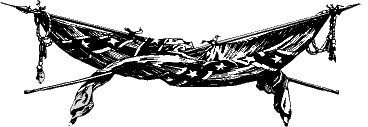
Although unable to recruit new troops to fill its ranks, the Orphan spirit managed, again and again, to rise to the call, giving their heart, arms and lives for the Southern Cause. It was their indomitable spirit that encouraged others to stand tall in spiet of overwhelming odds. Shout, shout, the battle cry of freedom! Towards the close of the war, they were called upon to escort Confederate President Jefferson Davis to saftey. Finally, on May 7, 1865, nearly a month after General Robert E. Lee surrendered his army at Appomattox, the last standing army lowered and folded its tattered and defeated battle flag . . . forever. All that remained in the small town of Washington, Georgia were less than 200 war weary soldiers of the Orphan Brigade. Many who would never return to their old Kentucky homes.
Who were these people?
Farmers, Laborers, Slaves, Sailors, Traders and Merchants, Volunteers (young, old, rich and poor), Immigrants, Native American Indians (Cherokees), Christians, Jews, Freemasons, Descendants of the American Revolutionary War, Veterans of the Mexican War, Black Confederate Soldiers (50,000-60,000), Politicians (Former U.S. President John Tyler and Former Vice President, John C. Breckinridge), Ministers (Leonidas Polk), Former U.S. Soldiers (Robert E. Lee), West Point & VMI Cadets& Graduates (P.G.T. Beauregard, Thomas (Stonewall) Jackson), Teachers, Judges, Lawyers, Doctors, Nurses, Pioneers, Freemen of Color (Henry Brown), Women, Young Boys, and Writers (Mark Twain).
Gray Jackets with Blue Collars John W. Blackburn
History of the Orphan Brigade 1861-1865 Ed Porter Thompson
Shrouds of Glory Winston Groom
Forgotten Confederates (Black Confederate Soldiers) Charles Kelly Barros, J.H. Segars &R. B. Rosenburg
Blue and Gray: - (periodical) August 1997 "Real Daughters of the Orphan Brigade", p. 39
Embattled Banner Don Hinkle
Diary of a Confederate Soldier John S. Jackman - 9th Kentucky, Company B
Rebel Private: Front and Rear William A. Fletcher
Facts The Historians Leave Out John S. Tilly
The South Was Right! James Ronald Kennedy & Walter Donald Kennedy
The Confederate War Gary W. Gallagher
The Approaching Fury Stephen B. Oates
Shiloh Larry J. Daniel
Stonewall of the West Craig L. Symonds
Charlie Brown