|
The
New Netherlands colony
The
Low Countries
The Netherlands'
contacts with the New World dated back to the first half of the
sixteenth century. The Low Countries, one of the most densely
populated regions in Europe, were not a unitary state but an agglomeration
of seventeen separate small provinces under the Spanish Crown.
As subjects of the king of Spain, Dutch merchants had access to
other parts of the Spanish Empire, including the Americas.
Henry
Hudson
After several failed expeditions, the small seventy-ton Halve
Maen set sail in April 1609 with a ship's company of sixteen commanded
by the English navigator Henry Hudson. He first set course for
the northeast, but before reaching Novaya Zemlya was forced by
the Arctic ice to put about. Hudson at length reached the North
Atlantic coast of the New World.
Hudson rounded Cape Cod and entered Long Island Sound in search
of a northwest passage to the Pacific. On September 12 he sighted
'as fine a river as can be found, wide and deep, with good
anchoring on both sides', Ninety miles upstream he was forced
to conclude that it was not the north-west passage. Disappointed,
Hudson had to end his quest, unaware of the fact that in exploring
this waterway he had sailed into history.
Pleasant and fertile
The voyage having failed in its principal aim, the directors of
the Dutch East India Company, showed little interest in Hudson's
discoveries. But others were more alert. Johannes de Laet, author
of The New World or a Description of the West Indies, described
this new land as 'pleasant and fertile', well suited to
habitation, with a mild climate and abundant crops which grew
virtually by themselves. This was music to the ears of Dutch merchants,
who lost no time in fitting out ships for the voyage to 'Hudson's
river'.
Those who set off after reading these tales of De Laet were unpleasantly
surprised when they encountered the severe winters of North America.
Nevertheless, for some merchants these voyages were profitable
enough to warrant their continuation.
Pelts
In Amsterdam,
the merchants were becoming worried for competition, lowered the
profits and heightened the risks. But as it happened, they had
more to fear from one another than from the Indians. In the autumn
of 1613 the Fortuyn [fortune], the Nachtegael [nightingale]
and the Tijger [tiger] lay at anchor in the mouth of the
Hudson. The three captains were locked in fierce competition for
the pelts brought by the Indians, each outbidding the other and
driving up the price day after day. When the winter arrivedt,
they were still there, and their holds were still empty. A disastrous
fire which destroyed the Tijger down to the waterline (parts of
the wreck were recovered in 1916 on the present-day site of the
WTC's Twin Towers) caused the final eruption.
New Netherland
The
merchants in Amsterdam decided that something must be done to
prevent this sort of thing happening again. In 1615 a group of
them obtained from the States General a monopoly of the Hudson
trade. Their charter was the first document in which the name
New Netherland appeared.
A number of trading posts were established, and ships departed
regularly both to trade and to chart the coastal waters. The eastern
seaboard from Connecticut to the Carolinas was charted in this
way by cartographers in the service of the Company.
Walloon
In May,
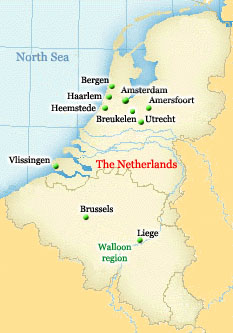
1624 thirty Walloon families, refugees from the part of the Netherlands
still under Spanish rule, set out for America. They were put ashore
in small groups at the mouth of the Delaware, the Hudson and the
Connecticut rivers, marking the extent of the territory claimed
by the Dutch. The most northerly outpost was established on the
upper reaches of the Hudson, just south of present-day Albany.
Its wooden blockhouse was named Fort Orange after William of Orange,
who had led the Netherlands to independence and whose family were
the hereditary stadholders, the heads of state of the Republic.
Manhattan
A year after the arrival of the first thirty families, a convoy
of six ships left Amsterdam for New Netherland, carrying food
supplies, weapons, agricultural tools, seeds, livestock and several
hundred new settlers. Dispersing the settlers over different locations
proved to have been a mistake. It was difficult to supply the
settlers on the coast, and the fortresses at the river mouths
could not be defended against attack from the hinterland. The
Indian tribes around Fort Orange were at war with one another,
bringing the fur trade to a virtual standstill.
Pieter
Minuit
And finally, they were threatening to attack the white intruders
who had usurped their land. In the spring of 1626 Governor Pieter
Minuit decided to relocate all the colonists on the centrally
situated island of Manhattan, which was easier to defend. Conditions
were primitive at first: the families lived in dug-out huts or
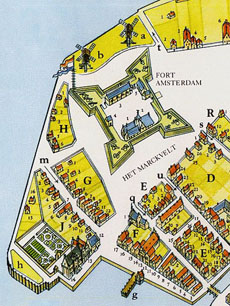
shared the stalls with their livestock. The building of a fort
[New Amsterdam] and houses got under way after the island was
purchased from the Indians for 60 guilders, a bargain even for
those times.
 Notwithstanding
the narrow economic base, the population of the colony steadily
increased, though its growth rate was in no way comparable to
that of neighboring New England, where streams of immigrants were
arriving. In 1643 the population numbered between 400 and 500;
by 1654 it had increased a good five-fold to 2600, and ten years
later had more than tripled again to 9000. Notwithstanding
the narrow economic base, the population of the colony steadily
increased, though its growth rate was in no way comparable to
that of neighboring New England, where streams of immigrants were
arriving. In 1643 the population numbered between 400 and 500;
by 1654 it had increased a good five-fold to 2600, and ten years
later had more than tripled again to 9000.
New Amsterdam
|
|
The Heeren XVII
As
this period of Dutch history is known, owed much of its prosperity
to the Republic's vast commercial empire that stretched from the
Indian Ocean to the Hudson River. The Dutch East India Company
(VOC), was founded in 1602 to trade with the Far East. Its governing
body, the Heeren XVII, constantly seeking to reduce costs, made
repeated attempts to find a northern passage to the Orient to
replace the hazardous route round the Cape of Good Hope.
. . . . . . . . . . . . . . . . . . . . . . . . . . . . .
The Republic at that time was probably the most powerful state
in Europe; it was certainly the most prosperous. It held a strong
attraction for foreigners seeking a better life. Via the Republic
many found their way to the Dutch colonies, where they hoped to
make their fortunes. New Netherland was just one of the possible
choices: they could equally well try their luck in the East Indies
or Brazil, or sign on as a sailor aboard a VOC ship
Pieter Stuyvesant
In May 1647 the man arrived who was to be identified more than
any other with New Amsterdam, and ultimately with its end. Pieter
Stuyvesant, then 37, had won his spurs in the West Indies. Stuyvesant
was a formal and authoritarian but a competent administrator who
began by introducing strict measures to bring the situation under
control. Although New Netherland never entirely lost the aura
of a frontier society, Stuyvesant succeeded in firmly establishing
his authority and restoring the colonists' confidence in the future.
York
The
fate of New Netherland was finally decided by the rivalry between
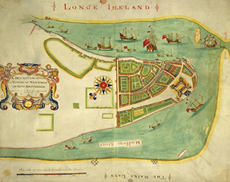
the two European maritime powers. In 1663 Charles II had generously
presented his brother, the Duke of York, with all the land between
the Delaware and the Connecticut, blithely disregarding the fact
that it belonged to the Dutch. At that moment the two nations
were not at war, so the duke could not very well claim his proprietary
rights.
New York
The Second Anglo-Dutch War broke out in 1664, and soon afterwards
four English frigates were dispatched to New Netherland. Knowing
they were on their way, Stuyvesant appealed for help from his
superiors in Amsterdam. It was not forthcoming. The directors
insisted there was no need for alarm. The English flagship anchored
in Gravesend Bay and her commander, Captain Richard Nicolls, informed
Stuyvesant: 'In His Majestie's name I do demand the towne, situate
upon the island commonly known by the name of Manhatoes with all
the forts thereunto belonging'.
The colony passed into English hands without a shot being fired.
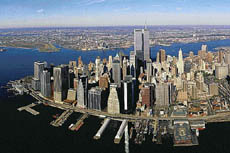
Except for a brief interlude in 1673, when the town, since renamed
New York.
New York, Click for a Webcam
After his acquittal Stuyvesant returned to the colony where he
had lived for almost twenty years, and where his children had
been born. Up to his death in 1672 he lived on his bouwerij (farm)
in the district still called the Bowery.
Germantown
After the loss of New Netherland, Dutch influence in North America
was by no means at an end. Indeed, the reverse seemed to be true.
For many years New York houses were still built in the Dutch style,
with gables, window shutters and raised stoops, even though there
was no danger of flooding as in Amsterdam. Not only did most of
the original inhabitants remain, but they were joined by a fresh
influx of immigrants from the Netherlands. The majority took British
nationality in order to be able to continue their trading activities
under the Navigation Act, which specified that only English ships
could carry goods to and from English ports.
The
old Dutch commercial families of New Amsterdam became part of
the New York ruling classes. New immigrants usually trekked inland
to establish farms far beyond the borders of the old colony. In
1683 a group of Mennonites and Quakers arrived in Pennsylvania,
some of whom settled around Philadelphia. The majority were Dutch,
but having come from an area near the German border, they were
frequently mistaken for Germans, and their main settlement was
later named Germantown.
United States
It was not only in the New World that the Dutch became involved
in the American War of Independence. While no longer the great
power of a century before, the Republic was still an important
European state; more particularly, it was an extremely wealthy
one. The
Continental Congress therefore sought support in Amsterdam for
its struggle against Great Britain. In 1780 John Adams, one of
the prime movers of the Revolution and a future president of the
United States, was sent as an envoy to The Hague to enlist support
for the American cause.
On April 19, 1782, the States General recognized the United States
as a sovereign nation, making the Republic the second power to
do so. In October of that year the two countries signed a treaty
of amity and commerce, each according the other the status of
most favored nation and providing for eternal peace and friendship
between them.
|
|