Morality Journal 4
1) This section was about the morality of the Catholic Church. Specifically, it centered on the Catechism of the Catholic Church (CCC). One of the things that the CCC says is that the morality of human acts depend always depend on the object (the mater of the act), the intent (the goal of the activity), and the circumstances (conditions involved in the act). As human beings, we are also obliged to inform and form our conscience as well as possible. Some ways to inform it are listening to church teachings, finding out the facts, and praying a lot. Using this information, we must develop principles of right and wrong to follow in our life and then have the courage to stand by them.
2) A) I think it would be worthwhile to remember the ways I can have some moral responsibility for cooperation with sins. Obviously by participating directly and voluntarily in a sin with others I would have moral responsibility for the actions. I would be doing the deed, it makes no difference if it�s with a group or not. Ordering, advising, praising, or approving others sinning makes me morally responsible as well. So it is not right for me to laugh when someone makes fun of another person, or for me to tell them how great it was when they tripped that weird kid. I also have an obligation to stop or at least hinder an immoral deed if I can do so, and I know that simply speaking up can often do the trick of stopping some things. It will still be difficult to do so though. By protecting evil-doers I can also be morally responsible. This one seems a little harder to follow, because I believe that there are instances where loyalty to a friend should outweigh this standard. It is also necessary for a fair trial, and so someone will need to defend the bad guys.
B)� �The Ten Building Blocks of Catholic Social Teaching� are also interesting. The principles respond to the need of a set easily learned principles (like the Commandments or Beatitudes) to help people live fulfilling lives in the community. The ten principles are: Human Dignity, Human Life, Association, Participation, Protection of the Poor/Vulnerable, Solidarity, Stewardship, Subsidarity, Human Equality, and the Common Good. While they are different, I feel that the Principle of the Common Good sums up the others fairly well. It states that the common good for all people should be considered by everyone, because we are social beings, and working to help our brothers and sisters is best for society as a whole. When we recognize that all people are equal and endowed to the same rights just by being born (Principles of Human Dignity, Life, and Equality) it is easier to see that we should all help each other, because we�re all in the same situation.
C) I�d like to
remember the story of Dietrich Bonhoeffer, the pacifistic
Lutheran pastor who threw away security for others. He had been offered a job
in
3)
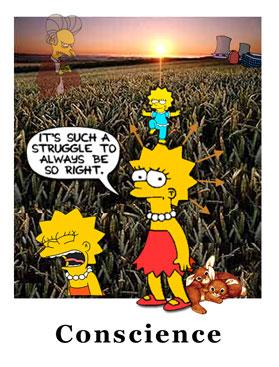
This is from http://www.timboucher.com/journal/2005/05/05/pop-tarot-conscience/
This image, as the author of the site it is on says, points out how Lisa Simpson is always the moral voice of the show The Simpsons. She is the only one who seems to have a formed Conscience with principles to guide her.
4) Why does doing
what is right always seem to be doing what is hard? Why isn�t it easier to do
the right thing?
5) The best thing
for me to do right now is form my conscience at a young age. I need to get more
in touch with myself and who I am through prayers and more alone time. I should
set up principles like truth, justice, or kindness and try to practice them
right away. If I can get into the habit of these good things now, they will be
easier to continue later in my life.
Home
My Homework Page