Journal 3 (Reason)
1) This section has of course been about reason. Part of this has to do with knowing how the mind works. The way the mind works is by receiving outside stimuli from the senses, and linking that to things similar (association) in our experience and then would lead to a reaction, but then our reasoning affects the process. We consider our knowledge from Authority (knowledge from more qualified people in an area and that we accept to be true from this fact), and our Experimental knowledge (knowledge from our first-hand experience of things), as well as our ability to critically think through things. This ability to think through things is led through possible consequences, is this bad/good or right/wrong? This reasoning is the final judgment of what we will do which leads to our action.
2)
����������� A) I�d like to remember the five common thinking errors. They are Non Sequiturs (a conclusion that does not follow from the premises on which it was based), False and Vague Premises (the conclusion follows logically from the premises, but the premises are either false or untrue), Ad Hominem (rather than attacking one�s argument you attack them as a person), Begging the Question (when you attempt to explain a point is true, but in doing so you already assume it is true), and lastly Red Herrings (a beside-the point statement said to distract others from the real issue). These errors are fun to look at because if you keep them in mind you can see them everyday life and try to correct them.
����������� B) The Principle of Contradiction is a tricky thing to keep in mind. It makes perfect sense, but it seems like we�ve grown up thinking that some things have a potential to be right. We often think of some things being partially right and others being more right, but really they contradict each other so only one can be right. It is an idea that takes some getting used to.
����������� C) Deduction and induction are interesting things. Deduction is logically deducing a conclusion from premises (affirmative or negative statements that are believed to be true). Inductions are generalizations that are believed to hold true everywhere for any given situation. Inductive statements are needed to speak beyond what are experience can justify because there is no way we can see every human in order to say that all of them are born with a mouth. We deduce and induce all the time without even realizing it.
3)
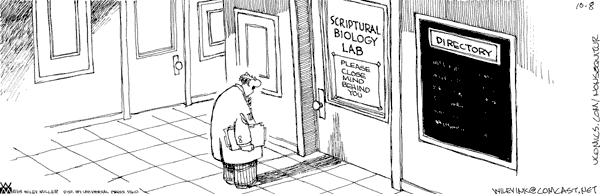
This comic reminds of the contradicting teachings of science and theology we talked about a little, it also reminds me of the thinking error Non Sequitur, because that is the name of the comic. This is from http://www.ucomics.com/nonsequitur/2005/10/08/.
4) Am I taking the Critical Steps to Thinking (know the facts, remembering the principle of contradiction, defining my terms, being intellectually humble, and looking for different perspectives)? Am I actually trying to think things through critically?
5) From this section I should take with me the knowledge I
have learned about how the mind works. All the knowledge of reasoning, thinking
errors, critical thinking and truth itself I should put to use. I can do this
by becoming aware of the flaws in my mind and fixing them so that my mind works
effectively and the way I want it to.
Home
Back to homework page