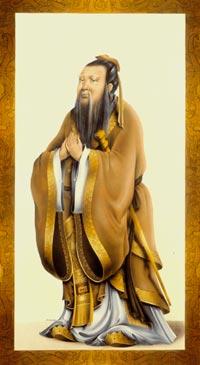
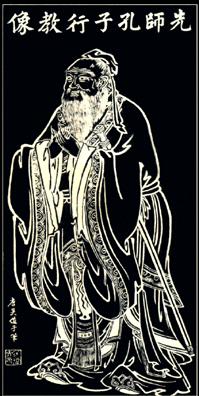
From http://nafosat.freenet.uz/confucius/index.shtml and http://www.iep.utm.edu/c/confuciu.htm.
Origination
Confucius was born in 551 B.C. in
| Selected Sayings of Confucius (With commentary by T.C. Peng) 1. Respect the old, educate the young, and trust your friends. (Proper conduct for the survival of civilization.) 2. Do not do to others what you would not have them do to you. (Uniform standards for equal justice.) 3. Great man sets the good example, then he invites others to follow it. (Do as I do, not double standard.) 4. Shall I tell you what knowledge is? It is to know both what one knows and what one does not know. (Intellectual honesty.) 5. Humanity-at-its-best: At home be humble, at work be respectful, and with others be loyal. 6. Society is not an adversarial system based on contractual relationship, but is a community of trust with emphasis on communication. 7. A political culture based on responsibility and trust is politics with moral persuasion. The purpose of government is not only to provide food and maintain order but also to educate. (People do not live by bread alone.) 8. Great man demands it of himself; petty man of others. (Buck stops at oneself; don't pass the blame to others.) 9. You can always learn from three people in the street, take up the good and improve the bad. (Learn from the successes and mistakes of others.) 10. Remain sincere in purpose while studying widely, continue to think while posing frank and open questions. Therein lies Manhood-at-its-best. (Sincerity and openness.) |
Teachings
����������� Confucianism is a system about building moral perfection within. It emphasizes that internally you must be virtuous. Confucius told kings that they had to govern them selves in a moral way before they could govern their people.
����������� Confucius taught to follow the Rites (li), or the Rituals (also propriety). They were a system set to put people into places and behaviors in a hierarchical type of society. People based relationships on these set ceremonies and behavioral types. This was set up to balance traits that could lead to conflict. The syystem was all about balancing certain characteristics to get the best blend. The most important part of Rites happens internally. The behavior becomes part of the individuals. Rites are about developing a sense of right and wrong within, not just doing something because you are told not to or you will be punished. You have to see the reason for paying respectful, or it is not really respect.
����������� Filial
Piety (xiao) is an aspect of Confucianism that
focus� on relationships between people. The five key relationships are between father and son, ruler and subject, husband
and wife, elder and younger brother, and friends[1].
These relationships are all important and have certain respects and guidelines
to follow both ways. Typically the elder of the relaionship commands more respect and is more empowered, but the respect still must go both ways It includes the need for respect towards elders not
because they are older, but because of their experiences that they can help you
to learn so you don�t have to experience everything personally to know it
(because you can�t).
Loyalty (zhong)
is a different level of filial piety, guiding the relationship between rulers
and ministers. It can also be the loyalty in other relation ships though. Rulers who were chosen by the �Mandate of Heaven� had moral
greatness, and were obeyed because of this. It does not mean that everything superiors say should be done is done thoughtlessly, it also encourages the commanded to challenge things from time to time to keep the superior in check.
����������� Humaneness (ren)
is the underlying cause of why people should follow the rites and filial piety.
It is essentially the Golden Rule �
phrased negatively "Do not do
to others what you would not like them to do to you".[2]
It is an aspiration to being a good judge of the characters of others, having
the ability to do what is right, be honest, look deeper into things (don�t
generalize), play your role in society, have empathy for others, and to do things fairly.
����������� An
important way that Confucius taught others his ideas was to show them by his
own example. This is how the concept of the perfect gentleman (junzi / chun tzu)
came about. The perfect gentleman is a moral idol for others to strive to be
like. Every perfect gentleman must display the above traits (rites, filial
piety, loyalty, and humaneness) to the fullest.
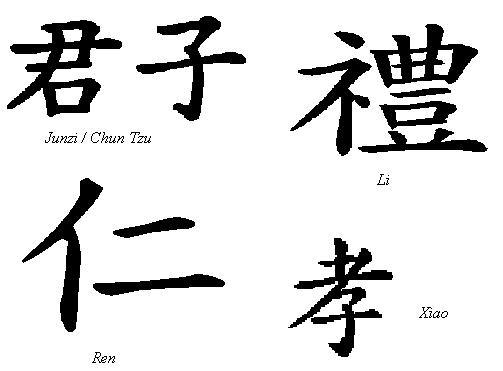
These images were accumulated from http://www.inf.uniroma3.it/~patrigna/china/xiao4.htm and http://www.aarweb.org/syllabus/syllabi/g/gier/308/308terms.htm.
For some insight into what confucius would say about modern USA click here.
Sources
http://en.wikipedia.org/wiki/Confucianism
http://encarta.msn.com/encyclopedia_761553693/Confucianism.html
http://guweb2.gonzaga.edu/faculty/wheeler/chinese_confucius.html
http://www.chinaknowledge.de/Literature/Classics/confucius.html