http://images.rottentomatoes.com/images/movie/coverv/46/149546.jpg
AFTER
|
http://images.rottentomatoes.com/images/movie/coverv/46/149546.jpg |
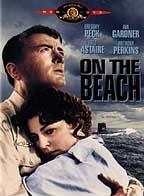
The American culture was drastically altered by the atomic bomb. Popular culture, such as films, illustrated the fear for atomic weapons. The 1959 film On the Beach, starring Gregory Peck and Fred Astaire, depicted the hopelessness of life after "World War III." After atomic warfare had completely devastated the Northern Hemisphere, only the very southern areas of the world such as South Africa, South America, and Southern Australia remained inhabitable. However, inevitable currents would soon take the radiation levels southward, giving everyone left in the world only a year to live. The powerful movie received rave reviews and still continues to question audiences today on the future of atomic warfare. |
Realizing the potential hazards, world leaders have sought eradicate nuclear weapons from the rest of the world. Three efforts are the Partial Test Ban Treaty (PTBT), the Nuclear Non-Proliferation Treaty (NPT), and the Comprehensive Test Ban Treaty (CTBT).
| Treaty | Year | Focus | Success |
| PTBT | 1963 | bans nuclear weapon testing in the atmosphere, underwater, and in space | France and China, two original nuclear countries, didn't sign the treaty, giving it a limited success. |
| NPT | 1968 | prohibits non-nuclear countries from acquiring, manufacturing, or possessing nuclear weapons. | 170/189 countries signed, providing overall success, but a few nuclear countries (India and Israel, etc.) didn't sign the treaty. |
| CTBT | 1996 | bans all nuclear explosions in all environments; countries cannot cause or encourage use of the weapons. | signed by 71 countries, including the 5 original nuclear countries (France, Britain, U.S., China, Russia) |
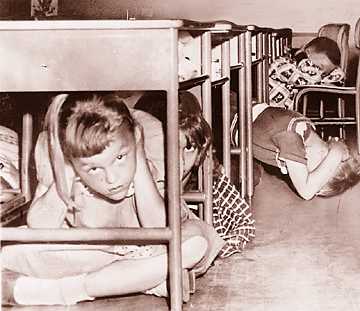
| Right after World War II, America was involved in the Cold War, a struggle of power between Communist and Non-Communist nations. At the center of this controversy was the potential for the atomic bomb. Their existence set a curtain of fear upon every civilian as underground fallout shelters were built in many parts of the world. Every child was taught "duck and cover" in case America was ever hit by a nuclear bomb. Several companies made big profits from building nuclear shelters. Air raid drills were conducted regularly in every American town. The magazine Popular Science even included step-by-step instructions on how to build a bomb shelter. |
Children in a Detroit school practice "duck and cover." http://www.detnews.com/history/shelters/shelters.htm |
|
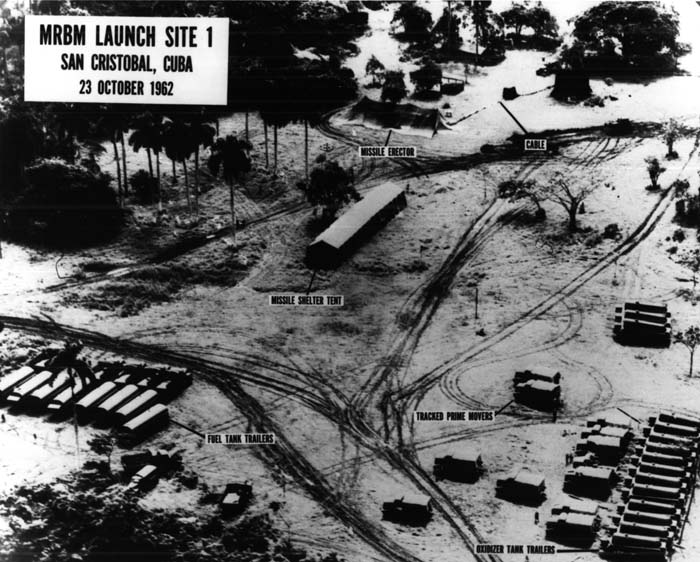
The U-2 surveillance photograph of Cuba, proving that the Cubans now had Russian nuclear weapons. (click for larger image) http://nsarchive.chadwyck.com/images/nsa/photos/cm003.jpg |
The 13-day Cuban Missile Crisis brought forth the most tension of the entire "war." U.S. surveillance photographed the Russians delivering nuclear weapons to the Cubans. President Kennedy immediately quarantined Cuba, saying that any nuclear weapons directed or shot from Cuba would be accounted for as if Russia had dropped the missiles. After placing a blockade and other restrictions on Cuba, the Russians finally decided to withdraw the weapons on October 28, 1962. |
Instances such as the Cuban Missile Crisis illustrate the panic that nuclear warfare set upon the entire world. Even currently, one of President Bush's justifications for fighting the War in Iraq is the potential weapons of mass destruction that Saddam Hussein was believed to have. "[America is] strongly supporting the International Atomic Energy Agency in its mission to track and control nuclear materials around the world. We're working with other governments to secure nuclear materials in the former Soviet Union, and to strengthen global treaties banning the production and shipment of missile technologies and weapons of mass destruction," President Bush in his January 2003 State of the Union Address. Several organizations have also been founded to advocate the destruction of nuclear bombs, such as the Nuclear Age Peace Foundation, whose mission statement includes "The peoples and governments of the world face an urgent challenge relating to weaponry of mass destruction and particularly to nuclear weaponry. At the crossroads of technology, terrorism, geopolitical ambition, and policies of preemption are new and potent dangers for humanity." (www.wagingpeace.org)
As time progressed, the shift of technological development of the bomb has drastically shifted from nuclear to other types of bombs. After World War II, the world learned that nuclear warfare is a perilous tactic that results in too many innocent deaths. Although the perceptions and emotions started out optimistically in World War I, World War II brought them to a turning point. Today, the general perception towards nuclear warfare is negative, with fear being the primary emotion.
Sources: