
| Oil of Wintergreen
WINTERGREEN gaultheria procumbens 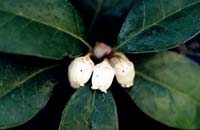 Oil is valuable in liniments. The species are known by the common name of Wintergreen. The name Pyrola is a diminutive of Pyrus (a pear tree), from the resemblance of it leaves to those of the pear. Botanical: pyrola secunda Pyrola secunda is known as Yevering Bells, from the resemblance of its flowers to little bells hung one above the other. Description Low herbs, with a slender shortly creeping stock; orbicular or ovate, nearly radical leaves; and white or greenish, drooping flowers, either solitary or several in a short raceme, on leaflets, erect peduncles. Sepals five, small. Petals five, distinct or slightly joined at the base, forming at first a spreading corolla, which persists round the young capsule, assuming a globular shape. Stamens ten. Capsule five-celled, opening by slits in the middle of the cells. Pyrola uniflora (one-flowered Wintergreen), found in woods, in Northern and Arctic Europe, Asia and America, and along the high mountain ranges of Central Europe. In pine woods from Perth and Aberdeen northwards. Flowers in the summer. Pyrola media (Intermediate Wintergreen), not found in England south of Warwick and Worcester, whence it extends to Shetland; it also is found in the north and west of Ireland. Pyrola minor (Common Wintergreen). In woods and moist shady places in Europe, Northern Asia and the extreme north of America, becoming a mountain plant in Southern Europe and the Caucasus. Frequent in Scotland, northern England, more local in southern England. Rare in Ireland. Flowers in the summer. Pyrola secunda. Very local in Britain, found in Monmouthshire and from Yorkshire northward to Ross-shire. It is very rare in the northeast of Ireland only. Flowers in the summer. LARGE WINTERGREEN Botanical: Pyrola rotundifolia Synonym: Round-leaved Wintergreen. The species are known by the common name of Wintergreen. The name Pyrola is a diminutive of Pyrus (a pear tree), from the resemblance of it leaves to those of the pear. Description A larger plant than Pyrola minor, with larger and whiter flowers and the petals more spreading, but chiefly distinguished from it by the long, protruding, much-curved style, usually at least twice as long as the capsule with a much smaller stigma, with short erect lobes. CONDITIONS ESSENTIAL OIL Medicinal Action and Uses |
||

HerbsRule
"What a long, strange trip it's been..."
Jerry Garcia {1942-95}
Bibliogaphy
Cosby Creek Web Design
