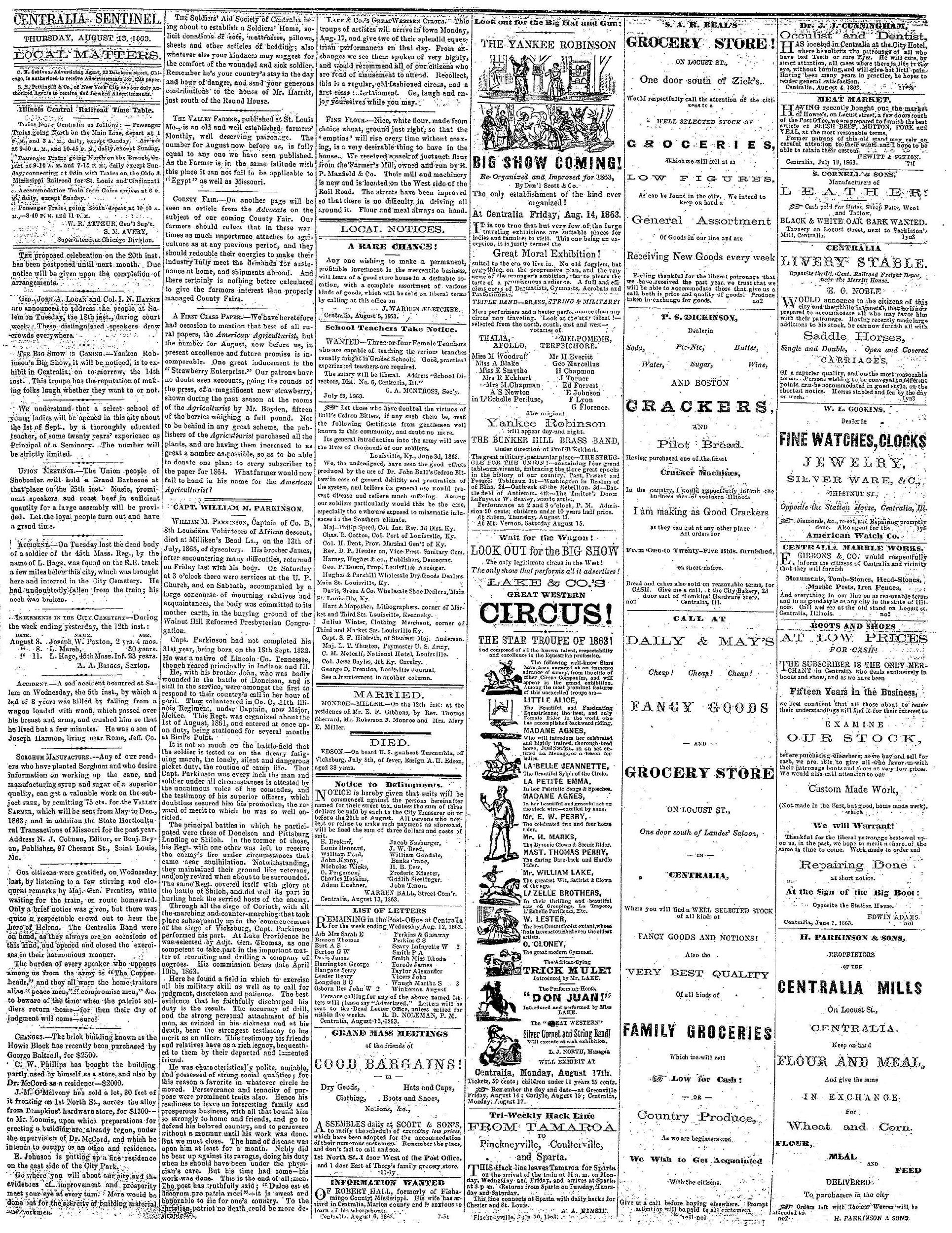
William M. Parkinson, Captain of Co. B, 8th Louisiana Volunteers of African descent, died at Milliken's Bend La., on the 13th of July, 1863, of dysentery. His brother, James, after encountering many difficulties, returned on Friday last with his body. On Saturday at 3 o'clock there were services at the U.P. Church, and on Sabbath, accompanied by a large concourse of mourning relatives and acquaintances, the body was committed to its mother earth, in the burying ground of the Walnut Hill Reformed Presbyterian Congregation.Capt. Parkinson had not completed his 31st year, being born on the 18th Sept. 1832. He was a native of Lincoln Co., Tennessee, though reared principally in Indiana and Illinois. He, with his brother John, who was badly wounded in the battle of Donelson, and is still in the service, were amongst the first to respond to their country's call in her hour of peril. They volunteered in Co. C, 11th Illinois Regiment, under Captain, now Major, McKee. This Regt. was organized about the 1st of August, 1861, and entered at once upon duty, being stationed for several months at Bird's Point.
It is not so much on the battle-field that the soldier is tested as on the dreary fatiguing march, the lonely, silent and dangerous picket duty, the routine of camp life. That Captain Parkinson was every inch the man and soldier under all circumstances is attested by the unanimous voice of his comrades, and doubtless secured him his promotion, the reward of merit to which he was so well entitled.
The principal battles in which he participated were those of Donelson and Pittsburg Landing or Shiloh. In the former of those, his Regt. with one other was left to receive the enemy's fire under circumstances that came near annihilation. Notwithstanding, they maintained their ground like veterans, and only retired when about to be surrounded. The same Regt. covered itself with glory at the battle of Shiloh, and did well its part in hurling back the serried hosts of the enemy.
Through all the siege of Corinth, with all the marching and counter marching that took place subsequently up to the commencement of the siege of Vicksburg, Capt. Parkinson performed his part. At Lake Providence he was selected by Adjt. Gen. Thomas, as one competent to take part in the important matter of recruiting and drilling a company of negroes. His commission bears date April 10th, 1863.
Here he found a field in which to exercise all his military skill as well as to call for judgment, descretion and patience. The best evidence that he faithfully discharged his duty is the result. The accuracy of drill, and the strong personal attachment of his men, as evinced in his sickness and at his death, bear the strongest testimony to his merit as an officer. This testimony his friends and relatives have as a rich legacy, bequeathed to them by their departed and lamented friend.
He was characteristically polite, amiable, and possessed of strong social qualities; for this reason a favorite in whatever circle he moved. Perseverance and tenacity of purpose were prominent traits also. Hence his readiness to leave an interesting family and prosperous business, with all that bound him so strongly to home and friends, and go defend his beloved country, and to persevere without a murmur until his work was done. But we must close. The hand of disease was upon him at least for a month. Nobly did he bear up against its ravages, doing his duty when he should have been under the physician's care. But his time had come--his work was done. This is the end of all men. The poet has truthfully said, "Dulce est et decorum pro patria mori,"--it is sweet and honorable to die for one's country. To the christian patriot no death could be more desirable.

©2006 C.S. Parkinson