

The Grand Review
of the Army
May 23-24, 1865
Washington, D.C.

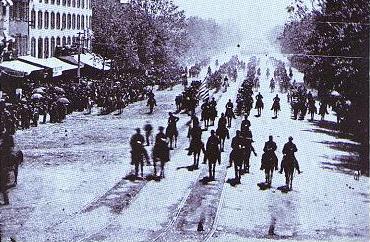
On May 23, 1865, a Grand Review for General George Gordon Meade's Army of the Potomac, was held in Washington, D.C.. The next day, the Union's other army; General William T. Sherman's legion from the west, marched down Pennsylvania Avenue. Two of my great-great-great grandfathers marched on the second day. John Odom Brakebill, of the 48th Illinois Infantry; and John Allen Brown, of the 42nd Indiana Infantry.
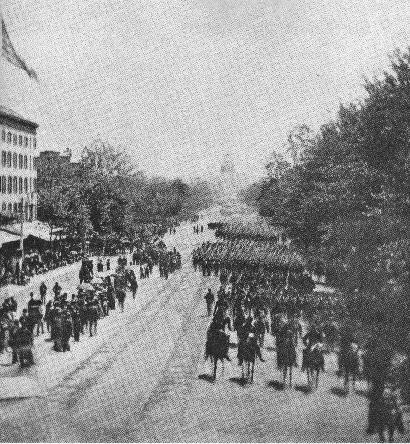
Crowds line the streets as two hundred thousand troops march down Pennsylvania Avenue. The recently completed Capitol building, can be seen in the distance. The men marched twenty abreast from the Capitol to the reviewing stand in front of the White House. The weather was perfect. Several bands lined the route, playing such tunes as When Johnny Comes Marching Home and When This Cruel War is Over; with the crowds singing along. The flag flew at full staff that day for the first time in four years. On the second day, at Sherman's appearance, the crowds threw flowers and placed garlands on his horse. When the band at the reviewing stand struck up Marching Through Georgia, the crowd cheered wildly. Thus one of the mightiest armies ever gathered passed in final review, before drifting back into private life.
A Second Review of the Grand Army
I read last night of the Grand Review
In Washington's chiefest avenue,-
Two hundred thousand men in blue,
I think they said was the number,-
Till I seemed to hear their trampling feet,
The bugle blast and the drum's quick beat,
The clatter of hooves in the stoney street,
The cheers of the people who came to greet,
And the thousand details that to repeat
Would only my verse encumber,-
Till I fell in a revery, sad and sweet,
And then to a fitful slumber.
When, lo! in a vision I seemed to stand
In the lonely Capitol, On each hand
Far stretched the portico, dim and grand
Its columns ranged, like a martial band
Of sheeted spectres whom some command
Had called to a last reviewing.
And the streets of the city were white and bare;
No footfall echoed across the square;
But out of the misty midnight air
I heard in the distance a trumpet blare,
And the wandering night-winds seemed to bear
The sound of a far tattooing.
Then I held my breath with fear and dread;
For into the square, with a brazen tread,
There rode a figure whose stately head
O'erlooked the review that morning,
That never bowed from its firm-set seat
When the living column passed its feet,
Yet now rode steadily up the street
To the phantom bugle's warning:
Till it reached the Capitol square, and wheeled,
And there in the moonlight stood revealed
A well known form in that state and field
Had led our patriot sires:
Whose face was turned to the sleeping camp,
Afar through the river's fog and damp,
That showed no flicker, nor waning lamp,
Nor wasted bivouac fires.
And I saw a phantom army come,
With never a sound of fife or drum,
But keeping time to a throbing hum
Of wailing and lamentation:
The martyred heroes of Malvern Hill,
Of Gettysburg and Chancellorsville,
The men whose wasted figures fill
The patriot graves of the nation.
And there came the nameless dead,-the men
Who perished in fever-swamp and fen,
The slowly starved of the prison pen;
And marching beside the others,
Came the dusty martyrs of Pillow's fight,
With limbs enfranchised and bearing bright:
I thought perhaps was the pale moonlight-
They looked as white as their brothers!
And so all night marched the Nation's dead,
With never a banner above them spread,
Nor a badge, nor a motto brandished;
No mark-save the bare uncovered head
Of the silent bronze Reviewer;
With never an arch save the vaulted sky;
With never a flower save those that lie
On the distant graves-for love could buy
No gift that was purer or truer.
So all night long swept the strange array;
So all night long, till the morning gray,
I watched for one who had passed away,
With a reverant awe and wonder,-
Till a blue cap waved in the lengthening line,
And I knew that one was kin of mine
Had come; and I spake-and lo! that sign
Awakened me from my slumber.
-Bret Harte
Bret Harte's poem, A Second Review of the Grand Army; was written shortly after the Grand Review. It sounded a note of sorrow amid the rejoicing. Those that died in service to their country formed a greater number then that which marched in the Grand Review. In the federal army, 110,070 were killed in battle or died of their wounds; 199,720 died of disease; 24,866 died in Confederate prisons; other causes brought the total to 359,528. Confederate numbers are not as definate, but it is estimated that 94,000 were killed in action; 59,297 died of disease; 4,000 died in prison and other causes brought the total to about 250,000. In all, over 600,000 lives were lost to the war.
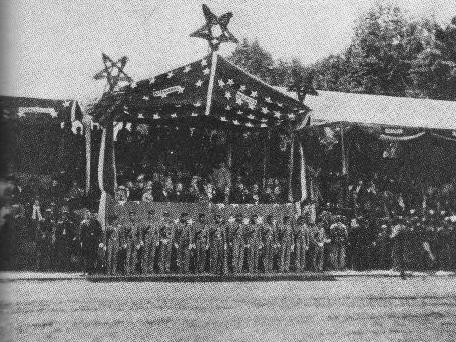
The Reviewing Stand
Situated in front of the White House, the reviewing stand was the final stop in the march. One notable face was absent from the reviewing stand. Abraham Lincoln, the commander-in-chief for the four long years of the war, was already dead from an assassins bullet. Lincoln is the solitary reviewer referred to in Harte's poem.
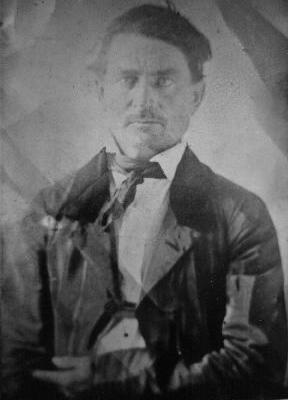
Among those who perished in the war was my great-great-great-great grandfather. Jacob Reed Garrett, a member of the 131st Illinois Infantry; died of disease at Natchez, Mississippi on March 22, 1864 at the US General Hospital. His wife, Mary Elizabeth Adams Garrett, died later that same year, leaving seven children orphaned. So overwhelming was the loss of life in the 131st, that the unit was combined with the 29th Illinois, in order to have enough soldiers to go on.

Back to the Civil War page