
Billy Wilson's Zouaves

A Short History of the
6th New York Volunteer Infantry

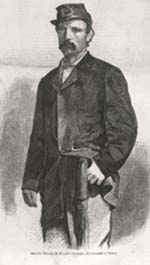
6th Regiment Infantry (Wilson's Zouaves)
Organized at New York City as follows: Companies "A," "B," "C," "D" and "E" April 30, and Companies "F," "G," "H," "I" and "K" May 25, 1861. Left State and moved to Santa Rosa Island, Fla., June 15-23, 1861. Attached to Santa Rosa Island, District of Florida, Dept. of the South, to May, 1862. Arnold's Brigade, District of Pensacola, Fla., Dept. of the South, to September, 1862. Wilson's Brigade, District of West Florida, Dept. of the Gulf, to November, 1862. Grover's Division, Dept. of the Gulf, to January, 1863. 1st Brigade, 4th Division, 19th Army Corps, Dept. of the Gulf, to June, 1863.
SERVICE.--Duty at Santa Rosa Island, Fla., June 23, 1861, to May 9, 1862. (3 Cos., at Fort Jefferson, Fla., January to March, 1862.) Action at Santa Rosa Island October 9, 1861. Engagement with Confederate works at Pensacola November 22-23. Bombardment of Forts McRae and Barrancas January 1, 1862. Reconnaissance on Santa Rosa Island March 27-31 (Co. "K"). Duty at Pensacola, Fla., May 9 to November, 1862. Expedition to Milton, Fla., June 14-15 (Cos. "B," "C," "E" and "H"). Reconnaissance from Pensacola to Bagdad and Milton, Fla., August 7-10 (Cos. "A" and "E") Ordered to New Orleans, La., November, 1862. Occupation of Baton Rouge December 17 and duty there until March 13, 1863. Operations against Port Hudson March 13-27. Moved to Donaldsonville March 28. Operations in Western Louisiana April 9-May 14. Teche Campaign April 11-20. Fort Bisland April 12-13. Porter's and McWilliams' Plantations at Indian Bend April 13. Irish Bend April 14. Bayou Vermillion April 17. Opelousas April 20. Moved to Barre Landing May 11, thence with trains to Berwick May 21-26. Action at Franklin and Centreville May 25. Ordered home for muster out, Mustered out at New York City June 25, 1863, expiration of term.
Regiment lost during service 14 Enlisted men killed and mortally wounded and 32 Enlisted men by disease. Total 46.
Colonel William "Billy" Wilson
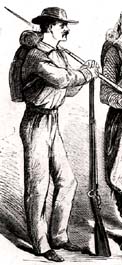
Uniform of the 6th New York
The 6th New York had a somewhat of a reputation among the other units they fought alongside. This description, taken from the article "Florida's War of Nerves", from the June 1999 issue of Civil War Times Illustrated, provides a look.
"In June 1861, the arrival of the 6th New York Volunteer Infantry--known as Wilson's Zouaves--at Fort Pickens livened things up a bit. A Union officer described the Zouaves as "thieves, plug-uglies, and other dangerous characters gathered from the slums of New York City." The regiments priest, Father Michael J. Nash, wrote that the police had had to escort the men, "literally mad with liquor," onto the steamship Vanderbilt, which sailed under sealed orders for Fort Pickens. Father Nash wrote, "Not one of us had ever heard of such a place."
Father Nash found himself shepherding an outfit with a shady reputation. Writing from Staten Island, New York, in June 1861, he said, "All are sons of Catholics ..., [but] their Christian education has been woefully neglected."
The New Yorkers landed on Santa Rosa Island on June 25. Mules were landed first and were allowed to graze freely on the island until camp could be pitched. The troops were landed next; but their inexperience caused them to be drenched by the time they reached land. They spent a rough night on the island, and Father Nash reported that many of them lay fearfully awake all night imagining "that the mules of whose liberty they were unaware, were southern cavalry scouring the island in quest of booty ..., for these poor animals ... continued their mad course ... over the sand hills all night." Wilson's Zouaves settled in quickly enough in their camp on Santa Rosa Island, however, and some of the men were at times detached to man the guns at Fort Pickens."
On the night of October 8, 1861, Brigadier General Richard H. Anderson launched a 1,000-man surprise attack against Fort Pickens. The troops were landed by steamer and barge on the eastern end of Santa Rosa Island at about 2:00 A.M.
Three columns were to march on Fort Pickens: one on the north side of the long island and another on the south side, with a third in reserve. Advance parties were sent out to pick off Federal sentries. A soldier of the 7th Alabama wrote of his first sight of death in combat: "I saw about a dozen of these sentinels lying where they had fallen the night before, all dead from wounds inflicted by the advance guard with their long keen knives. I recall the horror with which I experienced the sight, and I carefully avoided the bodies.".
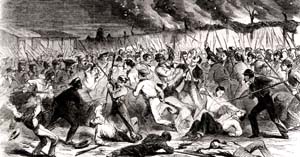
At 4:00 A.M., Anderson's men surprised Camp Brown, home of Wilson's Zouaves, about a mile east of Fort Pickens. As the attackers gave a lusty Rebel Yell and charged the camp, their comrades across the bay, listening for the sounds of battle, reacted with wild cheering of their own. The Zouaves fled in panic toward the safety of the batteries near the fort. The Confederate attackers overran Camp Brown, but lost the important element of surprise when they paused to look the camp over and set it ablaze. Flames from burning tents and camp buildings soon illuminated the night sky above Santa Rosa Island
Attack of Wilson's Zouaves at Camp Brown,
October 8, 1861
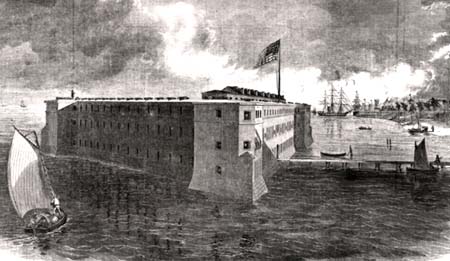
Fort Taylor near Key West, Florida
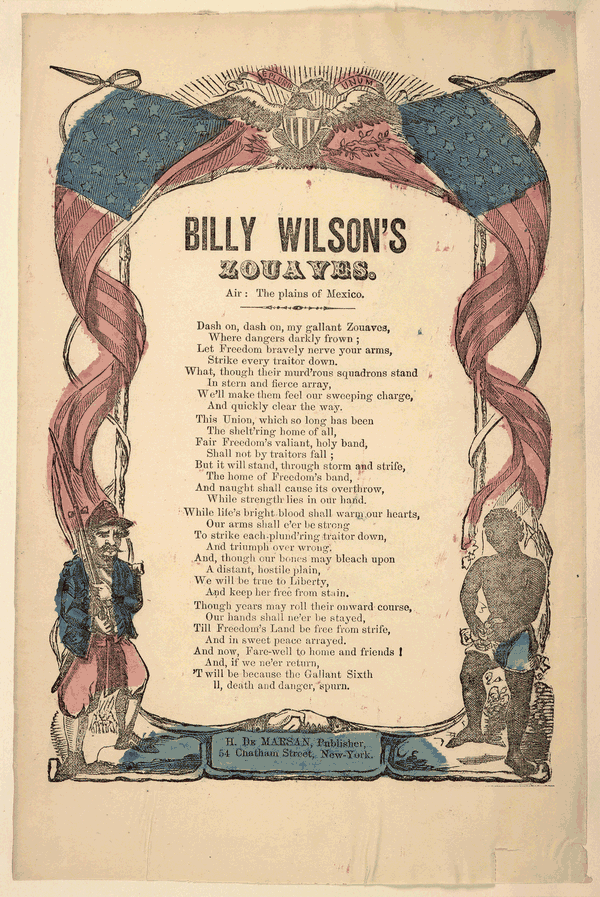
This is the song Billy Wilson's Zouaves, sung to the tune of The Plains of Mexico (an old Mexican War tune). I haven't been able to locate the music yet, but I'm still trying.
Billy Wilson's Zouaves
Dash on, dash on, my gallant Zouaves,
Where dangers darkly frown;
Let freedom bravely nerve your arms,
Strike every traitor down.
What, through their murd'rous squadrons stand,
In stern and fierce array;
We'll make them feel our sweeping charge,
and quickly clear the way.
This Union which so long has been
the sheltering home of all,
Fair freedoms valiant holy band,
shall not by traitors fall.
But it will stand through storm and strife,
The home of freedom's band,
And naught shall cause its overthrow,
While strenght lies in our hand.
While life's bright blood shall warm our hearts,
Our arms shall e'er be strong,
To strike each plundering traitor down,
and triumph over all.
And though our bones may bleach upon
a distant hostile plain,
We will be true to Liberty,
and keep her free from stain.
Though years may roll their onward course,
Our hands shall ne'er be stayed,
Till Freedom's land be free from strife,
And in sweet peace arrayed.
And now, Farewell, to home and friends,
And if we ne'er return,
T'will be because the gallant sixth,
will, death and danger spurn.

Back to the Civil War