
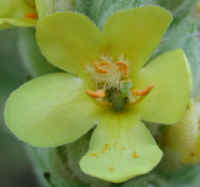
 Mullein Oil verbascum thapsus verbascum thapus Scrophularace CONSTITUENTS Leaves are nearly odorless and of a mucilaginous and bitterish taste. They contain gum as their principal constituent, together with 1 to 2 per cent of resin, divisible into two parts, one soluble in ether, the other not; a readily soluble amaroid; a little tannin and a trace of volatile oil. Flowers contain gum, resin, a yellow coloring principle, a green fatty matter (a sort of chlorophyll), a glucoside, an acrid, fatty matter; free acid and phosphoric acid; uncrystallizable sugar; the bases some mineral salts, of which are potassia and lime, and a small amount of yellowish volatile oil. They should yield not more than 6 per cent of ash. Their odor is peculiar and agreeable: their taste mucilaginous. For medicinal purposes it is generally collected from wild specimens, but is worthy of cultivation, not merely from its beauty as an ornamental plant, but for its medicinal value, which is undoubted. Oil produced by macerating Mullein flowers in olive oil in a corked bottle, during prolonged exposure to the sun, or by keeping near the fire for several days, is used as a local application in country districts in Germany for piles and other mucus membrane inflammation, and for frost bites and bruises. Mullein oil is recommended for earache and discharge from the ear, and for any eczema of the external ear and its canal. Dr. Fernie (Herbal Simples) states that some of the most brilliant results have been obtained in suppurative inflammation of the inner ear by a single application of Mullein oil, and that in acute or chronic cases, two or three drops of this oil should be made to fall in the ear twice or thrice in the day. Mullein oil is a valuable destroyer of disease germs. Fresh flowers, steeped for 21 days in olive oil, are said to make an admirable bactericide. Gerarde tells us that 'Figs do not putrifie at all that are wrapped in the leaves of Mullein.' On the Continent, a sweetened infusion of the flowers strained in order to separate the rough hairs, is considerably used as a domestic remedy in mild catarrhs, colic, etc. A conserve of the flowers has been employed on the Continent against ringworm, and a distilled water of the flowers was long reputed a cure for burns and erysipelas. Mullein oil is a valuable destroyer of disease germs. Fresh flowers, steeped for 21 days in olive oil, are said to make an admirable bactericide. Gerarde tells us that 'Figs do not putrifie at all that are wrapped in the leaves of Mullein.' |
||
GreenWitchGarden
"What a long, strange trip it's been..."
Jerry Garcia {1942-95}
Bibliogaphy
Cosby Creek Web Design
