
| HAWTHORNE TREE
|
||
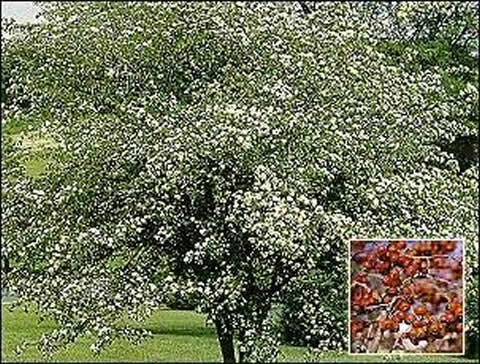 crataegus laevigata crataegus oxyacantha PARTS USED Flowers, leaves and fruit DESCRIPTION Hawthorn grows as either a shrub or a tree in England and continental Europe. It is widely grown as a hedge plant. Its trunk or stem have hard wood. smooth and ash-gray bark, and thorny branches. Small, shiny leaves are dark green on top, light bluish green underneath, and have three irregularly toothed lobes. White flowers have round petals and grow in terminal corymbs during May and June. Fruit or haw is a 2 to 3 seeded, scarlet on the outside, yellowish and pulpy on the inside. The following article is reproduced with kind permission of P.Topham, U.S. Nutritional and Herbal Researcher: A small native European tree, widespread in hedges, along road sides and field boundaries. It has greyish bark, tough, thorny and gnarled branches. Leaves are dark-green and deeply lobed. Clusters of white flowers appear May to June followed by red berries in the autumn. HISTORY Dioscorides, a Greek Herbalist, used Hawthorn in the first century A.D. It went out fashion as a medicine until the 19th century, when an Irish physician included them in a secret remedy for heart disease. Years later, the medicine was found to be made from hawthorn berries, which are still prescribed in folk medicine for a variety of heart-related problems - among them high blood pressure and over-rapid heartbeat. ACTIONS ASTROLOGY DESCRIPTION and HISTORY DOSAGE FOLKLORE MAGICAL USE SOURCE(S) Lady Tia © 2000-2002 Shelley Day, Alternative Healthzine Copyright © 2002 P. Topham: U.S. Nutritional and Herbal Researcher - All Rights Reserved HOLISTIC ONLINE Organic Nutrition |
||
