| |
common ground |
|
 |
| |
|
|
|
|
|
|
accomplish this feat before the 20th century. When the Founding Fathers penned the document, they believed its relevance would extend beyond the fledgling nation. Thomas Jefferson wrote of their efforts, “It is impossible not to sense that we are acting for all mankind.”
His words are not just a personal inkling—they are an age-old American intention. A century and a half before the Declaration of Independence, standing on the tiny deck of the Arabella off the Massachusetts coast, preacher John Winthrop said of the New World, “We will be as a city upon a hill. The eyes of all people are upon us.” In his 2000 presidential campaign, George Bush echoed: “Our nation is chosen by God and commissioned by history to be a model to the world.” The notion that America has an obligation to both demonstrate and spread freedom is an integral part of our self-image. (Think Enduring Freedom in Afghanistan or Operation Iraqi Freedom in the Middle East.)
Between Winthrop and Wal-Mart, 1,300 miles down the coast and 375 years later, what happened?
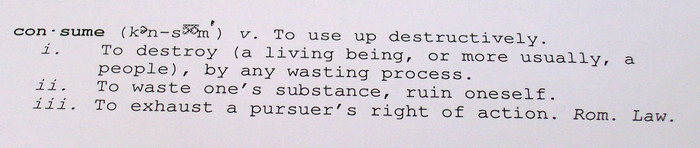
Here’s an idea. Even before Winthrop and long before communist Hollywood starlets or Al Qaeda, the biggest threat to Jefferson’s grand freedom emerged from France. In the 14th century, consume was introduced into the English language from a French word that, in turn, was a derivation of the Latin root consumere—to take up completely, devour, exhaust, spend. All the early uses of consumer have this connotation of destruction. Pulmonary tuberculosis —one of the biggest health threats of the 19th and early 20th century—was also popularly known as consumption, or the wasting disease. Watching Black Friday footage in my tryptophan drear, it was
2. An aside on the tragic deficiency of American ‘stuff’—Amount the U.S. spends annually on imported toys: $23,631,000,000; Amount spent by the next ten highest toy-importing nations, combined: $21,729,000,000. Percent of American products used once, and then thrown away: 80.
| |
|
| |
|
|
|
|
evening news transfixed me. I watched each channel’s coverage of Black Friday, not because they were different, but because they were the same. In Maryland, when asked how the melee could be avoided in future years, one woman summed the sentiment: “That was terrible shopping. They need to get more stuff in the store.” (Probably the first time in recent memory that America has been accused of a lack of ‘stuff.’2)
Curiously absent from the shopper’s interviews was any reflection on the ridiculousness. Instead, the same consumers who, hours before came to blows over snow blowers and duvets, have that transient camaraderie that arises from shared injustice. And what had they endured? On November 26th, in the aisles of big-box stores nationwide, Americans were deprived of their ability to exercise their ‘freedom of choice,’ freely.
On November 26th, bargain hunters were not the only citizens decrying some kind of deprivation. France was still reeling from violent riots over racial discrimination and the mistreatment of immigrants. In Azerbaijan, several people were killed when a protest against a corrupt and authoritarian regime was broken up with truncheons, tear gas, and water cannons. Tear gas was also used in a Beaufort, Texas Wal-Mart to subdue a queue-jumper.
The irony is painful and the impulse is to cringe, bemoan another knock to American dignity, and move on. But behind the pettiness and absurdity of Black Friday, there is something terribly revealing. The day’s events say something big about the small-mindedness, the screwiness, of the American idea of freedom.
Strictly speaking, we should have the best grasp on the concept. America was the first to draft a constitution and one of only seven countries of the world’s 192 to