Salvation Comes to Salvacion
by
Alvin C. Tanicala, CIDSS Writer
Barangay Salvacion
is picturesque- lush flora, fertile land, and a river teeming with
life.
As you breathe in
the freshness of the air and appreciate the beauty of the
surroundings, you would not notice that the place used to be a war
zone.
Salvacion, part of
the infamous Marag Valley, was once site to fierce gun battles at
the height of insurgency in the 1980’s.
During the insurgency, Marag Valley was considered a
stronghold of the communist rebels.
Many lives were
lost because of the bloody fighting.
The armed forces poured many resources in trying to reclaim
the area. With as much
fervor, the communist rebels defended it.
Daily the staccato burst of automatic gunfire is heard.
Fireballs from bombs were also common spectacles.
Even death seems so ordinary.
These events
deadened the community as they chose to ignore the war, but the war
decided to suck them in.
Time of Fear and Terror
Gavino
“Lumideng” Reymundo, was 15 years old when the clashes begun.
He remembers the old folks calling those times as the Reign
of Fear and Terror (Tiempo ti But-buteng ken Riribuk).
Lumideng, a happy-go-lucky lad was forced early into
experiencing the fear and terror, both as a spectator and as a
partaker.
 Armed groups
started visiting the barangay in the early 1980’s.
The villagers thought that the
armed men were government
forces on routine patrol. Nothing
was out of the ordinary so the community took them in as guest-
offering Isneg generosity. Then
another armed group came. They
asked if they saw individuals carrying weapons.
Thinking that the group was asking for the whereabouts of their
colleagues they answered yes. Armed groups
started visiting the barangay in the early 1980’s.
The villagers thought that the
armed men were government
forces on routine patrol. Nothing
was out of the ordinary so the community took them in as guest-
offering Isneg generosity. Then
another armed group came. They
asked if they saw individuals carrying weapons.
Thinking that the group was asking for the whereabouts of their
colleagues they answered yes.
However, Lumideng
observed something was amiss. The
previous group wore slippers and some were barefooted, while this
group was suited-up. Completely
and appropriately attired with caps and boots.
The weapons carried by the earlier group were old and even
antiquated, some even were unsophisticatedly homemade, compared to
the M-16s and M-14s these men were carrying.
When it became clear that the village had been “coddling”
and feeding communist rebels (New
People's Army)
they felt fearful. Fortunately,
the villagers were only firmly warned not to do it again.
“They keep coming
back. They were like
mushrooms, appearing from nowhere”, Lumideng continues, in the
vernacular.
The military forces
got wind of the brief stopovers of the rebels.
To monitor such movements and to report on rebel-civilian
dealings spies were planted in the community.
Things started getting scarier when the NPA’s found out
about the spies.
“One night, the
NPA’s came. An uncle
and a cousin were killed because they were accused of being spies.
They said that it was as an example to the barangay…
” recounted Lumideng.
The bodies were
recovered seven years later.
Not to be outdone,
the military forces also gave “examples”.
Gathering an entire sitio as witnesses, they would beat,
almost to death, a suspected rebel or sympathizer.
Lumideng also
experienced first-hand, the violence and terror.
While on his way to buy seed for the next planting he was taken
and held at a military camp. Accused
of being a rebel spy he was brutalized- manhandled and tortured- by
soldiers. Fortunately,
he was released nine hours later after he was proven innocent of the
charges.
Armed encounters
were so close to their villages and homes they can watch actual
gunfights – complete with screams from the wounded and the dying;
the smell of cordite from explosions and gunfire.
What followed was
an exodus.
The entire populace was forced to evacuate.
They have to leave their homes in a hurry, carrying only what
they could and leaving behind heavier heirlooms only to be looted.
To ward off hunger,
they opted to work as farm or house helpers in nearby municipalities
and areas. It was
backbreaking labor and it was their way of life for more than a
decade.
The Homecoming
Lumideng left
Salvacion in 1982 as a teenager. He came back in 1994 as an adult.
Burned out remnants of homes welcomed them when they
revisited their sitios- scars of a conflict they would rather forget.
The reign of fear
and terror is over, according to the local police and military
authorities, the last major armed encounter in the area happened 10 years
ago. No clashes have
been reported to date. Still,
they are cautious, having experienced terror and fear first hand.
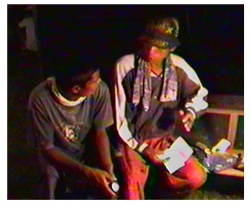 The task of rebuilding their community is now at hand and
together with sixty families, they hope to save their village from
further desolation. The task of rebuilding their community is now at hand and
together with sixty families, they hope to save their village from
further desolation.
Now a father to
four beautiful girls and a husband to an adoring wife, Lumideng is a
visionary and an optimist. He
wants to have a better tomorrow for his four daughters.
When asked about his feelings about his horrid experiences,
he just shrugs his shoulders. He
holds no grudges.
In the spirit of
bayanihan, Lumideng does his share in rebuilding his community.
Wanting to ensure a brighter future for his children and perhaps for
his grandchildren. He
is grateful of the government’s effort in introducing development
in his barangay. He
hopes that these programs like the Core Shelter Assistance Project will be a step towards a better life and a brighter future.
CSAP and CIDSS
The Core Shelter
Assistance Project (CSAP) is a Comprehensive and Integrated Delivery
of Social Services (CIDSS) implemented project aimed at addressing
the emergency housing needs of the families and communities
displaced by armed conflicts or disasters caused by nature or are
man-made.
Lumideng’s
barangay is a beneficiary of a Ps. 1.5 million CSAP-CIDSS project.
He compares CSAP as food laid before him; all he has to do is
partake of it. He
admonishes his barangay mates to take hold of the opportunity and
not wait to be spoon-fed.
His
commitment to the bayanihan and CIDSS approach has emboldened him,
as well as other sixty families in building sixty core shelters.
He recognizes that the rise of barangay Salvacion is the
salvation of his family and community.
He believes in people who help themselves.
However, in helping themselves others should also play a
role.
Convergence
Convergence in
Salvacion is very well present.
The coming together of various government resources from
various agencies is proof enough that, once again, bayanihan is
alive. 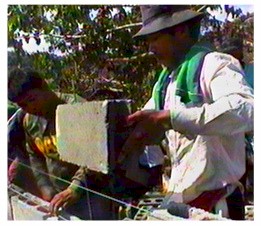
The provincial and
municipal offices of Apayao are committed to the project.
They have given their respective commitments and
counterparts. The
Department of Social Welfare and Development –CAR, for its part,
sources out the Ps 1.5 million for the project, while the provincial
government provided Ps. 300,000.00 for the road gravelling to ensure
the access going to the barangay and for the transportation of the
construction materials and aggregates.
The Armed Forces of
the Philippines (AFP) through the Philippine Army's 50th Infantry
Battalion deployed elements of its engineering brigade to assist in
the construction of the core shelters.
The Department of
Health (DOH) through the municipal health office and the Department
of Public Works and Highways (DPWH) through the municipal
engineering office will be developing a potable water system and
conduct trainings in sanitation management for the emerging community.
The Department of
Education, Culture and Sports (DECS) under the Third Elementary Education
Program (TEEP) vowed to construct a two-room, multi-grade classroom
for grades I-IV and to improve the Early Childhood Education (ECD)
program with the rehabilitation of a daycare center to be funded by
the municipal government. These
structures will make sure that the children in the community will
have access to basic education.
The municipal
government also assured the provision of technical support through
supervision and consultation during the construction phase of the
CSAP.
There are also
plans of building a rural health unit and the establishment of a
multi-purpose cooperative to be coordinated with the Department of
Health (DOH) and the Cooperative Development Authority (CDA). The community members will give labor counterparts.
The energy in the
shared spirit of the community and the government is truly
promising.
Barangay
Salvacion is now saved.
VIEW
THE PICTURES
For More Information Contact:
CIDSS-CAR
40 North Drive, Baguio City
Tel: (063) 074-442-8619
FAX: (063) 074-442-7917
E-mail: [email protected]
|




 FEATURES