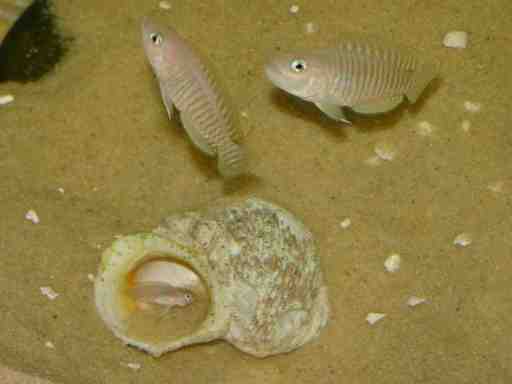
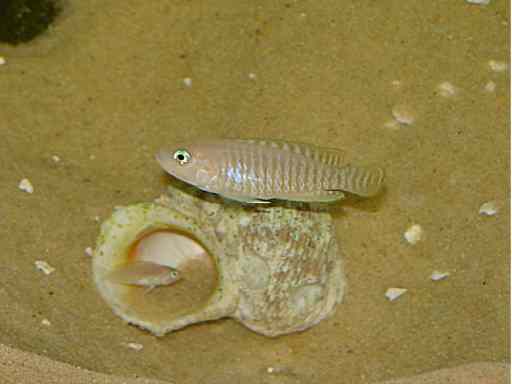
A set of four tiny half-inch fry and four empty shells were placed into a peaceful 30-gallon tank with a sandy substrate. There were no other aggressive or large fish in the tank. They immediately began living within the shells and within a few weeks, would build a pit centered around their home. By the time they were six months old and spanned an inch in size, they were defending their little shells from anyone who would enter their territory.
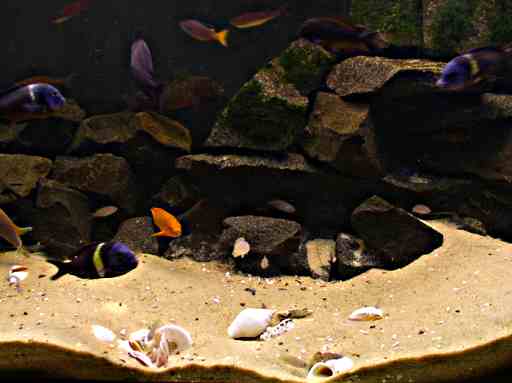
Their first brood numbered only three fry (Shown middle and lower) and they all survived. Within the next six months, the colony grew to approximately fifty individuals, with the original four fish and their children breeding prolifically. They began to overtake the tank, aggressively forcing other larger fish onto smaller areas. At this point, the entire colony was moved into a 75-gallon community tank shown above.
Only the largest individuals were able to hide within the limited number of shells provided and survive the intense predation that followed. Over time, they began rebuilding their community by excavating pits around their shells. However, their tiny pits were at the mercy of much larger fish excavating within caves or building temporary spawning pits of their own. What took a day to excavate would be destroyed with a single swoosh of a large Tropheus. In addition, neighboring L. multifasciatus can be seen randomly dumping their sand into each others territories. Over time huge amounts of sand can be shifted from one end of the aquarium to the other.
Currently the landscape within the aquarium is in a very interesting dynamic state of flux with new pits being built every week as other pits are filled in. Shells are constantly buried as new ones are exposed. Even in this hostile and ever changing environment, an occasional fry can be found amid a sea of sand and predation.