

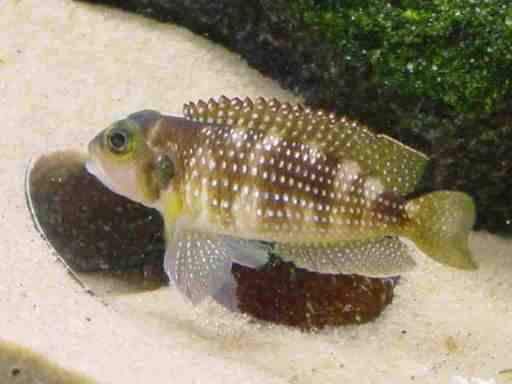
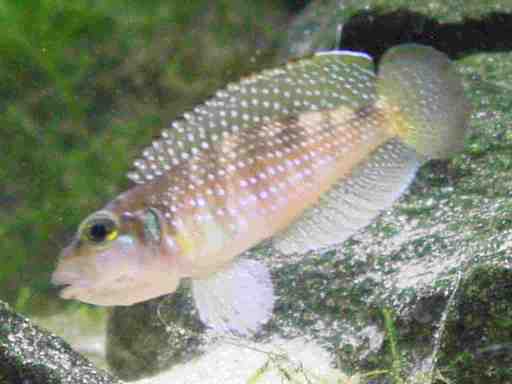
Unlike L. multifasciatus, this 1.5" shell dwelling fish, does not share its shell with others, including mates. Breeding pairs are not known with this polygamous species rather, dominant males will control a harem of females located within his territory. This female (shown upper) will not tolerate other females within her own sub-territory, including the slightly larger dominant male (shown middle with an aggressive posture), unless he is fertilizing her eggs.
A colony of 6 juveniles were placed into a 75-gallon community tank with plenty of rockwork. Almost immediately, they were attacked by Tropheus and other larger Lamprologus species, namely L. pulcher and L. cylindricus. Their immediate defensive mechanism was to dive headlong into the sandy substrate, leaving only their eyes and the upper ridge of their snout exposed. Unfortunately, the other fish found this behavior to be very interesting and would hover immediately above the buried fish and investigate by pecking. Some of the more fortunate individuals would eventually find cover within some nearby shells. However, they were under constant predatory pressure from their much larger tank mates. Eventually, the survivors were moved into a more peaceful 30-gallon tank.
A single male took residence on prime territory far to the left, leaving two females, an alpha female also on a prime territory far to the right, and a subordinate female on a marginal sub-prime rocky area in between. Only the dominant male and alpha female had shells to call their home.
During courtship, the dominant female would disappear within her shell, presumably laying eggs, while the male would rest adjacent to the shells opening, periodically releasing sperm and fanning the sperm into the shell. After the male performed his parental duties, he retuned to his own shell, abandoning the female to care for their new brood. About a week later, approximately 15 fry could be seen radiating from the shell however, whenever the new mother would enter her shell, the subordinate female would raid the nest preying on fry. Since these fish are extremely territorial, had the subordinate female owned her own prime territory, she would not have been in such close proximity to the neighboring nest and possibly both nests would have survived in harmony.

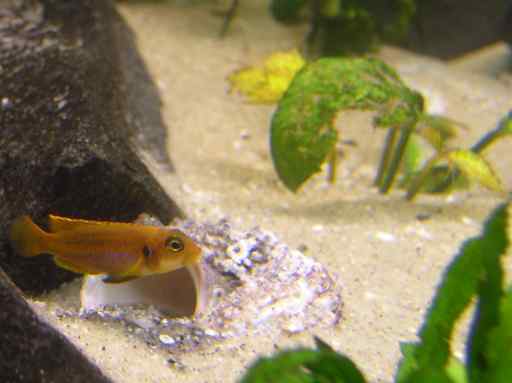
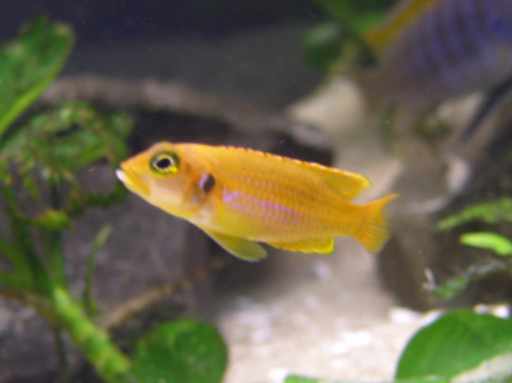
When five more unsexed juveniles L. ocellatus were added to the original monogamist pair described above, the social order reverted to polygamy. The male unearthed the buried shells and began patrolling an area approximately eighteen inches across. Over the next two months, two females had taken up residency within his territory, on opposite sides of the male's shell. Where the L. meleagris females described above failed, these two females succeeded in breeding within their own little sub-territories and were extremely tolerant of each other. The dominant male also helped in defending the area from the other males and rouge females.