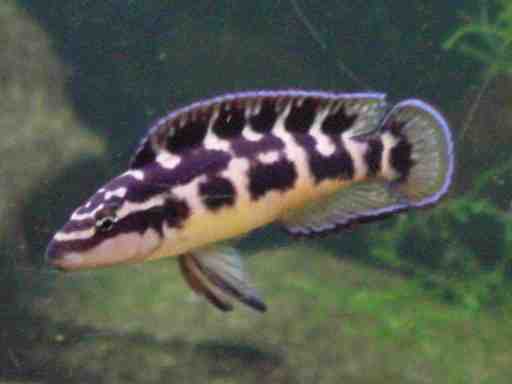
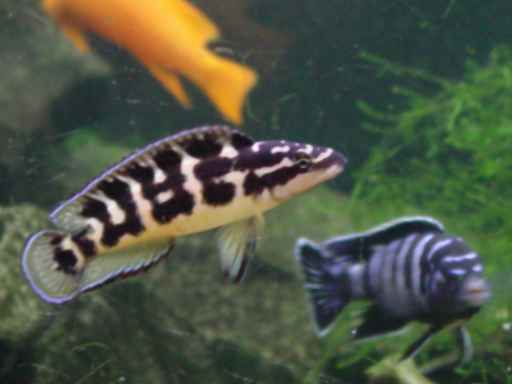
An extremely territorial and combative species, J. transcriptus will wander far and wide to combat potential intraspecific competitors to the death, in a search for possible mates. Along this vein, there is no need to start with a large colony of juveniles, when only one pair will survive. Also, mixing with other closely related species would surely mean death for the loser and should be avoided. In our case, 4 juvenile individuals were mixed into a 75-gallon community tank full of rockwork.
Once a pair has been identified, the remaining individuals should be rescued and moved. Females (shown upper) are significantly larger then males (shown middle) and can be distinguished by a thick urogenital opening, which slopes towards the posterior along the anal fin. In contrast, a male's urogenital opening is longer, thinner and slopes forward towards the anterior. As a monogamous species, J. transcriptus mate for life by forming a strong bond between mates. Once paired, they should not be separated, due to the difficulty of forming new bonds. "Married couples" just simply do not seem to accept getting remarried.
An elusive breeder, eggs are deposited along the side or ceiling of the cave. The only evidence that breeding had occurred was the sudden presence of a half dozen dark fry swimming along the ceiling and walls of the cave. As the weeks passed, there seemed to be continuous parade of fry exiting the cave. Even when a large N. leleupi invaded the cave and forced the pair out, the 3/4" juvenile seemed too difficult to evict and stayed in the immediate area. Apparently they were able to find tiny cracks to retreat to, which the N. leleupi could not access. The pair did find a new cave and the parade continued.