NEW YORK CITY's HOME GROWN AFRICAN CICHLID FISHERIES
Cyprichromis leptosoma "Utinta"
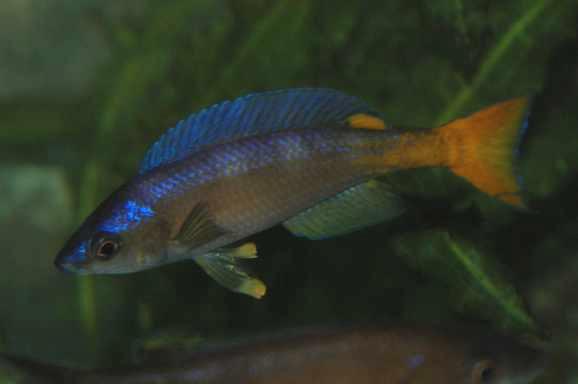
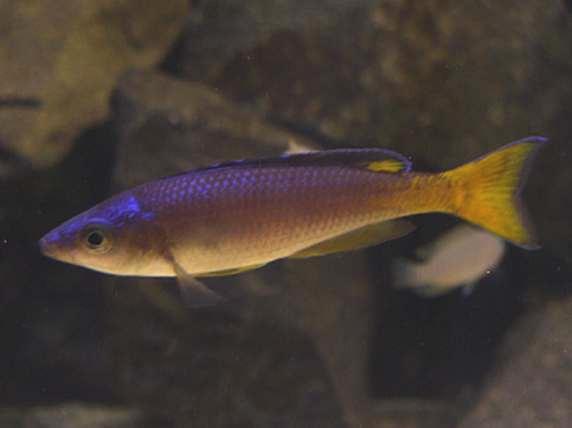
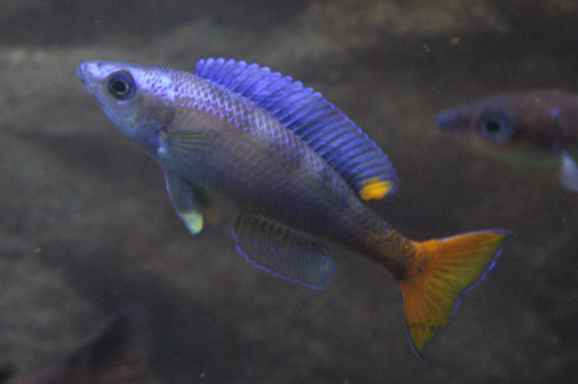
Male C. leptosoma "Utinta," either have a brightly colored orange tail or a darker blue-black tail (Not shown). In addition, the egg spot, which is usually located on the anal fin of other fish such as Tropheus, is located on the ventral fin. This egg colored tip is located directly below the genital opening, which attracts and brings mouth brooding females much closer to the genital opening than with Tropheus, thus insuring that more eggs become fertilized.  This adaptation is due to the fact that these fish are mid-water spawner and that there are no visible territorial markers to help males and females during their courtship ritual.
Another distinctive mark of the Utinta is the bright orange ocelli, which is located on the dorsal fin of the orange tail.  Blue tail males in turn display a blue ocelli (Not shown).  Finally, three broad vertical bars can be faintly seen on the body during courtship (Shown upper and middle).  At other times when the male is at rest, the body is an even tone (Shown lower).
Females in contrast are rather drab almost completely lacking in color.  As they develop from gray colored fry, females will eventually possess yellow highlights in the dorsal fin, which can only be seen under intense lighting.
The Utinta leptosoma are found along the mid-southern range of the Tanzanian coastline, from Kekese to Ulwile Island. To the north leptosomas from Bulu Point lack the ocelli, while to the south, the ocelli is less distinct and males also possess a black base along the dorsal fin.
FOR MORE INFORMATION REGARDING:
Our basic tank setups.
The ecology of the Rift Valley Lakes
About us
Homepage
Back to Cyprichromis leptosoma main page
Hosted by www.Geocities.ws

1