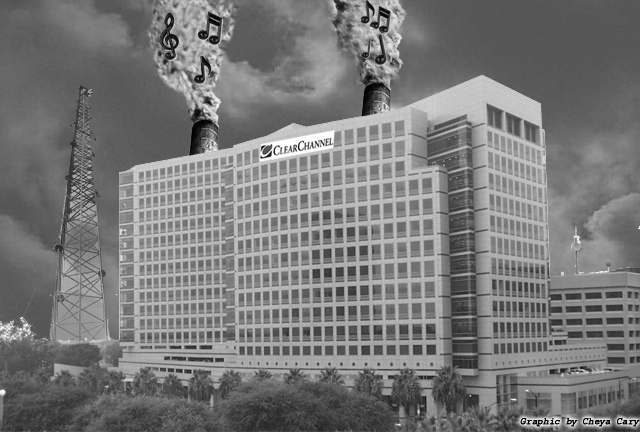
Clear Channel - A company
that single-handedly controls over 1,250 radio stations,
owning roughly 60% of all rock
programming. Clear Channel owns more than 60% of the
concert market as well. Clear Channel has about 1,000,000,000 listeners
worldwide. Yes. That’s one-sixth of the world’s entire
population. Did someone say ‘monopoly’?
In addition to owning hundreds of radio stations, Clear Channel
completely owns tours of chart-topping bands such as
Aerosmith, Madonna, U2, Janet
Jackson and N’Sync. They also exclusively book 135 live entertainment
venues, including the local Shoreline Amphitheater. But enough about
what Clear Channel has. Let’s focus on what it doesn’t
have: a soul.
Peculiarly, the bands Clear Channel doesn’t own rarely, if at all,
show up on their airwaves. The ‘No Play list’ doesn’t
end there, though. Songs deemed to have offensive material are also removed.
This seems reasonable, but Clear Channel isn’t cracking down on
profanity. Instead, Clear Channel banned over 150 songs that supposedly
referenced, you guessed it, terrorism. Among these banned songs are,
strangely enough, The Beatles “Lucy in the Sky with Diamonds” Bob
Dylan’s “Knocking on Heaven’s Door” and the Bangles
favorite, “Walk Like an Egyptian.” While a minute few of
the banned songs were overtly violent, this one was banned because they
said “Egyptian.” Egyptian, Afghani, Saudi,
Iraqi, tomayto, tomahto.
While monopolies in of themselves are
not evil incarnate, the aggressive abuse of power that often comes
with them
is. Clear
Channel pressures
artists into signing promotion deals, paying Clear
Channel to advertise their concerts. When Blink 182 put on a
concert in
Cincinnati without
first agreeing to let Clear Channel advertise it, the
band was banned from the Clear Channel-owned concert
hall. Nobody
In Particular
Presents,
a small promotions firm that has defended Blink 182
in the past, filed suit against Clear Channel for monopolistic
and
predatory
business practices. “Clear
Channel repeatedly has used its size and clout to coerce
artists to use Clear Channel to promote their concerts
or else risk losing air play
and other on-air promotional support.” says NIPP.
The Federal Communication Commission (FCC)- responsible
for moderating corporate media- and therefore Clear
Channel- is led by Michael
Powell, son of now-former Secretary of State, Colin Powell
(Nepotism? No!).
According to law, no company is allowed to own more than
five FM stations or five
AM stations in any one area. This limit is an attempt
by the government to ensure diversity of owners and programming.
Under
Powell’s leadership,
this limit has had a recurring habit of being deregulated.
Each time, this deregulation has led to a gain for Clear
Channel. This makes many
people believe that Clear Channel has strong ties
to the Bush administration. This is only further evidenced
by Clear Channel’s donations to
the Bush campaign, contributing thousands of dollars
to the platform. Clear Channel’s political action
committee donates 77% of their federal contributions
to the Republican party. According to the nonpartisan
Center for Responsive Politics, that’s a far larger
share than any other entertainment industry. On a side
note, George W. Bush sold
Clear Channel VP Tom Hicks the Texas Rangers for $15
mil.
Clear Channel’s
puppetry of the music industry can be felt locally as
well. The popular Bay Area radio station KSJO (92.3 FM)
transformed overnight into a Classical
Latin music station in an effort by Clear Channel to
look ‘diverse’.
KSJO was but one of 40 stations sold recently by Clear
Channel to be run by minorities. This seems to be a thoughtful
move, seeing as the
Latino populace in California continues to grow. There’s
just one catch, though. Clear Channel bought back the
advertising revenues to
six of the 40 stations, which gives them virtual control
over the stations they apparently sold. Make that two
catches. Latino oldies constitute
the new stations’ entire playlist. Not
all Latinos listen to Latino oldies, or Latino music
altogether. That’s like saying
all African-Americans listen to 50-Cent or all whites
listen to...eh...Vanilla
Ice.
Hey, generalization saves time, right?
[For those of us interested, there are several petitions
circulating the local area for the return of KSJO, originated
by Michael Martin, a most righteous dude. If you're interested
in
signing,
then email
Michael your name and phone number to be added to the list.]
One of Clear Channel’s strategies for homogenizing the music industry
is the practice of voice tracking. Voice tracking is when computer-generated
sound clips are broadcast to radio stations to give it that ‘local
flavor’ (ie. “Hello, Mountain View!”), when actually
the station is simulcasting a central transmission. In effect, this creates
dozens of stations across the country that have the same songs, same
DJ’s and same opinions. The only difference between them is the
fake radio personality occasionally shouting “Where’s it
at, MV?” So, when listening to Clear Channel stations, we’re
not only listening to corporately-owned, irrationally censored music,
but we’re also listening to the same channels. It’s all canned.
The point of all of this is media control. If one company owns a majority
of all radio stations, they are given the uncanny ability to filter vast
amounts of information. They can choose to ignore any negative comment
about themselves or their partners. From the sound of the accusations
against Clear Channel, they’re doing just that. Free speech isn’t
canned.
Perhaps the underlying flaw of Clear Channel is that
it is, simply, a business. As with any business,
their primary
concern
is money.
Clear Channel is most interested in playing whatever
music sells well. However,
music is not a business. Music is an art. If only
mainstream and commercialized bands are given airtime, the
depth
and diversity of the music world
would
be crippled. Rap and punk music would become the
only listening options. I can only speak for myself, but
I sure as hell
don’t
want to live in a world ruled by Good Charlotte.
---