Last
modified: 18 February 2004
SYNOPSIS OF MY RESEARCH
(Source titles are identified by journal name and volume number only. Full citations can be found in my “List of Publications” which is accessible by
going back to my Home Page.)
The first of my books, Psychology
on the Couch was in the same vein as two articles in journals (Journal of Environmental
Management 24 and Psychological Record 38). It critiqued the post-1879 programme of establishing psychology as a science (by means for example of insisting on experimental methodology) and concluded that this serves only to make brain and behaviour the exclusive foci of departments that purport to be teaching about the mind.
This was a reaction from gathering data with a view to establishing lawlike generalities about people (the “nomothetic” approach). It was impossible for me to ignore such differences as those of age and sex (two “subject
variables” often described as "demographics") and ever since I have been interested in
characterising groups and, at the limit, individuals (the “idiographic” approach). Most of my
nomothetic work has concerned either laterality or mere exposure. Descriptions of these follow, before a section on Aspects of idiographic
psychology.
1. LATERALITY
My
published work in laterality divides into four preoccupations: general theory, monaural laterality, the relation of right
speech advantage in dichotic listening to telephoning, and handedness. Descriptions follow of each of these in
turn.
(i) LATERALITY
THEORY
Laterality has already seen interest in
itself rise in the early part of the twentieth century, fall off, and then rise
rise again more steeply (since the Second World War) (International Journal of Clinical
Neuropsychology 9). My own theoretical work has centred upon the explanation of the auditory
laterality effects discovered with the invention of the stereophonic tape
recorder, though I have also had a few more general ideas.
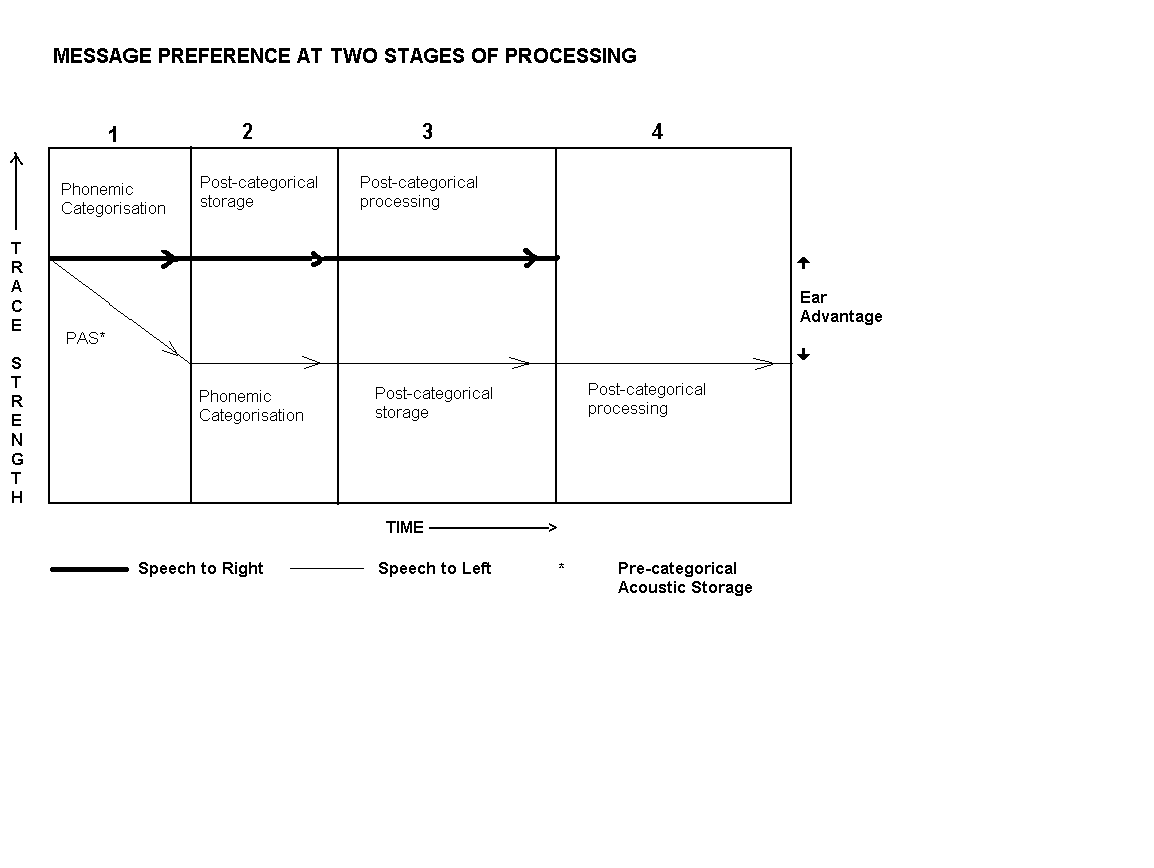
1. AUDITORY LATERALITY EFFECTS (See my article in Cognitive
Systems 1) Reviewing experimental literature on the right-sided speech
advantage (conventionally, "the right-ear advantage = REA") I formulated two broad generalisations
that seemed well supported to me:
(i) dichotic (different stimuli to the two ears
at the same time) lateral differences arise at an early stage of speech
processing, and
(ii) ear differences are much easier to show with dichotic than
monaural (one stimulus to one ear) presentation of the speech.
I have argued
that both facts can be explained with minimal assumptions about underlying
neural function, as follows.
(a)
When
listening to a syllable a "limited capacity channel" in our
perceptual system assigns each distinct part of the incoming acoustic waveform
to a particular phonetic category (e.g. /b/, /d/, /g/, /a/ etc)
(b)
the
internal trace of one of the dichotic stimuli must wait in temporary (“buffer”)
storage while the other is being assigned its constituent phonemes,
(c)
the
information in this buffer is rapidly lost, which is what causes better performance
in report of the first stimulus to be processed,
(d)
following
passage through the “phonetic categorisation” gate, traces are held in a much
more durable form and do not decay at a comparable rate when meeting any further
gates. This might be because the assigned phonetic category is part of the listener’s
internal “schemata”.
I hold this
model disposes of any necessity for the idea of "functional decussation"
originally used to explain the
experimental findings on auditory lateral advantage. I believe that idea to
be unnecesarily committal on the underlying neurophysiology (see my manuscript
abstracted in Social and Behavioral Sciences Documents 17, 43-44) though this does not, of course, mean that it will not turn out one day to be true after all.
For a
bibliography of over 200 titles in journals relevant to this model see Cortex
25.
2. MORE GENERAL IDEAS The one that I would like to single
out is that the hemispheres can be seen as a directional
mapping system (through the commissures). The homologous connections
of many of these commissural fibres can be seen as a physical basis for abstracting
concepts from structural similarity (Psychological Reports 63, Psychology 25).
This runs rather counter to the current emphasis on localisation, belonging more to the idea enduring through the (pre-)history of neuropsychology that the brain can and should be seen as an integrated whole.
(ii) MONAURAL LATERALITY
On the working model described above in (i).1, it is monaural presentation, rather than dichotic, that affords the best hope of throwing light on post-categorical processes. For, although a memory or linguistic load can be incorporated into a dichotic listening task, it is inescapable that dichotic stimuli competing for the limited-capacity phonetic categoriser will strain the perceptual system; whereas monaural tasks can place primary strain on more mnestic or lexical or post-lexical processing. I have tried hard to find “monaural ear differences”, and did discover one reported in Cortex 17, but it proved difficult to work with (Psychology 22).
Both these experiments
used accuracy (errors) as the dependent measure while there is also a substantial
literature on monaural ear differences measuring latency of response. (I once used the latency measure myself, but my collaborators in this
research drew it over towards visual rather than auditory presentation of
lateralised stimuli (Acta Psychologica 75).) The whole literature
on monaural ear differences has developed into a substantial one, though with
enthusiasm fitful (International Journal of Clinical
Neuropsychology 10).
iii)
RIGHT SPEECH ADVANTAGE AND TELEPHONING
An
important virtue of my working model is that it leaves completely open what type
of explanation to use for the direction of lateral difference. In particular, the
model will accommodate explanatory factors over and above hemispheric asymmetry
tout court. Thus I have found that
monaural habits in telephoning have an influence upon the REA, possibly through
biasing the direction of attention, but that the REA remains significant when
attention is controlled experimentally (Neuropsychologia 20). Other
environmental factors, many of them deriving from the normal tendency to prefer
the right hand, may also influence the REA. These will need to be understood
and monitored to improve the validity of using REA as a soft neurological
indicator of normal cerebral dominance. A methodological development that may
permit readier demonstration of REA is my use of group testing (subjects placed
in between loudspeakers rather than wearing headphones) – Cortex 22
319-324.
There is a vast range of manual
functions for which regular use of one hand, usually the right, can be
observed. Nevertheless my factor analysis of two commonly used reduced-set
inventories of handedness suggests there is a major factor of Handedness
accounting for a great deal of the variance in correlation matrices on the
chosen functions(Cortex 22, 325-6, International Journal of Clinical
Neuropsychology 11). I have also compared the two inventories (Edinburgh
and Annett) with respect to their utility as clinical and research tools (Neuropsychology
5). Handedness, a much older soft neurological indicator of cerebral
dominance (i.e., whether it is normal or abnormal), is positively correlated
with "telephone ear", which, as stated above, is itself correlated
with the more recent REA indicator.
I have also found evidence in support
of the teasingly recurrent reports of a small correlation between handedness
and cognitive attainment (measured by scholastic performance in my study in the
Journal of Genetic Psychology). This sort of correlation is often cited
as a parallel to the different aphasiological patterns of left-handed and
right-handed brain-damaged patients often reported by studies comparing them.
It was Robert B Zajonc, who has
combined neuropsychological interests with a leaning towards experimental
social psychology, who revived interest
in the 1960s in the everyday observation that people or objects you come across
on a regular basis can "grow on you". One everyday illustration of this
“mere exposure” phenomenon is in commercial advertising, where the deployment of
sheer repetition in screening television ads and the graphic displays on
prominent billboards in population centres where individuals see them many
times are intended to create favourable attitudes to brands. Another such
illustration is the documented advantage of incumbents and of easily-recognised
celebrities in elections.
To provide evidence for a causal relation
between familiarity and liking, Zajonc conducted experiments. With stimuli
completely new to his subjects, he varied the amount of repetition. He
confirmed that, as the number of previous exposures to a particular stimulus
increases from zero, so reported liking for the stimulus also increases. Other
researchers were more interested in everyday stimuli such as names or snatches
of music, and turned back therefore to essentially correlational work. They
reported that such stimuli evoke both an "exposure effect" and beyond
a certain degree of familiarity an overexposure effect of decreased liking.
My own research has shown that the
combined exposure/overexposure effect (i.e., an inverted-U cartesian function
connecting familiarity and liking) is both large and easily replicable, with a
different sort of stimulus (landscapes) from those previously studied (Journal
of Environmental Management 21). I have also applied the advantages
conferred by inexpensive microprocessors offering "do-loops" to the
Zajonc-type experiment. Using these machines, that do not tire or vary, I have
readily elicited the inverted-U function from subjects with
experimentally-controlled familiarity. Repetition was carried on far beyond the
maximum frequency used by Zajonc. The effect depends upon the type of stimulus
(nonsense speech shows it but not abstract computer graphics images). This may
be due to differences in the ease with which these are learned. (Current
Psychology 6, Social and Behavioral Sciences Documents 16)
Undergraduate
projects that I have supervised found that brain damage from stroke reduces the
exposure effects. Furthermore, amnesia is likely to influence exposure effects
(Neuropsychology 4).
3.
ASPECTS OF IDIOGRAPHIC PSYCHOLOGY
My interest in left- and right-handers could already be said
to concern group differences and so be idiographic. It originates in neurology,
and my belief that there is often a psychiatric overlay to neurological
problems has led me to write a book called Environment and Mental Health.
This argues that there is a cognitive bias towards mistakenly attributing
mental disturbance to biological factors, and so neglecting possibly much more
significant factors to do with the environment. Thus the urban/rural
distinction is relevant to mental disturbance and this distinction was the
focus of an article in Journal of Environmental Management 31, which
used a sample of schoolchildren in Northern Ireland. A major group difference
in Northern Ireland is between Protestant and Catholic, which was the focus of my
articles in International Journal of Group Tensions 20 and Studies in
Education 6. Finally, my interest in mental disturbance has also led me to
an interest in “conceptual systems” which was the topic of my note in Personality
and Individual Differences 6.