Introduction to Eastern Orthodoxy
Where are the Orthodox?
The Orthodox churches of the world comprise 25% of all of Christianity. The reason why they are largely unknown by American Protestants is because the vast majority of them are in former Eastern bloc countries. By far the country with the most Orthodox Christians is Russia, with somewhere around 100-150 million. By contrast, the 2nd largest country with an Orthodox concentration is Romania, with 23 million. The Orthodox Church is very much concentrated in countries such as Russia, Romania, Greece, Serbia, Bulgaria, etc.
Where did the Orthodox Church come from?
Actually, the Orthodox claim to be the oldest Christian Church in existence. During one of my visits to an Orthodox Church I saw a popular bumper sticker that read: "The Orthodox Church - in existence since 33 A.D."
As you probably already know, there aren't a lot of Orthodox Christians in America. And they do not have a high profile within Protestant Christianity. This is because the geographical center of Orthodox Christianity for a millennium has been in Constantinope, now Istanbul, Turkey. Less than 100 years before the Protestant Reformation, Constantinople was taken captive by the Turks, and became a Muslim country. Turkey has been a Muslim country ever since. So while the Protestants were breaking free of Roman Catholicism, they paid little attention to the Orthodox in the East, and the Orthodox were too busy with their own problems to worry about the Protestant Reformation and westward expansion. Therefore, its only been in the last 100 years or so that there has been any kind of presence felt by the Orthodox here in America.
Orthodox worship
Here are a few things that are unique to Orthodoxy that you should expect to see if you visited one of their worship services:
1. A sense of holiness
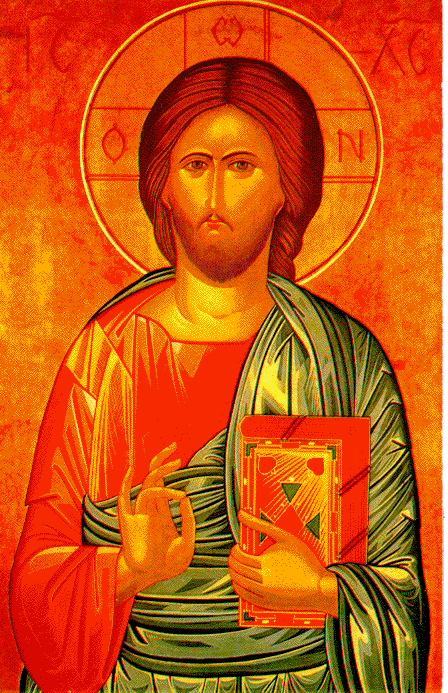
Here is how one brochure puts this. The purpose of Orthodox worship is to bring the people closer to God. People are created with bodies. Therefore Orthodox worship is intended to be exerienced with all of the senses. So they have colorful icons in their services (sight), incense is strong (smell), they celebrate the Lord's Supper during every service (taste), there is a sermon (hearing), and the people kiss things (touching). More on the kissing part later. But all of this does in fact lead to a sense of holiness in the air during an Orthodox worship service.
2. Stand up, stand up for Jesus
In one of the services that I attended, we stood for about 3/4 of the 3 hours that we were there. We got started about 9:00am, and finished up around noon. The only times we sat were during the 10 minute homily, and during the Eucharist.
A name that you need to know in regards to Orthodoxy is St. John Chrysostom. He was the bishop of the church in Constantinople in the late 4th/early 5th century. He wrote a liturgy that is still the basic liturgy of many Orthodox churches today. In his time, it was not unusual for services to last 5 hours, and for the congregation to stand the entire time.
3. The sign of the cross
The Orthodox people make the sign of the cross frequently in worship. They touch the forehead, chest, right shoulder, then left shoulder to end over the heart. It's the opposite of the Catholic sign of the cross. The hands are held in a certain way while doing the sign. The thumb and first 2 fingertips are pressed together, with the last 2 fingers pressed down to the palm. The 3 fingers held together are symbolic of the Trinity. The 2 fingers against the palm are symbolic of the 2 natures of Christ.
4. No kneeling
Unlike in Catholic worship, the Orthodox do not kneel. They do sometimes prostrate themselves, but not in every service.
5. Kissing
It's very common for Orthodox worshippers to kiss the icons when entering the church. Some even kiss the chalice, the priest's vestments, the priest's hand, and everyone kisses the cross at the end of the service.
Also, people sometimes greet each other with a kiss, but in American churches this is not always the case. They do greet each other with the words "Christ is in our midst", and respond with "He is and shall be."
6. The bread of the Eucharist
The Orthodox do close off communion to nonmembers, although they are encouraged to eat some of the bread. This was my experience at St. Ignatius Orthodox Church in Franklin. We had decided not to eat any of the bread, but one of the deacons actually brought it to us so that we could be included. He knew that we were students at Belmont, and were already believers at Protestant churches.
7. Confession
Like Catholicism, the Orthodox Christian is expected to make regular private confession to the Lord in the presence of a priest. The Orthodox pastors are allowed, and even encouraged, to marry. But during the service there is no general confession of sin. It is expected that the private confession throughout the week will suffice.
8. Music
About 75% of the service is singing. The singing is usually a cappella, although they are not dogmatic about this. Some churches do have organs.
Also, the entire liturgy is sung. Even the spoken parts are sung. The liturgy actually feels like one long song. For newcomers, it can be difficult to keep up with the liturgy, but for regulars it is pretty much the same order every week.
9. Mary
Similar to Catholicism, the Orthodox have a special reverance for Mary. She is referred to during the service as "Theotokos", which means Mother of God. They do ask Mary to pray for them, as they do other saints as well. The belief is that the saints are not dead, they are just "departed to the other side". The icons serve as reminders of the saints who join with us in our worship.
10. The 3 doors
Behind the alter the Church will have an iconostasis (icon-stand), that will include 1 icon of the Virgin and Child, and 1 icon of Christ. This creates 3 doors. The central door is the Royal Door, where only the priests and deacons carrying the Eucharist are allowed to come through. The side doors are "Deacon's Doors" where altar boys and others enter and exit.