The
Pakbeh Regional Economy Project
The
Pakbeh Regional Economy Project
Chunchucmil, Yucatan, Mexico.
Background and Basic Research Goals
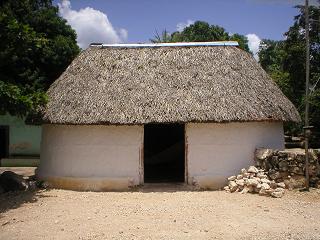
Today, the Chunchucmil region contains a number of smaller villages inhabited by descendants of the ancient Maya. This part of Yucatan has poor farm land, and it is difficult for even the low populations of today to make a living from traditional slash-and-burn agriculture. So Pakbeh project members seek, in part, to understand how such a large ancient population could have not only survived, but apparently thrived in this region. This has led us to explore alternative means of subsistence, such as commerce, exploitation of resources in the seasonally inundated savannah to the west, and harvesting of salt from coastal salt beds to the northwest.
PREP's other most basic goals include documenting the chronology of occupation and the extent of the site in its different eras of settlement. We have determined that the site had a small occupation during the end of the Middle Preclassic Period (approximately 500 B.C. to 200 B.C.) which continued until the Early Classic Period, at which point the site grew to its largest extent, covering at least 25 square kilometers of dense urban settlement. If one were to include the less densely settled periphery, the size of the Early Classic city leaps to over 64 square kilometers.
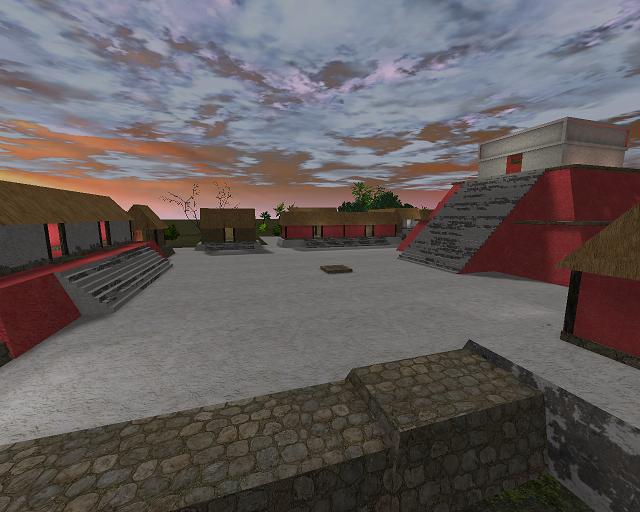
During its Early Classic zenith, the center of Chunchucmil consisted of a series of monumental architectural complexes called quadrangles. Quadrangles are composed of a large patio with a tall (approximately 10 m high) temple on one side and lower range structures on each of the other three sides. The quadrangles were connected to each other by a series of raised stone avenues called "sacbes". Though the quandrangle with the largest temple also has the site's only ballcourt, there is no single architectural complex that dominates the site center. The lack of a dominant complex and the absence of preserved stone carvings documenting dynastic histories has led us to infer that rulership at Chunchucmil was different from its Classic period neighbors.
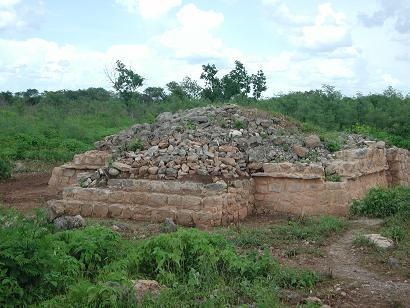
The residential areas of Chunchucmil during the Early Classic Period consist of distinctive settlement units called albarrada groups. These groups usually contain a small patio (occasionally two or three) around which houses, a shrine, and auxiliary structures (storage rooms, kitchens) cluster. The buildings, patio, and additional open space for gardening and other activities are "fenced" in by low stone walls called albarradas. Intensive excavations within a small sample of albarrada groups have determined that multiple, closely related families occupy these albarrada groups. Research within albarrada groups has also focused on daily life and the creation of individual and social identity.
Systematic mapping, combined with test pitting in a large sample of albarrada groups and quadrangles has sought to document differences among and between quadrangles and albarrada groups. Such differences include ethnicity, control of labor, access to rare goods, and access to arable land and other resources on the landscape.
In the Late-Terminal
Classic period, Chunchucmil's population declined and the quadrangles
were abandoned. In place of the albarrada groups, a new form of settlement
appeared, consisting of broad platforms approximately 1 m or more in
height. The chronology of abandonment of the site is not securely known
at this point, though the remains of a defensive barricade in the site
center has led project members to suggest that the remaining inhabitants
of the site in the Terminal Classic Period were conquered and dispersed,
perhaps by armies from Chichén Itzá.