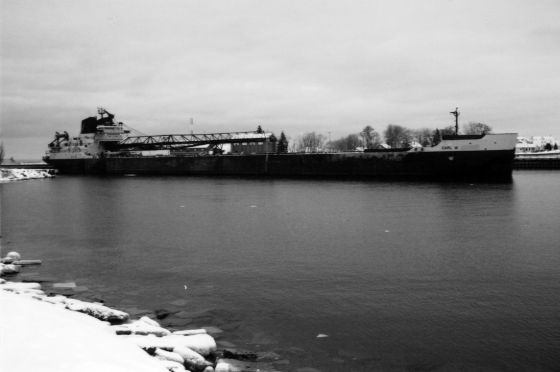
Freighter Earl W (Oglebay) Entering Manistee Harbor
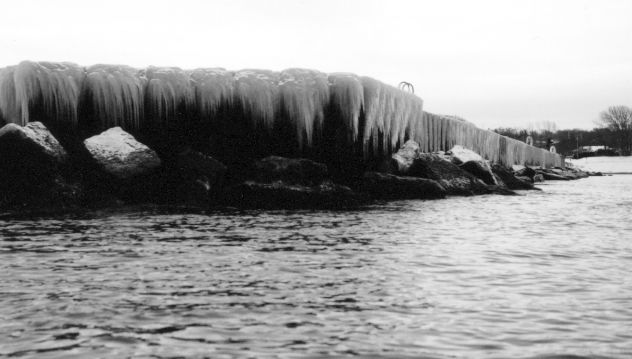
South Pier Ice
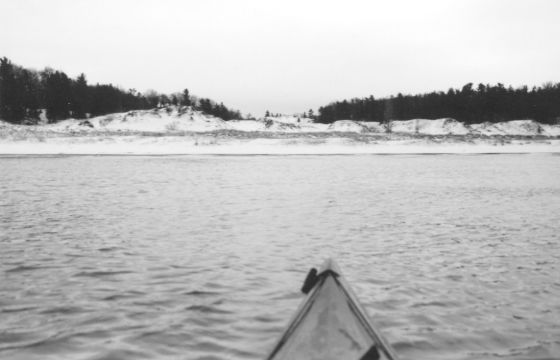
Snowy Nordhouse Dunes
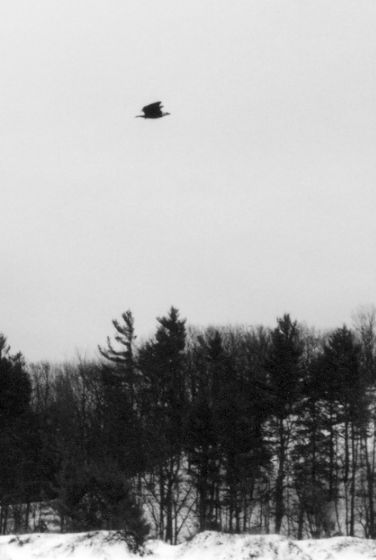
Bald Eagle
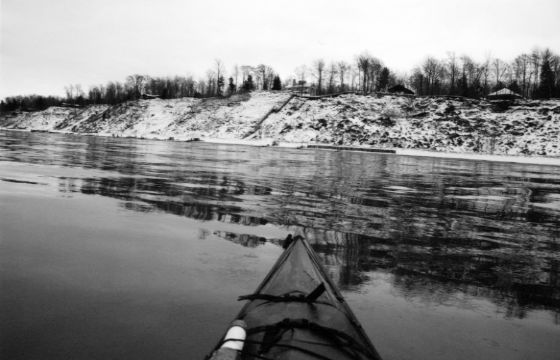
Icy Skim on the Water
December 9, 2007 - With the Lake Michigan weather station buoys removed for the winter, wave height information must be inferred using the wind gauge at Manistee's Blacker Airport. The night before, a few solid hours of calm wind bode well. Rising at 5am, I found the trend continued thro' the night allowing the waves to subside. It is very unusual this time of year for calm wind and waves to continue throughout the day and afford good paddling. Even a moderate wind will carry freezing spray up onto a wetsuit and soak or freeze any insulative layers pulled over it. Ideally, insulation should be under a baggy drysuit.
I arrived in Manistee before 9am and parked near the boat ramp just inside the harbor. A river-class freighter, the Earl W, was just entering the harbor probably to deliver coal to the many industrial plants on Manistee Lake. Thick black diesel smoke issued up and hung in the cold still air as the Earl W shimmied around the tight riverbend occasionally pumping its engines as the propeller boiled water up three feet high against its rudder.
Would the lake outside the harbor be calm? An earlier attempt to finish this last 12-mile segment of shoreline in the greater span from Pentwater to Grand Traverse Point suffered abandonment due to waves. A dubious consolation was paddling thro' the vibrant picture postcard Victorian city of Manistee and touring the paradoxical lake beyond.
Manistee Lake is truly an industrial amusement park with nary a residential home along seven miles of shoreline. Instead, two salt brine plants sit next to large coal piles to feed their boilers. Outfalls splash process water into the lake. An additional brine plant shutdown a few years ago due to international competition and during demolition earlier this year suffered a fire which melted away siding exposing its burned out steel skeleton as a sad testament to the ravaging world market and how in many ways US workers now compete against pre-Dickensian societies for customer orders. A worker in a cherry picker high up against another building near the onshore sewage treatment plant assessed wind damage to siding peeled off during a fall storm which spawned tornadoes across northern Michigan. A blue engine traveled from factory to factory switching boxcars and tankers around railroad tracks which circle nearly the entire shoreline. Bobbing in the middle of the lake is rather like standing in the basement surrounded by a tabletop HO railroad set as the blue engine can be seen miles down the lake inching along thro' coal yards and factories, disappearing from view periodically only to return chugging pass wetlands on the opposite shore. A large steam cloud with a sulphurous tinge rises from a paper mill. Next door a foundry sits quietly, and across the lake pressure relief valves pop and hiss at a third brine plant. The lake bottom holds a cocktail of petrochemicals, metals, and organic acid. Nonchalantly digging a paddle blade into the sediment produces chunks of coal and a disappointing oily sheen.A few slabs of ice from Manistee Lake, broken up by passing freighters, drifted in the harbor. Round half-foot waves from the north allowed easy passage while the wind drew very lightly from the southeast onshore. The temperature was near 20F and a solid gray shroud held off the sun. Areas of high bluff with trees shadowed the wind nearshore to a breath allowing ice crystals to form a skin upon the water which was fractured into one-foot square pieces. Thankfully, there was not enough ice to impede progress. Most lakeshore cottages looked closed up and lifeless. The shore was covered by a thin crusty coat of snow. The only residents seen were a couple walking two playful dogs on the beach. The lake was quiet with not a single boat all day. The city had stopped plowing the snow from the boat ramp some time ago, and the docks were pulled from the water.
Many goldeneyes and seagulls paddled and flew around during the day. It was a pleasant surprise to see four or five bald eagles, more than has been seen during long summer paddles on Lake Michigan. Winter brings Canadian eagles down to Michigan's open waters where they can continue fishing. The eagles are usually noticed soaring in and alighting in birch and tall white pines atop the bluff or in back of the shore to better survey the lake. Low waves let eagles see fish more easily. One eagle stood majestically on the snowy shore.
I suppose most sensible touring paddlers launch trips from major towns and paddle miles along the foresaken shoreline before turning back for the car and later perhaps a meal, but nothing says civilized savage quite like launching a trip from the boondocks, paddling miles into a harbor town, pulling the yak up onto the waterfront, and seeking out fine dining opportunities downtown. I did the shoreline between Manistee and Frankfort just that way by launching two trips from the public boat ramp off Bay View Road on the north side of Portage Lake. In Manistee, the best place downtown to pull out is pass the thousand yards of high docks and yacht berths until just west of the US31 drawbridge. On the south side of the river there is some open riprap for a paddler to clamor out onto just pass the last dock, which was put in this year and is somewhat lower than the rest. Conveniently, across the waterfront alley are steps going up to the outdoor deck of the Tuscan Grill restaurant which has live music Saturday nights, but there are other establishments within a short walk. The Frankfort trip was actually an overnighter because of the 20-mile distance from Portage Lake. I had to paddle pass all the yacht berths on Frankfort's waterfront to find some riprap to climb out on and slid the yak out of sight just under the boardwalk. One might overnight at the cushy local B&B, but I hit the water after supper and pulled out at nightfall seven miles south of town below a high bluff the locals call "Old Baldy," which is part of the little-known 3-mile long Coastal Preserve owned by the Grand Traverse Regional Land Conservancy. It is a peaceful place to sack out overnight on the beach next to the yak around late summer after the Piping Plovers finish nesting.Ice gradually built on the kayak rigging and hull but remained at a safe thinness. The rudder cables were thick with ice and would have rendered the rudder useless for steerage had it been deployed. Ice fused the rudder deployment line to the hull. Rounding a small point midway between Manistee and the Nordhouse Dunes Wilderness Area, the top of the lighthouse at Big Sable Point can be seen with aid over the most distant shore. Cold entering my immobile feet and legs causes me to question whether I can complete this segment, but the sight of my destination brews renewed determination. A few swigs of hot coffee and the paddling resumes. The only moment suffering a wave onto the sprayskirt was on the sandbar which are doubly shallow now that Lake Michigan is near a record low water level due mainly to drought. Low water seems also to have reburied the once protruding remains of a small wooden shipwreck along the Nordhouse Dunes Wilderness Area just south of where the trail from the Nurnberg Road trailhead comes out to the lakeshore. This is as far north as I have paddled launching from Ludington State Park.