| SUBWOOFER 101 & DO YOU NEED ONE? |
| For deep bass, DVDs have a separate LFE (low frequency effects, the .1 in 5.1) track included among the other five tracks, and a 5.1 receiver has a subwoofer "pre-out" that utilizes a powered subwoofer for this sixth track. Bass Management: While selecting speaker settings on most A/V receivers, choosing the "NO" or "OFF" for the subwoofer will distribute LFE (low frequency effects) from the .1 track throughout the remaining five speakers assuming the rest of the speakers are set to "LARGE". Recomended Setting: You may switch individual speaker sizes to compensate for bass distribution. For example, I have my center and rear channels set to "SMALL" and my mains are set to "LARGE" with the Sub set to "NO." Therefore, sound below 80Hz (the LF cut-off in my receiver) is produced by my main speakers only while frequencies below 80Hz roll-off quickly for the other speakers. This setting is optimal because my rears and center aren't desgned to handle such low bass. With the addition of a subwoofer, I now have all my speakers set to small and the sub handling all the bass. Of course, experimentation with settings is the best way to get the most smooth and clear bass. Updated: 10.21.01 The Importance Of A Subwoofer: Subwoofers are much more versatile than speakers connected to an amplifier. Powered subwoofers have a built in amplifier and frequency cutoff controls. For example, you can "cutoff" the bass so that only sound under 50Hz goes to the subwoofer instead of using the receiver's built-in cuttoff frequency. 50Hz is just an example...cutoff ranges on subwoofers are typically between 40Hz-140Hz (also know as the continuously variable frequency). A subwoofer's built-in amplifier is usually more powerful than the receiver thereby allowing the huge bass driver to work with more efficiency and punch. I once read that you are supposed to use 2-3 subwoofers since movie theaters are equipped with monsterous bass systems and bass is so hard to produce accurately. While this is a good idea for large rooms, one subwoofer is fine for small-medium sized rooms (15x15, 10x12,...). Subwoofer Placement: Since bass is nearly directionless, you will find that placing a sub in a room will sound best in a specific area. The best way to find a suitable position is to experiment with locations even if it means spending a day crawling on the floor pin-pointing the best sound. Subs are typically in corners or next to main speakers. What To Look For In A Sub: Human hearing capacity is limited from about 20Hz to 20,000Hz where the low end is bass, and the upper end is high frequency sound. When purchasing a subwoofer you'll notice the "frequency response" spec. A good subwoofer will have a freq. range of about 20Hz-200Hz. Although a subwoofer might claim to go as low as 20Hz, it may have been measured at low volumes. In other words, one company's sub might produce continuous 20Hz bass at 65dB (decibels) while another produces 20Hz bass at 75dB. A subwoofer's capabilities depends on the amplifier's power and the enclosure design. The best way to find the perfect subwoofer is to audition various models at the store or at home. Popular Models From $400-$600 MSRP: Velodyne CT-100 $500 Velodyne CT-120 $600 HSU Research TN1220HO $450 (Amp required) Klipsch KSW-12 $600 Paradigm PS-1200 $600 SVS 25-31CS $380 (Amp Required) **KUDOS TO SONY'S SA-WM40 12" Sub...$250, check it out** |

|
| Copyright 2001, 2002 |
 |
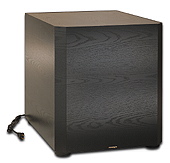 |
| Velodyne CT-120 |
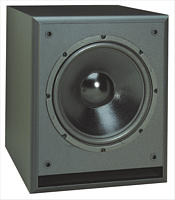
| Paradigm PS-1200 |
 |
|
|