NOTE: On October 26 geocities will be shutting down their free hosting service and this web site will be moving. Please check back here on October 1 to find out the the new location.
UPDATE: This Web Site has moved. The home page for the new site is located at: http://sites.google.com/site/chs4o8pt
You can reach this page on the new site by clicking on the correct link in the Table of Contents.
If You Don't Believe In Spirits Or The Afterlife, Start Here:If you've never investigated the scientific evidence, proving the existence of spirits and the afterlife you might be surprised to learn how much solid evidence there is. There was sufficient evidence reported by highly reputable scientists for afterlife research to have been accepted by mainstream science as long ago as 1922. It is very easy to read a brief description of the evidence for the paranormal and dismiss it by assuming some normal explanation. However, if you put in the time and effort to learn more, you will find that there have been many careful investigations that rule out the conventional explanations. A good way to learn more about this evidence is to look at these free e-books and other sources of information:
Table of Contents |
Otherwise, Start Here:This book is a practical guide to spiritual development. It explains how to develop yourself in ways that will benefit you in the afterlife. It describes things you can do that will help you to develop spiritually, including how to become a spiritual worker and attract guides to help you in that work. There are chapters that will show you how to do spiritual healing, how to communicate with your spirit guides and other spirits. Theoretical information needed to understand the purpose and mechanism of these practices is also provided. Wherever possible, common sense, empirical, or scientific explanations are provided rather than mystical explanations or references to ancient lore. There are numerous references to additional sources of information including many free e-books and news articles on the internet. There are also links to Blogs and Discussion Forums where you can meet other people with similar interests and discuss any aspect of spirituality, spiritual healing, the afterlife, and parapsychology. Scroll down to see the Table of Contents |
Table of Contents | (View Each Chapter on a Separate Page ) |
|
This book explains methods by which anyone may develop their psychic abilities, but more importantly it also explains how the ordinary person without highly developed psychic abilities can become a spiritual worker. You don't have to be a professional medium to work with spirits. Some spiritual teachers, Spiritualist churches, and books on spirituality do not explain this fact. Among people in the general population, there is a wide range of levels to which psychic abilities are developed. There are many different ways a person can work with spirits and each of these requires a different level of psychic ability. It is not well understood and not often discussed, but many of these ways of working with spirits require little or no psychic ability at all. By focusing on tasks that require highly developed psychic abilities, such as a psychic medium giving readings to other people, the teaching of tasks that require little psychic ability are neglected, and the vast majority of the general population remains ignorant of the many, many opportunities for them to work with spirits. There is no need for the ordinary person to remain ignorant of this fact. Spiritual healing and spirit rescue can be done without any overt psychic ability. Communicating with spirit guides can be done by most people who make the effort and who may not realize they have any psychic ability at all. This information is not well understood and it is a goal of this book to show you that working with spirits is for everyone. If this information were known by the general public, the number of spiritual workers and the amount of spiritual work accomplished would increase substantially. Because most people do not understand they have the capacity to do spiritual work, there are relatively few people involved in that work. Increasing the number of spiritual workers and the amount of spiritual work accomplished would have many benefits for all people, those on earth and those in the afterlife. |
You may contact the author at yol9qjps at gmail dot com
|
This book has a lot of information, so it is important for the reader to understand which chapters are most important. The most important chapters in order of importance are:
|
Spiritual DevelopmentWhat does it means to be spiritual or spiritually developed? There are three aspects to spiritual development: skills, beliefs, and evolution.
Start of Chapter
Therefore, humility is the sign of a highly evolved soul. One should look for this characteristic when seeking a spiritual teacher. For humans living on earth, spiritual evolution is the most important aspect of spiritual development. This is because in the afterlife you will have spiritual skills. In fact, spiritual skills will be the only skills you will have at that point. Also, in the afterlife, you will have the right beliefs because you will be able to see for yourself what the afterlife is like. However, unless you use your time on earth correctly and learn to love and to eliminate selfishness, you will not have that ability when you move into the afterlife. While the great religions of the world teach that developing love for others is the primary objective of spiritual development, it is not enough to say this without some instruction on how to develop love. Our biological nature puts up many obstacles against love. People hear the beautiful words of the great teachers and then find that it is impossible to live according to their beliefs. This damages people psychologically and brings disrepute to preachers and followers alike. Therefore it is important for humankind to have an explanation of how to develop love. Love arises spontaneously when hatred and anger and other forms of selfish and negative thought are absent. The way to eliminate selfishness through meditation can be found in the page on meditation. If you practice meditation daily, then gradually over the years, without straining to be perfect, you will become less and less self centered and a natural love for others will arise within you. The chapter on Short Topics has more On The Purpose of Life. For more information on spiritual beliefs see the page on The Principles of Spiritualism . Start of Chapter
A person's beliefs have a strong influence on his ability to develop spiritual skills. If he is skeptical and continually attributes anomalous experiences to coincidence and "natural explanations", he will weaken his abilities through negative reinforcement. This will also discourage spirit guides that may be trying to help him. Each person is born having spiritual skills, but our societal attitudes result, in this way, in most people losing awareness of their natural abilities as they mature. Therefore it is necessary to undo the effects of living in an unbelieving society. To develop spiritual skills, a person must be accepting of the phenomena and must continually look for spiritual influence in his life in the form of coincidences, hunches, and other unusual phenomena. In this way he will increase his awareness of spiritual influence in his life and notice more and more the activity of his spiritual skills. This positive feedback will lead to improvement and enhancement of his spiritual skills. Therefore it is necessary to err on the side of credulity rather than skepticism. There is the risk of incorrectly attributing coincidence to spiritual influence, however this risk must be borne. One must always maintain an awareness of this risk and never take rash or unwise actions based on supposed spiritual influence and never allow belief in infallibility to take hold. The regular practice of meditation and relaxation is also helpful in the development of spiritual skills. These practices calm the mind and allow one to notice subtle thoughts, impressions, and sensations that may be associated with spiritual phenomena. |
|
Preliminary Experiences Spiritualist Church Spiritual Healing Concluding Remarks IntroductionI thought it might interest you to read about some of my experiences learning mediumship at a Spiritualist church. Since I've learned through a systematic process, it seems to me that anyone could do the same thing. This is different from a lot of what has been written on the subject which is usually about people who are very psychic to begin with. I think it's important for people to understand that these abilities are natural and anyone can learn to develop their innate abilities. Also, many people who are strongly psychic feel "different" from others. They might find it a relief to meet people with the same abilities and also rewarding to find meaning and a purpose in their gift by using it to help others through a Spiritualist church. (I'm not trying to push religion or church attendance on anyone, I just have had some different types of experiences than what I've read about and I think other people might find them interesting and helpful to read.) I should probably start with some odd coincidences I experienced which made me want to learn about psychic phenomena and eventually led me to a Spiritualist church for that reason... Preliminary ExperiencesOnce, when I was living in an apartment building, I was going downstairs to take the garbage out to the dumpster and I absentmindedly went all the way down to the basement instead of going outside. (I never did that before or after that one time.) As I realized my mistake, I looked up and saw someone come out of his basement apartment. He looked at me with a worried expression and asked if I knew how to turn off the water. His bathtub faucet was broken and would not shut off and the tub was about to overflow. I was able to show him an access panel with shut-off valves - all the apartments were similar and I knew from my own apartment where they would be in his. Another time, when I was having problems with my job, I began to take long walks over to the next town. I like to take walks for exercise but these were unsually long and at the time I didn't know why I was going so far. After a few days of this I saw on a poster that the other town was going to have a fair with booths for community organizations to raise money. I had been living in that area for ten years and had not gone to any of the local events like that before (or after) but I decided to walk all the way over for that one. When the day came around and I went there, I wandered around for a while and then sat down on a bench. After a few minutes, I looked up and noticed a gap in the crowd on the sidewalk. Alone, in the middle of that gap was someone wearing a bright yellow sports coat. I thought to myself, "Who's that in the yellow jacket? Wait, that's ...." It was someone who I used to work for who was dressed like that because of the fair. I said, "Hi" as he got near and during the ensuing conversation I mentioned that I was thinking of changing jobs. He had an opening and I went to work for him shortly thereafter. At one point, after many coincidences like those above, I started wondering what was going on and tried looking on the internet for information on psychic abilities. I saw a local psychic was having a book signing at a bookstore in my area. I�m mostly a homebody so I normally wouldn't have gone to the signing especially since it was in a town I'd never been to. However, when I checked the map, I saw it was right next to a town I was going to on the same day to have lunch with a friend. The bookstore was just down the road from the restaurant. That's an interesting coincidence but I also unexpectedly received a gift card for that bookstore a few days before the signing. I have never had a gift card for that store before or since. I went to the signing, bought the book with the gift card, and afterwards I asked the author how one can develop their psychic abilities. The author recommended a Spiritualist church near where I lived that had classes. I started going to the Spiritualist church and I took classes there. Spiritualist ChurchThe first time I tried to do mediumship in class I was astonished with the results. I did exactly what the teacher said and it seemed to work. After a short period of meditation, I looked around the class (we were sitting with the chairs in a circle) and when I got to one particular person it seemed like I was looking at him through a zoom lens. He stood out from the other students in my field of vision. I tried looking around again and the same thing happened when I got to him. Then I closed my eyes and in my mind's eye there appeared a tall man in a uniform. When my turn came to describe my experiences, this person said that his grandfather had been tall and wore a uniform on his job. The teacher of the class encouraged me to try to get more information and I tried again and saw a scene of the sea shore. It turned out the grandfather had also lived near the water. I had never experienced anything like this before in my life. I was in shock for a couple of days afterwards. As the classes continued I had many other experiences. Once I gave a reading to a woman in the class and I saw, in my mind's eye, her and another woman sitting drinking coffee. I described what I saw but she said there was more than one person who fit the description. Then I saw the other woman smoking a cigarette and there were very unusual little square framed pictures on the wall behind them. With that information the other student knew exactly who the spirit was. Once, early in the morning I was lying in bed at home and the image of a woman popped into my head. I saw her in profile and she had a very distinctive profile because of the shape of her nose. I had never seen her before, but later that day, this woman (living, not a spirit this time) with the distinctive profile showed up at church for the first time. It was shortly after I had started going there and we ended up in many of the same classes and became good friends. Another time I was at home lying in bed awake very early in the morning, and the image of a man appeared in my mind's eye. I somehow knew he had been a veteran. At the same time, I thought of something I had read the day before and understood it in a new way. It was the Sunday of Memorial Day weekend and that insight would have made a great Memorial Day talk at church. However, I wasn't planning to give a talk during the service. After the service, though, there was a mediumship class. When I took my turn in class I started to give a reading to a woman, and the image of the man came into my mind's eye again. I described him and she recognized him as her father who was also a veteran. I explained that I had a message from him for the group and I spoke about the insight I had already received from the spirit. The woman said that that it was characteristic of the type of messages her father gave through other mediums. In another reading I brought through a family member of a woman in the class and I saw a church, a fishing pier, and a box truck. It turned out the spirit was a deacon at the church, they used to go fishing at the pier, and he drove one of those larger square shaped ambulances. Sometimes the mistakes are the most convincing part of a reading. Once during a reading I saw a swimming pool and I said, "You went swimming together". The person said, "no that's not right." I went on and continued the reading with other evidence but the pool came back. When I asked, "Why do I keep seeing the swimming pool?", the person said, "Well, she [the spirit] had a swimming pool in her back yard, but we never swam in it together". Skeptics will say mediums get their information from the person getting the reading but in this case it seemed to me that I was contradicting what the person was saying and sticking with what I was perceiving, and the information was eventually validated. In one reading, I saw buildings in a foreign country I have never been to. I was able to find the same buildings on the internet in a photograph of the city. I have also heard amazingly accurate information from fellow students when getting readings in the mediumship classes. One student was able to tell that when I was a child, my grandmother used to wrap snacks in a plastic bag and drop them out of her apartment window to me while I would stand on the walkway below. Another student saw a vision of a snowy field when bringing through my uncle. He had lived in a town called White Plains. One time in class, a student brought through one of my spirit guides. Since we usually have not met our spirit guides in life, we usually don't recognize them from a description of what they looked like. However, spirits can identify themselves as guides because they are around us in during the day and can tell the medium things about us that a stranger wouldn't know. During this class, while giving me a reading, the student saw a flashlight with a propeller on top. I had no idea what this was meant. Later, as the class ended, some other people in the building were also leaving and they turned out the lights without realizing they had left us in the dark. I automatically reached into my pocket and pulled out my key chain on which I have a small flashlight. This flashlight is turned on by twisting the top. It is amazing that the spirit was not only able to tell the student about a flashlight that I completely forgotten about, but that they were also able remind me about it by arranging to have us left sitting in the dark. Spiritual HealingThe Spiritualist church also teaches spiritual healing. This form of healing is commonly misunderstood by the public. In Spiritualist churches it is never advocated as a substitute for mainstream medicine - it is used in conjunction with mainstream medicine or when mainstream medicine is unable to help. Spiritualism does not promise specific results from healing, it is simply a way of praying for healing for the highest good of the recipient. Spiritual healing is not "faith healing" the recipient doesn't need faith, it is used on infants and animals who don't even know they are receiving healing. I have had positive reports from people I've given healing to including healing while talking on the phone, and I've also had some success healing myself. When doing spiritual healing many people feel an odd tingling or numbness and often a lot of heat. I've tried many different types of meditation and the experience of giving healing is not like anything else I've tried. Most people can experience this for themselves and give healings to friends and family members even if they are not developing other psychic abilities. Concluding RemarksDespite all of these experiences, I don't consider myself very psychic. I don't really feel that I have control over these events. I hypothesize that spirits are able to influence me when and if they want to. For this reason I don't consider that I am any different from anyone else and I think that this is a very important point. I think everyone can learn to experience the same things I have. If I am slightly more sensitive it might be because I practice meditation - which anyone can do. When the mind is calm and one is familiar with the normal activity of the mind through introspection, that person might be more aware of the faint influence of spirits. I find the same types of exercises that help people to unleash creativity also help to access information communicated by spirits. I hypothesize that this is because spirit communication often isn't strong enough to reach consciousness but remains subliminal. Therefore anything that helps us to get in contact with subconscious thoughts also helps to get in contact with spirit influences. It's sort of odd that in the mainstream culture of the US, psychic abilities are considered either non-existent or rare and unusual, while at the same time Spiritualists have been quietly going about their daily lives living with and experiencing psychic phenomena as a normal everyday thing as certain and natural as the sunrise or the changing seasons. Spiritualist churches can be a good place to learn about practical aspects of psychic phenomena and to meet other psychics. However, one has to be careful because church politics can get heated at times. You'd think spiritual people were above that but, no, they are not much different from everyone else. Also psychic abilities do not indicate a person is an "advanced soul" or "holy", all types of people have these abilities. When you see a minister in front of a congregation or a teacher in front of a class, their pubic persona may give you the impression that they are extraordinary. Then when you find that, behind the scenes, they have the same combination of strengths and weaknesses that all people have, you can become disappointed (which is, actually, a bit unfair to them). So, I would encourage readers to investigate any Spiritualist churches in their area but not to be over awed at the same time. Before going to a medium, or a spiritualist church, you should also read this book review that discusses fraud. Another thing to be aware of if you decide to attend a Spiritualist church is that sometimes the sermons are not particularly spiritual. Some churches are more interested in bringing in entertaining speakers rather than spiritual teachers. Such speakers are often more interested in creating dramatic situations with themselves as the center of attention and this degrades their mediumship when they use a reading to attract attention to themselves rather than to the miracle of communication with spirits in the afterlife. My philosophical leaning is towards the ideals of love, forgiveness, tolerance, selflessness, and humility as taught by Jesus and Buddha. I am far from perfect and would love to find a place to go to receive encouragement in the pursuit of those ideals. However the sermons preached at the few Spiritualist churches I've attended are more often about how to use the power of thought to get what you want. While this is not exactly unspiritual, there are many voices in our society that advocate the pursuit of materialistic ambitions and very few advocating more spiritual pursuits. One of the important roles of a church is to be a place to go once a week to be reminded of spiritual values and to be reminded that there are other people who share those values. In my experience, the Spiritualist churches I've been to could do more in this regard. Another minor complaint I have is with some of the principles of the religion that many Spiritualist churches in the US read during the weekly service. One of these principles says, "... we make our own happiness or unhappiness as we obey or disobey Nature's physical and spiritual laws". There is a grain of truth in this. For example the law of karma states that good actions have good consequences and bad actions have bad consequences. Positive thinking as explained in the chapter on The Power of Thought can help you maintain a better outlook in life. Also, any effective principles of psychotherapy can be considered physical laws. However the principle as stated is misleading. Most people would interpret it to mean that if someone is unhappy it is their fault for being ignorant of or living out of harmony with natural law. This is not just absurd it is harmful. Many people are drawn to spiritualist churches because they are suffering from grief over the death of a loved one. They seek solace in the knowledge that they can be reunited with them in the afterlife and they may hope to receive messages from them through mediums. Psychologists will tell you that grief is necessary and healthy and failure to grieve is not a sign of someone living in harmony with natural law but a source of psychological problems. There are other people who may be suffering from depression due to biological causes or people suffering from difficult lives and experiences that are not their fault and not a result of any bad actions on their part. To make these people think that their unhappiness is due to ignorance of natural law is wrong. Psychologists have been pursuing their science for many years now and they don't have a magic solution for people with deep seated difficulties. When they do find an effective treatment it is generally not anything that can be learned by studying a simplistic statement of natural law. To blame unhappiness on living in discord with natural law is foolish. Another principle many Spiritualist churches in the US read during the weekly service is the Golden Rule: "Do unto others as you would have them do unto you." It can be helpful to put yourself in the place of the other person when trying to understand why people do what they do. It can also be helpful to ask yourself, "how would I like it if someone did that to me" before you do something that affects other people. However in the real world you find many different people from different cultures with different opinions on what is right and what is wrong and how people should be treated in different situations and therefore the golden rule isn't always the best guide. The golden rule also leads to various absurdities: If I made a mistake I would prefer it to go unpunished - does that mean I should do similarly unto others and not report a crime if I witness one? Just because I might like a certain person to be affectionate towards me does not necessarily mean they would like it if I was affectionate towards them. The Spiritualist churches in England use a different set of principles which are superior to those use commonly used in the US and it is these principles which are explained in the chapter Principles of Spiritualism However, on the whole, Spiritualist churches provide valuable services to the community. Many people with strong psychic abilities feel "different" from others, and have to keep quiet about their experiences for fear of being made fun of, being shunned, or being labeled "weird". They might find it a relief to meet people with the same interests, experiences and abilities at a Spiritualist church. They might also find it rewarding to find meaning and a purpose in their gift by using it to help others through spiritual healing and mediumship at the church. Mediumship is helpful for people suffering from grief, and to resolve any personal issues left unfinished by a death, and to prove that existence continues after the body dies. |
IntroductionMost spiritualist organizations have several principles that define their religious beliefs. In many spiritualist churches the principles are read during the Sunday service to remind the congregation of what the religion stands for. The principles of spiritualism define a rational universe created by a sane, rational, and loving God, and show how our life on earth affects our experience when we cross over to the spirit world. Start of Chapter
Originally, six principles were given by the spirit of Robert Owen through the mediumship of Mrs. Emma Hardinge Britten. Spiritualist organizations have added to these principles and modified them for various reasons, but here the original six principles will be discussed. These principles are the latest revelation in a series of revelations that are recorded in the old and new testaments. Each revelation in the series is a refinement of the Truth according to what people of the time are ready to hear and what misunderstandings need to be corrected. The first three principles affirm three important tenets found in many religions.
The second principle tells us that every person is equal in the sight of God and that we owe each other our love, respect and kindness, and that God our parent wants and expects his children to take care of each other. It's interesting that in the book of Matthew, Jesus says, "Love the Lord your God with all your heart and with all your soul and with all your mind. This is the first and greatest commandment. And the second is like it: Love your neighbor as yourself." The third principle tells us that our consciousness, continues to exist after the body dies and in the hereafter we will still have the same personality with the same good or bad traits that we had in the earth life. The next three principles are:
The fourth principle implies that spirits are really alive right now. If we can communicate with them, the dead are not asleep in their graves waiting for a Messiah to resurrect them. The fifth and six principles together tell us a lot about the afterlife. They tell us that neither the right faith, nor the sacrifice of someone else, nor forgiveness will get us into heaven. We have to choose to work our way up through the different levels in the spirit world, and we must accomplish that work by our own efforts. This work is usually some form of service to others. These principles also tell us that no one is condemned to an eternity in hell if they lack the right faith during their life. Faith is not mentioned. At any time here or hereafter, anyone may choose to take the path of righteousness. Start of Chapter
The fifth principle also tells us that in our brief life on earth we are preparing our eternal life in the hereafter. The old adage, "You can't take it with you" applies to material things. Money, wealth, or power that you may have amassed while alive will not accompany you to the afterlife. However, from the third principle we know that the personality does continue in the afterlife. Therefore the most important spiritual rewards are not given like medals but are developed by each person during their life. Traits like forgiveness, tolerance, kindness, trustworthiness, reliability, and perseverance are the highest spiritual rewards, they have the most value in the afterlife. They are earned because they are developed by the effort of the individual during life, but they are not dispensed by a panel of judges. Another way we prepare our future life is by our spiritual understanding. If you have a correct understanding of the facts of your spiritual nature your transition to the spirit life will be easier. Your expectations of the afterlife affect how you will interpret your perceptions of it. Correct expectations lead to correct perceptions when you cross over. Incorrect expectations lead to incorrect perceptions. If we have a correct understanding of our spiritual nature we will adapt more easily to the spirit world. Lastly, if you are loving and unselfish in this life you will start out in the afterlife at a higher sphere. We know from what spirits have told us that each higher sphere is more beautiful and a greater pleasure to be in so it is both a compensation and reward to live in a higher sphere. If you are cruel and selfish in this life you will start out at a lower sphere, and you will probably be less happy there either because you will regret your mistakes from this life, and you may have tasks to do to atone, or you may suffer due to continued ignorance. Start of Chapter
This brings up an idea expressed in the fifth principle which should be clarified: that is the meaning of retribution for evil deeds. Whatever suffering is experienced in the hereafter is caused by a person's own wrong actions. This can be due to the fact that when one has passed into the spirit world and has a wider perspective, one often feels great remorse for misdeeds done while living. Also, in the spirit world you will be drawn to people with tendencies like your own, like attracts like. For example, if a person is cruel he will find himself among cruel people and they will be cruel to each other. This will go on until the person realizes the characteristic of cruelty is causing him suffering and he desires to change. When his attitude changes, what he is attracted to will change, and his circumstances will change. Here's another example: If you committed wrong actions due to greed, jealousy, or vengeance, in the hereafter you will not be able to satisfy your greed, jealousy, or desire for vengeance and that unsatisfied craving will be your suffering, the more intense the desire, the more intense will be the suffering - until you realize your wrong attitude is the cause of your own suffering. If you don't want to change your ways in the hereafter your wrong actions will continue to cause you suffering. However at some point in time, every soul will realize that selfishness leads to suffering and unselfishness and service to others leads to joy and happiness. This is why everyone at some point will decide to tread the path of righteousness. You can make this decision in this life or in the hereafter. However if you do it in this life your experiences in the hereafter will be a lot nicer. It is important to understand that there is no vindictive punishment. Suffering in the hereafter is a natural consequence of a person's wrong actions and the amount of suffering is exactly what is caused by those wrong actions. Start of Chapter
There are some other very important implications of the six principles. Our expectation that God should be fair and rational is correct. No one is condemned to an eternal hell because they are ignorant. No one is condemned to eternal hell for believing in only what their senses tell them. No one is condemned to eternal hell for relying only on their own intellect to understand the reality they experience. If a person is led to misunderstandings by relying on their senses or intellect he can change his views in the hereafter when he has a broader perspective and can still work his way up through the spheres in the spirit world. Conversely, no one gets a free ticket into heaven because of their faith or because of someone else's sacrifice. Everyone must work their way up through the different levels in the spirit world by their own efforts. The principles of spiritualism, if understood, encourage a person to lead a loving and unselfish life. If everyone understood the principles, the world would be a much more heavenly place. Spirits often make this point to those who doubt the sincerity and sanctity of spirit communication. It is very important for us to share our knowledge of spiritualism and the principles of spiritualism with other people. This knowledge leads people to live a better life and make this world a better place. Also, since we prepare our future life while we are on earth, knowledge of the principles of spiritualism while a person is living on earth will help them to have a better life in the hereafter as well. The principles of spiritualism are a revelation. They remind us of our relationship to God, our relationship to each other, and our immortality. They reveal to us that reality is a logical and fair system created by a loving God, to teach us that love, and unselfishness, and service to others, lead us to joy and happiness in the hereafter. |
|
Christians need not reject the phenomena of Spiritualism.
|
IntroductionI thought it might interest you to hear about some of the darker aspects of my experiences learning mediumship. We say that learning mediumship is learning to communicate with spirits, but it is more aptly described as allowing spirits to learn to put thoughts in your mind. Many people don't realize how much control over you this gives spirits. Spirits can do more than just communicate with you, they can put impulses into your mind and put in ideas that you are likely to act upon because you think they are your own. This can be a positive thing when the spirits are working for the highest good, but it can also be dangerous if the spirits are undeveloped. In ordinary life you have to be wary of people who may intend to mislead you or harm you. The same is true in spiritual life. Start of Chapter
It was about a year after I began attending services and taking classes in mediumship at a Spiritualist church that I first realized how vulnerable I was to spirit control. I was invited to give a short talk during a service that was going to be given by the students taking classes at the church. The service was on the anniversary of the passing of an important member of the church who had died the previous year. I wrote my talk several days before the service, but after I finished, I had a strange feeling that there was something wrong with it. I read it over and thought to myself, "The talk's good, it's just what I wanted to say." but as soon as I put it down I had a nagging feeling that there was a problem. This went on for a day or two. I would think there might be some problem with the talk so I would re-read it and see that it was fine. Then, when I would put it down and do something else, I would get that nagging feeling again that something was wrong. By the day before I was to give the talk, it became intolerable. I was so overwhelmed with feelings of oppression and lassitude that I realized I would have to change the talk or stay in bed until after the service. Once I decided to change my talk I felt better immediately. I renamed the original talk "The Forbidden Talk" and filed it away. I wrote a new talk about my experiences with the person whom the service was memorializing. Originally I didn't want to give a talk about this person, even though it would have been very appropriate for a memorial service, because I didn't know them while they were alive. However, I had met them after they became a spirit. During mediumship classes, I had brought the spirit through for her surviving spouse. I had seen visions of the spirit's childhood home, the area she grew up in, her wedding, and the home the newlyweds made. I felt the intense love the spirit still had for her spouse. In some ways I knew more intimate details about her life than I knew about some of my close friends. I knew this spirit was still involved in the church, still watching over the students, and still around her surviving spouse, because the spirit had helped me to learn mediumship in class by communicating through me to her spouse. I wrote my new talk about those things. It went over quite well when I gave the talk. The surviving spouse was elated by it which pleased me immensely. I'm sure that more good was done by my giving that talk than giving "The Forbidden Talk" would have done, but I can't help but harbor a residual bit of resentment that I was used in that way. It wasn't like someone asked me. I was coerced. It was not like I was a puppet being controlled by strings. It was more like a subtle knowledge that my own will was too feeble and inconstant to resist a greater and unyielding power. No matter how hard I tried there was no other outcome possible than my submission to that greater power. As they say: resistance is futile. Start of Chapter
No matter how experienced you are in psychic self-defense, there is always the risk that undeveloped spirits may try to harm you. A couple of times I was "attacked" by a disembodied voice. The attack involved giving me bad financial advice in the hopes I would act upon it and suffer a financial loss. The first time, the voice advised me, "Sell all your stocks and buy them back in six months." Although I didn't know what the stock market would do or who the voice was, I knew it would be foolish to follow that type of advice so I didn't. It was the right decision. If I had followed that advice, I would have missed out on significant gains in the stock market that occurred in that time period. The second "attack" occurred when I heard the voice tell me, "Refinance your house." This would also have been foolish since I had just paid off the mortgage. I ignored that advice too. Having been unsuccessful attacking an area I am competent in, managing my finances, the disembodied force eventually found a different way to harm me. Changing its method of operation by communicating through a vision, it attacked me in an area of greater vulnerability. This attack was through a relationship with a friend. It is too personal to write about so I will just say I was fortunate to learn my lesson without suffering greater harm than I did. If you think you are receiving information and advice from spirits and it seems too good to be true, it very well might be. Even if you know and trust the spirit, remember, just because they're dead, doesn't mean they're smart. That's what "The Forbidden Talk" was about. You can probably understand why some spirits might not think too highly of it. It seems that this topic is still subject to suppression. In the last five days, as I was finishing up this article and getting ready to upload it to my web site using my dial-up internet service, I had to have the phone company out to my house to fix my phone line three times. Twice the repair men had to put my line on a new wire, and twice they also mistakenly put the line on a wire that was not going into my house. I spent an entire weekend without a dial tone. When I tried to call the phone company repair number on my cell phone, my otherwise properly working cell phone couldn't connect to that number. I've lived here for fifteen years and never had a similar problem. Start of Chapter
The telephone linemen were not the only people I had 'spiritual' problems with. One time someone told me they were pressing criminal charges against me. At the time, I was in a church which had recently formed. An official of our new church referred to himself using a certain title and I had used that title when I mentioned him in a written document. The accuser, an important official in the Spiritualist community, felt that the use of the title by an official of our church was incorrect and we were therefore guilty of criminal fraud. The shock of the accusation put one of our group in the hospital. I had no money in my budget for legal advice. Luckily, I was able to find out from a reference librarian at a law library that in the United States, there are no legal definitions of, nor constraints on, the use of religious titles. The freedom of religion our constitution provides not only protects religions from oppressive governments but it protects religions from other oppressive religions. So, the accuser was the one perpetrating the fraud. The charges were entirely without merit and nothing ever came of the threat. There was a funny side to this too. The accuser had a web site that mentioned the official in our church and used the same title they had threatened me for using. Their web site also contained other information about that official which, although flattering, was obsolete. We thought it rather amusing that all of this favorable but incorrect information continued to be displayed on their web site for more than a year after they tried to suppress us with charges of fraud. Start of Chapter
The action of spirits can be so subtle that you don't even realize they are influencing you. Before we started that new church I had been volunteering at another church and had a key to the building. For some reason, I didn't realize why at the time, I had cut back on my volunteering. One Sunday before the service, I decided to return my key since I no longer used it. Four or five times that day, before I went to church, I seemed to remind myself with unusual intensity and distinctness, "I have to return my key today". When I came to church, I returned my key to the proper official and went into the service. Later that same day, an event occurred that caused a schism that led to the formation of the new church. It seemed that a force unknown to me had led me to cut back on my volunteering weeks beforehand and then reminded me repeatedly on that day to return my keys. While it was happening, I didn't have any idea that there was a meaningful purpose behind it all. The reminders to return my key were so strong and since I thought they were a result of my own thinking, I attributed a greater importance to them than if they were just faint impressions. This shows that spirits don't even have to have a strong will, they just have to communicate an idea distinctly, clearly, and frequently and the person will automatically and without questioning accept it as his own will. At other times, while giving readings as a medium, I have made types of gestures that I don't usually make. At the time, I thought the gestures were my own, but I was told by the people getting the readings that those gestures were meaningful and helped identify the spirits communicating through me. In one case the gesture involved clapping my hands with one palm slapping the back of the other hand and making a loud noise. It turned out I was bringing through a martial arts instructor and as part of the training in that form of combat they would make sounds by slapping their hands. Another time the gesture was less mundane and actually somewhat morbid. I was giving a reading in class and I asked the spirit what caused his death. I felt a sensation between my neck and my heart. In order to explain this to the person getting the reading, I looked down and put my hand below my chin, made a fist, and said, "When I asked the spirit how he died, I felt a sensation in this area." I opened and closed my hand once or twice. The usual interpretation would be that the death involved a problem with breathing because the location indicated the lungs were affected. Chills went down my spine when the person told me that the spirit committed suicide by hanging himself. By closing my fist under my chin instead of just pointing with a finger, I was making the gesture of holding a noose around my neck. Fortunately, the spirit had enough tact not to influence me to move my head to one side while moving my fist upward in the other direction and sticking out my tongue to pantomime being hanged. This ability of spirits to control a medium without the medium knowing can create serious difficulties for some people. Once you experience how subtly spirits can influence you, you can never be sure if a thought or impulse is your own or not. Some people will take this to an extreme and justify all sorts of foolish and selfish actions by convincing themselves they are being led by benevolent spirit guides. Other people may take it to the other extreme and develop irrational fears that they are influenced by undeveloped spirits. People who are unstable or prone to overindulge in their own fantasies should be very cautious about learning mediumship. My Experiences I made a Ouija board once. It was a piece of cardboard with the letters of the alphabet written on it. I took a clear plastic drinking cup and sawed through it about an inch from the bottom and used the bottom part upside down as the pointer. After first praying for protection and asking for good and wise spirit guides to help me, I asked if this would be a good way to communicate with my spirit guides. I put my hands on the cup and it moved around and around and settled over two letters: "NO". I tried it again and the same thing happened. I thought that if the thing worked, it was telling me it wasn't a good means of communication and I shouldn't use it for that reason. However, if it wasn't working and that advice wasn't valid, then I still shouldn't use it because it didn't work. However, a few months later I decided to buy a commercial Ouija board at the toy store. They had a very nice one with a pointer that glowed in the dark. Around that time, I had been going out for a walk every day and I usually kept aware of the weather and rarely got caught in the rain. The day I went to get the Ouija board, I walked to the toy store. When I left the toy store with my new Ouija board, it started pouring rain and in just a few minutes I was completely, totally, thoroughly, soaked through all my clothes even though I was wearing a supposedly waterproof jacket. The only thing that stayed dry was the Ouija board which was protected by the plastic bag from the toy store. Attracting Undeveloped Spirits There are many reports of people having problems with undeveloped and impersonating spirits when they use a Ouija board. Part of the problem with Ouija boards is that they are marketed as a game. When people approach spirit communication as a game, they will attract spirits that like to play games. They may find the "playful" spirits communicating with them are lying to them, trying to frighten them, and impersonating deceased loved ones. Ease of Impersonation Even trained mediums can run into problems using the Ouija board that they wouldn't have with mental mediumship. This is because with the Ouija board and other forms of physical mediumship, it is easier for the spirit to to be deceptive. With mental mediumship you have direct mind to mind contact and the medium can pick up the personality of the spirit just from that contact. If you are with an old friend, you have an idea of their presence and their personality when you are with them. When communicating by mental mediumship, it's just like that but it's with a spirit you just met. For example, with mental mediumship, if I am giving a reading and an impersonating spirit comes through and I say, "I have a spirit who says he is your father. I sense that he liked to play practical jokes and used four letter words in every sentence." The sitter may say, "No, that's not my father". However with the Ouija board and physical mediumship, the medium is not necessarily in mental contact with the spirit, the spirit simply uses the medium as a tool to interact with the physical world and so he can disguise himself very easily. Development of Mental Mediumship Another reason the Ouija board is dangerous, is because it may start as physical mediumship but develop into mental mediumship. When this happens, it may give an undeveloped spirit a chance to learn to control the mind of the medium.
It is not uncommon for persistent Ouija board mediums to, after a time,
develop a sense of what the letter will be before the pointer arrives at
it. This is the beginning of mental mediumship. At this stage the user
can do away with the Ouija board and just say the letter. If they
continue to practice this way, they may eventually develop a sense of
what the word will be before it is completely spelled out. At this
stage, they can stop spelling the words and just say them.
This can lead to a very accurate form of mental mediumship.
"Our Unseen Guest" by Darby and Joan is a book about a woman who
learned mediumship this way.
However, if the Ouija board user is working with an undeveloped spirit, and they have allowed that spirit to learn to control their mind in this way, they may find that it is very difficult at that stage to ignore the influence of that spirit. This can be a problem even if the spirit is not malevolent. A well meaning spirit who simply has a controlling personality can be a problem if they try to exert undue influence on the medium. There are a lot of reasons to be wary about using the Ouija board. If it is used as a game, the users will attract spirits that want to play games and they may find they are communicating with deceitful spirits. It is also very easy for undeveloped spirits to impersonate deceased loved ones of the users through the Ouija board. And, if the users persist in using the Ouija board, they may find themselves, much to their distress, under the influence of those undeveloped spirits. I'm not totally against the Ouija board. In the right hands it can be a useful tool as it was in the book "Our Unseen Guest". Also, a lot of people find it is a way to personally experience the truth of the afterlife. But it would probably be better if it wasn't marketed as a game and if it came with instructions on how it should be used, who should use it, warnings about undeveloped and impersonating spirits, and how to ask for protection and guidance. Start of Chapter
This is why it is so important for a developing medium to live in a way that will attract only the highest and best spirit guides. The medium starts off thinking he is going to learn to communicate with spirits, when in reality he is allowing the spirits to learn to control him. When the spirits are acting for the highest good it can be a privilege to be part of their team. But if the medium has become involved with less developed spirits, it may be too late when he discovers that what he has really done is to allow the spirit to learn to control him. |
|
It is almost always a mistake to commit suicide. Yet, many people exaggerate the negative consequences of suicide in the afterlife because they are afraid someone might kill themself if they were not afraid of being punnished for it. However, exaggerating the negative consequences of suicide is also a mistake because it increases the suffering of those who are grieving for suicide victims, and it causes confusion to suicide victims when they cross over.
In the vast majority of cases, people kill themselves due to abnormal brain chemistry. This was the subject of a radio program on NPR. The description of the program on the NPR web site explains....
What drives people to suicide? NPR's Michelle Trudeau reports that in laboratories around the country, neuro-scientists are trying to find out. They're studying the brains of people who've committed suicide and comparing them with people who died suddenly. People who commit suicide appear to have different brain chemistry than others. However, once the spirit is no longer under the influence of the physical body, they come back to their right mind. I've seen mediums bring through spirits who committed suicide on the John Edward show, and in Spiritualist churches, and I've even brought through one myself in a mediumship class and it is clear that no one is automatically condemned to the lowest spheres in the afterlife solely because they killed themself. There is no special punnishment in the afterlife for people who commit suicide. Spirits who need healing or other types of help when they cross over get the help they need in the afterlife. If their suicide causes problems for others, they will regret it, just like someone with cancer might regret the burden their illness caused other family members. Even if the suicide was due to mental illness or for, example, a brain tumor and there are no karmic consequences, they still might regret the suffering of their loved ones still on earth. If you kill yourself to avoid karma (the consequences of your actions) that is a mistake because you can't hide from your karma. It will catch up with you in this life or the next. If you kill yourself to avoid regret over your actions in life you will still regret those actions in the afterlife. For this reason people who learn about the afterlife are less likely to commit suicide. It was found that people who have a near death experience are less likely to commit suicide. Investigators then also observed that people who learned about the afterlife and the fact that suicide doesn't help in any way, are also less likely to commit suicide. John Edward and George Anderson two higly respected mediums both say no one is punished in the afterlife. John Edward in his book "One Last Time" in the chapter "Sneaking Peaks" has this to say about suicide:
We are not punished on the Other Side, except by ourselves. We ask ourselves why we did what we did, and seek to improve. George Anderson's "Lessons from the Light" in chapter six: "Suicide" has this to say
The issue of passing by one's own hand is a difficult one for us to understand, mainly because what the Other Side has told me with regard to suicide flies in the face of just about every religion. I am not sure why it would, though, because the hereafter's way makes perfect sense. As I stated before, nothing is beyond the understanding and wisdom of the Infinite Light, and no one is punished in the hereafter for their actions on the earth - they are simply shown the impact of their actions on those who love them, and the soul must take it from there. |
|
Use The Law of Attraction WiselyThe law of attraction states that you attract into your life whatever you think about and by focusing your mind on something you want, you can bring it into your life. This law, in one form or another, is explained in many books including "The Power of Positive Thinking" by Norman Vincent Peale, "Think and Grow Rich" by Napoleon Hill, and the Bible in Matthew 17:20. Some people pretend that this law is a secret in order to make it seem more interesting. They are either ignorant or deceptive and cannot be considered a reliable source of information. The law of attraction should be considered an advanced law because it is very powerful and it can be easily misused in ways that will have undesirable consequences for the user. These undesirable consequences are predicted by the law of karma. The law of attraction should only be used by people who understand the law of karma and who carefully consider the karmic consequences of their actions. There are a number of ways in which the law of attraction may be used inappropriately.
Therefore the law of attraction needs a warning label. That warning label is the law of Karma. You should never use the law of attraction unless you have first mastered the law of karma. The law of attraction should be considered an advanced law because it is very easy to use incorrectly. It is not for beginners and it should not be dabbled with until you have understood some prerequisites, like the law of Karma. The law of attraction is a powerful law and because of it's power, if you misuse it, you will generate an inordinate amount of bad karma and you may regret the consequences. This does not mean you should avoid using the law of attraction. It means you should use it wisely. The Law of Proportional AssistanceThe law of proportional assistance states that spiritual assistance is given in proportion to the effort one makes. You can read more about this in "The Betty Book" by Stewart White: "In everything you do the amount of success depends on the amount of energy you put into it," said the Invisibles. "The force we bring into the world, let us call it inspirational force for the sake of giving it a name, comes from a combination of conditions created by the person himself. We can only take advantage of that combination. Once a person of his own force establishes it, we can act on it. The initial step is your work. This force is, roughly speaking, emanations from you which meet complementary forces from this side. We utilize what you unconsciously possess. You were born with wings: why prefer to crawl through life? You acquire exactly in proportion as you arouse yourself to take." The most powerful prayer is "Oh God, please show me how to ..." It is much more effective than to simply ask that something be done for you. The Law of CravingThis law comes from Buddhism. People tend to want all sorts of things. Material things, as well as power and status. Most people find that once they get something, pretty soon it loses it's luster and they want something else. Eventually insightful people realize that getting what you want isn't all that wonderful after all. Then gradually, naturally, they begin to stop wanting things. This leads to a very spiritual type of peace and happiness. It is important for people to understand that 'you can't take it with you'. We incarnate to develop character traits that we can benefit from throughout eternity. These traits include love, forgiveness, tolerance, perseverance, humility, cooperation, etc. This is important to keep in mind when you read about other natural laws that tell you that you can get a relationship and a big house if you focus your thoughts on them and pray for them and follow the spiritual guidance you receive. In our culture there are many, many voices encouraging people to learn to attain material things and so few voices urging more spiritual values. It is important not to lose sight of those spiritual values. |
|
Concentration Meditation
Insight Meditation Kundalini A Still Mind The Ego and Spiritual Development More Recommended Reading |
Concentration MeditationThere are many different types of meditation used for many different purposes. One very common type of meditation is to sit quietly and concentrate on one thing like the natural rhythm of your breathing, the sensations in your body, or repeating a mantra possibly in rhythm with your breath. You focus your attention in one of these ways, and when you notice your mind wandering you bring it back to the focus of attention. In this type of meditation you do not expect any mystical experience or altered state of consciousness. The alternation between concentration and distraction is important and without distractions arising the meditation would be merely relaxation and not education. Some people feel that because they have trouble concentrating, they can't meditate, or they aren't any good at it. In this situation, it may help them to change their understanding of what meditation is. It can be better to think of meditation not as an exercise where you hold the mind still, but as an exercise where the mind is given a chance to become still. Like a wild horse put in a pen, when you start a meditation session, the mind may run around and around in circles. But just as the horse will eventually calm down and stop running, so will the mind eventually slow down and become calm if you sit quietly and persist in meditation. The more turbulent your mind is, the longer it will take to calm down. (When the mind is very turbulent, it may help to combine meditation with relaxation exercises.) In this view, a meditation session is a process of letting out and letting go which leads to a calmer and more relaxed state of being at the end of the session. As you concentrate, you make the effort to let go of thoughts and emotions by thinking of the object of the meditation (i.e. a mantra) to displace other thoughts from your mind. As you do this, you know that letting go is not the only important thing you are doing during meditation. When you notice you are distracted by a thought or emotion you also understand that this distraction is part of another important process - letting out. There is no need to feel any regret or annoyance that you have lost concentration. When you notice you have become distracted, you understand that these thoughts and emotions that arise are an equal part of meditation. Their arising is part of the process of letting out. After each distraction, the mind is a tiny bit calmer. It may help to think of it as if there are a finite number of times you will lose concentration before the mind becomes calm and you have to experience each of those distractions to get to the final state of being calm and relaxed. When the mind is very turbulent, distractions will come fast and furious. No matter. Just keep going back to concentration knowing that this is the natural way a turbulent mind becomes calm, and if you are patient and persistent you will find peace through this process of letting out and letting go. While you meditate, as you notice distractions and go back to focusing the mind, there may be a tendency to suppress the intruding thoughts and feelings. This may lead to developing a habit of suppressing thoughts and emotions during other times. The way to avoid this pitfall is when you notice a distraction in meditation, if you find you are also experiencing an emotion, take a moment to notice the sensations of the emotion in your body and note to yourself what the thought that caused that emotion was. As you bring your mind back to the focus of meditation, you may also allow your awareness to linger on the sensations in your body that accompanied the emotion. Meditation Is Not A PanaceaMany people are attracted to meditation because they hope it will help them cope with stress or calm mood swings. However, if they are suffering from an organic metabolic imbalance, neither meditation, nor other mental approaches such as cognitive therapy or self analysis may be the best solution. For example:
The effects of diet on moods are numerous. If you are attracted to meditation for it's calming effects, you may also find it helpful to do further research on the effect of diet on moods and emotions. Each person is unique and you may have to experiment to find what works best for you. The effect of diet and metabolism on moods and emotions has consequences for meditators and those interested in spiritual development. If one's nerves are on a hair trigger because of high levels of stress hormones, then any minor thing that might upset one can cause a stress reaction. One consequence of a stress reaction is that the mind can become fixated on the thing causing the stress reaction. (This fixation can result in symptoms such as obsessive compulsive disorder, misophonia (dislike of certain sounds), and phobias.) If you are trying to meditate but your mind is fixated on something that has caused a stress reaction, you may find it hard to concentrate correctly on the meditation and you may feel that meditation is too difficult. Also, if one is subject to strong emotions of anxiety or depression, those emotions can make meditation more difficult. In meditation one tries to reduce the influence of the ego by letting go of attachments and aversions. If those attachments and aversions are the result of this type of metabolism induced anxiety, depression, or fixation one may become easily confused and think they are being selfish or self centered and unable to let go and spiritually immature when in fact they are simply affected by their metabolism. Understanding why one is having a difficulty like this may help one work through it. Meditation, as well as relaxation exercises, self analysis, cognitive therapy, and positive thinking have many benefits and may help one cope with symptoms of organic disorders causing anxiety, fixation, and depression, but you should understand mental approaches have their limits and realize meditation is not a cure-all as you read the rest of this chapter and especially the sections on "Insight Meditation", "Kundalini" and "Three Ways To Reduce The Ego". Furthermore, meditation will be easier and more effective if this type of organic mood disorder is under control. Counting The Breath
An excellent meditation technique useful for beginners and experienced
practitioners alike is counting the breath. Breathe normally and count
the breaths up to ten. Say the numbers inwardly like a mantra in rhythm
with your breathing. After ten, start over again counting from one.
You can count both inhalations and exhalation or just exhalations. Try
not to lapse in to the state where you count with half your mind and the
other half is wandering off, try to devote your full attention and
awareness to the counting. The difference is like being vaguely aware
of background music as compared to listening intently to a piece of
music interests you. If you find that meditation takes you into a
deeply relaxed state where it seems to take a lot of effort just to say
each number inwardly, you can stop counting and just observe each
breath. If you find your mind wandering then go back to counting.
Another good meditation technique is to repeat inwardly the following mantra in time with the natural rhythm of the breath. This form of meditation is helpful because the mantra helps you to remember what you should be doing during the meditation. Say the mantra in time with each inhalation / exhalation: Sitting / still
Sitting still is helpful because movement tends to reduce the depth of
relaxation that you can attain. However, it is not necessary to be too
strict. If you feel like fidgeting or scratching an itch go ahead, just
understand it is better to be still and avoid unnecessary movement.
Once you start observing your breath it may seem awkward to breathe
naturally without consciously influencing your breathing. Don't worry
about this, just do the best you can, relaxing your abdominal muscles
may help. If necessary, just try to breath gently and calmly, neither too
shallow, rapid, deep or slow. Remember that the mind should not be
wandering, and bring it back to the mantra if you find you have become
distracted by stray thoughts.
Concen- / trating
This mantra helps to remind you how to balance letting out and letting
go. Concentration helps to calm the mind. When distractions arise they
are not a problem. They can be beneficial in that the my be thoughts
that need to arise from the subconscious into the conscious to help you
learn from the past or deal with emotional issues. However too much
focus on negative thoughts and feelings can be counterproductive (this
is discussed further in the section on
Insight Meditation)
so once you become aware of the distracting thought, don't dwell on it
but go back to focusing your attention on the mantra.
Letting go / of thinking
This mantra is another how to mantra. It reminds you of what to do during the meditation session. It can be used during sitting meditation, relaxing while lying down, or as mindfulness practice during daily activities such as cleaning the home or taking a walk.
With practice, you will find that you can hold this attitude of peace for a longer and longer time and through more and more stressful situations. This meditation can be especially helpful when used in combination with self healing meditation. The Benefits of Concentration MeditationThe benefits of this type of meditation include, calming the mind, helping you to understand the nature of the mind because it can be understood better when it is calm and you can see what is happening. You gain understanding of the temporary nature of thoughts and emotions and other sensations which helps you to have more equanimity since you understand that ultimately thoughts and emotions are not reality they change and cannot be trusted. Observing the thoughts that arise to distract you is also useful since that helps you to understand what is bubbling up from your subconscious. Concentration in meditation interrupts the habitual patterns of the mind, of thought, tension, attitudes, poses, and negativity. The more these are interrupted the more their hold on you is weakened giving you the freedom to throw off unconscious ingrained habits, and to choose consciously how to use your mind. The point of using meditation to calm the mind is not so that you can use it like a tranquilizer and and live according to spiritual values because meditation allows you to be calm all the time. It is also not so that you develop, by practicing daily, the habit of keeping the mind calm and focused and the body relaxed during daily activities. These two things may occur to some extent, but are not realistic goals for most people. Ultimately the great benefit is that when the mind is calmed by meditation, the practitioner will see from their own experience that selfishness and negative attitudes, attachments and aversion are undesirable and unpleasant. It helps the practitioner to become more aware of these undesirable qualities and allows them to notice those qualities when they arise. Because of this learning experience that comes from calming the mind with meditation, the practitioner naturally begins to change of his own volition and these undesirable qualities begin to diminish. Meditation is like a microscope used to identify an infection, not like a tranquilizer use to medicate away undesired psychological traits. One of the important consequences of this type of meditation is that it reduces the strength and force of your ego. When you see how ephemeral the mind is, how flimsy are the attachments we hold on to so strongly, it makes you less selfish, less self-centered. This is important because when selfishness is eliminated, love is what remains. This type of love is not selfish like romantic love, it is not controlling like parental love, it is not ambitious like the love of those trying to solve the great problems of the world. It is a very simple type of love for other people. For example when you are on the highway and you see someone driving wildly, you wish for that person that they could have the same peace that you do and you remember how unpleasant it was when you were in a similar state of mind, rushing somewhere, feeling out of touch and at odds with other people. At the grocery store you see the other shoppers and hope they have a good dinner with their families and enjoy a pleasant evening. When you are in a crowd you see each person and realize each one is unique and has a unique experience in their life. All this diversity interests you and you want to understand and appreciate each person, their ideas, their values their difficulties and their successes. When you notice the blessings in your life you are moved to sincerely pray that others may have similar blessings because the thought of others doing without causes you fear and anguish. This is one of the most important aspects of spiritual development. It is seeing others through the eyes of God, a loving father. You start by looking at the activity of your own mind but you end up moving closer to God. Insight MeditationInsight meditation is good for helping to increase awareness and understanding of emotions. While you meditate, observe the physical sensations in your body that accompany emotions. This is similar to what cognitive therapists call "defusion". This awareness helps to change your experience of emotions from a "reality" to just another temporary sensation. It also helps you to see how your thoughts create your emotions. With each emotional state be on the lookout for its characteristic:
When you learn to recognize emotions by their own characteristics, you learn they are temporary and you stop believing in them, they have less effect on you and on your experience of reality. It causes you to be less focused on yourself and thus less self-centered. When you understand yourself better, you become more tolerant of others. Just be aware that you may find a lot of hidden emotions this way so go slow if you need to. When you learn to be more aware of your emotions in meditation, you will also find that you are more aware of them in daily life. You will see more clearly when they arise and what the cause is, so you can deal with them sooner and they will have less impact on other situations. As you become more aware of your emotions, you will see that they are impermanent, constantly changing, they lack any strong foundation in reality, they are subjective, illusion. However, if you believe you cannot control your emotions you will probably be correct because you will not try or you will give up too easily. On the other hand, if you believe you can control your emotions, you may discover you have some ability to do so. Learning to control emotions is part of the normal maturation process that all people go through as they pass out of infancy. Yet little children do not worry the same way adults worry, they do not get annoyed at the same things adults get annoyed at. This indicates that many negative attitudes and mental patterns are learned. They are not much different from other aspects of personality, like posture, facial expressions, and tone of voice, that are also learned. If emotional reactions are learned, it must be true that they can be unlearned and that different and better ways of reacting and thinking can be learned in their place. At this point you may ask, "Should I let my myself experience my emotions and in that way release them and let them out? Or, would that just reinforce a negative habit? Should I try to let go of emotions - just drop the train of thought? Or would that be suppressing them?" Control means the ability to start and stop something at will. Therefore at times you will find it appropriate to release emotions by allowing them to express themselves fully in all their characteristics. When you do this, ask yourself, "why am I feeling this way?". When you answer, again ask "why?", probing deeper and deeper for understanding. Are you being reasonable? Are you being realistic about your expectations of others? Is there a more reasonable or realistic way to think about the situation? For example, rather than thinking: "that person is a *!@#$" you might observe: "that person did ___ and I am reacting angrily". Also, a dislike of strong emotions can compound the difficulties caused by them so it can be helpful to face emotions in this way and in doing so lose that fear. At other times you will find it appropriate to observe your initial emotional reactions to an event and decide not to go down that road. It is possible to allow yourself to think a thought and at the same time not give emotions control over your mind and body. Relax the body and mind, don't tense up, let go of that mind set, drop any attitudes or poses you find yourself taking on. Try to see if there is a deeper cause of the emotion, but sometimes you will see that your emotional reactions are just habits that you picked up over time, maybe from your parents when you were very young or elsewhere. If you learned to react in a certain way, you can also learn to react in a different way. It can be helpful to relax and repeat a phrase such as, "I don't have to react this way" or some other phrase based on a better way of thinking about the situation. Other examples might include "I have plenty of time" when you are unnecessarily hurrying, or "that person doesn't see himself the way others do" when you see someone doing something wrong. Sometimes just resetting your perspective with, "Relax, don't take things so seriously, lighten up, don't be so intense" can really make a big difference in your attitude. Always remember to be relaxed when using a reminder phrase. If you reach a point where you find that you have done all that you can but you still can't let go of an emotion, then it is time to ask for help from a higher source. Try lying down, doing some deep relaxation exercises and then self healing. There is no hard and fast rule on when to practice letting out and when to practice letting go. Often it will be useful to practice letting out emotions that have a long history, that you are having trouble with from your past, that you have been holding in and need to bring out into consciousness. At some point when you feel that you have done "enough" letting out of a certain emotion you may decide it is time to let go of it. Practice letting go of the emotions that come and go during the various annoyances and inconveniences of the day. If you find things happening faster than your ability to let go and you find emotions building up inside, then letting them out may be better. In time you should find that letting out and letting go are really not opposites but part of the same process. You may find yourself thinking about something, noticing an emotion in the back of your mind, deliberately letting it out into your consciousness to see what it is, and then letting go of it and moving on. One method of balancing letting out with letting go is found in concentration meditation described in the previous section. In that type of meditation you attempt to concentrate on some focus of attention. When you notice you are distracted you simply go back to concentrating. When distractions arise, that is the process of letting out. Going back to concentrating is the process of letting go. As you meditate this way the technique itself provides the balance. The How It Works Mantra is one way to keep in mind how to balance letting out with letting go. If you find you are considering whether to let out or let go of an emotion you should also consider there are more than just those two approaches. Ultimately what you should do depends on the cause of the emotion.
Insight meditation is used for the purpose of learning to perceive how and when thoughts and emotions arise. As described above, in insight meditation you observe the physical sensations associated with emotions. However, it is possible to over do this. When you dwell on the sensations that make up an emotion you are in effect practicing to create that emotion within yourself. If you dwell too much on negative emotions you may develop the habit of making yourself unhappy. However this principle can be used constructively. When you think of things that make you feel good and dwell on the sensations of those emotions, you can develop the ability to fill yourself with good feelings. See the Practicing Peace meditation (above) for a practical method of using this principle. Believing that emotions are inevitable can have a negative impact on your life because it may lead you to avoid various activities if you believe negative emotions will be associated with them. However, if you believe you can control your emotions you will be open to a wider range of experiences because you will not be so afraid of the emotions that may occur. If you change your belief and come to recognize that emotions are not inevitable, then you may find that it causes you to change your behavior. You try new experiences and are not put off by negative emotions and see all that has been explained here is true. This reinforces your new belief which leads you to try more new things and change old habits and expectations in a positive feedback loop. This is similar to what psychologists call "behavior modification". Since people come into this life to learn from their experiences this can be a help in one's spiritual development. Letting out and letting go of emotions also helps one to eliminate a lot of negative thinking and attitudes thus making one more fit for the higher spheres in the hereafter as well as helping you to find peace in this life by freeing you from your self-centered delusions. If you change your beliefs about emotions you may notice immediate changes in your experiences but in general this process of learning about emotions will be something that you develop gradually over a number of years. If you find you can't let go of an emotion, try to get help from a higher source through prayer or through self healing. Sometimes during meditation, something called "Kundalini energy" is released. This may be experienced as a tingling or feeling of energy rising up the spine, or it may involve muscle contractions, twitching and grimacing, or sobbing. There are differing opinions on the cause of this. One hypothesis is that stress causes unconscious muscle tension and over a life time that can effect the nervous system. When one begins to relax and explore the inner realms through meditation, the conscious mind can become aware of that tension. As this tension transitions from the unconscious mind to the conscious mind, the Kundalini phenomena may occur. Often the Kundalini energy is confused with or thought to cause whatever emotions a person is experiencing at the time. However, experience shows that it is actually independent of emotions. When a person is depressed he may think the phenomena is causing or caused by depression. The same thing occurs when he is anxious. However when he is neither anxious or depressed the phenomena may continue to occur. Often, allowing the phenomena to occur can have the effect of relieving stress or tension or releasing whatever emotion the practitioner may be experiencing at the time. For this reason allowing the phenomena to occur can be beneficial at times. However, if the phenomena is felt to be undesirable there are several alternatives one can take. One alternative is to simply stop the meditation practice. Another is to do a different type of meditation. This might be either a more relaxing form of meditation or a less relaxing form of meditation. In general, lying down is the most relaxing way to meditate. Besides lying down, relaxation exercises can be combined with meditation during a session. Alternatively, a less relaxing form of meditation that might be helpful is walking meditation. Experience shows that Kundalini energy flows when the practitioner is in a state in between that of the normal busy waking mind and the deeply relaxed state attained through deep relaxation exercises. If you are experiencing Kundalini energy and find it troublesome, it would be wise to investigate it further and seek other sources of information beyond this article. Kundalini is experienced differently in different people so you should read as many different opinions on it as you are able to find. When first experienced, the strangeness and persistence of the phenomena may be disquieting. However, over time when one gains familiarity and observes that it is not causing emotions, one begins to accept it as something that just happens, neither good or bad. A Still MindOne reason to practice keeping the mind still with meditation is to learn from experience that when the mind is still, you don't make emotions. In a healthy person, for an emotion to arise, there has to be some conception in the mind to which the emotion is a reaction. You have to perceive and recognize danger before you feel fear. You have to remember the past before you feel regret. When you see that attachments and aversions disappear when the mind is stilled, that attachments and aversions can be let go by calming the mind, you are no longer a slave to attachments and aversions. You are not an emotionless zombie either. You can go through life normally except you are no longer controlled by attachments and aversions, you are free. You can still get angry if you want to, but now it is your choice. Attaining this insight - that by stilling the mind you become free - is easier said than done. It cannot be accomplished through reason. You have to develop the skill yourself. It requires time spent in meditation observing the mind, the bodily and sensory reactions to thoughts which are the reactions to the distractions that arise as you try to concentrate during meditation. Complete absence of mental activity is not necessary. What is necessary is the skill of being aware of emotions as they arise, of the thoughts that precede the emotions, and the ability to relax the mind, refrain from thinking, to let go of all thoughts, for just a moment to let go of any arising attachment or aversion. This skill is developed by observing the mind and bodily sensations as you try to concentrate during meditation. Letting go involves relaxation. Letting go can mean relaxing your grip on something. Relax your grip on thoughts. If you find you are becoming tense or feel repressed from meditation, try to relax more during meditation. In the beginning, you may have to let strong emotions have their way until they naturally dissipate to the point where you can let go of them. The human mind has a great capacity to deny, hide, and suppress thoughts and feelings and only time and effort can allow one to bring all that is occurring in the mind into awareness. As awareness deepens, letting go of more and more becomes possible, and one becomes more and more free. The Ego and Spiritual DevelopmentMany spiritual philosophies recognize the ego as an obstacle to spirituality. Buddhism is one doctrine that offers solutions to the problem through its meditation practices. Part of the "ego problem" is due to the physiological fight or flight reaction. This is the evolved response to perceived threats to safety, status or territory that occurs in many animals. The result of the fight or flight reaction is anger or fear or other negative emotions. You can counteract the fight or flight reaction with relaxation. Because relaxing meditation or relaxation exercises can help reduce the flight or fight reaction, it can have the effect of reducing the ego. This is one reason meditation and relaxation exercises can help promote spiritual development. To actually diminish the ego, however, is easier said than done. Several Buddhist practices provide help. These include:
The walking meditation can be used for mindfulness during other daily activities or during daily relaxing meditation practice. To do this breathe naturally rather than in rhythm with your steps. If you have meditation beads or a rosary you can use them to combine the concentration-relaxation mantra with the phrases in the walking meditation. Repeat the concentration-relaxation mantra ten times (counting with the beads) in rhythm with your breathing, then say the phrases from the walking meditation and continue in that manner. This is a life-long process. It is not something you can attain once and then coast along afterward. One of the pitfalls of this path is the tendency to use concentration in meditation to suppress thoughts or emotions. This is not the right use of concentration. To avoid this, one must be aware of tension - tension is a sign of suppression. The antidote to it is to increase the amount of relaxation in the practice. The correct approach is to use both concentration and relaxation. Concentration, for example on a mantra, or on a guided meditation, keeps the mind from dwelling on and reinforcing negative mental habits. Relaxation counters the fight or flight reaction those mental constructs may have induced. Learning from the past and planning for the future are both necessary and deserve time allocated for them. However, you don't have to be totally wrapped up in your thoughts all the time. When you make a effort to spend part of your time living in the moment, you see, by what happens in their absence, that your regrets and fears can create a delusion of unhappiness, and you see that the delusional mental state is self induced and also optional. However, in some cases thoughts and emotions need to be analyzed consciously. This is especially true when we don't know why we feel a certain way. Sometimes, strong emotions need to expressed. The proper balance between analysis, expression, concentration and relaxation is something that each person must find for themself. It is part of spiritual development because it allows one to live according to their spiritual values by reducing interference from anger and fear, the fight or flight reaction, the ego. This balance, when developed, has eternal value - it's something you can bring with you from the earth life to the afterlife. This is one of the reasons we benefit from incarnating into the physical plane. The physical plane provides a situation were we have a mechanism for developing selflessness (lack of egotism) something that is of benefit to us for all of eternity. One other interesting point about all this is that these practices can appeal to anyone because they bring peace and tranquility. Religion, belief in God, the afterlife or spirits are not necessary for someone to make progress in their spiritual development.
Here are three approaches to diminishing the ego. These methods can be used together, they do not invalidate each other and they do exclude each other. A person can try to develop in all three ways at the same time.
More
More articles on meditation can be found on my blog:
Recommended ReadingMore information on meditation can be found in the books suggested in the meditation section of the Recommended Reading chapter. |
|
Spiritual healing as practiced in the religion of Spiritualism is never advocated as a substitute for mainstream medicine but is used in conjunction with mainstream medicine. There is substantial empirical evidence, including scientific research, that demonstrates spiritual healing works (see the section below on recommended reading). Here is a method of laying-on-of-hands spiritual healing: Always advise your sitters to see a doctor if they have a serious condition. The person receiving healing should sit in a chair. The healer stands behind the chair and places his hands on the shoulders of the sitter.
The healer mentally repeats the following prayer: The healer then mentally repeats the following reminder: At this point the intention to heal is all that is necessary for healing to begin. However the healer may visualize healing light coming down from God into his head and through his hands to the sitter. In addition, the healer can mentally repeat a prayer such as: If the desired recipient of healing is at a distant location, the same method is used except the healer's hands will not be in contact with the recipient and the healer may sit or lie down. Several people can be named in the prayer to send healing to all of them. In self-healing, this same technique would be used with a prayer such as, "Oh God, please may I have healing energy to give me healing for my highest good." The healer should always direct his intentions to provide healing for the "highest good" of the sitter rather than for any specific outcome. No one lives forever, however spiritual healing may ease pain and/or ease the transition of passing when a cure is not possible. A secondary method of self healing may be done with a guided meditation.
When healing another person, it is not necessary to touch the sitter. If the receiver is bedridden the healer and receiver may hold hands or the healer may just sit or stand near the receiver. This can continue for any amount of time, 5 to 20 minutes would be typical. Repeat as often as desired, daily among family members or weekly from a dedicated healer is typical. Do not expect miraculous results. While there may be a few exceptional healers who can obtain significant results in one treatment, it is more common to repeat treatments over a period of weeks, months, or years depending on the condition. Healing is not synonymous with curing. Do not promise results. Do not make medical diagnoses unless you have a license to do so. Results may come in unexpected ways and times. Healing may manifest in acceptance of the condition or other alternative experiences. The healing does not come from the healer, it comes through him from a higher source which applies and directs the healing force for the highest good of the sitter. This should be kept in mind by the healer during healing. The healer's intention should not be to heal by his own power. His intention should be to offer himself as a channel through which he moves the healing force. The healer should be in a relaxed, alert, meditative state. His mind should not be racing or wandering wildly, nor should it be asleep or allowed to drift in a drowsy manner. Super-intense concentration or straining should be avoided. It is possible to think of something else while healing, and this should be avoided too. The healer should only be thinking of healing. If you are repeating a prayer, don't just say the words mindlessly but understand them, be aware of their meaning as you say the prayer. If you mention a person's name, think of the person or visualize them if you know what they look like. If you use the word "God" bring to mind your idea of God when you use the word. If you ask for healing energy to come into you and to flow through you, visualize that. The correct effort of concentration is key to channeling the greatest amount of healing force possible. The healer should be physically and mentally relaxed, rested, and in good health. If he is upset and cannot relax or (except in self healing) is in ill health, the healing session should be postponed. If the healer is in a depleted state due to dieting, or exhausted from too much exercise, or is very hungry there may be difficulty bringing through the healing force. If you develop a sense of the healing force flowing through you, you may be able to notice how it fluctuates with the quality of your concentration and other conditions. This type of feedback will allow you to achieve your maximum potential as a healer. Remember your intention, not your effort, is to heal. Your mental effort is to bring through the healing energy. The law of proportional assistance applies here. There are many, many different types of techniques used for spiritual healing. What they have in common is the intention of the healer to heal. The differences are simply different techniques that help the healer to maintain intention and concentration over an extended period of time. Therefore the best technique will be the one that allows the healer to maintain intention and concentration and this may differ from healer to healer. Anyone can do this. Psychic ability is not required or even an indicator of healing ability. The sitter does not need faith, it can be used on animals and infants who do not understand anything about it. Family members of the chronically ill can do this for their loved ones. Spiritual healing is completely natural to human beings. Every parent who has held a sick child and wished for its recovery has performed this type of healing. When you place your hand on some part of your body in response to pain, you are doing it. Health professionals such as physical therapists, massage therapists, and chiropractors may also be spiritual healers while not being aware of it. The more you practice healing the more effective you will become. The best healers will have a sincere desire to help others with no thought of reward or recognition. You can send healing to those not present simply by sitting quietly, entering a meditative state of mind, and praying for healing to be given to those you name. You can visualize healing white light coming down to your head from a higher source while repeating a prayer such as, "Oh God, please move healing energy through me to [name the person(s) to receive healing] to give them healing for their highest good." You may also visualize the recipients in vigorous good health. The length of time for healing would be the same as for laying on of hands. It is typical to do this daily. You can heal more than one person during a session by naming each person individually. Sending healing to "where it's needed for the highest good" is a practice that leads to spiritual unfoldment. You can improve your ability to transmit the healing force by practicing every day. This will attract spirit helpers because it demonstrates your dedication, and will give them an opportunity to become attuned to you. You can practice by laying-on-of-hands, by sending healing to those not present, or by sending healing "to where it's needed for the highest good". All of these methods are equally effective for the development of the healer. Remember: The correct application of the healing force is in the spirit of love.
It is a misunderstanding to distinguish between the physical world and the spirit planes. They are all part of the one universe. This misunderstanding occurs because people have difficulty perceiving the spirit planes. However the distinction made by extremists who blindly prefer either spiritual healing or mainstream medicine is incorrect. Both healing technologies have their areas of effectiveness in treating the complex being of a spirit incarnated in a physical body. For example, if a bone is broken, it would be most efficient to set the bone with physical manipulations and once the ends are correctly aligned, then apply spiritual healing in conjunction with the body's natural healing process. There are a number of factors that can influence the effectiveness of spiritual healing:
|
|
I thought it might interest you to hear about a strange series of coincidences that taught me some important lessons about spiritual healing. It started early one Sunday morning, near the end of May, when I went out to get groceries. I usually drive to the grocery store, but I also bring one of those folding shopping carts in the trunk of my car. My townhouse condominium is a bit far from my parking spot, so I bring the cart to take groceries from my car to my house. The cart was very old and battered and was already missing a few of the horizontal wires that form the sides of the cart. The cart also wobbled when it rolled because the wheels were so off kilter. It worked well enough from my parking spot to my house, but I wouldn't want to have to use it if I walked to the store and had to bring the groceries home on foot. When I got to the grocery store, I noticed that new shopping carts like mine were on display in a prominent location where they hadn't been before. In fact, I had never noticed a prominent display of carts like that at any grocery store ever. I didn't think anything unusual of it at the time. I finished my shopping and took my groceries home. As I was wheeling the cart full of groceries from my car to my house, I heard the tinkling sound of one of the metal wires that form the sides of the cart bouncing on the ground. The wire had fallen out. None of the wires had fallen out for years. I didn't think anything unusual of it, but I put the wire securely back in place with my leatherman pocket tool and brought the groceries into my house. The next week, as I was going out to my car to go to the grocery store, I heard the same tinkling sound as the week before. The same wire fell out again. The cart was completely empty, there was no reason whatsoever for that to happen. "Okay," I thought to whomever was listening, "I understand. It's time for a new cart. No problem." At the grocery store I bought a new cart, it was the last one left on display. This was an interesting coincidence, my old cart started falling apart just when the grocery store has a prominent display of new ones. The next step in this strange series of coincidences was when things started to go wrong. Later that week, while doing my usual three times a week workout of calisthenics and weight training, my shoulder began to hurt. I had had an occasional slight ache on and off there for many months but I just avoided the exercise that seemed to cause it. The other exercises never seemed to make it worse. Until now. Over the next two days the pain got worse and worse. I tried ibuprofen but it didn't seem to help. I had some pain killers left over from my last root canal four and a half years ago. Fortunately they kept me going until I was able to go to the doctor the next day. Otherwise, I would have gone to the emergency room in the middle of the night. It hurt that much. The doctor told me I was doing pretty much the right thing, rest the shoulder and continue using the sling I had been using. He gave me a new prescription for the same pain killers. He also told me to keep taking the ibuprofen even if I didn't notice it working. The injury was too severe for the ibuprofen to eliminate the pain like it might on a simple sore muscle, but it would reduce the inflammation and the recovery would be faster. Even if the pain seemed to be getting worse, it would still be less than without taking the ibuprofen. This lesson about how ibuprofen works taught me something important about spiritual healing. In addition to the ibuprofen and pain killers, I had been using a spiritual healing technique that I had learned at a Spiritualist church. Spiritualist do not believe spiritual healing is a substitute for mainstream medicine. We believe in using it in conjunction with mainstream medicine. I've been told by people whom I've given healing to that it has helped with various conditions including depression, cold symptoms, breathing difficulty, and others. I had used it successfully on myself before for sore muscles. However in this case it seemed that just like with the ibuprofen, it didn't miraculously cure the injury. I knew that a miracle was unlikely but one always hopes and when hopes are not realized, disappointment inevitably follows. However, just like with the ibuprofen, spiritual healing treatments should be continued even if they don't seem to work right away. While it is impossible to predict the outcome for any particular case, spiritual healing is believed to be able to decrease the severity of symptoms and reduce the amount of time needed for healing. I knew all of these things from the classes I had taken at church, but now that I had had this experience myself, and I realized that it was also true with mainstream medicines like ibuprofen, I really understood it in a much deeper way. A few hours after the doctor's appointment, I felt much better. I didn't need the pain killers any more. This totally astonished me since I had been so uncomfortable previously. I wondered if the pain went away so suddenly because of the cumulative effect of the spiritual healing I had done. There was also another possibility. Some people believe that sometimes an illness is intended to teach the sufferer a lesson. There are even healing techniques that use psychology based on the belief that once the lesson is learned, there is no longer a need for the disease and healing will then occur spontaneously. I never really believed this before, but now I wondered if that was why the pain went away so soon after I understood this lesson. There was one more thing I understood more clearly from this experience. During the most painful period of the injury, after a session of self healing, while I did not necessarily feel relief from pain, I did experience some relief from suffering. Pain is a sensation. Suffering is an attitude. Constant pain can really wear you down, but after a session of self healing I had a much more positive attitude even though I was disappointed that the pain remained. I was interested in doing things rather than lying in bed feeling sorry for myself. A person's psychological outlook can help or hinder healing. Stress can cause disease. A positive attitude can help in recovery. I knew all of this from the classes I took at church but now I really experienced how spiritual healing can improve one's psychological outlook when suffering from pain and in that way facilitate healing. I had a much deeper understanding of this phenomena from the experience. This effect also helped me when I used spiritual healing during the long wait in the doctor's office and at the pharmacy getting my prescription filled. There are many trials associated with medical conditions and spiritual healing helped me to get through them with a better attitude. What does all this have to do with the shopping cart? Well, a couple of days later it was grocery day again. My arm didn't hurt if I was careful about how I used it, and I was gradually regaining a full range of motion. However, I still couldn't drive my car because it had a manual transmission. I walked to the grocery store and took my new shopping cart. As I walked to the store I wondered about these coincidences. How come my old cart started falling apart just when the store had a display of new ones? How come I got the new cart just before a minor ache I'd had for months turned into a serious injury and I couldn't drive and really needed a properly working cart? I thought it must be a sign telling me to look deeper into the meaning of this injury. Was the injury planned? Were there more lessons in it I needed to learn? Was there anything else unusual about the injury? I realized there was one more thing that was coincidental. About a year earlier I had started going to the Spiritualist church that I currently attended. Since then, I had been going to the class in spiritual healing at the church. On the same Sunday that my old cart started falling apart, I was asked, if starting a few weeks later, I would like to be one of the healers who does laying-on-of-hands during the Sunday services. I agreed to do it.
Here was another coincidence: just before I was going to be a healer in
the church services, I was given this "advanced course" that taught me
so much about spiritual healing by experiencing those things for myself.
|
Recommended Reading |
RelaxationRelaxation is helpful for spiritual development because it can help you to maintain a calm and unhurried attitude that will help you live according to the spiritual values you develop through meditation. Different relaxation exercises have effects on different systems in the body. In this chapter, relaxation exercises are provided for relaxing or calming the muscles, respiration, the mind, and emotions. By using these relaxation exercises in combination, all of these mind/body systems can be relaxed or calmed at the same time. This results in faster, deeper relaxation than can be achieved by using only one exercise by itself. Start of Chapter
Yoga and StretchingStretching or yoga can be a helpful preliminary to any of the other relaxation exercises. If there are certain parts of your body which you find become especially tense, you may want to pay particular attention to them when stretching. Such areas include the back, calves, shoulders, neck and jaw.The jaw can, for some people be particularly difficult to relax. It can be helpful in relaxing the jaw to repeat the sequence of 1) clenching the teeth with moderate but not too much pressure while pulling the lips back in a grimace and scrunching up the eyes, 2) then open the jaw as wide as possible (and optionally sticking out the tongue), 3) and then forming the lips into an "o" as if you were blowing out a candle. Repeating this several times will help relax the muscles of the jaw. Start of Chapter
(Self) Hypnotic Induction(Self) Hypnotic induction can also be used to relax the muscles. Focus your attention on each part of the body in turn from the toes to the top of the head and say to yourself that it is becoming "relaxed and heavy". For example say, "My toes are relaxed and heavy, my feet are relaxed and heavy, my calves are relaxed and heavy..." working your way through all the muscles of the body. As you name each part of the body, take a moment and relax it and observe if it really does begin to feel relaxed and heavy. Use as much detail as you feel is appropriate. For example, you may name all the components of your foot - toes, sole, instep, ankle, heel, Achilles' tendon - or if you prefer you can be less detailed and just name the toes and the feet. You have to find out what works best for you and use that.A very detailed list of the parts of the body includes: the toes, insteps, soles of the feet, the ankles, the heels, the Achilles' tendons, the calves, the shins, the knees, the hamstrings (back of the thighs), the quadriceps (the front of the thighs), the groin, the lower abdomen, the belly, the chest, the buttocks, the lower back, the mid back, the upper back, the shoulders, the fingers, the palms of the hands, the back of the hands, the wrists, the forearms, the elbows, the biceps (the front of the upper arm), the triceps (the back of the upper arm), the Adam's apple, the gullet, the nape of the neck, the forehead, the eye brows, the eyelids, the eyes, the cheeks, the nostrils, the nose, the lips, the teeth and gums, the tongue, the chin, under the chin, the jaws, the ears, the temples and the crown of the head. Remember to focus on both right and left arms and legs. It can also be helpful to imagine a white healing light shining on each part of the body. If you do this say something like, "A healing light shines on my toes making them feel relaxed and heavy ..." etc. Start of Chapter
If you find your heart rate is high, use a longer count so that you maintain a slow rate of breathing. As the heart rate slows you may find that you need to use a lower count to keep the breath rate from getting too slow. Also, if you are trying to relax after some physical activity and are short of breath, you should use a lower count. You should not strain to slow the rate of breathing when doing this exercise. Start of Chapter
Concentration meditation will help relax the mind. See the chapter on Meditation for more information on concentration meditation and how to do it. Start of Chapter
Notice how deeply relaxed you get while visualizing. Notice that dreamy state that is so different from ordinary waking consciousness. You may feel waves of relaxation spreading through yourself as you visualize. Visualization has been found to increase the amount of theta waves the brain produces. Theta waves also have been found to be co-incident with psychic experiences. This may help explain why in chakra mediation the successive visualization of each chakra and its corresponding color have been found by many psychics to be helpful in psychic development. Start of Chapter
There are various philosophies about the chakras. The discussion here is a practical approach that has been found to be useful for relaxation. Focusing your attention on the chakras and observing any sensations you feel in them can be used as a relaxation exercise because you have to be relaxed to feel the sensations in the chakras. In this view, the chakras are just another part of the body to relax, as well as an indicator of relaxation. The chakras are located at the base of the spine, in the abdomen, the solar plexus, the heart, the base of the throat, the brow, and the crown of the head. These are regions where you feel sensations that accompany strong emotions. A lump in the throat, a broken heart, a sinking feeling in the pit of the stomach, a stress headache, soiling your self when frightened, etc. Since the chakras are areas where the physical effects of emotions are expressed, relaxing the chakras can help in letting go of emotions. If you notice an unusual sensation or tension in a chakra it may indicate you are experiencing an emotion. If you are not conscious of this emotion it may help to focus your attention on that sensation in the chakra to help you bring that emotion into consciousness. This may help you in letting go of that emotion since being conscious of an emotion is helpful in letting go of it. Working with the chakras is believed to be associated with psychic development, and raising the Kundalini. If you do not want to develop psychic abilities, or experience Kundalini energy you may want to avoid this work. Place your finger a short distance in front of your forehead just above the bridge of your nose. Do you feel an odd sensation? This is your brow chakra. Focus your attention on the other chakras one at a time. Try to notice any sensations you may feel in them. If you don't feel anything, you can try touching a chakra and then observing the sensation that lingers after the touch. Sometimes focusing your attention (or imagining a point or light) a short distance above the crown chakra or in front of the other chakras will help too. Start of Chapter
Your emotional state can be thought of as a bodily system that can be addressed directly with a specific type of relaxation exercise. One way to do this is to imagine or remember a pleasant situation. This differs from the visualization section above because here you are selecting the situation for the emotional reaction it will induce in you. Try to imagine you are in a place or situation that fills you with good feelings. You might imagine you have something you want. It's okay if it is something materialistic like a lot of money. Or, it could be relaxing in the backyard of your dream house, or having a special relationship with someone you love. Or, it could be a memory of a time you felt good, maybe when you were with a cherished pet, on a wonderful vacation or when you were with someone you love. It could be anything that happened that made you feel good. Whatever would make you feel at peace and content. When you think of a pleasant situation, notice how good you feel. Notice how you are able to replace whatever emotions you were feeling previously with the good feelings that you generate with your memory or imagination. Start of Chapter
Don't just do these techniques mechanically, you must use them consciously, and see to it that they are working and that you are relaxing as you do them. Using these different exercises in combination produces an extremely deep state of relaxation very quickly. One can also alternate and repeat techniques during the same session. For example, start with progressive muscular relaxation, then repeat a sequence of hypnotic induction, relaxing your emotional state, visualization, rhythmic breathing, and concentration meditation, until the desired depth of relaxation is attained. When you combine techniques in this way, spend a short period of time on each technique and repeat the sequence rather than using one technique for the entire session. There are quite a lot of things you can do when you are in a deep state of relaxation.
After a relaxation session, take a few seconds to notice how relaxed you feel. Try to maintain this state rather than immediately going back to "normal" out of habit. It can also be helpful to note your emotional state before you start these exercises and compare that to how you feel when in a deep state of relaxation and how you feel afterwards. If you feel that an emotional disturbance is lessened when in a deep state of relaxation, try to notice if and when the upset returns after the exercises. Relaxation exercises do not just help you to relax at the time you do the exercises. They help you to develop the ability to relax as a skill, as a habit, that you carry with you throughout out the day. Then, over time, when you find yourself experiencing tension due to stress or strong emotional reactions, you will develop the skills and know how to relax and let go of the tension and emotions as they occur throughout the day. Don't drive your car or operate dangerous equipment if you are not fully alert! However you can take breaks during the day and spend a few minutes to become deeply relaxed. Use these breaks to help you maintain a calm, relaxed and unhurried attitude all day long. You may also start and/or end a meditation session by doing these relaxation exercises. If you are especially anxious, nervous, or overly enthusiastic about something, you can use these techniques help calm yourself. Start with rhythmic breathing and notice your heart rate. Your goal for the session will be to lower your heart rate. Use all the exercises and repeat the cycle of induction, visualization, and rhythmic breathing a few times until your heart rate goes down. At this point you should feel much more relaxed although you may still feel the effects of adrenalin. The advantage to this system is that there is an objective measure of when you are relaxed: the heart rate. This is more reliable than just setting a fixed amount of time for doing a certain technique. Start of Chapter
More information on relaxation can be found in meditation section of the Recommended Reading chapter. |
|
The Verses About the Verses How to Use the Verses Commentary Distracted States of Mind The VersesI have the habit of being relaxed Everyday can be a relaxing day About the VersesLife can be stressful. A little bit of stress makes it harder to deal with other stressful situations - it makes us irritable. We can get caught in a negative feedback loop, a downward spiral. Over the years we may become so accustomed to stress that we automatically react negatively whenever we are in a situation that conflicts with our desires. We may react negatively out of habit. This article is intended to show you how to break that habit and to replace it with a new habit - the habit of being relaxed. People turn to meditation for various reasons and different types of meditation are suited to different purposes. In the practice described in this article, the objective is to develop equanimity by learning to be relaxed. Meditation by itself can have the effect of relaxing the practitioner. However there are also other types of relaxation exercises that allow the practitioner to relax. Different relaxation exercises have effects on different systems of the body. Some relax the muscles, some relax the respiratory system, some relax the mind. In this context, meditation is understood to be a relaxation exercise where the mind concentrates on saying a mantra in time with the natural rhythm of the breathing. This has the effect of calming both respiration and the mind. The verses explain the correct method of meditation and therefore help the practitioner to maintain a correct practice. The verses may be repeated inwardly or aloud. When saying them inwardly, it can be helpful to say them in time with the natural rhythm of the breathing, but that is not necessary if it is found to be too difficult. The lines should be recited in a rhythm with four beats per line. This can accommodate one or two complete breaths (inhalation and exhalation) per line. The verses should be recited calmly and in a relaxed manner so that the tempo and rhythm has a calming effect. This practice helps the practitioner to develop the habit of being relaxed at two levels. First, by using this practice in meditation, relaxation exercises, during daily activities at various times during the day, and especially when you notice you are becoming tense or upset, you train yourself to be more relaxed. Secondly, during a practice session, if you notice you have become distracted and lose track of saying the mantra, you may also notice that some of the distracting thoughts make you tense or upset to one extent or another. As you go back to saying the mantra, and you relax away that reaction, you practice changing how you react to those types of thoughts. This also helps you to develop the habit of being relaxed. These verses are phrased as an affirmation. The desired result is stated as if it is already achieved. If that result has not already been achieved, using the affirmation may create a conflict in the mind of the practitioner. That conflict is desirable. It forces the practitioner to recognize the difference between his behavior and his beliefs and leads him to look for ways to resolve the conflict. If the practitioner is resolute in maintaining his beliefs through the use of the affirmation, then he will have to modify his behavior and comply with the affirmation to resolve the conflict. Be aware that this practice will take time to have an effect. Have realistic expectations. At first just try to notice if it helps you to relax. You may not be able to stay calm in every situation, but this practice can be used to regain a calm state if something happens that upsets you. Also, don't over use the verses by trying to blot out every negative thought. Give yourself time to think through the events in your life. Balance letting emotions out with letting them go. The practice in this article should help you to let go of emotions. But both letting out and letting go are necessary. Therefore it must be understood that in addition to this practice you may want to also use other practices that assist in letting out emotions. More information on "letting out" can be found in the chapter on Meditation in the section on Insight Meditation. Briefly, "letting out" involves understanding your emotions through self-analysis and through observing the physical sensations that accompany emotions and allowing them to be expressed. How to Use the Verses
CommentaryI have the habit of being relaxedThrough persistent and correct use of these verses, one can develop the habit of being relaxed. This is necessary because over a lifetime, one, may develop habits of worrying and negative self talk. We were not born with these negative habits, but since they were learned, we can also learn new mental habits. Using these verses correctly will help you to replace old mental habits with new ones. Purpose of the verses:Through meditation and mindfulness relaxation and moreUse the verses in meditation, during daily activities, and in relaxation exercises. The more you use the verses the stronger the habit of being relaxed will become. "More" refers to not just reciting the verses but trying to apply what they say, such as speaking with charity, and trying to understand things from the other person's point of view in order to be able to forgive. Doing these things will help you to develop a more relaxed attitude towards life. I use these verses to unlock that doorThe "door" is the door to the state of being relaxed as well as to the higher realms of the spirit world. As you develop your mind and develop positive mental habits you will become fit for higher realms in the afterlife. How to meditate / relax:Breathing naturally gently in timeWhen saying the verses inwardly, try to say the verses in time with the natural rhythm of the breathing. If you find that too awkward, try to breathe calmly and gently without taking inordinately deep and slow breaths, or inordinately rapid breaths. If you say the verses too rapidly or do not breathe comfortably, that can cause tension or excitement rather than relaxation. The idea is to coordinate saying the verses and breathing in a way that is calming and relaxing so that using these verses is relaxing. With stillness and focus I calm my mindStillness refers to remaining physically still during meditation, and relaxation exercises. During daily activities try to move in a relaxed deliberate manner rather than making rapid and jerky movements. Focus refers to concentrating the mind on the verses. If you find yourself distracted just go back to saying the verses. Distractions are normal and to be expected. They are not something to try to overcome, or an indication of any lack of ability. Living a normal busy life will cause the mind to be somewhat "hyperactive" and that is just they way it is. Observing emotions I relax and let goBalance observing the physical sensations that accompany emotions with focusing your mind on something else and relaxing to let go of the emotions. Don't repress anything but also don't train yourself to be over emotional by obsessively trying to let out emotions. Attachments and aversions are delusions I knowWhen you observe the activity of the mind in meditation, you see how emotions come and go, how opinions, likes and dislikes, poses, and attitudes are ephemeral and not reality, but arbitrary, temporary, delusions. How to stay calm and handle situationsI remind myself throughout the day
|
|
Spirit guides are non-physical beings, whose experiences qualify them to be of assistance to you, and who try to guide you through life to help you fulfill the purposes for which you are living. An important consequence of the existence of these guardians is that it implies that every person can receive communications from spirits. Why would people have spirit guides if they couldn't be guided? If spirit guides can influence you, how do they do it? Usually, your guardians don't appear and talk to you face to face, so they must influence you through your mind. Spirit guides don't force us to follow their advice. Some people are so attached to their own ideas, desires, and ego that they are unwilling to consider anything that contradicts their attachments. In these cases people can ignore guidance but that doesn't mean that they are not receiving it. Most of the time you perceive guidance as an idea that comes to your mind but you don't recognize that it is from outside yourself. However it is sometimes possible to learn to recognize these communications and to improve your receptivity: To learn to do this, try this exercise every day at the same time of day: Sit down with the intention of writing about important issues or questions in your life or issues or questions of spirituality that you have an interest in. These are the types of topics that spirit guides try to help you with. One would expect that they would try to guide your thinking as you write about these subjects whether or not you are intentionally trying to communicate with them. Begin with a short prayer asking God to watch over you, protect you, and guide you. The Lord's Prayer is excellent for this purpose. Then start writing, on paper or at a keyboard. Continue for twenty minutes or so. Do not practice more than an hour a day. The changes that will occur in your experience of this will occur over a time period measured in years. Do not expect astounding results immediately. Do not do anything suggested by this writing that you would not do under ordinary circumstances. Do not get carried away and consider every idea that comes into your head a divine revelation making you infallible. If you like what is written and it makes obvious sense then accept it at face value. If you disagree with it then reject it. As you write try to maintain a detached state of mind. Don't judge what you write while you are writing it. You can judge it later when you are done. Resistance or doubt interferes with your receptivity. Just write whatever comes. Accept silly stuff you think you might be making up - remember you are looking for gradual changes over a period of years so in the beginning don't expect profundity or expertise. Also, the communication may come in the form of ideas not a series of words, in this case it is your own mind that puts the ideas into words, so there may be a very good reason why it might seem like the writing is coming from your own mind. The important point is to maintain a receptive / meditative state of mind so that you and your guides can gradually build a rapport. It takes time. Sometimes you may start off with something that seems silly but as you go on it winds around to something profound. If nothing comes to mind then sit and meditate until thoughts begin to arise. Don't put pressure on yourself to perform. If you really don't like what is coming through then don't write it. If you do this practice daily over a period of years you may gradually become more aware of when you are being guided. It is possible that rather than sensing a presence, you may just notice subtle changes in the characteristics of the style or mechanics of writing that indicate you are being influenced. Even if you don't notice anything different, you may find that what you write is useful and meaningful to you so that you may continue this practice for that reason alone. It is important that your intentions be pure and that you do this because you desire to know more clearly the divine plan so that you may be able to play an appropriate part in it. If you look inside yourself and see that your motives are purely for amusement or to attain power then you should not do it.
|
IntroductionEveryone has spirit guides, therefore everyone can be influenced by spirits. Why would people have spirit guides if they couldn't be guided by them? But, can everyone learn to recognize the influence of spirits in their own lives? The answer is yes, and this chapter will explain how.* There is a natural method for learning to communicate with spirits. It makes use of the fact that spontaneous communications with spirits can occur when a person is in the deeply relaxed state that occurs just before falling asleep which psychologists call the hypnogogic state. Not all mental activity that occurs in the hypnogogic state is spirit communication, but by observing the activity of their mind in the hypnogogic state, a person can also practice recognizing faint mental impressions that are similar to those that occur during spirit communication. Throughout my life, I have often seen people in my mind's eye just before falling asleep. I often wondered if they might be spirits because the people I saw were of every race, type, and age. I am not around many different people during the day so I didn't think I was just remembering or dreaming about what happened during the day. After I began to take classes in mediumship at a Spiritualist church, I tried to communicate with these people. I found that some of the people I saw were recognized by my classmates as deceased relatives and that the information conveyed by these people seemed to be characteristic of those relatives. I concluded that seeing these people is a natural and spontaneous form of spirit communication. I also found that preparing to do mediumship by doing a meditation that causes a person to become deeply relaxed and to enter the hypnogogic state helps them to do better mediumship. Everyone goes through the hypnogogic state every time they fall asleep and anyone can learn how to cultivate that state through relaxation exercises. Therefore if one is interested in learning to communicate with spirits they can make use of this natural ability to become highly receptive to spirit communications. * The section Everyone is a Medium in the chapter on Short Topics expands on the discussion of why everyone can perceive communications from spirits. Start of Chapter
This chapter is primarily about learning to communicate with spirits, however you can also use the method described here if you are interested in developing other types of psychic perceptions. Precognition, remote viewing, and astral projection* have all been experienced using this method. To use this method for these or other types of psychic perceptions, it is recommended that you still perform Exercise 3 daily (below). In Exercise 4, once in the hypnogogic state, you can simply observe your hypnogogic visions and other perceptions. Keep a log and see if any are precognitive (happen in the future). You also can ask your spirit guides to help you develop other psychic abilities that interest you. For example, you can ask about distant locations or help visiting the astral or spirit planes. *The terms remote viewing, and astral projection are used in different ways by different authors. Here, remote viewing is used to refer to perceiving distant locations in the physical universe and astral projection is use to mean perceiving the astral or spirit planes. Astral projection is meant to refer having only mental perceptions. The experience of leaving the body, traveling to another location, and seeming to actually be there is a separate phenomena and would be referred to using the term out-of-body-experience. Start of Chapter
Scientists have found that theta brain waves are associated with reports of psychic experiences and that visualization exercises induce theta waves (See "Leaving The Body" by Scott Rogo). The types of psychic phenomena reported from various sources include remote viewing, out-of-body experiences, spirit communication, precognition, and possibly others. Scientists have also found that theta waves are produced during the hypnogogic state - the state between sleeping and waking. This is important because the hypnogogic state is recognizable by the person experiencing it. A person can use it to identify when a he is generating theta waves and thus in a psychically receptive state without the need for expensive EEG equipment. Exercise 1 will show you how to learn to recognize the hypnogogic state by watching yourself as you fall asleep. You will recognize that the hypnogogic state is occurring when you are very relaxed, your mind starts wandering wildly, and you see frequent images in your mind's eye. Exercise 2 will show you how to induce the hypnogogic state by using a combination of relaxation exercises including visualization exercises. (These relaxation exercises are described in the chapter "Relaxation". ) You can learn to get into the hypnogogic state at times other than bed time by performing a combination of relaxation exercises. If each exercise in the combination relaxes a different system in the body, then using them in combination will relax you faster and to a deeper state than one relaxation exercise by itself. A good way to combine relaxation exercises for this purpose is to start with ten to twenty minutes of meditation using The How-To Mantra as described in the chapter on Meditation while sitting, then, lying down, repeat a sequence of: chakra work, hypnotic induction, visualization of colors, and repeating a mantra or prayer in rhythm with the breathing as in the chapter Develop the Habit of Being Relaxed . Exercise 3 will help you to learn to recognize the hypnogogic state by trying to repeat a mantra or a prayer as you are performing a relaxing type of healing meditation. A healing prayer is used in Exercise 3, but the Lord's Prayer, the rosary or any mantra that is several sentences long would work as well. (You can also learn to recognize the hypnogogic state this way by repeating the mantra as you fall asleep at bed time rather than during a meditation or relaxation exercise). When you find you are so deeply relaxed that you cannot concentrate for more than a few words at a time without becoming distracted and it feels like it just takes too much energy to keep saying the mantra, you are in the hypnogogic state. You can use these exercises to learn to get into the hypnogogic state in successively less restful postures. Initially you should start lying down with your eyes closed. Once you are able to enter the hypnogogic state when lying down, try doing it sitting up with your eyes closed, then lying down with your eyes open, then sitting up with your eyes open. There are also numerous health and psychological benefits associated with cultivating the theta state. The hypnogogic state can be used to enhance creativity. Thomas Edison, one of the greatest inventors of all time, used the hypnogogic state to get ideas for his work. He would hold a fist full of ball bearings and when he began to doze off, his hand would relax and the bearings would fall on the floor. The noise of the falling bearings would alert him to his state. Some readers may think that these hypnogogic visions are merely dreams or that they are simply a window into the unconscious mind. These views are entirely consistent with the contention that many hypnogogic visions are psychic perceptions. Many psychic perceptions are too faint to reach consciousness and remain subliminal. Any activity that accesses the unconscious mind will help to make psychic perceptions conscious. When a person is dreaming, theta brain waves are predominant. In the book "An Experiment With Time" by J. W. Dunne, the author shows that many dreams are precognitive. He gives an explanation of how anyone can learn to remember their own dreams and prove this for themselves. Another book, "The G.O.D. Experiment" by Gary Schwartz explores this phenomenon too. Lastly, there are a great number of anecdotal reports of spirit communication during dreams. Many such reports can be easily found found by searching on the internet. Doing the exercises explained below should allow most people to learn to communicate with spirits very easily. It will still take time (years) and consistent practice to develop this ability, this is not an instant short cut. It is a way for people to use a natural capability of the mind (the hypnogogic state) as a stepping stone to develop the ability to communicate with spirits. It takes the mystery out of mediumship. Start of Chapter
One should be very careful before undertaking these exercises. You should read the chapter Further Adventures of a Student Medium and the books "Confessions of a Psychic" by Susy Smith and "Thirty Years Among the Dead" (http://www.spiritwritings.com/ThirtyYearsAmongTheDead.html) by Carl Wickland first to learn about some of the risks involved. These books should scare you. After a while the fear will subside and rational caution will remain. You should not undertake the study of mediumship if you abuse addictive drugs or alcohol, or if you are involved in activities that are harmful to other people, or if you are suffering from emotional or mental illnesses. You should only undertake the study of mediumship if your intention is to act in the service of God and humankind. You should understand that the purpose of psychic development is to advance the spiritual development of yourself and others. Like attracts like, and any type of selfish behavior or selfish motivation for gain or renown you have in learning to communicate with spirits will attract spirits that are also selfish. You can never gain any benefit to yourself by interacting with selfish spirits. Such spirits may promise you some benefit, but being selfish, they will not deliver on their promise though they will use you for their own purposes which may leave you permanently under their influence doing things that are harmful to yourself and other people. If you are certain that your motivation is pure, you may begin these exercises. ExercisesExercise 1 What is it like to receive communications from spirits?Exercise 1A Observe the Hypnogogic State.As you fall asleep at night, notice your mental state. When you find your mind wandering wildly and you see dream like images in your minds eye, you are in the hypnogogic state. Watch yourself whenever you go to sleep and learn to recognize this state. These hypnogogic experiences are very similar to what many mediums experiences when communicating with spirits. If you have done this exercise you now know what it is like to communicate with spirits. It is not mysterious, it is not extraordinary, and it does not require any special ability at all. This exercise gives you practice recognizing the faint mental impressions that occur during spirit communication. it will help you learn to do mediumship even though there may be no spirits communicating while you practice it. Exercise 1BThe point of exercise 1 is to give you an idea of what you will experience when you are communicating with spirits so that you will be able to recognize spirit communications. Exercise 1A is more realistic because you are passive, the experiences seem to happen spontaneously and you just observe them. However if you have trouble observing the hypnogogic state there is another way to have these same experiences. Visions and words are most often (but not always) communicated by spirits subjectively, that is, you experience them in your mind. To get an idea of what this is like:
Smells and physical sensations are often communicated objectively. When a spirit communicates a smell or physical sensation it is often experienced exactly the same as when it is really happening.
Start of Chapter
In order to communicate with spirits when you want to, it helps to be able to enter the hypnogogic state at will. These relaxations techniques will help you learn to do so. Try a variety of relaxation techniques and see which ones can help you get into the hypnogogic state at will. Often a combination of techniques will work best. The details of the various relaxation techniques are explained in the chapter on relaxation.
After doing relaxation exercises for ten or so minutes, stop but continue to lie still and let your mind wander freely, notice if it goes into the hypnogogic state. Start of Chapter
Two distinct groups of advanced spirit guides working through different mediums have both given similar instructions on how to meditate to cultivate spiritual development. This meditation involves moving healing energy from a higher source through you and into the world with the intention that it be used for the highest good. When you do this type of meditation you identify yourself as a spiritual worker and you attract spirit guides who desire to work with you and who will help you develop into a better spiritual worker. This includes the development of spirit communication. These two groups of spirits guides are those who communicated through Grace Cooke (See "Meditation" by Grace Cooke) and those who communicated through Betty White (See "Anchors to Windward" by Stewart Edward White) The following is a suitable application of these instructions:
Generally spirits in the spirit world do not have any physical disabilities that they may have had on earth. If you see a spirit that is deformed or you perceive an angry, malevolent, confused, or unhappy spirit, you may be encountering an earth bound spirit. In the beginning it is wise to avoid contact with such spirits. If you encounter such spirits you should repeat the prayer for protection until you feel comfortable again, and imagine a barrier of white light surrounding you that only the highest and best forces can penetrate. When you become more experienced communicating with spirits, you may want to try to help earth bound spirits by encouraging them to complete their transition into the spirit world and to look for loved ones who may be trying to help them. Details on how to do this are explained on the Spirit Rescue page. The book "Thirty Years Among the Dead" by Carl Wickland is also a good reference on how to do this.
Never do anything because you think a spirit told you to that you would not otherwise do without spirit influence. In the beginning you may have difficulty distinguishing spirit communications from your own wishful thinking or your own fears. In any case, a spirit guide's role is to help you consider all options before you make a decision and not to make a decision for you. Sometimes when you are doing the above meditation, you may feel sensations around your head or in other parts of your body. This can be an indication of spirit guides working with the healing energy to give you healing or working on you to help you become more sensitive to communications. (See "How To Develop Your ESP" by Susy Smith who calls this "changing your chemicals" in her chapter on "The Development Class") Start of Chapter
In addition to the healing meditation in exercise 3 you can also have a dedicated practice session for communicating with your spirit guides. If you do this you should still continue doing exercise 3 every day too.
Sometimes it may seem like your guides are not available to work with you. One reason for this may be that your guides want you to learn to recognize when there are no spirits communicating with you. This is an important part of learning to communicate - knowing when spirits are present and when they are not. The following set of questions is an example of how you might structure a communication session:
You can then ask any personal or spiritual questions you might have. However, don't become dependent on spirits for every little triviality in your life. It is not the responsibility of spirit guides to run your life for you. You are incarnated to learn from your own experiences and decisions. If you would like to hear from any friends or relatives in the spirit world you can try these questions:
It is not a good idea to strongly insist on hearing from a particular person in the spirit world. If you want to hear from them they will know about it. If they are unable to come to you, you can be sure there is a good reason for it. It may be better for them to avoid the earth plane for a period of time after their passing, or they may be involved in important work that keeps them from visiting you. If you want to give readings to other people, it is probably a good idea for you to take classes from an experienced medium. However if you are in a class and want to practice giving readings you can add these questions to your communication sessions:
An important point about the way this exercise is designed is that you are controlling the process. Spirits are allowed to help us in proportion to the effort we make. By taking the initiative instead of just lying around waiting for the spirits to do something, you earn a much higher level of assistance. When you find you are able to enter the hypnogogic state easily when lying down, you may want to try this exercise sitting in a chair. In that case the following points may be helpful:
If you find you have trouble entering the hypnogogic state sitting up, don't worry about it, just go back to doing the practice lying down. You can always try again in the future. If you are able to notice your mental impressions in the hypnogogic state then you have a pretty good idea of what it is like to communicate with spirits even if you are not yet doing so. Spirits influence the mind by using its natural capabilities, and communicating with spirits seems very natural and very similar to what one experiences in the hypnogogic state. (In fact many of the thoughts that come to us are inspired by spirit guides but we don't recognize it.) This is the cause of one of the biggest difficulties in learning mediumship: that people don't recognize they are being influenced by spirits because it seems like the normal activity of their mind. Start of Chapter
A "reading" is the term used to described a session in which a medium helps spirits to communicate with a living person. Learning to give readings is a serious endeavor and the many details and complexities of giving readings to other people are more than can be covered in this short chapter. When giving a reading you may be dealing with people who are suffering from intense grief or you may have to communicate sensitive personal information. Proper training is needed learn to handle these situations correctly. If you would like to learn to give readings to other people you should study with a authentic and experienced medium. Spiritualist churches often have inexpensive classes.
How to Find a Good MediumThe best way to determine if a medium is good is to watch them give readings to others first and then try a reading from them yourself. This is possible at Spiritualist churches where messages from spirits are given during the weekly service. You can attend church services for a few weeks and watch the mediums that work at the church. If you do not get a reading during the services, you may be able to schedule a private reading with the medium. Spiritualist churches often have fairs or "mediums day" events where you can schedule a reading with the medium of your choice. During a reading, if all the medium tells you is that the spirit "is an old lady with gray hair", or "was a father figure" that is usually not enough to tell you who the spirit is. A medium should be able to provide information about a spirit which would normally be unknown to the medium, and which uniquely identifies who the spirit was when they were living on earth. This information may be a description of the appearance of the spirit while they were alive, things the spirit liked to do, things they did with the person getting the reading, the cause of their death, their personality, their relationship to the person, etc. All mediums work differently so the types of information may vary from medium to medium. When giving the reading, the only questions the medium should ask are if the person getting the reading recognizes the spirit and if the information about the spirit is correct. The person getting the reading should only answer yes or no. The purpose of a public demonstration of mediumship is to show the continuation of the personality after the death of the physical body. In order for everyone present at the demonstration to see that a spirit is communicating with the medium, the medium must ask the recipient of the reading to say whether or not they recognize the spirit and if the information coming through is correct. It is also necessary for the medium to receive this type of feedback in order to maintain their skills (This is explained in more detail in the subsection "Feedback" of the section "The Traditional Method of Learning Mediumship below). Some mediums may allow the person to ask other types of questions at the end of the reading. However you should be very suspicious if the medium asks you any questions about yourself or the spirit. This could provide the medium with information that they could use to make educated guesses about the spirit. Questioning by the medium occurs sometimes and is not necessarily an indication of deliberate fraud, it may simply be due to inadequate training. However the medium's job is to tell you what the spirit wants to say. The telephone doesn't need to know anything about you or the person you are speaking to, and a medium shouldn't either. You should also be aware of a technique that stage mentalists use called cold reading. Someone using these techniques can create the impression that they are psychic when they are not. Before you go to a medium, you should understand how this works. If you intend to learn to give readings to other people you also need to understand how this works so that you can avoid using these techniques inadvertently. An overview of cold reading can
be found on the internet at:
An example of a cold reading is explained at:
Before going to a medium, or a spiritualist church, you should also read this book review that discusses fraud. Another WarningBe very careful in selecting a teacher. Being a good medium is not the only characteristic you should look for in a teacher.
On the other hand, when you see a teacher in front of a class, their pubic persona may give you the impression that they are extraordinary. Then when you find that, behind the scenes, they have the same combination of strengths and weaknesses that all people have, you can become disappointed - which is a bit unfair to them. If you are unable to find a teacher or are not interested in becoming a medium, there are still many benefits to continuing the healing meditation daily. It will give healing to yourself and others, it will bring the highest and best spiritual influences into your life and it will help you to grow spiritually. Outline of a ReadingEvery medium is different and a style that works for one medium might not be appropriate for another. The method of organizing a reading described here is only a suggestion. If it does not seem appropriate for you, you do not have to use it.
The example below involves only one spirit.
During a real reading, several spirits may come through, either one
after another or at the same time.
A reading starts with the medium giving evidence of the spirit. Evidence is any information that will help the person recognize the spirit. This can be information about the appearance of the spirit while they were alive, things the spirit liked to do, things they did with the person getting the reading, the cause of their death, their personality, their relationship to the person, etc. Sometimes additional evidence is provided if needed to distinguish between more than one spirit who fit the initial description. If the person recognizes the spirit from the evidence, then the medium can move on to the message. The message is whatever the spirit may want to say to the person. It may be something as simple as an expression of love for the person or that the spirit is truly alive and well in the spirit world. The message may also be something more complicated such as advice about a personal problem the person is facing. In this case, the message will often be some type of encouragement rather than a specific solution to a problem. We are incarnated to learn from our experiences and decisions and spirits will not lightly take away that learning experience by giving away the answers to life's problems. If the evidence is not recognized, the spirit may be a guide. The person getting the reading may have never known the guide while the guide was on earth, so the person will not recognize the description of the spirit. In this case, the spirit can identify themself as a guide by showing that they are around the person. This is done by giving information about the activities the person has been involved in. For example, if the spirit is a guide that is helping them in their career the spirit may give information about what the person does on their job. If the spirit is determined to be a guide, the medium may then move on to give the message. If the spirit does not give evidence that they are around the person then the spirit may have a message for another person present. Sometimes a medium will not be able to correctly ascertain who the reading is for. In this case, the medium may try an indirect reading. In an indirect reading, the medium describes the spirit and then asks if anyone present recognizes the spirit. If another person present recognizes the spirit, the medium may provide more evidence to confirm the identification before moving on to give the message. If no one in the group recognizes the spirit then a message may be given for the group or an anonymous person. Start of Chapter
The traditional method of learning mediumship usually consists of going to a class that meets once a week. In class, students either communicate with spirits during a meditation session and discuss their impressions afterwards, or they meditate as a preparatory exercise and then give each other readings afterwards. There is no reason why someone who is practicing the method of communicating with spirits described in this chapter cannot also take such classes. If students desire to give readings to other people, it is recommended that they take classes with an experienced medium. Anyone considering taking classes will find it helpful to understand the differences between the traditional way of teaching mediumship and the method described here. The State of WakefulnessMost mediumship classes teach students to communicate with spirits in a more wakeful state than the theta/hypnogogic state used here. When giving readings to other people it is preferable to do it in either normal waking consciousness or the slightly relaxed state of mind associated with alpha brain waves. The alpha state is usually achieved through meditation done immediately before communicating with spirits. A High Dropout Rate with the Traditional MethodAs a practical matter, the traditional method of teaching mediumship doesn't work for many people. Students who are already somewhat psychic may find the classes a good way to develop and hone their skills. However, if someone is not aware of their psychic abilities at all, that type of class may not be much help. The dropout rate for mediumship classes is very high, and this is because many people do not get any positive results in the beginning which leads to discouragement. This is especially pronounced in classes where beginning students are mixed in with more advanced students. People who are already somewhat psychic are often drawn to classes, so even a "beginners" class may have students with a wide range of abilities. It can be extremely discouraging for a true beginner in these classes and that is one of the reasons the method described here is so important. Anyone can get started in the privacy of their own home without worrying about how they compare to other students. Working Alone when NecessaryThe method of communication described here can be used by anyone working alone. This is an advantage because taking classes in the traditional method may be impractical for a number of reasons:
Teaching Non-psychicsOften a person who is very psychic is not the best person to teach those who are of average psychic ability. This is because a strongly psychic person who has been communicating with guides or spirits since childhood will probably not understand what a non-psychic experiences when beginning to learn to communicate with spirits. While most classes are taught by people who are strongly psychic, the method described here is designed for any person but especially those who do not yet realize they are psychic. Daily PracticeLearning mediumship is in some ways similar to learning to play a musical instrument. It would be absurd to think that anyone could become proficient at a musical instrument if the only time they could get their hands on the instrument was during a weekly lesson. While the traditional method of learning communication with spirits involves classes that meet once a week, the method described here permits practicing everyday. UncertaintyGiving a reading to another person involves a large amount of uncertainty. The medium does not know if a spirit will be available, if the spirit will be good at communicating, or if the spirit will be recognized by the person receiving the reading. Reducing this uncertainty can help the medium to work with the assurance needed to act with complete integrity. It can also help the medium to be more relaxed during a communication session which leads to more accurate, precise and detailed communication. The method discussed here helps to reduce uncertainty by providing the student with a large body of experiences from daily practice and by teaching the student to perceive the presence of spirit guides before commencing a communication session. PsychometryMany teachers include other types of psychic skills in their classes. This may be attractive to some students. Other students, however, may want to avoid developing the psychic skill called psychometry. In psychometry, a person obtains information about an object and the person who owns it simply by touching the object. When developed, this skill can be used by a psychic to obtain information about a spirit other than through true mind to mind communication. Some people feel that a medium's job is solely to help the spirit to communicate with the person receiving the reading. According to this view, information obtained by psychometry is misleading and out of place since it is not communicated intentionally by the spirit. This can be complicated by the fact that some students may not know whether the information they are receiving is coming from the spirit or through psychometry. For this reason some mediums prefer not to develop psychometry. Asking QuestionsIn the traditional method, mediums are taught not to ask questions that are too specific because of the danger of filling in the answer with whatever might come from the activity of their own mind rather than what comes from the spirit. Passive vs. Active MediumshipMany teachers of the traditional method of learning mediumship tell students that in order to get started, the should "just start talking" whether or not they realize they have any information about a spirit. This is intended to retrieve subliminal information that the spirits may have communicated but which has not reached the conscious mind of the medium. However this type of "active mediumship" may lead to "creative readings" that come from the mind of the medium. This reduces the accuracy of a reading. The method described here is entirely passive. The medium asks questions of his spirit guides and then observes the mental activity arising in his mind. This method is not completely accurate either, however it avoids this source of invalid information. A similar problem with the traditional classes is that students are often taught to say everything that comes into their mind without thinking about it in order to prevent the analytical part of their mind from keeping back something the spirit may be trying to communicate. This can be helpful for beginners who may have trouble recognizing that they are receiving communications from spirits and who need to learn which types of mental activity are caused by spirit influence and which are not. Unfortunately, in an experienced medium it can also result in various associations, memories, and inferences that are come from the mind of the medium being incorrectly attributed to the spirit. Prejudice Against EducationIt is unfortunate that among devotees of spirituality, including teachers of mediumship, a few individuals have a prejudice against education. They suffer from the mistaken belief that education, especially education in engineering and science, prevents a person from being spiritual and interferes with their ability to develop mediumship. This belief is false. Anyone interested in taking classes in mediumship should be aware of this phenomena so they can avoid making the mistake themselves and steel themselves to it's effects if it is applied to them.In his book "After Life : Answers From The Other Side" the medium John Edward has written about a mediumship demonstration he gave with another medium that proves that education does not interfere with spirituality or mediumship. John Edward had worked in the medical field as a phlebotomist. His partner in the demonstration had studied geography extensively. During the demonstration, John amazed his partner with his knowledge of cardiac and blood disease. Likewise, his partner gave a reading where her detailed knowledge of geography allowed her to discuss a small town in Prussia, a country that no longer existed, that was relevant to the deceased relative of a member of the audience. This shows that education does not interfere with spirituality or mediumship but that the opposite is true. Education makes possible feats of mediumship that would be impossible without it. Spiritualists formed churches so that their beliefs and practices would be considered as valid as any other religion in the eyes of society. This was needed to protect them from persecution. It is profoundly ignorant and hypocritical for a spiritualist to publicly make any group of people the butt of jokes and snide comments about perceived handicaps. Anyone claiming to be a spiritual teacher would be embarrassed to be found out making jokes about ethnic or religious groups or about people with handicaps. Yet slurs against educated individuals continue at Spiritualist churches. Spiritualism claims to be compatible with other religions and welcomes everyone to its services. It is extremely hurtful to single out certain individuals as second class citizens because they are well educated. This is nowhere more true, and nowhere more hypocritical, than in a church which claims to provide a haven where people can express their interests in spirituality without fear of persecution. This prejudice is not just hurtful. The prejudice itself can interfere with a person's ability to learn mediumship. In a mediumship class, the teacher will most likely be an experienced medium who is seen to have access to information that most people do not have. If the teacher seems to believe a student will not be able to learn mediumship because of their education, it can be very damaging to the student's belief in their potential. Belief in one's own potential is crucial to success in most endeavors but none more so than in mediumship. FeedbackPsychologists who study how people learn have found that feedback is essential to learning. If feedback is eliminated then a learned skill cannot be maintained. This has also been shown to apply to learning psychic abilities (See "Learning to Use ESP" by Charles T. Tart Ph.D.)In traditional mediumship classes, feedback is provided to a student by the other students in the class. When a student perceives a spirit, they describe the spirit and the information they obtain from the spirit. When another student in the class recognizes the spirit they say so and that provides the feedback. In the case of spirit guides or distant relatives, a person may not recognize the spirit because they never met them in life. This can cause a problem for the student because the lack of feedback will be ambiguous. The student will not be able to tell if the information in the reading came from a spirit or from his own imagination. When working with the method described here, you use a different type of feedback. You use the feedback of your own senses. A child learning to walk does not need a critical review of their gait. They learn from the feedback of their own senses. They know if they fall to the floor. They know if they are remaining upright. When you use the method described here, you observe the mental impressions in your mind and that provides the feedback. This is somewhat like learning to ski without poles. Using ski poles when learning to turn can cause the student skiers' attention to become focused on their hands instead of on their balance and their feet. By taking away their ski poles, a distraction is removed and they naturally focus their attention where it should be - on their sense of balance and the position of their feet. When learning mediumship with the method described here, by working alone, the student is able to focus on the activity of the mind and over time learn to recognize different types of mental impressions. In the traditional method there are many distractions which make it difficult for the student to pay attention to their internal experience. Worrying about whether or not someone in class recognizes the spirit is one distraction, the next section describes other types of distractions that are problematical with the traditional method. There is also another type of feedback that can occur with the method described here. Sometimes the mental impressions that occur during practice will be precognitive. For example you may be reading a book and realize that you saw the scene from the book you are reading that morning during a practice session. Or, an acquaintance may be showing you some photographs when you see something in a picture that you saw in your last practice session.
DistractionsThere are other distractions that are avoided by working alone. These include repetitious or irrelevant advice from the teacher which can distract the student from observing the activity in their mind and can result is losing the connection with the spirit. It is hard to describe how frustrating and discouraging it can be for a student who only has a few minutes a week to practice, to have the teacher continually interrupting, harassing, nagging and otherwise distracting them from trying to observe what is going on in their mind during spirit communication. Some teachers overestimate their psychic ability and claim to know what the student is experiencing internally and then give irrelevant advice based on their own fantasies. Other times a teacher may have a strong opinion about how students should communicate with spirits and will keep interrupting a student to remind them of what to do while all along the student is trying to do what the teacher is suggesting. Other teachers like to show off their abilities by interrupting the student with information the teacher is obtaining from the spirit. Sometimes a teacher will ask the student to obtain specific information from a spirit which distracts the student from bringing through what the spirit is trying to communicate. Putting on a Good ShowAnother source of distraction occurs when teachers (often those associated with Spiritualist churches) put a great emphasis on teaching their students to make a good impression while giving a reading. The focus is on presenting a confident image to the people present at the demonstration. These teachers are training their students to give readings during the church services where a confident medium helps to give the members congregation confidence in the truth of survival after death. Sometimes this emphasis is made too early in the training and it can distract students from focusing their attention on the main objective of the class which is learning to communicate with spirits. It can significantly retard their development which is especially serious when the students' only practice time is their weekly class. Some teachers will tell their students to end a session if they do not have a good connection with a spirit. This is often the correct thing to do for an experienced medium who is giving a public demonstration. However it is completely wrong advice for a beginner. If a beginner is having difficulty connecting with a spirit the most likely explanation is that the student needs to improve their skills. Instead of being told to give up, the student needs to be encouraged to keep trying in order to learn to connect with spirits. If beginning students are told to give up when they encounter difficulty, they will wonder whether the teacher believes that they can ever learn. The teacher will most likely be an experienced medium who is seen to have access to information that most people do not have. If the teacher seems to lack confidence in the student's ability, it can be very damaging to the student's belief in their potential. This can be disastrous for a student by destroying the confidence they have so slowly attained by patient and diligent attendance at weekly classes. Belief in one's own potential is crucial to success in most endeavors but none more so than in mediumship. Start of Chapter
Everyone Can Be Influenced By SpiritsEveryone has spirit guides and therefore everyone can be influenced by spirits. Everyone Has The Ability To Perceive Psychic ImpressionsEveryone goes through the hypnogogic state when they fall asleep and generates theta brain waves which are associated with psychic experiences. By learning to induce the hypnogogic state when you want to (exercise 2), you are able to become psychically receptive at a time of your own choosing. Spiritual AssistanceIn exercise 4, you learn how to correctly pray for assistance in learning to communicate with spirits. When you pray for spiritual assistance, assistance is given in proportion to the effort you make. Through daily practice and asking questions your effort will be substantial and will allow your guides to give you substantial assistance. Free WillEveryone has free will. This means that anyone who has a sincere desire to learn to communicate with spirits has the right to pursue it. The method described in this chapter is open to anyone who has the sincere desire to learn. You do not need the approval of a teacher. The method will work for anyone whether or not they are already in touch with their psychic abilities. Law of AttractionThe law of attraction states that like attracts like and that you attract what you think about.
Start of Chapter
http://www.mind-energy.net/archives/232-On-the-Latest-Study-of-ESP-and-OBEs.html
Remote Viewing - There are many similarities between remote viewing and mediumship and it would benefit any student of one technique to to learn the other. The methods of remote viewing have been studied scientifically and it was discovered that anyone can do remote viewing if they use the right method. Those studies also revealed several principles of psychic perception that can be applied to improve the accuracy of any psychic reading.
|
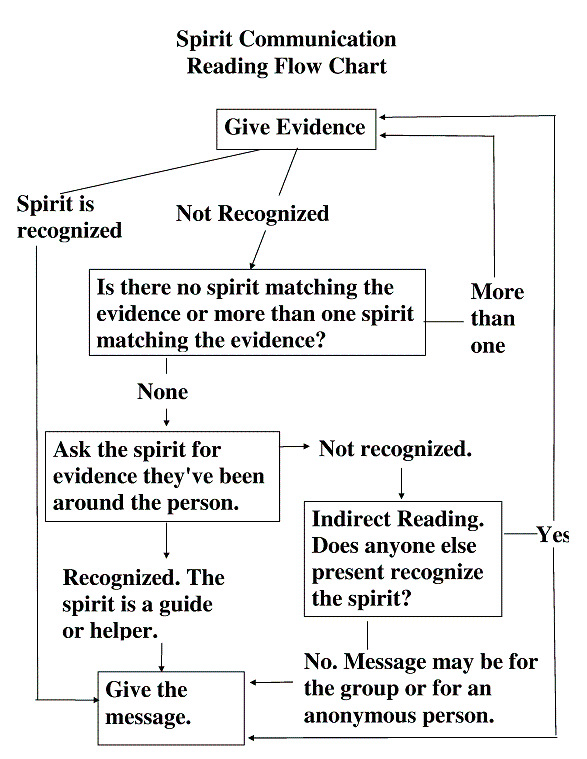
|
Spiritual unfoldment is the process by which a person may become more aware of their spiritual nature - more aware of the spirit within themselves. Two groups of advanced spirit guides have independently given remarkably similar practices to those seeking spiritual unfoldment. The practices combine meditation , relaxation , spiritual healing , and spirit communication. These practices are described in the following books:
The similarity between these practices is that in them, the practitioner acts as a conduit for "healing light" or "flow-through from the Source" with the intention that it be used for the highest good. When you do this, you identify yourself as someone who desires to be a spiritual worker. This attracts spirit guides who will become your co-workers and who will help you develop in ways that will make you a better spiritual worker. To try this yourself you should first read the pages on spiritual healing and relaxation. Then read Exercise 3 on the Communicating with Spirits page. (You don't have to communicate with spirits to do this healing meditation.) This type of anonymous healing may seem somewhat theoretical and
abstract at first. But, consider the fact that there are many cases of
spontaneous remissions and other unexplained healings that have been
observed to occur. Any healing that results from this practice could
make a world of difference to the person that receives it. Remembering
that the healing is intended for an actual person somewhere in the world
will help you to remain focused and maintain the intensity of your
intention as you do this practice.
|
|
There are many things you can do in this life that will lead you to experience better conditions in the hereafter. However these are not always well known or often thought of. In general the more you can do for others and the more effort you make to develop yourself spiritually, the better will be the conditions you find yourself in in the hereafter. Since these things may be important for your future state, it cannot hurt to ask for help and guidance with them. The prayers listed here are suggestions that relate to helping others or developing yourself. An important principle of prayer is that you will receive help in proportion to the effort you make. Therefore it is wisest to ask for guidance to show you how to do something, when appropriate, rather than to ask that something be done for you. Oh God,
|
|
Spirit rescue is the process of helping earth bound or undeveloped spirits complete their transition into the spirit world and get them started on the path of eternal progress. You don't have to be psychic to do this sort of work. The simplest way to help earth bound spirits is to pray for them. If you suspect an earth bound spirit at a certain location, the following prayer may help them: "Oh God, please send angels or spirit guides to help any earth bound spirits at [name the location here] to cross over to the spirit planes." You can modify this prayer according to whatever information you have about the identity or location of the earth bound spirit. If you want to try communicating with earth bound spirits, that can be done too. Author and psychic Susy Smith, in her book "Confessions of a Psychic", explains that spirits can hear you when you speak aloud, and you can help troubled spirits by speaking or reading aloud and explaining the facts of the afterlife to them. Before you begin rescue work you should read "Confessions of a Psychic" and also "Thirty Years Among the Dead" by Carl Wickland. The latter book is available free on the Internet. To begin helping troubled spirits, you should set aside a certain time every day and read aloud the "sermon" below.
|
|
One of the topics that spirits often speak about through mediums is the power of thought. Reality is subjective in many ways, and you have control over these subjective areas by the way you think. Positive Thinking Affirmations Perspective Your Thoughts Affect Others Positive ThinkingUsing positive thinking to develop a positive attitude towards other people. Much of what has been written on the subject of positive thinking has been about how to use it to accomplish material goals. However, positive thinking is an important technique (in addition to meditation ) that you can use to develop a positive attitude towards other people and in doing so, reduce the unpleasantness of negative feelings such as anger and hate. This helps one to developing love for other people which is an important step in spiritual evolution and is an important purpose for which spirits incarnate on earth. "The Power of Positive Thinking" by Norman Vincent Peale is a good general reference on positive thinking. The discussion here which you are now reading focuses on the specific application of how to use positive thinking to help develop a positive attitude towards other people. Positive thinking is simply the process of creating a positive thought whenever you notice a negative thought occurring in your mind. This practice has been advocated by spirits in "Confessions of a Psychic" and "The Book of James" by Susy Smith and in "The Betty Book" by Stewart White. Ways of thinking are to a large extent determined by habit and by what has been learned and practiced over a lifetime. You can use positive thinking to learn a new way of thinking about other people. With practice, positive thinking becomes automatic. To use positive thinking in this way, you must first notice when you are thinking unloving thoughts about other people. Insight meditation can help you increase your awareness of unloving thoughts like anger or hate because it helps you become more aware of emotions. When you find yourself thinking an unloving thought, you need a way to create a positive thought in a way that will help you break the habit of negative thinking. A practical solution to this is to simply say a prayer for the benefit of another person when you find yourself thinking an unloving thought about them. You might think it would be difficult or insincere to say a prayer for the benefit of someone you dislike or are angry at. However if you pray, for example, that the person be protected so that only the highest and best forces can influence them, then the prayer is not only an unselfish request for the benefit of the other person, it is also a prayer for the benefit of humanity and for yourself. Another characteristic of a prayer like this is that it can help you keep in mind that every one is a child of God and that all are evolving on the same path of development even if some are further along than others. In addition to replacing a negative thought with something positive, it should also help you to forgive the other person. You can say the prayer for a person or a group of people. Such a prayer can be something like:
(Instead of "them" or "they" you can say the name of the person or group.) If you are thinking a negative thought about someone you otherwise love or are friendly with, you might want to add something for their benefit like:
or whatever else you feel is appropriate. AffirmationsAffirmations can be used to help you accomplish goals that you set for yourself. They work by helping you to replace self defeating and self limiting thoughts with enabling thoughts through a process of mental rehearsal and visualization of the accomplishment of your goal. Athletic trainers understand this principle and teach their athletes to mentally rehearse an athletic skill through visualization. Here is a hypothetical example: Suppose someone wants to write a book. If he is afraid that he won't finish the book, that he can't write well, that no publisher will publish the book, that it will be unpopular, and that he will be cheated by the publisher, all these fears will interfere with accomplishing his desire. He will procrastinate in writing, he will be reluctant to put in a whole hearted effort, he will be contentious with prospective publishers, and he will be afraid to promote the book. However he can overcome such self limitations by visualizing the thing he wants to achieve with the help of an affirmation. An affirmation that could be used in this situation might be: "I finished my book according to schedule, it was accepted by a successful publisher, my book is on sale and in demand everywhere." At the same time he would visualize having completed the book, its acceptance by a publisher, the book for sale in a store window and a long line of people waiting to buy it. Notice that in this example, the affirmation says "I finished my book" rather than "I can write a book." There is a reason why the affirmation is phrased as if the desired outcome was already accomplished. With an affirmation you should create more than just the belief in your ability to do something, you should create the belief that you will actually do it and be successful. Nothing can be more convincing than an accomplished fact. It will release your whole potential. In our example, this would enable the person to put in a 100% effort on the book, work constructively with his publisher and whole-heartedly promote his book. The affirmation in the example is not used to influence one's emotional state. The information in the section on Insight Meditation on the Meditation page is better suited to working with emotions. There is also a spiritual side to this. If you pray for help you will receive it in proportion to the effort you put in. Once you start making a whole-hearted effort through the use of affirmations and positive thinking, the help you receive from spiritual forces will be that much greater. While you are working on the book, your spirit guides may help you in writing it and get you connected with the right publisher. Your motivation for accomplishing your goal should be unselfish. If your motivation is good and pure you will attract the right kind of spirit guides. PerspectiveWhat you think about has a very large effect on how you experience reality. There are a number of things you can do to help maintain a positive perspective in life.
Your Thoughts Affect OthersYour thoughts affect other people. On a physical level, your thoughts affect what you say and do, and that affects other people. Your thoughts affect your posture, your tone of voice, and your facial expressions all of which have an effect on others. However, there are also reasons to believe that your thoughts can affect people on a spiritual or psychic level too. People are spirits incarnated in a physical body. Since spirits can communicate with each other it is also possible that incarnated spirits can communicate on a spiritual level. Have you ever known what someone was going to say before they said it? Many people have had at least some small psychic experience. So, even though you might not be aware of being psychic, there is good reason to believe that at some level mind to mind influence can occur between people. This is one reason why you should try to be charitable in your thoughts of others. Try to understand why other people do the things they do. Don't suppress your thoughts, but try to understand why you might have negative thoughts. Let your thoughts and emotions express themselves, but still try to see things from another's point of view. Also, in your own mind try to make the distinction between your emotions and your intentions. |
PrologueMany scientists have conducted their own research into the afterlife and found the phenomena are real. Some of the scientists who have conducted or believe in afterlife and psychical research are Nobe Prize winners (see below: Eminent Researchers). These scientists were not fooled by magic tricks. Highly skilled stage magicians have investigated many mediums and have found them to be genuine (see the chapter on Skeptical Fallacies for more information and links). Studies have shown people with more education are more likely to believe in the afterlife, and most medical doctors believe in the afterlife (see the chapter on Skeptical Fallacies for more information and links). These highly educated and intelligent people are right, there is no death. Departed loved ones are not gone, they continue to live in a higher realm. Not many people are aware of how much evidence for the afterlife there is. If you read through this chapter, you will be one of the few people who can fully appreciate how many different types of evidence there are. This chapter outlines the different types of evidence for the afterlife and has links to web based sources of information including links to free e-book versions of important studies on the afterlife. If you look into those linked sources of information, you will be able to see the rigor and substantiveness of the evidence for the afterlife. Do you want to learn more about this life affirming subject? If so, read on ... Some of the best evidence for the afterlife is:
I can tell you the evidence for the afterlife is overwhelming and it is extraordinary. This evidence supports the conclusion that the afterlife is real, it has withstood the test of time and the collection of new data. However, I can't make you read about it. You have to do that yourself.... IntroductionThis chapter summarizes some of the scientific evidence for the afterlife and, wherever possible, includes links to on-line references and additional sources of information. In many cases, the links include references to the actual reports and writings those who conducted the investigations which you can look up to more fully understand this evidence. The purpose of this chapter is to acquaint readers with the wide variety and compelling nature of this evidence which is not well known to the general public. The evidence goes beyond proving paranormal phenomena are real, it proves the existence of spirits and therefore the afterlife. The definition of scientific proof that skeptics use to assert that evolution by natural selection is proved is discussed and that same definition holds for the existence of spirits and the afterlife. A quick glance through this chapter will show that there are many different independent forms of evidence and that the evidence is not limited to mediumship. There is objective evidence obtained through electronic instruments as well as evidence obtained through collecting reports directly from people who have witnessed afterlife phenomena and who otherwise have no involvement with the field of afterlife research or mediumship. Some people feel that extraordinary claims require extraordinary evidence. The evidence for the afterlife is so extensive and varied that it is, in fact, extraordinary evidence. The chapter Skeptical Fallacies examines objections to this evidence and shows those objections are not valid. The possibility that these phenomena are the result of psychic powers of living people are disproved in the sections on Super-Psi and Where Do Mediums Get Information From? in the chapter on Short Topics. If you follow the links and look further into the evidence you will see that besides a variety of types of evidence, there is also a large cumulative amount of evidence. Theoretically, one solid case is sufficient to prove the assertion that a thing exists. However, for the afterlife, there are many, many solid cases from many types of evidence. Start of Chapter
The following passages are taken from "29+ Evidences for Macroevolution: Scientific "Proof", scientific evidence, and the scientific method" by Douglas Theobald, Ph.D. This is part of the FAQ for one of the foremost communities of skeptics on the internet. Interestingly, much of what is written about the theory of scientific proof that is used to justify the theory of evolution by natural selection also applies to belief in the afterlife. The primary function of science is to demonstrate the existence of phenomena that cannot be observed directly. Science is when you make hypotheses and and test them against empirical evidence. Our hypothesis is that spirits and the afterlife exist and when considered against the evidence the conclusion that they do exist is inescapable. Start of Chapter
After reading the cases below, you can find out much more about the scientific evidence for spirits and the afterlife by reading these detailed overviews.
Start of Chapter
Source: The Survival Files by Miles Edward Allen http://www.survivaltop40.com/case24_soulmate.pdf
Source: Psychic Adventures In New York by Neville Whymant http://www.freewebs.com/psilib/PsychicAdventuresWhymant.txt
Source: "R-101" by Michael Prescott http://michaelprescott.freeservers.com/R-101.htm Also see: The Survival Files by Miles Edward Allen http://www.survivaltop40.com/case14_R101.pdf
Source: "An Amazing Experiment" by Charles Drayton Thomas http://www.survivalafterdeath.org.uk/books/thomas/contents.htm Source: CBC News Thursday, January 27, 2005 http://www.cbc.ca/story/canada/national/2005/01/27/psychic-body050127.html# Start of Chapter
Reincarnation researcher Ian Stevenson investigated children who had
verifiable memories of past lives. Stevenson interviewed everyone
involved, the children, the current families, and surviving members of
the families from the previous life. He found that these children
remembered geography, faces, and names of people in locations they had
never been to. Some children could converse in a foreign language they
spoke in a past life. Some had birthmarks on their body where they had
sustained injuries in the previous life.
http://www.scientificexploration.org/journal/jse_02_2_stevenson.pdf (1.3MB)
http://www.scientificexploration.org/journal/jse_07_4_stevenson.pdf
More links to on-line
research articles by Ian Stevenson can be found in
the chapter on
Recommended Reading.
Also see the following URL for a list of publications by Ian Stevenson
The evidence for reincarnation cannot be explained by inadvertent mediumship or other forms of psychic perception.
Start of Chapter
Individuals near death can often see the spirit world
and they also see spirits who come to help them make the transition.
Many examples of this are described in Death Bed Visions by
William Barrett:
Visions have
included spirits of individuals who had died but who the patient
thought were still living.
This proves the visions are accurate and not imagined.
Those attending the dying sometimes see the same spirits the dying see. This also rules out hallucinations since multiple witnesses would not have identical hallucinations.
"A short time before she expired I became aware that two spirit forms were standing by the bedside, one on either side of it. I did not see them enter the room; they were standing by the bedside when they first became visible to me, but I could see them as distinctly as I could any of the human occupants of the room....
More examples of multiple witness death bed visions can be found on my
blog post:
There is also a case of a death-bed vision being confirmed through a medium. It occurred while Richard Hodgson was investigating the medium Mrs Piper. During one sitting, a spirit communicated through automatic writing and explained that she had attended someone on his death bed and had spoken to him using an unusual phrase. A relative of the deceased who was with him at his death-bed was contacted and confirmed that the dying man claimed to have seen the spirit. The relative spontaneously told what the dying man said of the spirit including the use of the unusual phrase given through the medium. An account of this is related in:
A FURTHER RECORD OF OBSERVATIONS OF CERTAIN PHENOMENA OF TRANCE
by Richard Hodgson L.L.D. Proceedings of the Society for Psychical Research Vol. XIII. 1898, p 284 - 582
See the foot note on page 378: The first writing of the sitting came from Madame Elisa, without my expecting it. She wrote clearly and strongly, explaining that F. was there with her, but unable to speak directly, that she wished to give me an account of how she had helped F. to reach her. She said that she had been present at his death-bed, and had spoken to him, and she repeated what she had said, an unusual form of expression, and indicated that he had heard and recognised her. This was confirmed in detail in the only way possible at that time, by a very intimate friend of Madame Elisa and myself, and also of the nearest surviving relative of F. I showed my friend the account of the sitting, and to this friend, a day or two later, the relative, who was present at the death-bed, stated spontaneously that F. when dying said that he saw Madame Elisa who was speaking to him, and he repeated what she was saying. The expression so repeated, which the relative quoted to my friend, was that which I had received from Madame Elisa through Mrs. Piper’s trance, when the death-bed incident was of course entirely unknown to me. Start of Chapter
People who have briefly died and been revived by doctors have reported seeing deceased loved ones in the spirit world. Some have reported verifiable information from remote locations they could not have obtained from their physical senses even if they had not lost consciousness. These veridical NDEs demonstrate the accuracy of NDE perceptions and proves that perception is not limited to the physical body. Here is one example: While Maria's body was being worked on by the medical staff she experienced leaving her body. She floated upwards some 4 stories and came out onto the roof of the hospital. There on the ledge of the roof she saw an old sneaker with a worn little toe and one lace tucked under the heel. When the resuscitation procedure had proved successful Maria came to and was quite preoccupied with her vision of the sneaker. ... She managed to persuade the social worker Kim Clark to go check and directed her to a window from which the shoe could be seen when leaning out. ... Clark easily found the correct window and there, indeed, lay the sneaker on the ledge with the worn little toe and the lace tucked under the heel just as Maria had described it. Additional On-Line References:
Veridical NDE's
There have been several hypotheses advanced to explain NDE's by means of ordinary biological phenomena. None of these hypotheses account for all the observed phenomena that have been reported to occur during NDE's. For more information see:
Start of Chapter
There are many reports of people observing spirits at the time of the spirit's death. Often the observer had no reason to suspect the observed person was near death. This rules out imagination as a source of the vision and proves the accuracy of the observation. Often there are multiple witnesses to the apparition which rules out hallucination as an explanation.
Also see: Start of Chapter
In the books tests, a spirit would give the position of a book on a shelf, the page number in the book, and the location on a page where an evidential message could be found. In the newspaper tests, a spirit would tell the contents of newspaper articles before they were printed. The purpose of these test was to show that mediums received information from spirits and not from the sitters by ESP or investigation since neither the medium nor the sitter could know this information. Here is one example where the spirit gives the location and content of an item in a newspaper not yet published and the person receiving the reading confirmed the prediction. Source: "Life Beyond Death with Evidence" by Rev. Charles Drayton Thomas. Many book and newspaper tests are described in detail in this book which may be downloaded free from: http://www.freewebs.com/psilib/ An overview of the book and newspaper tests is given in this blog entry by Michael Tymn:
Start of Chapter
A more detailed discussions of the cross-correspondences can be found at:
"CROSS CORRESPONDENCES: Spirit Communications and a Love that Survived Death!" by Troy Taylor
"Cross-Correspondences" by Konstantin Oesterreich
"The Eager Dead & Undying Love" by Michael Tymn
A Lawyer Presents the Case for the Afterlife by Victor Zammit. Chapter 16. The Cross Correspondences.
Several examples of cross-correspondences are given in the book "Contact
with the Other World" by Professor James Hyslop in chapter XIII
"Experimental Incidents". This book can be downloaded free from:
Start of Chapter
Mediums sometimes receive communications from spirits who are unrelated to, and unknown by, the sitters and the medium. These spirits come through to communicate for purposes important only to themselves. They give verifiable information about their identity and cause of death. For example, the spirit of Runolfur Runolfsson was buried with a thigh bone missing. He communicated through a medium and gave the correct location of his thigh bone which was hidden in a wall. He asked for it to be found and buried. When the wall was opened up and searched, a thigh bone was found. For more information see:
A brief description at survivaltop40.com:
Haraldsson E. and Stevenson, I, 1975. 'A Communicator of the Drop-in
Type in Iceland: the case of Runolfur Runolfsson'. Journal of the
American Society for Psychical Research 69. 33-59.
You can read more about drop-in communicators from these on-line sources:
The Harry Stockbridge case:
The Biedermann drop-in case:
Gudni Magnusson:
Start of Chapter
Proxy sittings are when a person goes to a medium on behalf of someone who is not present at the sitting. In such cases the medium and the proxy sitter may not know who the reading is for or anything about that person. In this case it is impossible for the medium to use cold reading or any previous knowledge about the person in their reading. When a medium can give verifiable information about the actual sitter and deceased individuals known to them, it is very strong proof of psychic functioning and when the medium can give specialized knowledge known only to the deceased it is very strong evidence that they are communicating with the spirit of the deceased. http://www.enformy.com/LeonardTOC.htm in chapter V "Proxy Sittings": http://www.enformy.com/LeonardCh05.htm http://www.explorejournal.com/article/PIIS155083070600454X/fulltext Start of Chapter
Electronic devices have allowed interactive conversations with spirits that anyone can hear. A demonstration was given live on Radio Luxembourg. Koenig installed his equipment under the watchful eyes of the Radio's own engineers and the presenter of the program, Herr Rainer Holbe. One of the Radio's staff asked if a voice could come through in direct response to his requests. Almost immediately a voice replied:Also see:'We hear your voice' and 'Otto Koenig makes wireless with the dead' (Fuller 1981:339). The Survival Files by Miles Edward Allen http://www.survivaltop40.com/case17_ghosts-machines.pdf Start of Chapter
Start of Chapter
The venerable psychical researcher Montague Keen collected a list of twenty cases suggestive of survival. This list was based on a similar list originally published by Professor Archie Roy in The Paranormal Review, a magazine published by The Society for Psychical Research. The original references for a number of these cases are available on the internet. Some of the cases can be found in on-line books written by the same author as the referenced article. Descriptions of many of the remaining cases can also be found on various websites on the internet.
Start of Chapter
Afterlife research should have been accepted by mainstream science long ago. There was sufficient evidence reported by highly reputable scientists for this to have occurred as early as 1922.
Start of Chapter
"What are the implications for science of the fact that psychic functioning appears to be a real effect? These phenomena seem mysterious, but no more mysterious perhaps than strange phenomena of the past which science has now happily incorporated within its scope." Charles Robert Richet winner of the 1913 Nobel Prize in Physiology and Medicine conducted his own investigations into the afterlife and wrote: The "guide" of the medium (i.e., the new personality that appears) then seems to be a genuinely extraneous intelligence. These phenomena can rightly be called metapsychic because, taking them all in all, the normal intelligence of the sensitive is quite insufficient to explain the strange and potent cryptesthesia. Sir William Crookes, discoverer of the element thallium and inventor the cathode-ray tube started out as a skeptic but after examining the medium D.D. Home for himself came to believe: "Of all persons endowed with a powerful development of this Psychic Force, Mr. Daniel Dunglas Home is the most remarkable and it is mainly owing to the many opportunities I have had of carrying on my investigation in his presence that I am enabled to affirm so conclusively the existence of this force."Gary Schwartz has published numerous research articles demonstrating the accuracy of mediums in scientific experiments including a triple-blind experiment in which the medium has no contact with the person getting the reading. This eliminates cold reading or the use of previous knowledge as an explanation for mental mediumship.
Anomalous Information Reception By Research Mediums Demonstrated Using A Novel Triple
-Blind Protocol
These scientists were not fooled by magic tricks. Highly skilled stage magicians have investigated many mediums and have found them to be genuine (see the chapter on Skeptical Fallacies for more information and links). Studies have shown people with more education are more likely to believe in the afterlife, and most medical doctors believe in the afterlife (see the chapter on Skeptical Fallacies for more information and links). See the chapter on Eminent Researchers for more emminent researchers. Start of Chapter
If you want to read more about the evidence for the afterlife, there are several recommendations in the section above on Detailed Overviews. If you would like to read a more in depth discussion by the researchers who collected the evidence, the following books may be of interest to you.
William Barrett:
"Death Bed Visions"
Julie Beischel, Gary E. Schwartz:
"Anomalous Information Reception by Research Mediums Demonstrated Using
a Novel Triple-Blind Protocol"
Explore
(New York, N.Y.) 1 January 2007 (volume 3 issue 1 Pages 23-27 )
Sir William Crookes:
"Researches Into the Phenomena of Modern Spiritualism"
Edmund Gurney: "Phantasms of the Living"
Erlendur Haraldsson & Ian Stevenson (1975).
A communicator of the "drop
in" type in Iceland: The case of Runolfur Runolfsson.
Journal of the
American Society for Psychical Research, 69, 33-59.
Loftur R. Gissurarson & Erlendur Haraldsson (1989).
The Icelandic
Physical Medium Indridi Indridason.
Proceedings of the Society for
Psychical Research, 57, 53-148.
Erlendur Haraldsson & Ian Stevenson (1975).
A communicator of the "drop
in" type in Iceland: The case of Gudni Magnusson.
Journal of the
American Society for Psychical Research, 69, 245-261.
Anna Hude:
"The Evidence for Communication with the Dead"
Professor James Hyslop:
"Contact with the Other World"
William James:
"Human Immortality: Two Supposed Objections to the Doctrine"
Sir Oliver Lodge:
"The Survival of Man"
Frederic William Henry Myers:
"Human Personality and its Survival of Bodily Death"
Charles Richet:
"Thirty Years of Psychical Research"
Michael Sage:
"Mrs. Piper & the Society for Psychical Research"
Ian Stevenson:
Birthmarks and Birth Defects Corresponding to Wounds on Deceased Persons,
Journal of Scientific Exploration, Vol. 7, No. 4, pp. 403-410, 1993
Charles Drayton Thomas:
"An Amazing Experiment"
Rev. Charles Drayton Thomas:
"Life Beyond Death with Evidence"
Neville Whymant:
"Psychic Adventures In New York"
"Journal of the Society for Psychical Research" and "Proceedings of the Society for Psychical Research
Journal of the Society for Psychical Research
Proceedings of the Society for Psychical Research
Proceedings of the American Society for Psychical Research
Mrs. Piper in the Proceedings of the Society for Psychical Research
|
|
Charles Robert Richet John William Strutt Sir William Crookes Sir Robert Boyle Sir Arthur Conan Doyle Richard Hodgson Gary Schwartz Neville Whymant More Eminent Researchers Books By Eminent Researchers Brian D. Josephson
http://en.wikipedia.org/wiki/Brian_Josephson
|
|
Skeptical Fallacies Evidence
About Skeptical ThinkingThis chapter is intended to help you understand how skeptics may use flawed reasoning to try to dissuade you from believing in the afterlife. Skeptics may give explanations which sound very rational from their point of view, but when examined closely are found to be insufficient to invalidate the evidence for the afterlife or to discredit belief in it. You also might find yourself trying to justify your beliefs and find it helpful to understand skeptical thinking in order to explain to a skeptic why you do not accept their reasoning. However, be aware this may not allow you to actually convince a skeptic of your point of view. Skeptics often know very little about the evidence for the afterlife. They have little interest in learning about it because they they don't believe in it. Therefore it would seem that simply providing information to educate them would result in a meeting of minds. While an educated believer can point out the skeptic's ignorance and mistaken assumptions, this does not guarantee a meeting of minds because the skeptic and the believer often have very different mind sets. The skeptic often feels that in order for him to accept a new belief, there must be proof of it. If he can hypothesize a possible flaw in the evidence, he will not consider the evidence proof even if there is no evidence that flaw has a real effect. In this case, an untested hypothetical explanation of why belief based on that evidence might not be justified is sufficient for the skeptic to remain disbelieving. However, you should realize that an untested hypothetical explanation is not necessarily sufficient to prove a belief is wrong. The skeptic often has difficulty seeing this. Sometimes this causes the skeptic to be accused of circular reasoning - it seems like he doesn't accept evidence because he knows the phenomena is not possible. However, if one considers the many scientific controversies of the past, one will see that whether or not a possible though untested flaw in the evidence is sufficient to dismiss a conclusion based on the evidence is very often a matter of opinion. A believer, on the other hand, would like a skeptic to offer proof the belief is incorrect. Often the skeptic will decry "It can't be disproving" or "You can't prove a negative". For example, you cannot prove spirits don't exist because spirits might exist in some place which we are not able to interact with or have any knowledge of. Making this complaint is a mistake and is usually due to ignorance of the evidence. It applies only when belief is based on faith alone. It does not apply when belief is based on an analysis of evidence such as the large body of evidence supporting belief in the afterlife. It is ironic that the skeptic who is ignorant of the evidence of the afterlife bases his disbelief not on an analysis of the evidence, but upon his own faith that the afterlife does not exist. It is not necessary for the skeptic to do the impossible and disprove the existence of the afterlife. It is sufficient to show that the evidence for belief is invalid, or show that a hypothetical flaw in the evidence has a real effect. For example, if a skeptic can show a medium was using cold reading techniques by analyzing a transcript of a reading and showing how the principles of cold reading were applied, that would invalidate the evidence attributed to that reading. However, a skeptic would be unlikely to agree to undertake such an effort. Since he doesn't believe in the afterlife, it would seem to him to be a waste of time to try to disprove it. He would expect the believer to provide proof cold reading did not occur. Again, considering the many scientific controversies of the past, one can see that what is a reasonable conclusion to draw from evidence can also be a matter of opinion. Often the believer is accused of being to credulous or not sufficiently analytical. When a skeptic and a believer try to discuss the subject, an argument in which both sides demand proof and criticize the other side's reasoning can result. The skeptic doesn't feel obligated to prove anything since if he is going to change his belief it is incumbent on the believer to provide iron clad proof. The believer makes what is in his mind a reasonable conclusion from the evidence and expects the skeptic to prove the evidence is flawed or that another explanation is true. Often it is hard to tell who is the believer and who is the skeptic. There is a certain symmetry where a believer acts like a skeptic of the opposite belief, and the skeptic acts like a believer in the opposite belief. The skeptic demands the believer provide better proof, the believer demands the skeptic prove his concerns have real consequences. Occam's razor doesn't help because it can be a matter of opinion as to what entities are unreasonable and therefore extraneous. So this begs the question, when discussing the afterlife with a skeptic, what should you do? It depends. Are you trying to educate the skeptic about the evidence? Are you trying to convince the skeptic that the belief is correct? Are you trying to explain why it is reasonable to believe? Are you trying to explain why his arguments against belief are not convincing? Which of these you attempt depends on the person involved and the situation. Whatever your intention, you should be clear in your own mind what you are trying to do. In general, it is wise to ignore and refrain from personal attacks and stick to a polite discussion of facts. Try to refrain from acrimony since making someone angry will decrease the likelihood that they will adopt your beliefs. Sometimes if you keep a neutral or friendly tone and ignore the negativity in a skeptic's approach and stick to facts he will see that you are serious in conducting a reasoned discussion and drop the attitude and continue the discussion in a less hostile manner. Keep in mind that two people can have the exact same experience and because of their personal bias' believe different things. For example, two bird watchers might be out in the countryside and see an unusual bird that is not native to the area. One person, an amateur meteorologist, might think it was blown off course by a recent hurricane, and another, a pet store owner, might think it is a pet escaped from a home destroyed in the hurricane. Who is right? Skeptical FallaciesEvidenceThere is no evidence of spirits or the afterlife.There is a huge amount of empirical evidence collected by researchers from interviewing experiencers and from controlled experiments including experiments conducted in laboratories. The chapter A Summary of Evidence has more details.
Start of Chapter
People who have more education are more likely to believe in the afterlife. Contrary to researchers' expectations, a poll of 439 college students found seniors and grad students were more likely than freshmen to believe in haunted houses, psychics, telepathy, channeling and a host of other questionable ideas. Most doctors believe in the afterlife. In the survey of 1,044 doctors nationwide, 76 percent said they believe in God, 59 percent said they believe in some sort of afterlife, and 55 percent said their religious beliefs influence how they practice medicine. Start of Chapter
If the second person isn't sure of the answer, he�s liable to go along with the first person�s guess. By then, even if the third person suspects another answer is right, she�s more liable to go along just because she assumes the first two together know more than she does. Thus begins an �informational cascade� as one person after another assumes that the rest can�t all be wrong. Start of Chapter
There are practical uses of the paranormal phenomena, as well as practical consequences of paranormal research in society. Energy healing, mediumship, induced after-death communication, past life regression, remote viewing, dowsing, psychic detectives, and the use of psychics in the commercial sector are all examples of this. There are professionals who practice energy healing and mediumship both of which have been validated by scientific experiments. In some hospitals nurses are allowed to practice therapeutic touch because research has demonstrated its effectiveness.
Scientific research has demonstrated the effectiveness of mediumship.
An example of such research is: "Anomalous Information Reception by
Research Mediums Demonstrated Using a Novel Triple-Blind Protocol" Julie
Beischel, Gary E. Schwartz Explore (New York, N.Y.) 1 January 2007
(volume 3 issue 1 Pages 23-27 DOI: 10.1016/j.explore.2006.10.004)
Scientific research has also demonstrated the effectiveness of energy healing. An example of such research is:
"The Effect of the "Laying On of Hands" on Transplanted Breast Cancer in
Mice" William F. Bengston, David Krinsley Journal of Scientific
Exploration, Vol. 14, No. 3, pp. 353-364, 2000
Induced after death communication (IADC) is a therapy
developed by a Veteran's Administration psychologist that helps patients
with post traumatic stress syndrome. The therapy allows the patient to
communicate with the spirits of those who's death was involved in the
traumatic experience of the patient. For more information see:
Similarly, past life hypnotic regression has had great healing effects on patients with emotional and physical problems. The evidence is clear that it has helped patients and therefore is beneficial to society.
Remote viewing is another application of psychic abilities that we see
in our society. There are a number of commercial enterprises that
provide remote viewing services and offer classes in remote viewing.
To learn more about remote viewing read "Remote Viewing - the Real Story" by Ingo Swann:
Dowsing services are also available commercially.
In "The Geller Effect" by Guy Lyon Playfair and Uri Geller, Playfair
writes in chapter 17 "Whatever It Is" that many business leaders believe
in ESP because they use it themselves. In chapter 9 of this book, Uri
Geller describes some of the work he was hired to do by companies that
paid him very large fees to use his psychic powers to locate oil and
minerals. The book can be found on-line at:
Police departments use psychics to help solve criminal investigations, as this article on the Canadian Broadcasting Corporation web site explains:
"Police in Nelson, B.C., have found the body of a young woman who disappeared last March, and they credit a local psychic for pointing them in the right direction."More articles about Psychic Detectives can be found in the chapter News Stories About Spirits. A number of businesses hire psychics as consultants to help
with their
business planning.
In the June 30, 2008 issue of
Newsweek
the article
"The $10,000-a-Month Psychic",
discusses intuitionist Laura Day who works for several
corporations.
Start of Chapter
If it is to be convincing, skeptical debunking must be backed up with facts and evidence and the same rigorous analysis of the data that skeptics demand from believers. When a debunker offers a reason to dismiss empirical evidence they must offer evidence of their own. If a skeptic accuses a medium of cold reading, they must provide a transcript of a reading and show how the medium is applying the techniques of cold reading to give the impression he is communicating with spirits. If they accuse an investigator of being duped by a medium they must describe the methods the investigator used, propose how a medium could commit fraud under those conditions, and demonstrate that it is actually possible to produce fraud under those conditions. This is the most common fallacy - to equate an untested and hypothetical explanation with a theory based on empirical data. This logical mistake can be hard for skeptics to admit. Some people believe in the religion of Materialism. Their belief is based on faith. Often such believers don't investigate the evidence for the afterlife because it contradicts their religious beliefs. They often try to discredit the empirical evidence for the afterlife by making up stories about why that evidence might be wrong without really investigating the evidence or by backing up their stories with facts. They don't even realize their stories are contradicted by facts because they never investigated the evidence in the first place. Start of Chapter
The central problem however lies in the fact that "extraordinary" must be relative to some things "ordinary." and as our theories change, what was once extraordinary may become ordinary (best seen in now accepted quantum effects that earlier were viewed as "impossible"). Many now extraordinary claims may become more acceptable not when they are replicated but when theoretical contexts change to make them more welcome. This suggests that what constitutes an "extraordinary" claim is subjective. What is an extraordinary claim? An extraordinary claim is a claim that contradicts strongly held beliefs. What any one person considers an extraordinary claim is therefore subjective. Science cannot objectively determine whether or not a claim is extraordinary. What is extraordinary proof? Extraordinary proof is evidence that disproves strongly held beliefs. Again, this is subjective. If a person with strongly held beliefs chooses to maintain disbelief in the face of contradicting evidence, then by the fact of that continuing disbelief, the proof is not extraordinary. Science cannot objectively determine whether or not proof is extraordinary. The notion that extraordinary claims require extraordinary proof is not a principle of the scientific method. It is actually a statement about psychology masquerading as scientific philosophy. There is no correspondence whatsoever between how strongly a person believes something and the method by which a contradicting claim can be proven. Each scientific question requires its own unique proof. The type of evidence required for that proof has nothing to do with whether or not someone has strong beliefs against it. The proof depends solely on the particulars of the problem in question. Some problems can be proven mathematically, some can be proven logically for example by deduction or induction. Some problems can be proven through observation in the field, others can be proven by experiments in the laboratory. Some things are easy to prove, some are hard. Due to the subjective nature of identifying extraordinary claims and extraordinary proof, all this notion really means is that if someone has strongly held beliefs, they will resist giving up those beliefs. It is an observation about human nature not a requirement determined by the nature of scientific inquiry. In fact, it is an observation about a characteristic of human nature which interferes with scientific progress. For example, a committee of scientists reviewing a scientific paper should judge that paper on it's own merits. They would be wrong to reject its conclusions if their only reason was because those conclusions contradicted the strongly held beliefs of some outside scientist. However that committee might reject the conclusions if those conclusions contradicted their own beliefs. Therefore this notion of extraordinary claims and proof cannot be considered part of the scientific method. It is only possible to consider it a statement of how bias interferes with objectivity. When skeptics assert this notion, if they are not cynically trying to misdirect the discussion away from evidence they don't want to consider, and if they are being sincere, then they are actually demonstrating that they are refusing to consider the evidence objectively. A corrected version of this notion would then read: An analysis of the history of science shows that extraordinary claims require extraordinary proof when people are unwilling to objectively assess evidence that contradicts their strongly held beliefs, and this has been an persistent obstacle to progress. The chapter A Summary of Evidence has a link to a skeptic's definition of scientific proof. At the time of this writing, that definition makes no mention of special requirements for extraordinary claims. What is interesting about that chapter is that the evidence for the afterlife which it outlines is, in fact, extraordinary. The evidence which proves the afterlife includes evidence from both observations in the field and experiments. Anyone who doubts this proof should look at that chapter and follow the links and read the references that give a full account of the evidence. Start of Chapter
There is no evidence that consciousness is a result of brain activity. Neurological activity can be measured and shown to be associated with mental activity, but this is not evidence that neurological activity generates consciousness. Clearly the brain and the conscious mind interact. Nerve impulses from sensory organs result in brain activity and the conscious mind becomes aware of the sensations perceived. When the mind generates the impulse to move, nerve impulses are carried from the brain to the muscles to cause movement. Consciousness is affected by brain activity and is able to influence brain activity. The brain might be an interface between the mind and the physical body, however there is no evidence that consciousness itself is generated by the brain. One theory is that consciousness is a non-physical process and that one of the functions of the brain is not to generate consciousness but to restrict consciousness. In that case, if you release the conscious mind from the brain as happens during a near death experience you should have expanded consciousness. This is exactly what happens. People who experience NDE's are able to perceive more than they do when in the body. They report seeing in 360 degrees and seeing colors that they do not see when in the body. Blind people report seeing during NDE's. Some near death experiencers report being able to communicate telepathically with other beings. Some report understanding that time is just an illusion or that they seem to have access to all the knowledge in the universe. This theory is often referred to as the "filter model" where the brain filters some aspects of consciousness like a colored glass can filter out some wavelengths of light. What passes through the filter is a restricted set of conscious faculties that we have while in the physical body. Restricting consciousness probably has some survival value. If a person had access to all the information in the universe about any time in the past, present or future, it might be difficult to concentrate on surviving here and now.
One of the early descriptions of the filter model of consciousness
can be found
in the introduction to of "Human Personality and its Survival of Bodily
Death" volume I by Frederic William Henry Myers.
Myers compares consciousness to light, likening the conscious mind to
the visible spectrum and the unconscious mind to parts of the
spectrum that are not visible. The brain may filter faculties from
any part of the spectrum conscious or unconscious and those faculties
that are passed through the filter are those faculties that
are available while we are in the body.
It is known that brain damage can also effect memory, reasoning, language and other mental functions. If the brain filters consciousness and what passes through the filter is a restricted set of faculties of consciousness that we have while in the physical body, then if the brain is damaged in certain ways, it might filter out more faculties or fail to transmit certain faculties clearly. This theory is sometimes called the transmission theory. It is discussed in detail in:
"Human Immortality: Two Supposed Objections to the Doctrine" by William James
In this lecture James agrees that thought is a function of the brain.
However he points out that there are different types of functional dependence. Besides thought being produced by the brain it might be released by the brain or transmitted by the brain.
James goes on to suggest that the functional dependency of thought on the brain might in actuality be a transmissive function.
He points out that there is no more evidence to suggest thought is produced by the brain than there is evidence that it is transmitted by the brain.
In the Preface to the Second Edition of "The Will to Believe and Other Essays", where this lecture is reprinted, James addresses the question: If the personality is a result of consciousness transmitted through the brain, how does that translate into immortality? If the brain dies, then the individuality dies. His answer is that the source of the transmitted consciousness is an individualized consciousness and what happens in the brain may be registered back in the consciousness that is the source of the transmission - the transmission is a two way transmission.
In summary, the brain may filter consciousness rather than produce consciousness. Only those faculties of consciousness which are transmitted through the filter are the faculties we have while in the body. This explanation of the relationship between the mind and the brain explains the same phenomena that are explained by the theory that the brain produces consciousness:
The theory that the brain filters consciousness is superior to the theory that the brain produces consciousness because the filter theory explains everything the production theory explains and it also explains many more phenomena that the production model cannot explain. Start of Chapter
The section on the fallacy: Belief in the Afterlife is not Falsifiable and Therefore is not Scientific explains the significance of falsifiability to a scientific theory. In short, for a theory to be scientific it must be supported by evidence. For a theory to be supported by evidence it must pass a test that could demonstrate the theory is false. Someone might question whether the transmission/filter model of the brain can be falsified. Any change in mental function can be explained by it. If conscious faculties are increased, as occurs during an NDE, it is ascribed to less filtering, if conscious faculties are decreased, as may occur after a stroke, it is ascribed to increased filtering. However the transmission model makes at least two predictions that can be tested:
The other way to falsify the filter model is to study the brain and determine if it produces consciousness or not. Proving the brain produces consciousness will falsify the transmission model. An electronics engineer can examine a radio receiver and determine that it does not generate the signal it receives and converts to sound. A scientist should be able to examine the brain and determine how it works in the same way. The research that is currently being conducted by neuroscientists to prove the brain produces consciousness may eventually reach a blank wall like an engineer tracing the signal all the way back to the antenna of a radio and then not being able to go any further and concluding that the radio is a receiver. The electronics engineer doesn't have to know anything about radio waves nor should the scientist have to know anything about non-physical consciousness. The engineer only needs an amplifier and and oscilloscope and he can trace the signal. Similarly the scientist only needs to understand the physical mechanism of the brain. The same electronics engineer can analyze a computer and show that all the behavior of the circuits are determined by the physical elements of the computer. If the brain produces consciousness, the scientist should be able to do the same thing for the brain. If you properly understand the brain you will know how, for example, an impulse to move your arm originates. If you can't explain how that impulse originates by the mechanism of the brain then you have to look for something outside the brain to explain it. If someone says a computer is a receiver for radio waves you can falsify it by demonstrating the behavior of the computer is explained by the properties of the physical elements comprising it. If someone says a brain is a filter for consciousness you can falsify it by demonstrating the behavior of the brain is explained by the properties of the biological elements comprising it. Neuroscience will eventually resolve this question. How might the filter model be proven? Perhaps some extremely improbable quantum phenomena will be found to occur in the brain on a regular basis. If nothing known to science can explain it, scientists will have to look for some new phenomena which may lead to the "discovery" of consciousness. Start of Chapter
This fallacy is often stated in this way but what it really means is that belief in the afterlife is not supported by evidence. The philosopher Karl Popper wrote that for a theory to be scientific it must be supportable by empirical evidence. Empirical evidence is evidence from either observation or experiment. Popper stated that a theory that is supported by empirical evidence is not just consistent with the evidence but must pass a test which if it failed would demonstrate the theory is false. The theory must be falsifiable. In short, for a theory to be scientific it must be supportable by evidence. For a theory to be supported by evidence it must pass a test that could demonstrate the theory is false. An essay written by Karl Popper explaining this philosophy can be found at:
Science, Pseudo-Science, and Falsifiability by Karl Popper
The theory of the afterlife has passed tests that could falsify it, and therefore it is supported by empirical evidence, which is to say, belief in the afterlife is scientific. Several tests of the theory of the afterlife come from Richard Hodgson's investigation into the mediumship of Mrs. Piper. This research is described in:
A Further Record of Observations of Certain Phenomena of Trance
by Richard Hodgson L.L.D. Proceedings of the Society for Psychical Research Vol. XIII. 1898, p 284 - 582:
In his investigation, Hodgson observed "communicators" that would communicate through Mrs. Piper while she was in a trance. There were different hypotheses proposed to explain them. They included deliberate fraud, alternate personalities, telepathy, and spirits. Tests for the hypothesis that the communicators were spirits included:
Failure at any of these these test would rule out the spirit hypothesis as an explanation Mrs. Piper's mediumship. In fact, the mediumship of Mrs. Piper passed all of these tests. The details of the investigation are in the Proceedings. Hodgson found that the communicators were not a result of fraud, and that they had knowledge unknown to the medium and the sitters. The communicators exhibited gestures, patterns of speech, and personal knowledge of the person they claimed to be. ( Communicators also showed an interest in living friends and relatives, and demonstrated that they maintained current knowledge about them.) Characteristics of the communication varied with the communicator not with the sitters. Spirits communicating shortly after death had difficult communicating. Spirits that suffered a long illness or mental turmoil before death had more difficulty communicating. Spirits who were communicating for the first time had difficulty coming through but learned after a few attempts and could be assisted by other spirits. Some spirits were never very good at communicating. Other spirits were particularly good at communicating names. These variations in characteristics of the communicators were unaffected by who the sitters were. Based on this evidence, Hodgson believed the communicators were spirits. If communicators knew only what the medium knew, the spirit hypothesis would be falsified. If the communicators did not demonstrate personal knowledge and characteristics of the person they claimed to be, the spirit hypothesis would be falsified. If characteristics of the communication were found to vary with the sitters, for example if some sitters always brought through strong communicators and other sitters always brought through weak communicators, then the theory that the communicators were independent entities would be falsified. Based on this empirical evidence one can see that belief in the afterlife is supported by empirical evidence, it has passed several tests that could falsify it and therefore belief in the afterlife is scientific. Start of Chapter
Some skeptics use this fallacy to avoid the burden of justifying their opinions. However, the proposition that you can't prove a negative can be disproved under the formal rules of logic. This is discussed in the article:
You Can Prove A Negative by Steven D. Hales
This article also explains why giving adequate reasons for rejecting the evidence said to prove something exists is equivalent to proving the thing doesn't exist. Therefore, a skeptic can disprove the existence of spirits and the afterlife by giving adequate reasons for rejecting the evidence said to demonstrate their existence. This shouldn't be a problem. Most skeptics claim to believe only what is proved. It is implicit in this claim that they will not believe what is not proved. If they don't believe in spirits and the afterlife, then they should be able to explain why they reject the evidence that is said to demonstrate their existence. In fact, most skeptics have no reluctance to explain why they reject the evidence for spirits and the afterlife. Many of their arguments are discussed right here in this chapter on skeptical fallacies. MediumshipMediums use information gathered about the subjects before giving them a reading.Some charlatans pretend to be mediums and do collect information about people and use it to give fake readings. However if a skeptic is going to accuse a particular medium of doing this, they should have some evidence otherwise they are simply guessing. Evidence could include testimony by people who inadvertently provided information or who were probed for information by the medium. Some charlatans routinely request personal information about sitters before allowing them into a seance. Such a fact, if verified, would also provide evidence. Also such charlatans usually keep records on people and share them with other charlatans (see The Psychic Mafia in the chapter on Book Reviews ). Evidence of the existence of records can also provide evidence that they are dishonest. One should also be careful with terminology. A medium is someone who facilitates communication with spirits. Someone who pretends to do this is not a medium just as a con-artist who pretends to be a doctor is not a doctor. Furthermore, just because charlatans exist, that does not prove there are no true mediums. Gary Schwartz has published numerous research reports demonstrating the accuracy of mediums in scientific experiments including a triple-blind experiment in which the medium has no contact with the person getting the reading. This eliminates cold reading or the use of previous knowledge as an explanation for mental mediumship.
Anomalous Information Reception By Research Mediums Demonstrated Using A
Novel Triple -Blind Protocol
Start of Chapter
Cold reading is when a medium makes general statements or uses body language or statements made by the sitter to make it seem like they are getting information from spirits. If someone thinks a medium is cold reading, they can examine a transcript of a reading and show how he does it. Either they can show how the information is provided by the sitter or how he makes general statements or how he changes his story based on what the sitter says. Cold reading cannot replicate what mediums do. Psychical researcher Montague Keen was on a TV show with a prominent stage magician in 2003. He described the magician's attempts at cold reading: The edited version [of the TV show] omitted his first futile but extended attempts at cold reading which was so unsuccessful that the embarrassed floor manager had to announce a technical fault and stop the show. Start of Chapter
A number of the best magicians have said that magicians are not able to reproduce spiritual phenomena in the same conditions in which mediums demonstrate such phenomena. Magicians have also express belief in the paranormal and the belief that some mediums they have observed are genuine. The following quote is from "Is There an Afterlife" by David Fontana Will Goldston, one of Europe's leading professional magicians, author of 40 works on sleight of hand, and founder of the Magicians' Club of London, testified in a national newspaper (the Daily Sketch) that 'I am convinced that what I saw [at a Rudi Schneider s�ance organized by Harry Price] was not trickery. No group of my fellow- magicians could have produced those effects under such conditions.' Goldston also spoke up for independent voice medium Hazel Ridley and for Helen Duncan (who may have been another who used mixed mediumship) and was sufficiently impressed by physical phenomena actually to become a spiritualist. Both David Abbott and Howard Thurston, contemporaries of Houdini and two of America's best-known magicians, confessed their conviction in the genuineness of physical phenomena (like Goldston, Thurston also became a spiritualist).
This quote is from "Magicians Who Endorsed Psychic Phenomena" By George P. Hansen
Other types of paranormal abilities have also been endorsed by magicians. "The Geller Papers" edited by Charles Panati: http://www.uri-geller.com/books/geller-papers/gpap.htm includes articles by magicians who endorsed Uri Geller's psychic abilities. The "Official Report: Society Of American Magicians, Assembly 30, Atlanta Chapter" by Artur Zorka, Chairman of The Occult Investigations Committee says:
... it is the unanimous finding of this committee that although we, as magicians, can duplicate each of these test results using methods known by us, under the proper conditions . . . there is no way, based on our present collective knowledge, that any method of trickery could have been used to produce these effects under the conditions to which Uri Geller was subjected. Leo Leslie, a Danish magician wrote in his book "Uri Geller": The judgment of all of us who were present for what occurred was one of total endorsement of Geller's paranormal claims: both his ability to bend metal and his talent for receiving telepathic signals. Start of Chapter
People who are afraid of death take comfort from the knowledge that they will continue on in the afterlife. People suffering from grief take comfort from the fact that their loved ones continue to exist, can communicate with them, and may be reunited with them in the afterlife. When people who have not investigated the empirical evidence for the afterlife deny it's existence or try to explain away the evidence by offering untested and unsupported hypotheses, they are also harming those suffering from grief. ResearchStart of Chapter
According to the Parapsychology Association Bibliography for 1998 the following journals are peer-reviewed and publish parapsychological research.
Start of Chapter
There is research demonstrating the afterlife (see the section in this chapter on the fallacy: There is no evidence of spirits or the afterlife.). In fact there was evidence that should have brought afterlife research into the mainstream of science as early as 1922 (see the section Early Research in the chapter Summary of Evidence). Unfortunately it is human nature that when people encounter evidence that contradicts their beliefs they tend to either ignore it or attribute it to fraud or incompetence. An exception to this, that reinforces people's disbelief in evidence for the afterlife, is that people are also prone to accept the beliefs of the majority even if it contradicts their own beliefs (see the section in this chapter on the fallacy: If afterlife research was valid, mainstream science would accept it.). Start of Chapter
Skeptics may try to apply this fallacy to both early and current researchers. The way to counter this fallacy is the same in both cases. Most scientists have published books or research papers where they describe their materials, methods, observations, and steps taken to prevent fraud. If someone is going to prove the researchers were fooled, they must describe the experimental methods used, suggest how the research subjects committed fraud, and demonstrate that it is possible to commit fraud in that way under those conditions. Researches into the
Phenomena of Spiritualism by Sir William Crookes In another part of the room an apparatus was fitted up for experimenting on the alterations in the weight of a body. It consisted of a mahogany board, 36 inches long by 9 1/2 inches wide and 1 inch thick. At each end a strip of mahogany 1 1/2 inches wide was screwed on, forming feet. One end of the board rested on a firm table, whilst the other end was supported by a spring balance hanging from a substantial tripod stand. The balance was fitted with a self-registering index, in such a manner that it would record the maximum weight indicated by the pointer. The apparatus was adjusted so that the mahogany board was horizontal, its foot resting flat on the support. In this position its weight was 3 lbs., as marked by the pointer of the balance.
Thirty Years of Psychical Research - Charles Richet
We have read and re-read, studied and analyzed the works written on these subjects, and we declare it vastly improbable, and even impossible, that eminent and upright men such as Sir William Crookes, Sir Oliver Lodge, Reichenbach, A. Russel Wallace, Lombroso, William James, Schiaparelli, F. W. H. Myers, Zollner, A. de Rochas, Ochorowicz, Morselli, Sir William Barrett, Ed Gurney, C. Flammarion, and many others, in spite of their close attention and their scientific knowledge, should all have been duped over and over again a hundred times by tricksters or have been the victims of an astounding credulity. It is not possible that they should all and always have been so blind as not to perceive frauds necessarily gross; so incautious as to form conclusions where no conclusion was legitimately possible; and so unskilful as never to have made a single unexceptionable experiment. A Priori, their experiments deserve careful consideration and not to be contemptuously rejected.
This book can be downloaded from:
In addition, the possibility of fraud does not prove fraud occurred, nor does one proven fraud imply there are no true psychics. There have been many cases of fraud in every profession but this does not mean that those professions are all populated by charlatans. Start of Chapter
There are many laboratory studies that prove the paranormal. Here are just a few:
Here are a few journals that publish psychic research:
Start of Chapter
This fallacy is easily exposed by comparing psychical research to research on evolution. The evidence for the theory of evolution by natural selection was not obtained through laboratory experiments. The evidence for natural selection was first observed by Charles Darwin in the wild on the Galapagous Islands. Later more evidence was found by other investigators burried in the ground as fossils. There is a huge amount of evidence for the theory of natural selection and virtually all scientists recognize it is reasonable to believe the theory based on that evidence. There are also a huge number of observations of paranormal phenomena made by scientists and other reliable sources. It is reasonable to believe those phenomena are real because the phenomena of psychical research are repeatable. These same phenomena are observed, in many cases under controled conditions, over and over by different observers. Psychics have produced the same phenomena for different investigators, and investigators have observed similar phenomena from different psychics. Start of Chapter
It is not correct to assert that all research conclusions based on aecdotal evidence are invalid because there are reliable forms of anecdotes and valid uses of anecdotal evidence. Certain fields of psychical research are often incorrectly criticized because they are said to rely on anecdotal evidence. These fields include crisis apparitions, near death experiences, death bed visions, and past life memories. While there are valid criticisms of anecdotal evidence and how anecdotes can be misused to reach incorrect conclusions, not every criticsim of anecdotal evidence applies to every anecdote or every use of anecdotes. Many of the criticisms of anecdotal evidence do not apply to the way anecdotal evidence is used in psychical research. The value of anecdotal evidence depends on the quality of the anecdotes and what they are used to demonstrate. For example, a high quality anecdote would involve first hand accounts by multiple identified witnesses of good character where each witness coroborates the others. The way anecdotes are use in research also determines whether the conclusions drawn from them are valid. For example anecdotes are often criticized because they cannot prove a cause and effect relationships. However anecdotes in psychical research are often used merely to prove a phenomena occurs and are not used to demonstrate a cause and effect relationship. The following is list of a the criticism of anecdotal evidence. The reasons they do not apply to the way anecdotes are used in psychical research is explained. (The following criticisms of anecdotal evidence are discussed in the wikipedia article on anecdotal evidnece.)
Rejecting conclusions of psychical research that uses anecdotal evidence is inappropriate because there are reliable forms of anecdotes and reliable uses of anecdotal evidence. If someone asserts that psychical research is flawed because it relies on anecdotal evidence, they must prove that assertion by identifying the conclusions of that research and demonstrate which specific criticisms of anecdotal evidence apply to the anecdotes used to reach those conclusions. Start of Chapter
When a researcher interviews someone who has made an observation it is evidence. This type of evidence is not just scholarly, it is scientific. Collecting evidence from individuals is used in other fields of science such as anthropology and sociology. There are many fields of science where reseach is not always done in a laboratory. Ecology, astronomy, field biology, botany, zoology are examples. Sometimes you have to go to where the phenomena are if you want to study them. In the book "21 Days into the Afterlife" Piero Calvi-Parisetti, MD. gives a good explanation of how anecdotal evidence is used.
Start of Chapter
The section on the fallacy: Belief in the Afterlife is not Falsifiable and Therefore is not Scientific explains the significance of falsifiability to a scientific theory. In short, for a theory to be scientific it must be supported by evidence. For a theory to be supported by evidence it must pass a test that could demonstrate the theory is false. It is possible for anecdotal evidence to be used in a test that can falsify a theory. One case where this was done was an investigation on crisis apparitions. When an apparition of a person is seen near the time of his death, it is called a crisis apparition. Evidence of crisis apparitions comes in the form of anecdotes because their occurence is not predictable and can't be studied in a laboratory. The section on the fallacy: Anecdotal evidence is not meaningful without a statistical basis for understanding it. Anecdotes may be due to chance coincidence. describes an investigation that determined the frequency of apparitions and then taking into account the frequency of deaths, determined that seeing a apparition of someone near the time of his death occurred much more frequently than chance coincidence could explain. This investigation demonstrated that crisis-apparitions are a paranormal phenomena and should be a high priority for scientific investigation because the known laws of science cannot explain the correlation between the death of an individual and the appearance of an apparition of them. However, if this investigation had shown that crisis-apparitions occurred at a frequency expected by chance coincidence, the paranormal hypothesis would have been falsified and crisis-apparitions would have no special priority for scientific investigation. This demonstrates that there are ways that anecdotal evidence can be used to confirm a theory and therefore anecdotal evidence can be scientific. Furthermore, conclusions drawn from eyewitness accounts can also be disproved. For example, if someone says he saw a ghost on main street, you may be able prove he was somewhere else at that time. You may not be able cross-check every statement in an anecdote but if you can demonstrate a high frequency of inaccuracy in those statements that can be cross-checked within a study, then you can cast doubt on the conclusions of that study. It is hard to do this, but all you have to do is interview people. It would be much easier to investigate a first hand eye witness account than for example to try to disprove astronomical observations that require expensive telescopes or physics experiments that required huge particle accelerators and require expensive computer time to analyze. The case of cloning fraud in Korea is another example. I don't have the equipment to show that was a fraud but I do have a telephone and I could easily investigate anecdotes. Additionally, if someone thinks anecdotal evidence is used to draw the wrong conclusions, they can try to reproduce the study. They can collect new anecdotes and investigate them more carefully. If they think the anecdotes are the result another phenomena they can design a study to test that hypothesis. Start of Chapter
Anecdotes are not all about people under stress. Many occur when the observer is in perfectly good health, not aware anyone is ill or has any expectation of experiencing anything paranormal. About fourteen years ago, about 3 o'clock one summer's afternoon, I was passing in front of Trinity Church, Upper King Street, Leicester, when I saw on the opposite side of the street a very old playmate, whom, having left the town to learn some business, I had for some time lost sight of. ... The next week I was informed of his somewhat sudden death at Burton-on-Trent, at about the time I felt certain he was passing in front of me. Start of Chapter
Anecdotes can be understood in a statistical context if a survey is conducted to learn about the frequency of the type of event described by the anecdotes. This methodology may be used to rule out chance coincidence as an explanation of anecdotal evidence. The psychical researchers of the late 19th century wanted to extend the methods of science so that personal experiences could be studied quantitatively and objectively. One way they did this was to use a survey to help make sense of anecdotal information about crisis apparitions. The survey was called "the census of hallucinations". They tried to do a representative survey of the British population asking a simple question: "Since January 1, 1874, have you when in good health, free from anxiety, and completely awake had a vivid impression of seeing or being touched by a human being, or of hearing a voice or sound which suggested a human presence, when no one was there ? Yes or no ?" If a subject answered yes, they requested further information. If the event seemed to include veridical information, they sought corroborating testimony from other witnesses such as family members to whom the subject described the hallucination at the time it occurred.
This is described in "Phantasms of the Living"
by Edmund Gurney, Volume 2 Chapter XIII "The Theory of Chance Coincidence"
Next, using sources of information on the frequency of deaths such as "Supplement to the 45th Annual Report of the Registrar-General", they calculated the expected probability of having a hallucination near the time of death of a relative or acquaintance. From this they were able to demonstrate that the frequency of crisis apparitions (seeing an apparition of someone near the time of their death) was much too high to be explained by chance coincidence. The census of hallucinations is also described in The Proceedings of the Society for Psychical Research. Many articles on the census can be read in the Proceedings on line at books.google.com. These articles can be easily found the Web Guide to the PSPR. Start of Chapter
Start of Chapter
The following on-line sources discuss how "scientific" theories of NDEs fail to explain all of the observed phenomena associated with NDEs.
|
|
In The Mass Media
Misrepresenting The Scientific Evidence Skeptics Ignore The Results of Their Own Experiments Mediumship
There are many examples of prominent skeptics who have obscured the truth. Skeptics often say that believers in the paranormal have been fooled by charlatans but it is the skeptics who have been fooled by prominent members of their community who seem to be more interested in winning the debate than in illuminating the truth. Skeptics often accuse mediums of preying on gullible people to make money but it is often the prominent skeptics who are trying to make money writing books and filming documentaries who are spreading misinformation in the pursuit of personal gain. In The Mass MediaIgnoring the Evidence in a Film DocumentaryIn "The Daily Grail", Rupert Sheldrake tells of a prominent who skeptic refused to consider peer reviewed scientific studies of telepathy in a debunking documentary.
Start of Chapter
In "Examining the Skeptics", Michael Prescott discusses rampant inaccuracy in a book by a prominent skeptic. [A prominent skeptic] comes across as a bullying figure, eager to attack and ridicule, willing to distort and even invent evidence - in short, the sort of person who will do anything to prevail in a debate, whether by fair means or foul.You have to read the full article to get the full effect, but if one chapter is so full of inaccuracies how many are in the entire book?
Another article by Michael Prescott "Everything old is new again:
Let's get Serios"
discusses Ted Serios who could psychically impress images on
photographic film. Prescott exposes not one but two skeptics who tried
to debunk Serios and made no mention of the the fact the Serios worked
under controlled conditions that prevented fraud. One of the skeptics
even listed the conditions but said they were a "preposterous set of
controls" included in a challenge to him to try to produce the
phenomena by ordinary means. He made no mention of the fact that the
psychic he was trying to debunk worked under those conditions.
Misrepresenting The Scientific EvidenceParapsychological ResearchA prominent skeptic's FAQ makes this incorrect claim about parapsychology: "And, there is not a single example of a scientific discovery in the field of parapsychology that has been independently replicated. That makes parapsychology absolutely unique in the world of science." According to parapsychologist Dean Radin, the truth is: A meta-analysis of the database, published in 1989, examined 800 experiments by more than 60 researchers over the preceding 30 years. The effect size was found to be very small, but remarkably consistent, resulting in an overall statistical deviation of approximately 15 standard errors from a chance effect. The probability that the observed effect was actually zero (i.e., no psi) was less than one part in a trillion, verifying that human consciousness can indeed affect the behavior of a random physical system.That's 800 experiments by more than 60 researchers over the preceding 30 years demonstrating odds of a trillion to one in favor of psychokinesis being real. In another case, Chris Carter in "Research of the Skeptics", tells of a skeptic who made entirely unsupportable statements about the supposed lack of evidence for psi phenomena.
Start of Chapter
Skeptics apply different standards of proof for parapsychological research and mainstream science. They justify this double standard by claiming that extraordinary claims require extraordinary proof. This is a fallacy which is exposed in the chapter on Skeptical Fallacies. That chapter explains that when skeptics apply this double standard, they are simply demonstrating they prefer to disbelieve parapsychological research because that research contradicts their strongly held beliefs and not because there is any objective scientific reason to doubt it. Since there is no objective scientific way to identify an extraordinary claim it is based on personal belief rather than scientific facts. Ultimately, it is hypocritical for a skeptic who claims to require scientific evidence before accepting a belief to use this double standard to reject parapsychological research. The Wikipedia article for Remote Viewing gives an example of this type of skeptical misdirection. Professor Richard Wiseman, a psychologist at the University of Hertfordshire and a fellow of the Committee for Skeptical Inquiry (CSI) has said that he agrees remote viewing has been proven using the normal standards of science, but that the bar of evidence needs to be much higher for outlandish claims that will revolutionize the world, and thus he remains unconvinced:[24]"I agree that by the standards of any other area of science that remote viewing is proven, but begs the question: do we need higher standards of evidence when we study the paranormal? I think we do. (...) if I said that a UFO had just landed, you'd probably want a lot more evidence. Because remote viewing is such an outlandish claim that will revolutionize [sic] the world, we need overwhelming evidence before we draw any conclusions. Right now we don't have that evidence." Richard Wiseman Daily Mail, January 28, 2008, pp 28-29 [24]http://en.wikipedia.org/wiki/Remote_viewing Start of Chapter
After making false claims "debunking" research by Rupert Sheldrake a prominent skeptic was forced to admit his own deception:
A research study in a medical journal showed consciousness can continue without brain function. A skeptic characterized the article as showing the exact opposite. In his "Skeptic" column in Scientific American in March, 2003, Michael Shermer cited a research study published in The Lancet, a leading medical journal, by Pim van Lommel and colleagues. He asserted this study "delivered a blow" to the idea that the mind and the brain could separate. Yet the researchers argued the exact opposite, and showed that conscious experience outside the body took place during a period of clinical death when the brain was flatlined. As Jay Ingram, of the 'Canadian Discovery Channel' commented: "His use of this study to bolster his point is bogus. He could have said, 'The authors think there's a mystery, but I choose to interpret their findings differently'. But he didn't. I find that very disappointing" (Toronto Star, March 16, 2003). Here, Pim van Lommel sets out the evidence that Shermer misrepresented. Skeptics Ignore The Results of Their Own ExperimentsStart of Chapter
A skeptical parapsychologist ignored her own successful experiments in order to make the claim that she could not demonstrate paranormal phenomena.
Start of Chapter
Skeptics proved that psychic Natasha Demkina can make accurate medical diagnoses. In testing her, they found a probability 50 to 1 in favor of a psychic explanation of her performance yet the skeptics said her claims were delusions.
Start of Chapter
A skeptic successfully repeated an experiment that showed a dog can predict when his owner is on the way home. The skeptic claimed the results refuted the phenomena.
MediumshipCold Reading Fails to Replicate What Mediums DoA prominent skeptic who claims mediums routinely use cold reading to fool people demonstrates that cold reading does not replicate what mediums do. The edited version [of the TV show] omitted his [the prominent skeptic's] first futile but extended attempts at cold reading which was so unsuccessful that the embarrassed floor manager had to announce a technical fault and stop the show. Start of Chapter
Martin Gardner wrote:
However a commenter in Michael Prescott's Blog explains:
Start of Chapter
Robert McLuhan, in his blog "Paranormalia", gives examples of skeptics... 1) Refusing to engage with parapsychological investigations on any level as being of no interest, undoubtedly fraudulent, obviously nonsense, etc. http://www.paranormalreview.com/News/tabid/59/newsid368/158/TV-documentary-on-Helen-Duncan-gets-it-wrong/Default.aspx 12/4/8 Giving Up the Ghost (Stories) http://www.dailygrail.com/news/giving-up-the-ghost-stories http://www.skepticalinvestigations.org/New/Examskeptics/Colborn_spotlight.html http://www.skepticalinvestigations.org |
Suppressed ParapsychologyAccording to a National Science Foundation poll, 60% of people believe in psychic phenomena. Unfortunately, a greater majority is still needed since there is currently little or no overt government funding for parapsychological research. Why is this so? In the preceding chapters, we have seen the extraordinary evidence for the afterlife and some of the eminent scientists who studied psychic phenomena and found it genuine. Despite this, we have also seen the misleading statements made by skeptics and some of the fallacies spread by skeptics. These misleading statements and fallacies have the effect of confusing many ordinary people about psychic phenomena, but the lack of government funding for parapsychological research is due to a much more serious problem. The problem is that in the U.S., top scientists and government agencies are actively involved in suppressing parapsychological research. One would expect that subjects as important to the understanding of humankind and the universe as the afterlife, telepathy, psychokinesis, remote viewing, and precognition would be worthy of scientific investigation. Unfortunately, there isn't the critical mass of popular approval necessary to overcome the forces in society that are working to suppress parapsychological research. Parapsychological research is suppressed through refusals to accept its results and by misrepresentations of those results. The forces behind this suppression include 1) individuals who control research funding who are attached to the status quo and who are afraid they will lose status and power if materialism is found to be incomplete and 2) government intelligence agencies that do not want to encourage and abet international competitors in developing paranormal techniques for intelligence gathering and psychic interference with electronic weapons. (A prime example of this resistance to parapsychological research by scientists and the government is seen in the NSF poll mentioned above which lists the results for belief in psychic phenomena under subject heading "Pseudoscience".) Conspiracy theories that require coordination at a high levels and cooperation among a large number of groups are unlikely. However there is evidence which is discussed below, to support the belief that parapsychological research is being suppressed by top scientists and government agencies in the U.S. Additionally, we do know there have been unacceptable activities in the U.S. in the past. For example there were drug and medical tests done on people who didn't know about it and didn't agree to participate. Failure to recognize the results of parapsychological research is a pale shadow compared to some the darker deeds that we know have been done and therefore suppression and misrepresentation of parapsychological research cannot be considered impossible. Start of Chapter
There is a great resistance by the scientific community to psychical and parapsychological research. This has been going on for over a hundred years. It was a problem in 1871 when Sir William Crookes unsuccessfully tried to present his research ( http://www.survivalafterdeath.org.uk/books/crookes/researches/contents.htm ) on psychokinesis to the Royal Society and it is a problem today. This resistance is mostly a social artifact left over from the time science led the revolution against superstition, creationism, and anthropocentrism. Like many revolutions, the scientific revolution went too far and those who benefited from its excesses are loath to give up the benefits. Dean Radin, in his book "The Conscious Universe" in the chapter "Seeing Psi" proposes that some scientists may have too much self interest in preserving the materialist status quo to be objective about psychic phenomena. He writes that if this is true, belief in psychic phenomena should depend how committed a person is to the materialist world view. He then presents evidence to support this contention showing that 68% of the general public believe in the possibility of psychic phenomena, 55% of college professors also believe, 30% of American Association for the Advancement of Science (AAAS) division heads believe, but only 6% of the members of the National Academy of Sciences (NAS) believe in psychic phenomena. Radin points out that a skeptic might suggest that this dependency is due to greater knowledge about perceptual and memory biases that are said to lead to mistaken belief in psychic phenomena. But it is also true that the skeptics' own perceptual and memory biases might be the cause of their skepticism. It seems unlikely that there would be a great difference in knowledge about perceptual and memory biases between AAAS division heads and NAS members. However, there would be a difference in attachment to the scientific world view since being a NAS member is more prestigious than being an AAAS division head. Therefore the contention that the cause of disbelief is due to perceptual and memory biases in skeptics seems to be justified. It should be understood that Radin is not saying NAS members are deliberately dishonest about the existence of psychic phenomena. He is saying they are so caught up in the scientific world view, (for example, because they get a lot of personal status from it, or because they spend their careers defining that world view) that they are unconsciously unable to accept that the scientific world view might be so seriously flawed, that it could have such big gaps in it, that psychic phenomena could be real. In the history of science, there are many examples where the mainstream scientific view was wrong. For example, the theory of continental drift was ridiculed when it was first proposed. This shows that what is a reasonable conclusion to draw from empirical evidence is subjective. Radin is saying that skepticism of parapsychological research by stop scientists is due to subjective factors and not actual problems with experimental design or interpretations of results. The fact that those people who have a greater stake in the correctness of the materialist world view are less likely to believe in psychic phenomena is evidence of this. Start of Chapter
There is also ample evidence that some agencies of the U.S. government have tried to suppress parapsychological research by deliberately misrepresenting the results of that research. The reason for this is to diminish the likelihood that international competitors will develop psychic techniques that could threaten the U.S. Ingo Swann in "Remote Viewing - The Real Story" ( http://www.biomindsuperpowers.com/Pages/2.html ) explains that the intelligence community in the U.S. became interested in parapsychological research when it became clear that the Soviets were heavily engaged in such research. Another factor that upset the defense department was that computers belonging to the Defense Advanced Research Projects Agency (DARPA), which were working on military projects at SRI, went haywire when Uri Geller was being tested on the floor below. If someone could psychically affect electronic circuits, they could interfere with any modern weapons system that used electronics. The DARPA Debunking of Uri Geller (1972)In late 1972, after DARPA computers seemed to have been affected by Uri Geller's psychic powers, DARPA sent the prominent skeptic Ray Hyman to debunk Geller.
Hyman reported that Geller was doing what magicians could do. However,
Hyman did not test Geller under controlled conditions that would enable
him to distinguish between stage magic and paranormal abilities. In his
book "Uri", Andrija Puharich, a scientist who validated Uri Geller's
psychic abilities, names two individuals from DARPA who started rumors
that Geller's abilities were not genuine. This was exposed as a
disinformation campaign when Targ and Puthoff at SRI obtained positive
results with Geller under tightly controlled conditions and their
research was published in the Nature article: "Information Transmission
Under Conditions Of Sensory Shielding" by Harold E. Puthoff, Ph.D., and
Russell Targ, Nature, VOL 252, No. 5476, Oct. 18, 1974, pp. 602-607.
NRC report on parapsychology (1987)In 1987, the National Research Council (NRC) issued a report that was the result of a request by the US Army for an evaluation of several subjects, one of which was parapsychology. The report incorrectly stated that there was no justification for parapsychological research. During an interview on Skeptiko Podcast, Chris Carter, author of "Parapsychology and the Skeptics", described this report:
There was even a National Research Council (NRC) report in 1987 which announced to the press: "The Committee finds no scientific justification for research conducted over a period of 130 years for the existence of parapsychological phenomena." It was a total hatchet job. According to the Wikipedia article on the NRC, the NRC is the working arm of the National Academy of Sciences and was founded to help develop military technology during World War I. Interestingly, as was pointed out above, the National Academy of Sciences members are likely to be highly biased against the validity of psychic phenomena. More information about this "hatchet job" can be found in the chapter "A Field Guide to Skepticism" in "The Conscious Universe" by Dean Radin ( http://www.skepticalinvestigations.org/guide/field_guide.htm ). CIA Report On Remote Viewing (1995)The CIA, at the direction of Congress, requested the American Institutes for Research to prepare a report on remote viewing. The report was released in 1995. The report incorrectly concluded that remote viewing was not useful for intelligence purposes. Edwin C. May, who had participated in intelligence programs using remote viewing, wrote in "The American Institutes for Research Review of the Department of Defense's STAR GATE Program: A Commentary" ( http://www.lfr.org/LFR/csl/media/air_mayresponse.html ) that the CIA had deliberately limited the scope of the report to ensure that the report would not find any cases where remote viewing had been useful for intelligence purposes. Start of Chapter
Skepticism in the MediaSome of the incredulity about psychic phenomena spread by the mass media is due to collaboration with government agencies. In his book "Uri", Andrija Puharich, wrote that individuals working for DARPA directly influenced Time magazine to publish an article that denied Geller's psychic abilities were genuine and tried to discredit the scientists who studied Geller at SRI. More details can be found in Puharich's book:
"Uri" by Andrija Puharich
Infiltration of Skeptical OrganizationsAccording to the Wikipedia article on Ray Hyman, Hyman was a founding member of the Committee for the Scientific Investigation of Claims of the Paranormal (CSICOP), a skeptical organization, and he also consulted for the Defense Department. This is fairly straight forward evidence suggesting that the Defense Department has infiltrated skeptical organizations. If one prominent member of a skeptical organization was working openly for the Defense Department, it seems possible, in light of the above examples of government misrepresentation of parapsychological research, that other prominent skeptics, also members of skeptical organizations, could be working secretly for government agencies. Start of Chapter
The phenomena of parapsychology are real. The report in Nature by Puthoff and Targ, and the statements by Edwin C. May are only two of the many sources of evidence of that reality which have been published since Crookes proved the existence of telekinesis in 1871. But, in light of the evidence provided above, it seems that the skeptics are still in control of the agenda. Despite the fact that the majority of people in the U.S. believe in psychic phenomena, and despite the fact that scientific evidence gained from parapsychological research has proven a number of those phenomena are real, there are forces that are preventing these subjects of immense importance to human understanding of the universe and our place in it from being investigated with the full vigor that they deserve. |
How to Use This Web GuideThis web page contains the tables of contents of those volumes of The Proceedings of The Society for Psychical Research that are available on-line at books.google.com.There are various ways to use this page. You can:
When you have found an article you want to read, go to the beginning of that table of contents and click on the link where it says: "Links to individual articles at books.google.com". That link will take your browser to a web page at the books.google.com web site where there will be a link to each article. Simply click on the link of your choice and you can start reading the article on-line. Alternatively books.google.com allows you to download the entire volume.
To navigate to the contents of a specific volume on this page, click on the corresponding link in the table of volumes below. The tables of contents of all the volumes are listed here on a single page to facilitate searching with the web browser Find function. Click on the volume number to scroll to its Contents.
Start of Chapter
Volume I 1882-1883. Links to individual articles at books.google.comOfficers and Council for 1882 1 Objects of the Society 3 Address by the President at the First General Meeting 7 First Report of the Committee on Thought-Reading 13 Note on Thought-Reading. By Professor Balfour Stewart 35 Note on Thought-Reading. By Rev. A. M. Creery 43 Appendix to the Report on Thought-reading. By Professor W.f. Barrett 47 Address by the President at the Second General Meeting 65 Second Report of the Committee on Thought-Transference (with Illustrations) 70 Preliminary Report of the Reichenbach Committee 99 First Report of the Committee on "Haunted Houses" 101 First Report of the Literary Committee 116 On Clairvoyance. By G. Wyld, M.D. (Abstract) 156 Annual Business Meeting, January, 1883 - Report and Financial Statement 158 Third Report of the Committee on Thought-Transference (with Illustrations) 161 First Report of the Committee on Mesmerism 217 First Report of the Reichenbach Committee 230 On Some Phenomena Associated with Abnormal Conditions of the Mind. By Professor W. F. Barrett 238 Address by the President at the Fourth General Meeting 245 Second Report of the Committee on Mesmerism 251 Record of Experiments on Thought-Transference at Liverpool. By Malcolm Guthrie, J.P., And James Birchall 263 Appendix to the Report on Mesmerism 284 Note on Muscle-Reading. By the Rev. E. H. Sugden 291 Circular No 1. On the General Work of the Society 295 Circular No. 2. On Dreaming and Allied States 303 Catalogue of the Library 307 Regulations as to the Lending of Books 319 Officers and Council for 1883 320 List of Members, Associates, Honorary and Corresponding Members 321 Constitution and Rules 331
Volume II 1884. Links to individual articles at books.google.com .Fourth Report of the Committee on Thought-Transference 1 Third Report of the Committee on Mesmerism 12 Appendix to the same 20 An account of some Experiments in Thought-Transference. By Malcolm Guthrie, J.P. 24 Second Report of the Literary Committee 43 Appendix to the same 53 Note on the Existence of a "Magnetic Sense."By Professor W. F. Barrett 56 The Stages of Hypnotism. By Edmund Gurney 61 Report of Wells Sunk at Locking, Somerset, to Test the Alleged Power o the Diving rod. By W. J. Sollas, M.A., D.Sc 73 The Divining Rod. By Edward R. Pease 79 Appendices (I, II,) to the Divining Rod 90,95 Annual Business Meeting 108 Third Report of the Literary Committee. - A Theory of Apparitions. Part I 109 Second Report of the Committee on Haunted Houses 137 President's Address at the Eighth General Meeting 152 Fourth Report of the Literary Committee. - A Theory of Apparitions. Part II. 157 Professor Balfour Stewart's Address at the Ninth General Meeting 187 An Account of Some Experiments in Thought-Transference. By Oliver J. Lodge, D.Sc. 189 An Account of Some Experiments in Mesmerism. By Edmund Gurney 201 Diagrams Illustrative of Thought-Transference 207 On a Telepathic Explanation of Some So-called Spiritualistic Phenomena. By F. W. H. Myers. Part I. 271 Abstract of the President's Address at the Eleventh General Meeting 238 M. Richet's Recent Researches in Thought-Transference 239
The Problems of Hypnotism. By Edmund Gurney 265 Library Catalogue 293 Rules of the Library 316 List of Members and Associates, December, 1884 317 Constitution and Rules 333
Volume III 1885. Links to individual articles at books.google.comAutomatic Writing. By Frederic W. H. Myers 1 Opening Address at the Thirteenth General Meeting. By Professor Balfour Stewart, F.R.S 64 Notes on the Evidence, collected by the Society, for Phantasms of the Dead. By Mrs. H. Sidgwick 69 Hallucinations. By Edmund Gurney 151 The Calculus of Probabilities applied to Psychical Research By F. Y. Edgeworth 190 Annual Business Meeting 200 Report on Phenomena connected with Theosophy (1) Statement and Conclusions of the Committee 201 (2) Account of Personal Investigations in India, and Discussion of the Authorship of the "Koot Hoomi" Letters (with Appendices). By Richard Hodgson 207 (3) Report of Mr. F. G. Netherclift on the Blavatsky-Column Correspondence 381 (4) Note on Certain Phenomena not dealt with in Mr. Hodgson's Account. By Mrs. H. Sidgwick 382 (5) Details of the Evidence referred to on Page 207 397
Some Higher Aspects of Mesmerism. By Edmund Gurney and Frederic W. H. Myers 401 Further Report on Experiments in Thought-Transference at Liverpool. By Malcolm Guthrie, J.P. 424 Local Anaesthesia induced in the Normal State by Mesmeric Passes 453 Report on an alleged Physical Phenomenon 460 Catalogue of the Library (Abridged.) 464 List of Members and Associates, December, 1885 475 Constitution and Rules 493
Volume IV 1886 - 1887. Links to individual articles at books.google.comHuman Personality in the light of Hypnotic Suggestion. By Frederic W. H. Myers 1 On some Physical Phenomena commonly called Spiritualistic, witnessed by the Author. By Professor W. F. Barrett 25 Note on the above Paper. By Professor Balfour Stewart, F.R.S. . 42 Results of a Personal Investigation into the "Physical Phenomena" of Spiritualism, with some critical remarks on the Evidence for the genuineness of such Phenomena. By Mrs. H. Sidgwick 45 The Possibilities of Mal-Observation in relation to Evidence for the Phenomena of Spiritualism. By Charles C. Massey 75 Note on the above Paper, by Professor H. Sidgwick, and further Discussion 99 Experiments in Muscle-Heading and Thought-Transference. By Max Dessoir 111 On Telepathic Hypnotism, and its relation to other forms of Hypnotic Suggestion. By Frederic W. H. Myers 127 The Calculus of Probabilities applied to Psychical Research. II. By F. Y. Edgeworth 189 Automatic Writing. III. By Frederic W. H. Myers 209 Opening Address at the Twenty-fourth General Meeting. By Professor Balfour Stewart, F.R.S. 262 Peculiarities of Certain Post-hypnotic States. By Edmund Gurney 268 Experiments in Thought-Transference. By Anton Schmoll 324 Accounts of some so-called "Spiritualistic" Seances. By Professor H. Carvill Lewis, M. A., F.G.S., and Others 338 The Possibilities of Mal-Observation and Lapse of Memory from a Practical Point of View : -
Experimental Investigation. By S. J. Davey 405 Multiplex Personality. By Frederic W. H. Myers .... 496 Stages of Hypnotic Memory. By Edmund Gurney 515 Note on Certain Reported Cases of Hypnotic Hyperaesthesia. By Frederic W. H. Myers 532 Critical Notices :- A. Binet and Ch. Fere, Le Magnetisme Animal. By Edmund Gurney 540 Dr. Gilles de la Tourette, L'Hypnotisme et les Etats Analogues au Point de Vue Medico-legal. By O. Elton 555 Dr. J. Ochorowicz, De la Suggestion Mentale. By Frank Podmore 562 Library Catalogue 569 List of Members and Associates 587
Volume V 1888 - 1889. Links to individual articles at books.google.comRecent Experiments in Hypnotism. By Edmund Gurney 3 Relation de Diverses Experiences sur la Transmission Mentale, la Lucidite, et Autres Phenomenes non Explicables par les Donnees Scientifiques Actuelles. Par M. Charles Richet, Professeur de Physiologie a la Faciulte de Medicine de Paris 18 Experiments in Thought-Transference. By A. Schmoll and .J. E. Mabire 109 Hypnotism and Telepathy. By Edmund Gurney 216 Critical Notices. By Frederic W. H. Myers. (1) Preliminary Report of the Commission appointed by the University of Pennsylvania to Investigate Modern Spiritualism in accordance with the Bequest of the late Henry Seybert 260 (2) Hystero-epilepsie Masculine: Suggestion, Inhibition, Transposition des Sens. Par le Professeur Fontan 263 Note relating to some of the Published Experiments in Thought-Transference 269 Opening Address at the Twenty-eighth General Meeting. By Professor Henry Sidgwick 271 The Connection of Hypnotism with the Subjective Phenomena of Spiritualism 279 On the Evidence for Premonitions. By Mrs. H. Sidgwick 288 Experiments in Thought-Transference. By Max Dessoir . . . 355 Supplement. I. Edmund Gurney's Work in Experimental Psychology. By F. W. H. Myers 359 II. French Experiments on Strata of Personality. By F. W. H. Myers . - 374 Opening Address at the Thirtieth General Meeting. By Professor Henry Sidgwick 399 On Apparitions Occurring Soon after Death. By the late Edmund Gurney, completed by F. W. H. Myers 403 Recent Experiments in Crystal-Vision ....... 486 Automatic Writing.�IV.�The Daemon of Socrates. By Frederic W. H. Myers 522 Supplement. I. On a Series of Experiments at Pesaro. By H. Babington Smith 549 II. Dr. Albert Moll's "Hypnotism." By Max Dessoir . . . 566 The Edmund Gurney Library ........ 575 List of Members and Associates 590
Volume VI 1889 - 1890. Links to individual articles at books.google.comAddress by the President, Professor Sidgwick, on The Canons of Evidence in Psychical Research .... . . . .1 Address by the President on The Census of Hallucinations ... 7 On Recognised Apparitions Occurring more than a Year after Death. By F. W. H. Myers 13 Further Experiments in Hypnotic Lucidity or Clairvoyance. By Professor Charles Richet 66 Duplex Personality. An Essay on the Analogy between Hypnotic Phenomena and certain Experiences of the Normal Consciousness. By Thomas Barkworth ......... 84 Notes of Seances with D. D. Home. By William Crookes, F. R. S. 98 Experiments in Thought-Transference. By Professor and Mrs. H. Sidgwick, and Mr. G. A. Smith ....... 128 Supplement.
II. Ad Interim Report on the Census of Hallucinations . . . 183 III. Professor Pierre Janet's "Automatisme Psychologique." By Frederic W. H. Myers 186 IV. Binet on the Consciousness of Hysterical Subjects. By F.W.H. Myers 200 V. "Das Doppel-Ich." By F. W. H. Myers 207 VI. Dr. Jules Janet on Hysteria and Double Personality. By F. W. H Myers 216 VII. Professor Liegeois on Suggestion and Somnambulism in Relation to Jurisprudence. By Walter Leaf, Litt. D. . 222 VIII Two Books on Hypnotism. By Walter Leaf, Litt. D. . . 225 Phantasms of the Dead from Another Point of View. By F. Podmore . 229 A Defence of Phantasms of the Dead. By F. W. H. Myers . . 314 A Record of Telepathic and Other Experiences. By the Author Of "A Record Of Recent Experiments In Crystal Vision" . . 358 Experimental Comparison between Chance and Thought-Transference in Correspondence of Diagrams. By Lieut.-Colonel G. Le M. Taylor 398 Supplement. I. Observations on Clairvoyance, &c. By Drs. Dufay and Azam . 407 Address by the President, Professor Sidgwick, on the Census of Hallucinations (his second address on this subject) . . . 429 A Record of Observations of Certain Phenomena of Trance-
(2) Part I., by Professor O. J. Lodge, F.R.S. . .443 (3) Part II., by Walter Leaf, Litt. D. ... 558 (4) Index to Items in Parts I. and II., specially difficult to explain by direct thought-transference. By Professor O. J. Lodge, F. R. S. . . . 647 (5) Part III., by Professor William James, of Harvard University 651 Supplement.
II. Review of A. Aksakof's Animismus and Spiritismus. By F. W. H. Myers 665 Supplementary Catalogue of the Edmund Gurney Library . . . 675 List of Members and Associates ........ 679 List of Members and Associates of the American Branch . . . 697
Volume VII 1891 - 1892. Links to individual articles at books.google.comExperimental Studies in Thought-Transference. By Baron Von Schrenck-Notzing, M.D., Munich 3 Some Recent Experiments in Automatic Writing. By Thomas Barkworth 23 On the Evidence for Clairvoyance. Part I. By Mrs. Henry Sidgwick . 30 Apparitions of the Virgin in Dordogne. By Leon Marillier . . . 100 Supplement. I. Professor William James's "The Principles of Psychology.'' By F. W. H. Myers 111 II. Short Notices of Books 134 III. Circular Letter No. 4. - Hypnotism: Its Conditions and Safeguards . 137 IV. Circular Letter No. 3. (2nd Edition.) Appeal for Collaboration. .141 V. Circular Letter No. 5. Importance of Publication of Names . . 144 On Alleged Movements of Objects, without Contact, Occurring not in the Presence of a Paid Medium. Part I. By F. W. H. Myers . . .146 Experiments in Clairvoyance. By Dr. Alfred Backman . . . .199 A Case of Double Consciousness. By Richard Hodgson . . . .221 Supplement. I. Third Ad Interim Report on the Census of Hallucinations . . . 259 II. On Spirit Photographs; A Reply to Mr. A. R. Wallace. By Mrs. Henry Sidgwick 268 III. Notices of Books. By H. E. Wingfield and W. Leaf . . .290 The Subliminal Consciousness. By F. W. H. MYERS 298 Supplement to the Paper on the Evidence for Clairvoyance. By Mrs. Henry Sidgwick 356 Note on a Visit to Kalmar. By F. W. H. Myers 370 Some Recent Thought-Transference Experiments. By Professor Oliver J. Lodge, F.R.S 374 On Alleged Movements of Objects, without Contact, Occurring not in the Presence of a Paid Medium. Part II. By F. W. H. Myers . . .383 Supplement.
I. "Riddles of the Sphinx." Reviewed by C. C. Massey . . 395 II. "The Occult Sciences" 408
List of Members and Associates 413 List of Members and Associates of the American Branch .... 433
Volume VIII 1892. Links to individual articles at books.google.comA Record of Observations of Certain Phenomena of Trance. By Richard Hodgson, LL.D : -� 1. Introductory .......... 1 � 2. Some Peculiarities of the Trance State ..... 4 � 3. Hypothesis of Fraud 6 � 4. Hypothesis of Thought-Transference from the Sitters . . 9 � 5. Clairvoyance and Prophecy ....... 27 � 6. The " Spirit " Hypothesis Concerning Phinuit and other "Controls" 28 � 7. Mrs. Piper's Early Trances ....... 46 � 8. Phinuit's Account of Himself ...... 50 � 9. Relation of Phinuit to Mrs. Piper 54 � 10. Conclusion .......... 56 Detailed Reports of Sittings . . . . . . . .59
On Indications of Continued Terrene Knowledge on the part of Phantasms of the Dead. By F. W. H. Myers . . . .170 Mr. Davey's Imitations by Conjuring of Phenomena sometimes attributed to Spirit Agency. By Richard Hodgson, LL.D. . . 253 Record of a Haunted House. By Miss R. C. Morton . . . 311 The Subliminal Consciousness. Chap. III. The Mechanism of Genius. Chap. IV. Hypermnesic Dreams. By F. W. H. Myers . 333 Further Information as to Dr. Backman's Experiments in Clairvoyance 405 General Meetings .......... 413 De l'Appreciation du Temps par les Somnambules. Par M. J. Delboeuf, Professeur a l'Universite de Liege .... 414 Some Experiments in Thought-Transference. By Dr. A. Blair Thaw 422 The Subliminal Consciousness. Chap. V. Sensory Automatism and Induced Hallucinations. By F. W. H. Myers . . . 436 Experiments in Thought-Transference. By Mrs. H. Sidgwick and Miss Alice Johnson 536 Supplement. I. William Stainton Moses. By F. W. H. Myers . . .597 II. The Second International Congress of Experimental Psychology. 601 Supplementary Catalogue of the Edmund Gurney Library . . . 612 List of Members and Associates 615 List of Members and Associates of the American Branch . . . 636
Volume IX 1893 - 1894. Links to individual articles at books.google.comGeneral Meetings .......... 1 The Subliminal Consciousness. By Frederic W. H. Myers. Chap. VI. The Mechanism of Hysteria .... 3 Chap. VII. Motor Automatism 26 The Defence of the Theosophists. By Richard Hodgson, LL.D. . 129 Mind-Cure, Faith-Cure, and the Miracles of Lourdes. By A. T. Myers, M.D., F.R.C.P., And F. W. H. Myers .... 160 Supplement. Notices of Books : - Dr. Moll's " Rapport in der Hypnose." By Waiter Leaf, Litt.D 211 Dr. Schmidkunz's " Psychologie der Suggestion." By Walter Leaf, Litt.D 214 Professor Brofferio's "Per lo Spiritismo." By Walter Leaf, Litt.D 216 Experiments at Milan with Eusapia Palladino. By Frank Podmore 218 Professor Tamburini's "Spiritismo e Telepatia." By H. Babington Smith 225
Mr. T. J. Hudson's "The Law of Psychic Phenomena." . 230 General Meetings .......... 235 Partial Anaesthesia. By Professor William Ramsay, PH.D.,F.R.S. 236 The Experiences of W. Stainton Moses. - I. By Frederic W. H. Myers 246 Indian Magic and the Testimony of Conjurers. By Richard Hodgson, LL.D 354 Supplement. Review :� Mr. Andrew Lang's (1) Introduction to Kirk's "Secret Commonwealth of Elves, Fauns, and Fairies." (2) Essay on "Comparative Psychical Research." By H. Babington Smith 367 Supplementary Catalogue of the Edmund Gurney Library . . 370 List of Members and Associates 371 List of Members and Associates of the American Branch . . 394
Volume X 1894. Links to individual articles at books.google.comGeneral Meetings 1 I. Address by the President, the Right Hon. Arthur J. Balfour, M.P., F.R.S 2 II. On the Difficulty of Making Crucial Experiments as to the Sources of the Extra or Unusual Intelligence Manifested in Trance- Speech, Automatic Writing, and other States of Apparent Mental Inactivity. By Professor Oliver J. Lodge, F.R.S. 14 III. Report on the Census of Hallucinations. By Professor Sidgwick's Committee ... ... 25
� II. - Method of Conducting the Enquiry and General Results 33 � III. - Discussion of the Trustworthiness of our Results ... ... 54 � IV. - Hallucinations and Pseudo-Hallucinations 70 � V. - The Relation of Illusions to Hallucinations 94 � VI. - Form and Development of Hallucinations 113 � VII. - Physiology of Hallucinations 134 � VIII. - Age, Sex, Heredity, Nationality, and Health. Recurrent Hallucinations ... ... ... ... 149 � IX. - Mental and Nervous Conditions in connexion with Hallucinations ... 166 � X. - Expectancy and Suggestion ... ... 174 � XI. - Organic Effects accompanying Hallucinations 198 � XII. - Death-Coincidences 207 � XIII. - Chance Coincidence ... ... 245 � XIV. - Veridical Hallucinations continued : Further Coincidental Cases ... 252 � XV. - Collective Hallucinations 303 � XVI.- Premonitions and Local Apparitions ... 331 � XVII. - Phantasms of the Dead 364 Conclusion ... ... ... ... 392 Appendix ... ... ... ... ... 402 Supplement. Review :�Mr. Andrew Lang's " Cock Lane and Common Sense." By Walter Leaf, Litt.D. ... ... ... 423 Supplementary Catalogue of the Edmund Gurney Library ... ... 427 List of Members and Associates ... ... ... ... ... ... 431 List of Members and Associates of the American Branch ... ... 454
Volume XI 1895. Links to individual articles at books.google.comGeneral Meetings .... 1 Experiments in Thought-transference. By Henry G. Rawson, Barrister-at-Law . . 2 Dipsomania and Hypnotism. By John Gordon Dill, M. A., M.D., and a Case by C. Theodore Green, M.R.C.S., L.R.C.P. (Lond.) 18 The Experiences of W. Stainton Moses. - II. By Frederic W. H. Myers . . 24 On the Apparent Sources of Subliminal Messages. By " Miss X." 114 Supplement. Reviews : - Recent Books on Hypnotism. By C. Lloyd Tuckey, M.D. 145 Mr. F. Podmore's "Apparitions and Thought-transference." By Wm. Romaine Newbold, Ph. D. . 149 Mr. W. Leaf's " Modern Priestess of Isis " (translation from W. S. Solovyoff), and Mr. E. Garrett's "Isis. very much Unveiled." By Frank Podmore . . 155 Herr Edmund Parish's " Ueber die Trugwahrnehmung." By Miss Alice Johnson 162 " Rivista di Studi Psichici." By Walter Leaf, Litt. D. 171 General Meetings 173 Some Experiments on the Supernormal Acquisition of Knowledge. By Mrs. A. W. Verrall 174 Analysis of Mrs. Verrall's Card Experiments. By C. P. Sanger, F.S.S. 193 The Voices of Jeanne d'Arc. By Andrew Lang .... 198 Resolute Credulity. By Frederic W. H. Myers .... 213 Telepathic Dreams Experimentally Induced. By Dr. G. B. Ermacora 235 Some Psychical Phenomena bearing upon the question of Spirit Control. By Charles Hill-tout ..... 309 Supplement. Subliminal Self or Unconscious Cerebration ? I. By Arthur H. Pierce ...... 317 II. By Frank Podmore 325 General Meeting 333 The Subliminal Self. By Frederic W. H. Myers. Chapter VIII. The Relation of Supernormal Phenomena to Time ; - Retrocognition ..... 334 Chapter IX. The Relation of Supernormal Phenomena to Time ; - Precognition . . .... 408 Report of the Hypnotic Committee for 1894�5 .... 594 Supplement. Review :- Professor Boirac's " L'Hypothese du Magnetisme Animal." By Walter Leap, Litt. D 599 Supplementary Catalogue of the Edmund Gurney Library . 601 List of Members and Associates ... 602 List of Members and Associates of the American Branch . 626
Volume XII 1896 - 1897. Links to individual articles at books.google.comCONTENTS. PART XXX General Meetings ........... 1 Address by the President, Professor William James .... 2 Sub-conscious Reasoning. By Wm. Romaine Newbold ... 11 Suggestion without Hypnotism, an Account of Experiments in preventing or suppressing Pain. By C. M. Barrows ... 21 Poltergeists. By Frank Podmore ....... 45 A Case of Information Supernormally Acquired. By Miss Alice Johnson 116 Supplement. James Braid ; His Work and Writings. By Dr. J. Milne Bramwell .......... 127 Glossary of Terms used in Psychical Research. By P.W.H. Myers 166 PART XXXI. General Meetings ..... .... 175 Personally Observed Hypnotic Phenomena. By Dr. J. Milne Bramwell .......... 176 What is Hypnotism? By Dr. J. Milne Bramwell .... 204 Some Experiments in Crystal-Vision. By Professor James H. Hyslop 259 A Case of Psychic Automatism, including " Speaking with Tongues." By Albert Le Baron. Communicated by Professor William James ......... 277 Supplement. Involuntary Whispering Considered in Relation to Experiments in Thought-Transference. By Professor Henry Sidgwick 298 Recent Experiments in Normal Motor Automatism. By F. W. H. Myers 316 Reviews : - Mr. Aksakoff's " The Precursors of Spiritism for the last 250 years." By Walter Leaf, Litt. D. . . . 319 Mr. T. J. Hudson's " A Scientific Demonstration of the Future Life." By Harlow Gale .... 330
General Meeting 337 Address by the President, William Crookes, F.R.S. . . . . 338 Supplementary Catalogue of the Edmund Gurney Library . . 357 Officers and Council for 1897 358 List of Members and Associates ....... 359 List of Members and Associates of the American Branch . 381
Volume XIII 1897 - 1898. Links to individual articles at books.google.comGeneral Meetings ..........1 On the So-called Divining Rod, or Virgula Divina. By Professor W. F. Barrett. Book I. Part I. Introductory 2 Part II. Moder n Literature on this Subject ... 12 Part III. Examination of Evidence 24 Part IV. Geological Opinion 220 Part V. Brief Survey of the Evidence . . . .237 Part VI. Theoretical Conclusions 243 Appendix A. The Words "Dowse" and "Dowser". . 256 Appendix B. Geological Opinion upon Underground Water 262 Appendix C. How the Rod is Held . . . . . 266 Appendix D. The Sensations Alleged to Occur in Dowsing 272 Appendix E. Note on the Horsham Experiments . . 278 Table of Contents 281
General Meetings .......... 283 A Further Record of Observations of Certain Phenomena of Trance. By Richard Hodgson, LL.D. Part I.
� 2. Development of Automatic Writing in Mrs. Piper's Trance 291 � 3. History of the G. P. Communications .... 295 � 4. Brief Accounts of Other Communicators . . 335 � 5. The " Spirit " Hypothesis and the Hypothesis of Telepathy from the Living ..... 357 � 6. Indications that the " Spirit" Hypothesis is True . 370 �7. Recent Changes in Mrs. Piper's Trance . . . 407 Detailed Reports of Sittings. Appendices I-IV. . . . 413
II. Reviews: -
Dr. John L. Nevius's " Demon Possession and Allied Themes." By Professor W. Romaine Newbold . 602 Mr. F. Podmore's "Studies in Psychical Research." By Andrew Lang ....... 604 Dr. R. Osgood Mason's " Telepathy and the Subliminal Self." By Professor James H. Hyslop . . 610 Mr. W. T. Stead's "Letters from Julia : or, Light from the Borderland." By F. W. H. Myers . . 612 Dr. Louis Waldstein's "The Subconscious Self and its Relation to Education and Health." By F. Podmore 614 Mr. Andrew Lang's "The Book of Dreams and Ghosts." By J. G. Smith 6l6
Supplementary Catalogue of the Edmund Gurney Library . . 619 Officers and Council for 1898 621 List of Members and Associates ....... 622 List of Members and Associates of the American Branch . . 644
Volume XIV 1898 - 1899. Links to individual articles at books.google.comPART XXXIV. General Meetings .......... 1 I. Part of the Presidential Address delivered to the British Association at Bristol, September, 1898. By Sir Wm. Crookes, F.R.S 2 II. A Further Record of Observations of Certain Phenomena of Trance. Part II. A.�By Professor Wm. Romaine Newbold 6 III. Discussion of the Trance-Phenomena of Mrs. Piper. I - By Frank Podmore 50 IV. A Contribution to the Study of Hysteria and Hypnosis ; being Some Experiments on Two Cases of Hysteria, and a Physiologico-Anatomical Theory of the Nature of these Neuroses. By Morton Prince, M.D. . . 79 Supplement.
I. - Address by Dr. J. Milne Bramwell .... 98 II. - Frederic W. H. Myers. The Psychology of Hypnotism 100 III. - David Yellowlees, LL.D., M.D. The Uses and Dangers of Hypnotism ...... 109 IV. - John F. Woods, M.D. Hypnotism in Organic Disease 109 V.- CHAS. A. Mercier, M.B., F.R.C.S. Eng. Suggestion and Crime ........ 110
III. Reviews :�
Mr. Andrew Lang's "The Making of Religion." By Frank Podmore 128 Dr. Otto George Wetterstrand's ' Hypnotism and its Application to Practical Medicine." La Revue de Psychologie. Dr. Edgar Berillon's " L'Hypnotisme et l'Orthopedie Mentale." By Dr. Chas. Lloyd Tuckey . . .139 Mr. E. W. Scripture's "The Now Psychology." By Professor James H. Hyslop ...... 144 L'Annee Psychologique. By F. W. H. Myers . . . 146 Mr. Henry Ridgely Evans's "Hours with the Ghosts." By Richard Hodgson, LL.D 147 General Meetings 151 I. On the Conditions of Certainty. By Professor Charles Richet 152 II. Coincidences. By Alice Johnson. Summary and Introduction ....... 158 Chapter I. Classification of Coincidences .... 165 Chapter II. General Discussion of Chance .... 178 Chapter III. Examples 193 Chapter IV. Examples,�continued ..... 261 Appendix I. (written jointly with W. E. Johnson) On the Construction of Artificial Chance Series . 293 Appendix II. Examination of a Premonitory Case . . 309 Appendix III. Some Premonitory Dreams .... 317 Appendix IV. A Guessing Competition. Was it a "lottery"? 322 I. The Forms of Apparitions in West Africa. By Mary H. Kingsley 331 II. A Few Notes on Occultism in West Africa. By J.Shepley Part,M.D. 343 III. Psychology and Psychical Research: a Reply to Professor Munsterberg. By F. C. S. Schiller 348 IV. Dr. Morton Prince's " Experimental Study of Visions." By F. W. H. Myers 366 V. Extract from J. E. de Mirville's "Des Esprits et de leurs Manifestations Fluidiques." With Introductory Note by Alfred R. Wallace, F.R.S 373 VI. Reviews:� Professor G. T. W. Patrick's "Some Peculiarities of the Secondary Personality." By F. W. H. Myers . . 382 Dr. Boris Sidis' "Psychology of Suggestion." By Dr. E. W. Taylor 386 Herr R. Muller's " Naturwissenschaftliche Seelenforschung." By Professor Harlow Gale ...... 389 Dr. G. B. Ermacora's "La Telepatia." By Professor Harlow Gale ........ 392 Miss X. (A. Goodrich-Freer)'s "Essays in Psychical Research." By Richard Hodgson, LL.D. 393 Judge Dailey's " Mollie Fancher ; the Brooklyn Enigma." By Professor W. Romaine Newbold .... 398 Supplementary Catalogue of the Edmund Gurney Library . . 399 Officers and Council for 1899 ........ 401 List of Members and Associates. . 402 List of Members and Associates of the American Branch . . . 426
Volume XV 1900 - 1901. Links to individual articles at books.google.comCONTENTS. PART XXXVI. General Meetings .......... 1 I. The Fire Walk. By Andrew Lang 2 II. Discussion of the Trance Phenomena of Mrs. Piper. II.�By Mrs. Henry Sidgwick ........ 16 III. Discussion of the Trance Phenomena of Mrs. Piper. III.� Reflections on Mrs. Piper and Telepathy. By Andrew Lang 39 IV. On Some Philosophic Assumptions in the Investigation of the Problem of a Future Life. By F. C. S. Schiller . . 53 Supplement. I. A Study in Spiritistic Hallucinations. By Professor Harlow Gale 65 II. A Case of Alleged Loss of Personal Identity .... 90 III. Note by Mr. F. C. S. Schiller on his Review of Professor Munsterberg's " Psychology and Mysticism " ... 96 IV. Reviews:� Miss A. Goodrich-Freer and the Marquis of Bute's "The Alleged Haunting of B-- House." By Frank Podmore 98 James Braid's " Neurypnology," edited by A. E. Waite. By J. Milne Bramwell 101 Dr. J. M. Creed's "My Experience of Hypnotic Suggestion as a Therapeutic Agent." By Chas. Lloyd Tuckey, M.D. 103 Mr. H. H. Goddard's "The Effects of Mind on Body as evidenced by Faith Cures." By Professor Harlow Gale 105 "L'Annee Psychologique." By F. W. H. Myers . . 105 PART XXXVII. General Meetings 109 Presidential Address. By F. W. H. Myers 110 PART XXXVIII. General Meetings .......... 129 I. On the So-called Divining Rod. By Professor W. F. Barrett, F.R.S. Book II. Table of Contents 130 Part I. Introductory 132 Part II. Experiments by the Author .... 144 Part III. Cases of Good Water Supply Found. . . 1G4 Part IV. Experiments with several Dowsers Independently 187 Part V. Experiments in Blindfolding the Dowser . . 200 Part VI. Cases of Amateur Dowsers .... 214 Part VII. Miscellaneous Cases 226 Part VIII. Professional Dowsers and Their Failures . . 234 Part IX. Continental, Colonial, and Californian Cases . 243 Part X. Bleton, the Notable French Dowser. . . 257 Part XI. Automatic Motion of the Rod .... 276 Part XII. The Malaise of the Dowser and its Origin . . 299 Part XIII. Origin of the Stimulus to Motion of the Rod . 303 Appendices 315 Supplement. I. Pseudo-possession. By F. W. H. Myers ..... 384 II. Reviews :� Mr. M. M. Petrovo-Solovovo's " The Scientific Investigation of Physical Phenomena with Mediums." By Walter Leaf, Litt. D 416 M. Camille Flammarion's " L'Inconnu et les Problemes Psychiques." By Frank Podmore .... 422 Dr. C. Lloyd Tuckey's "Treatment by Hypnotism and Suggestion." By G. F. Rogers, M.D. ... 433 Mr. Percival Lowell's "Occult Japan ; or, the Way of the Gods." By the Hon. Everard Feilding . . . 434 Dr. A Lehmann's " Aberglauben und Zauberei." By F. C. S. Schiller ......... 437 Dr. Paul Gibier's "Psychism ; Analysis of Things Existing." By Frank Podmore . . . . . . . 441 Miss Alice Feilding's "Faith-Healing and Christian Science." By G. F. Rogers, M.D 443 III. The Fourth International Congress of Psychology. By Dr. Frederik Van Eeden ....... 445 PART XXXIX. In Memory of Henry Sidgwick.�(With Portrait.) By F. W. H. Myers 449 PART XL. General Meetings ......... 465 The Development and Genealogy of the Misses Beauchamp : a Preliminary Report of a Case of Multiple Personality. By Dr Morton Prince 466 Supplementary Catalogue of the Edmund Gurney Library 484 Officers and Council for 1900 ..... 485 List of Members and Associates ..... 486 List of Members and Associates of the American Branch 510
Volume XVI 1901. Links to individual articles at books.google.comCONTENTS. PART XLI. A Further Record of Observations of Certain Trance Phenomena. By Professor James Hervey Hyslop, Ph.D. Table of Contents 1 Chapter I. Introduction ....... 4 Chapter If. General Account of the Facts .... 20 Chapter III. The Telepathic Hypothesis 124 Chapter IV. The Spiritistic Hypothesis 158 Chapter V. Difficulties and Objections .... 24^ Chapter VI. Conclusion 280 Preliminary Note to Appendices ..... 2f)7 Appendix I. Detailed Record of Sittings . . . 803 Appendix II. Record of Sittings, continued . . . 3I,7 Appendix III. Record of Sittings, concluded . . . 417 Appendix IV. Experiments on the Identification of Personality ..... 537 Appendix V. Experiments in Communication through a Tube 624 Appendix VI. Experiments in Hypnosis . . . 635 Appendix VII. Quotations bearing on the Mental Condition of the Communicator while Communicating 643
Volume XVII 1901-1903. Links to individual articles at books.google.comCONTENTS. PART XLII. May, 1901. In Memory of F. W. H. Myers,�(With Portrait.) I. By Oliver Lodge, D.Sc., F.R.S. - - 1 II. By Professor William James.�Frederic Myers' Service to Psychology 13 III. By Professor Charles Richet ------ 24 IV. By Frank Podmore.�F. W. H. Myers and the Society for Psychical Research 29 V. By Walter Leaf, Litt.D.�F. W. H. Myers as a Man of Letters 33 PART XLIII. March, 1902. Address by the President, Dr. Oliver Lodge, F.R.S. 37 PART XLIV. June, 1902. General Meetings 59 I. Introduction to the Reports of Sittings with Mrs. Thompson. By Sir Oliver Lodge, F.R.S. 61 II. On the Trance Phenomena of Mrs. Thompson. By the late F. W. H. Myers 67 III. Account of Sittings with Mrs. Thompson. By Dr. F. Van Eeden 75 IV. A Record of Two Sittings with Mrs Thompson. By J.O. Wilson and J. G. Piddington 116 V. Report on Six Sittings with Mrs. Thompson. By Richard Hodgson, LL.D. - - 138 VI. Note on a Possibly Automatic Incident observed in the case of Mrs. Thompson. By Alice Johnson - 162 VII. Notes on the Trance Phenomena of Mrs. Thompson. By Mrs. A. W. Verrall 164 Supplement.�Reviews : Professor Flournoy's " Nouvelles Observations sur un Cas de Somnambulisme avec Glossolalie." By F. C. S. Schiller - - 245 Professor Jastrow's " Fact and Fable in Psychology." By F. N. Hales "----. 252 Dr. A. Binet's" La Suggestibilite." By Dr. F. Van Eeden - - 263 Dr. Osgood Mason's " Hypnotism and Suggestion in Therapeutics, Education and Reform." By the Hon. E. Feilding - - 265 M. Sage's " Madame Piper et la Societe Anglo-Americaine pour les Recherches Psychiques." By Mrs. A. W. Verrall - 268 Mr. Andrew Lang's " Magic and Religion." By E. N. Bennett - 269 Mr. H. G. Hutchinson's " Dreams and their Meanings." By N. W. Thomas 272 Herr P. N. Cossmann's "Elemente der empirischen Teleologie." By Dr. F. Van Eeden 273 Mr. G. C. Hubbell's " Fact and Fancy in Spiritualism, Theosophy, and Psychical Research." By N. W. Thomas - - - 274 PART XLV. February, 1903. General Meetings, 277 I. Some Experiments in Hypnotism. By " Edward Greenwood " 279 II. Malay Spiritualism. By Walter Skeat .... 290 III. The Poltergeist, Historically Considered. By Andrew Lang - 305 Remarks on Mr Lang's Paper. By Frank Podmore - - 327 Further Remarks. By Andrew Lang 333 IV. Discussion of the Trance Phenomena of Mrs. Piper. By Hereward Carrington ... . 337 Remarks on Mr. Carrington's Paper. By Professor J. H. Hyslop - 360 On Professor Hyslop's Report on his Sittings with Mrs. Piper. By Frank Podmore 374 Mr. F. Podmore's " Modern Spiritualism : a History and a Criticism." By Alice Johnson 389 Professor W. James' "The Varieties of Religious Experience." By F. C. S. Schiller 403 M. Maurice Maeterlinck's "Le Temple Enseveli." By J. G. Piddington ... 411 M. Ch. de Coynart's " Une Sorciere au XVIII Siecle." By J. G. Piddington 416 "Deuxieme Congres International de l'Hypnotisme. Comptes Rendus." By Dr. C. Lloyd Tuckey 422 Mr. R. J. Ebbard's " Will-Power." By Dr. C. Lloyd Tuckey - 423 M. C. G. Leland's " Have You a Strong Will ?" By Dr. C. Lloyd Tuckey - ... 424 Dr. A. Moll's "Christian Science, Medicine, and Occultism." By Dr. C. Lloyd Tuckey 434 Dr. C. G. Jung's " Zur Psychologie und Pathologic sogenannter occulter Phanomene." By N. W. Thomas .... 425 Mr. G. Spiller's"The Mind of Man." By N. W. Thomas - - 426 Edmund Gurney Library : Supplementary Catalogue - 428 Officers and Council for 1902, 429 List of Members and Associates 430 List of Members and Associates of the American Branch - - - 455
Volume XVIII 1903 - 1904. Links to individual articles at books.google.comCONTENTS. PART XLVI. June, 1903. Presidential Address. By Sir Oliver Lodge, F.R.S. ... 1 Supplement.�Reviews: Mr. F. W. H. Myers's " Human Personality and its Survival of Bodily Death": I. By Professor William James 22 II. By Sir Oliver Lodge, F.R.S. 34 III. By Professor Th. Flournoy 42 IV. By Walter Leaf, Litt.D. -, - 53 "The Nineteenth Century" and Mr. Frederic Myers. By Andrew Lang 62 Reply to Mr Podmore's Criticism. By Professor James H. Hyslop - 78 PART XLVII. January, 1904. General Meetings ... 103 I. On the Types of Phenomena displayed in Mrs. Thompson's Trance. By J. G. Piddington 104 II. On Certain Unusual Psychological Phenomena. By John Honeyman, R.S.A. 308 PART XLVIII. March, 1904. Address by the President, Professor W.F. Barrett, F.R.S. 323 PART XLIX. October, 1904. General Meetings - 351 I. A Case of Multiple Personality (with Illustrations). By Albert Wilson, M.D. Introduction 352 History of the Case 355 Theory of Cerebral Changes connected with Changes of Personality 380 Appendix I. : Writings of the different Personalities - ... 387 Comments on the Writings and Drawings of the Secondary Personalities. By Alice Johnson - - 393 Diary of Appearances of different Personalities - - 398 Diary of Appearances of the Normal State ... 400 Description of Illustrations 402 Appendix II. : Letter from Mr. Piddington to Dr. Wilson - - - 405 Comments by Dr. C. Lloyd Tuckey '- - - - 412 Comments by Dr. Robert Jones - - - - 413 II. The Answers to the American Branch's Questionnaire regarding Human Sentiment as to a Future Life. By F. C. S. Schiller 416 III. The Poltergeist at Cideville. By Andrew Lang - - - 454 Supplement. I. The History of a Haunted House. By Dr. J. Grasset. Translated and Abridged by Vera Larminie - - - 464 II. Reviews: Dr. J. Milne Bramwell's " Hypnotism: its History, Practice, and Theory." _ By Walter Leaf, Litt.D. - 481 Dr. J. Maxwell's " Les Phenomenes Psychiques: Recherches, Observations, Methodes." By The Hon. E. Feilding 490 Editorial Note - - - - 501 Mr. F. C. S. Schiller's "Humanism: Philosophical Essays." By F. N. Hales ... - 501 Officers and Council for 1904 505 List of Members and Associates 506 List of Members and Associates of the American Branch 533
Volume XIX 1905 - 1907. Links to individual articles at books.google.comCONTENTS PART L. April, 1905. General Meeting, 1 I. La Metapsychique. Par Professeur Charles Richet, - - 2 II. Report on Various Spiritualistic Phenomena. By Lieut.- Colonel G. L. Le M. Taylor, 50 III. The Light thrown on Psychological Processes by the Action of Drugs. By Ernest Dunbar, 62 PART LI. December, 1905. General Meeting, - - 79 II Psychological Aspects of the Welsh Revival, 1904-5. By the Rev. A. T. Fryer, 80 II. Xenoglossie : l'Ecriture Automatique en Langues Etrangeres. Par Professeur Charles Richet, 162 III. Discussion of Professor Richet's Case of Automatic Writing in a Language unknown to the Writer : I. By Sir Oliver Lodge, 195 II. By Mrs. A. W. Verrall, 205 III. By the Hon. Everard Feilding and Alice Johnson, 245 IV. Reponse aux Observations de M. Feilding et Mdlle. Johnson. Par Professeur Charles Richet, - 262 Supplement. I. Dr. Henry Head's "Goulstonian Lectures for 1901." By J. G. Piddington, 267 II. Reviews: Mr. F. W. H. Myers's "Fragments of Prose and Poetry." By Walter Leaf, Litt.D., 342 Drs. Boris Sidis and S. P. Goodhart's "Multiple Personality." By W. M'Dougall, ... 345 PART LII. February, 1907. General Meetings, 355 I. Richard Hodgson : In Memoriam (with Portrait): I. By Mrs. Henry Sidgwick, 356 II. By J. G. Piddington, ... - - 362 III. By M. A. De Wolfe Howe, 368 II. Presidential Address. By The Right Hon. Gerald W. Balfour, 373 Supplement. I. Mr. Petrovo-Solovovo on Spiritism. By Walter Leaf, Litt.D., 397 II. The Case of Sally Beauchamp. By W. M'Dougall, M.Sc., M.B., 410 III. Reviews: "Henry Sidgwick : a Memoir. By A. S. and E. M. S." By Frank Podmore, 432 Professor J. H. Hyslop's " Borderland of Psychical Research," " Enigmas of Psychical Research," and " Science and a Future Life." By Hereward Carrington, - - - 451 Professor Jastrow's "The Subconscious." By Frank Podmore, 455 APPENDIX TO PART LII. March, 1907. Officers and Council for 1907, 461 List of Members and Associates, - 462 Index to Vol. XIX., 500
Volume XX 1906. Links to individual articles at books.google.comCONTENTS PART LIII. October, 1906. On A Series Of Automatic Writings. By Mrs. A. W. Verrall - 1 Table Of Contents. Part I. General Description Of The Script. Chapter I. Introductory 6 Chapter II. Form and Style of the Script 18 Chapter III. Other General Characteristics .... 47 Chapter IV. Varieties of Dramatic Form Assumed 67 Chapter V. Comments in the Script on the Phenomena 84 Chapter VI. Unverifiable Statements and Allusions - - - 105 Part II. Verifiable Matter Contained is The Script. Chapter VII. Reminiscences and Connexion with Dreams, etc. - 133 Chapter VIII. Experiments in Conveying Information Telepathically to the Script 156 Chapter IX. Spontaneous References to Living Acquaintances - 177 Chapter X. References to other " Sensitives"; Cross-correspondences 205 Chapter XI. Cross-correspondences, Continued - ... 219 Chapter XII. Miscellaneous References to Past Events - - 276 Chapter XIII. Miscellaneous References to Future Events - - 319 Illustrative Appendix 340
Volume XXII 1908. Links to individual articles at books.google.comCONTENTS PART LVII. October, 1908. I. Presidential Address. By Mrs. Henry Sidgwick, - - - 1 II. A Series of Concordant Automatisms. By J. G. Piddington. Introduction, 19 List of Sittings with Mrs. Piper, 27 Explanation of Abbreviations and Terms, 29 Cases of Cross-Correspondence. I. St. Paul, ... - - - 31 II. Francis and Ignatius, 36 III. Triangle within a Circle, - ... 36 IV. Steeple, 38 V. Library, my own Name and Mrs. Sidgwick's, - - 46 VI. Hope, Star and Browning, 59 VII. Arrow, 77 VIII. Giant and Dwarf, - - 87 IX. Laurel Wreath, - - 94 X. Celestial Halcyon Days, ------- 103 XI. Crossing the Bar. The [Greek text omitted] Incident, - 107 XII. Violets, - ' - 172 XIII. Cup, - - - 179 XIV. Diana, 193 XV. Heaven lies about us in our Infancy, and Faith, Hope and Charity, - - 209 XVI. Euripides, - - - - 210 XVII. Spirit and Angel, 220 XVIII. O'er Mountains, Seas and Lakes and Rivers, - 230 XIX. Light in West, 241 XX. Azure and Horizon, - 281 XXI. Thanatos, - 295 XXII. Laus Deo, - 304 XXIII. Music, - 307 The Latin Message, 312 III. An Incident in Mrs. Piper's Trance : being an attempt to elicit from Myers, evidence of acquaintance with a circumstance in the life of Frederic Myers. By Mrs. Henry Sidgwick, - - - 417
Volume XXIV 1910. Links to individual articles at books.google.comCONTENTS. PART LX. March, 1910. General Meeting, .......... 1 Supplementary Notes on the First Report on Mrs. Holland's Script. By Alice Johnson, 2 Supplementary Notes on "A Series of Concordant Automatisms." By J. G. Piddington, 11 Further Experiments with Mrs. Piper in 1908 : Introduction. By Mrs. Henry Sidgwick, Mrs. A. W. Verrall, and J. G. Piddington, 31 I. Classical and Literary Allusions in Mrs. Piper's Trance. By Mrs. A. W. Verrall, 39 II. Three Incidents from the Sittings : Lethe ; The Sibyl; The Horace Ode Question. By J. G. Piddington, - 86 III. Cross-Correspondences between Mrs. Piper and Other Automatists. By Mrs. Henry Sidgwick, - - 170 Second Report on Mrs. Holland's Script. By Alice Johnson, - - 201 A New Group of Experimenters. By Mrs. A. W. Verrall, - - 264 Sequel to the " Sesame and Lilies" Incident. By Alice Johnson, - 319 Postscript to the Lethe Incident. By J. G. Piddington, - - - 327 PART LXI. August, 1910. General Meeting, 329 Presidential Address. By H. Arthur Smith, 330 Report on the Junot Sittings with Mrs. Piper. By Helen De G. Verrall. Introduction, - - 351 Detailed Record of Sittings, 355 Supplement. I. Some Recent Developments in Psychotherapy. By T. W. Mitchell, M.D., 665 II. Review:
APPENDIX TO PART LXI. November, 1910. Officers and Council for 1910, 699 List of Members and Associates, 700 Index to Vol. XXIV., 741
Volume XXV 1911. Links to individual articles at books.google.comCONTENTS PART LXII. March, 1911. I. Commemorative Address: William James and Frank Podmore. By H. Arthur Smith, 1 II. Frank Podmore and Psychical Research. By Mrs. Henry Sidgwick, - 5 III. In Memory of William James. By W. M'Dougall, - - 11 IV. William James as Philosopher. By Professor J. H. Muirhead, 30 V. Professor Pigou on Cross-Correspondences. By the Right Hon. Gerald W. Balfour, - 38 VI. Report on a Further Series of Sittings with Eusapia Palladino at Naples : I. General Report. By the Hon. Everard Feilding and W. Marriott, 57 II. Statement by Count Perovsky-Petrovo-Solovovo, 59 III. Detailed Account of the Table-lifting Incident, - 63 IV. Comments on the Above. By Alice Johnson, - 67 V. Note on the Report. By W. W. Baggally, - - 69 Supplement : Reviews : Mr. F. Podmore's " The Newer Spiritualism." By the Rev. M. A. Bayfield, - ... ... 70 Open Letter to Dr. Stanley Hall. From Andrew Lang, - 90 Dr. Tanner's "Studies in Spiritism." By Mrs. Henry Sidgwick, 102 "The One-Horse Dawn": Additional Note on an Experiment described in Proc. Vol. XX. By Mrs. A. W. Verrall, - 109 PART LXIII. June, 1911. I. Evidence of Classical Scholarship and of Cross-Correspondence in some New Automatic Writings. By Sir Oliver Lodge : Introduction, 113 Part I. Concerning the Script of February 4, 1910, , - 120 Part II. Concerning the Script of February 10, 1910, - - 147 II. Notes 011 Mrs. Willett's Scripts of February, 1910. By Mrs. A. W. Verrall, 176 I. History of the Period from March, 1908, to March, 1910, 177 II. Sources and Correspondences of Phrases in Mrs. Willett's Script, 190 III. Third Report on Mrs. Holland's Script. By Alice Johnson : Introduction, 218 Cross-Correspondences, -------- 229 The Principle of Selection in the Production of Scripts, - 282 Appendices, 293 IV. Note on the Cross-Correspondence "Cup." By Mrs. A. W. Verrall, 304 V. Miss Verrall's Script of March 16, 1908: a Correction and an Addition. By Mrs. A. W. Verrall, - 320 VI. The Hypnoidal State of Sidis. By T. W. Mitchell, M.D., - 338 Supplement : Reviews: "An Adventure," - 353 Professor Robinson Ellis's " The Tenth Declamation of (Pseudo-) Quintilian." By F. C. S. Schiller, D.Sc., - - 361 PART LXIV. August, 1911. General Meetings, 363 I. Presidential Address. By Andrew Lang, - 364 II. Poltergeists,Old and New. By Professor W. F. Barrett, F.R.S., 377 III. Les Phenomenes Physiques de Spiritisme: Quelques Difficultes. Par le Comte Perovsky-Petrovo-Solovovo, - - - - 413 IV. On the a priori Argument against Physical Phenomena. By Sir Oliver Lodge, 447 V. A Case of Emergence of a Latent Memory under Hypnosis. By G. Lowes Dickinson, 455 Supplement : Review : Professor Flournoy's " Esprits et Mediums." By the Rev. M. A. Bayfield, 468 APPENDIX TO PART LXIV. December, 1911. Officers and Council for 1911, - - 477 List of Members and Associates, - 478 Index to Vol. XXV., 520
Volume XXVI 1913. Links to individual articles at books.google.comCONTENTS PART LXV. September, 1912. General Meetings, 1 I. Presidential Address. By the Right Rev. Bishop W. Boyd Carpenter, D.D., 2 II A Month's Record of Automatisms. By Mrs. A. W. Verrall, 24 III. Correspondences Croisees. By Joseph Maxwell, M.D., . . 57 Editorial Note, ' 145 IV. The Latin Message Experiment. By Mrs. Anna Hude, . . 147 Note on Mrs. Hude's Paper. By J. G. Piddington, . . . 171 V. A Hitherto Unsuspected Answer to the Horace Ode Question. By J. G. Piddington, 174 Some Observations on Mr. Piddington's Paper. By the Right Hon. G. W. Balfour, 221 A Reply to Mr. Balfour's Observations. By J. G. Piddington, 231 VI. Two Tennysonian Quotations in Mrs. Verrall's Scripts. By J. G. Piddington 245 Supplement: Review: N. Vaschide's "Les Hallucinations Telepathiques." By Mrs. Henry Sidgwick, 251 PART LXVI. November, 1912. I. Some Types of Multiple Personality. By T. W. Mitchell, M.D., 257 II. A Study in Hysteria and Multiple Personality, with Report of a Case. By T. W. Mitchell, M.D., 286 III. A Note on the Unconscious in Psycho-Analysis. By Professor Sigm. Freud, M.D., LL.D. (Vienna), 312 IV. The Theory of the Subconscious. By Boris Sidis, M.A., Ph.D., M.D., 319 Supplement: Reviews: Mr. M'Dougall's " Body and Mind, a History and a Defence of Animism." By the Right Hon. Gerald W. Balfour, . 344 Prof. Dr. E. Bleuler's " Die Psychanalyse Freuds." By V. J. Woolley, M.D., 367 Dr. Edwin Ash's " Faith and Suggestion." By C. Lloyd Tuckey, M.D., 370 The Liverpool Psycho-Therapeutic Clinic. By A. Betts Taplin, L.R.C.P., 373 PART LXVII. July, 1913. I. A Reply to Dr. Joseph Maxwell's Paper on "Cross-Correspondences and the Experimental Method." By Mrs. Henry Sidgwick, 375 Appendix I. By Mrs. A. W. Verrall, .... 401 " II. By Alice Johnson, 409 " III. By J. G. Piddington, 415 II. Andrew Lang and Psychical Research. By the Rev. M. A. Bayfield, 419 III. A Study of Dreams. By Dr. Frederik Van Eeden, . . 431 IV. Presidential Address. By Professor Henri Bergson, . . 462 Officers and Council for 1913, 481 List of Members and Associates, 482 Index to Vol. XXVI., 522
Volume XXVII 1914 - 1915. Links to individual articles at books.google.comPART LXVIII. January, 1914. I. A Reconstruction of some " Concordant Automatisms." By Alice Johnson. Synopsis, 1 Introduction, 4 Chapter I. Cross-correspondence : " Ave Roma Immortalis," 11 � II. The Theory of Cross-correspondences and the Latin Message, ...... 24 � III. Cross-correspondence: " Hope, Star and Browning," ....... 28 � IV. Cross-correspondence : " Alexander's Tomb," 50 � V. The [Greek text omitted] Incident, . . 77 � VI. Cross-correspondence : " The Clavigers," . 127 " VII. Some General Conclusions, .... 143 List of Illustrations, . . . . . . . .156 II. Presidential Address. By Professor Henri Bergson. Translated by H. Widon Carr, D.Litt 157 Supplement : Review : Mr. Hereward Carrington's " Personal Experiences in Spiritualism." By Count Perovsky-Petrovo-Solovovo, 176 Thought-Transference�Experimental. By John E. Coover, Ph.D 186 PART LXIX. July, 1914. I. Philosophy, Science, and Psychical Research : A Presidential Address. By F. C. S. Schiller, D.Sc., . . .191 II. Some Recent Scripts affording Evidence of Personal Survival. By the Right Hon. Gerald W. Balfour, . 221 III. Note on the Same Scripts. By the Rev. M. A. Bayfield, 244 IV. A Further Study of the Mac Scripts. By Helen De G. Verrall 250 V. Experiments in Thought-Transference. By Clarissa Miles and Hermione Ramsden 279 VI. To Clear the Air. By the Rev. M. A. Bayfield, . . 318 VII. The History of Marthe Beraud. By Helen De G. Verrall, 333 SPECIAL MEDICAL SUPPLEMENT. VIII. Recent Experience in Hypnotic Practice. By Sidney Wilkinson, M.R.C.S., L.R.C.P 370 IX. Some Auto-Suggested Visions as illustrating Dream- Formation. By V. J. Woolley, M.D., . . . 390 X. Pseudo-Physical Phenomena in the Case of Mr. Grunbaum. By Alice Johnson, 400 Review : Professor S. Freud's " Psychopathology of Everyday Life " (Translated by Dr. A. A. Brill). By Constance E. Long, M.D., 411 PART LXX. May, 1915. I. Some Recent Experiments in Thought-Transference. By Helen De G. Verrall, 415 II. A Discussion of the Willett Scripts. I. By Hereward Carrington, 458 II. By Ivor Lloyd Tuckett, M.D., .... 466 III. By the Rev. M. A. Bayfield, 474 Review : Dr. Morton Prince's " The Unconscious, The Fundamentals of Human Personality, Normal and Abnormal." By F. C. S. Schiller, D.Sc 492 Officers and Council for 1915 507 List of Members and Associates 508 Index to Vol. XXVII 548
Volume XXVIII 1915. Links to individual articles at books.google.comCONTENTS PART LXXI. December, 1915. Preface, ..-.--..-... i List of Papers concerning Mrs. Piper previously published in the Proceedings, ii Synopsis of Contents, - - ... - - - - v Explanations concerning Treatment of the Records, - - xvii Dates of some Events bearing on the History of Mrs. Piper's Trance, xix Chapter I. Introductory, -.-..--- 1 " II. Theories of Controls as to their Relation to the Body and Spirit of the Medium, 29 � III. Individual Controls, - - - - - - 75 " IV. Indications (1) of Artificiality in the Language of the Controls, and (2) of Common Memories and Associations of Ideas in different Controls, - 130 � V. Communicators, 159 � VI. The Waking-Stage, and the Corresponding Stage in going into Trance, 205 � VII. Relation to each other of Mrs. Piper's different States of Consciousness, ..... 258 � VIII. Effect of Sitters and of so-called " Influences" on the Trance Phenomena, .... 294 " IX. Conclusion, 315 Appendix to Chapter I.: Some Prophecies, .... 332 � � � II. : Theories of Controls as to their relation to the Body and Spirit of the Medium, .... 335 Appendix to Chapter III. : Specimens of Individual Controls, - 437 " � � IV.: Some Passages about Speaking by Thought, - - 518 � � � V. : Communicators, .... 520 � VI. : The Waking-Stage and the Corresponding Stage in going into Trance, 549 " " � VII. : Relation to each other of Mrs. Piper's different States of Consciousness, - 614 � � VIII. : Effect of Sitters and of so-called " Influences " on the Trance Phenomena, - - 619 Chronological List of Page References to Sittings, - - 646 Index to Vol. XXVIII., 653
Volume XXIX 1918. Links to individual articles at books.google.comCONTENTS. PART LXXII. November, 1916. I. Cross-Correspondences of a Gallic Type. By J. G. Piddington, 1 II. Presidential Address. By Professor Gilbert Murray, LL.D., Litt.D., ....... 46 III. Report on a Series of Experiments in "Guessing." By Mrs. A. W. Verrall, ...... 64 IV. Recent Evidence about Prevision and Survival. By Sir Oliver Lodge, F.R.S., ....... III V. Obituary Notice: Mrs. A. W. Verrall, . . . .170 Supplement : Reviews : Mr. Henry Holt's "On the Cosmic Relations." By Professor W. R. Newbold, . . . . .177 Professor Boris Sidis's "The Foundations of Normal and Abnormal Psychology." By F. C. S. Schiller, D.Sc., . 186 Professor Juno's "Collected Papers on Analytical Psychology" (translated by Dr. Constance Long). By T. W. Mitchell, M.D., . . . . . .191 PART LXXIII. March, 1917. The Ear Of Dionysius : Further Scripts affording Evidence of Personal Survival. By The Right Hon. G. W. Balfour, . 197 PART LXXIV. December, 1917. I. On the Development of Different Types of Evidence for Survival in the Work of the Society. By Mrs. Henry Sidgwick, . . . . . . 245 II The Ear of Dionysius : A Discussion of the Evidence. By Miss F. Melian Stawell, ..... 260 III The Ear of Dionysius : A reply. By The Right Hon. G. W. Balfour, ....... 270 IV. Presidential Address : The Theory of Survival in the Light of its Context. By L. P. Jacks, LL.D., . . . 287 V. Some Experiments with a New Automatist. By Mrs. W. H. Salter, ....... 306 VI. Some Recent Oases of Premonition and Telepathy. By the Rev. M. A. Bayfield, ..... 350 VII. In Memoriam�Mrs. A. W. Verrall, .... 376 VIII. Reviews: Proceedings of the American Society for Psychical Research, "The Doris Fischer Case of Multiple Personality." By F. C. S. Schiller, D.Sc., . . . . .386 Sir Oliver Lodge's " Raymond." By Mrs. Henry Sidgwick, 404 APPENDIX TO PART LXXIV. March, 1918. Officers and Council for 1918, ...... 410 List of Members and Associates, . . . . . .411 Index to Vol. XXIX., .451
Volume XXXI 1921. Links to individual articles at books.google.comCONTENTS. PART LXXIX. May, 1920. I. In Memory of Lord Rayleigh, O.M., F.R.S. By Sir Oliver Lodge, F.R.S. 1 II. In Memory of Sir William Crookes, O.M., F.R.S. By Sir William Barrett, F.R.S. 12 III. The Doris Fischer Case of Multiple Personality. By T. W. Mitchell, M.D. 30 IV. The Psychological Foundations of Belief in Spirits. By C. G. Jung, M.D., LL.D. 75 Supplement. Review :�Dr. Ernest Jones's " Papers on Psycho-Analysis." By T. W. Mitchell, M.D. 94 Note on " A Record of Observations of Certain Phenomena of Trance" (Proc. S.P.R., Vol. VI.). By Sir Oliver Lodge, F.R.S. 103 PART LXXX. November, 1920. I. Presidential Address. By William McDougall, F.R.S., M.Sc., M.B. 105 II. Report on a series of Cases of Apparent Thought-Transference without Conscious Agency. By Hubert Wales - 124 Supplement�Reviews : Dr. Troland's " A Technique for the Experimental Study of Telepathy and other Alleged Clairvoyant Processes." By F. C. S. Schiller, D.Sc. 218 Professor Sigmund Freud's " Totem and Taboo. Resemblances between the Psychic Lives of Savages and Neurotics." By J. C. Flugel 224 Lieut. E. H. Jones's " The Road to Endor." By W. H. Salter 229 PART LXXXI. April, 1921. An Examination of Book-tests Obtained in Sittings with Mrs. Leonard. By Mrs. Henry Sidgwick. � 1. Introductory 242 � 2. A Case where the Communicator's Memory seems the Probable Source of Information .... - 253 � 3. Mrs. Beadon's Book-Tests ... - 260 � 4. Instances of Statements about Words or Sentences in a Book which turn out to be Verbally Accurate - - - 270 � 5. Some Miscellaneous Cases - - - 289 � 6. Special Experiments .... - 300 � 7. Question of Cross-Correspondences - - - - 313 � 8. Seemingly Genuine Mistakes, and others - - - 338 � 9. Discussion of Statements which may throw Light on the Mode of Perception of a Page in a Closed Book - - 349 � 10. Conclusion ... - 375 Appendix A : Note on Chance in Book-Tests - - - 379 " B : Cases of Accurate Description of Objects in connection with Book-Tests .... 386 " C : Supplementary to � 8 - 393 � D : Supplementary to � 9 - - 398 Officers and Council for 1921 - - 417 List of Members and Associates - - - - - - 419 Index to Vol. XXXI. 465
Volume XXXII 1922. Links to individual articles at books.google.comCONTENTS. PART LXXXII. July, 1921. I. A Further Report on Sittings with Mrs. Leonard. By Mrs. W. H. Salter 1 Supplement : Reviews : I. Dr. A. v. Schrenck-Notzing's " Physikalische Phaenomene des Mediumismus." By F. C. S. Schiller, D.Sc. - 144 II. Dr. Max Dessoir's " Vom Jenseits der Seele." By F. C. S. Schiller, D.Sc. .------- 146 III. Dr. W. J. Crawford's " The Psychic Structures at the Goligher Circle." By E. J. Dingwall - - - 147 PART LXXX1II. July, 1921. I. Problems of Hypnotism : An Experimental Investigation. By Dr. Sydney Alrutz 151 II. The Phenomena of Stigmatization. By the Rev. Herbert Thurston, S.J. 179 PART LXXXIV. January, 1922. I. Report on a Series of Sittings with Eva C. - - - - 209 II. The Modus Operandi in so-called Mediumistic Trance. By (Una) Lady Troubridge 344 Supplement : Review : Dr. William Brown's " Psychology and Psychotherapy" ; Dr. Constance E. Long's " Collected Papers on the Psycho- logy of Phantasy " ; Mr. A. G. Tansley's " The New Psychology and its Relation to Life." By T. W. Mitchell, M.D. 379 |
|
Personal Experiences Science
Skeptical Topics ReincarnationPoetry Sermons Psychic Development And Spiritual DevelopmentOn The Purpose of Life Free Will, Personal Responsibility, and Blame Everyone is a Medium Religion
|
Types of Mystical Experiences
Zen Buddhist Practices
Chanting Aum
Kensho and Kundalini
Oneness Through Love
Communicating with Other Entities
Spirit Contact During Meditation
Communicating with Spirit Guides
Alien Healers
Learning Mystical Traditions
Seeking Out Mystical Experiences
Understanding Ancient Traditions
Western Versions of Traditional Practices
Learning from Books or Teachers
Belief vs. Direct Experience
IntroductionThere are a number of difficulties for Westerners who want to learn about mystical traditions that originated in the ancient past or that come from other parts of the world. Many of the mystical traditions can be difficult to understand because what we know about them may be translated from a different time, language, and culture. There also may be idiosyncrasies if a body of knowledge comes from an oral tradition that makes it different from what you might expect from a modern self-help guide. Sometimes there are aspects to these traditions that we just don't understand. In some cases, a practitioner's world view can influence how he understands a phenomena. However, often certain aspects of these traditions can be understood in modern terms, especially if there is a practical side with exercises and practices that are used for specific purposes. If you want to understand these mystical traditions, in some cases theoretical knowledge will help, but in many cases you have to do the practices and experience them for yourself. When these ancient traditions are taught in the West, sometimes the finer points are lost, therefore, if you want to learn about mystical traditions, you should chose teachers or books by authors who are qualified to teach them. Certain traditions are more amenable to book learning than others, so learning from books can work in some cases, but sometimes a good teacher will be much better than a book. Types of Mystical ExperiencesZen Buddhist PracticesCertain aspects of mystical traditions can make sense in modern terms, especially if there is a practical side with exercises and practices that are used for specific purposes. This is true for the meditation practices of Zen Buddhism. Different forms of meditation are useful for different purposes. When the mind is more turbulent, it is easier to meditate using a technique that is more active. Chanting is a more active form of meditation than just sitting and observing the breath. This is why, in many Western Zen centers, they follow the traditional practice of chanting at the beginning of the nightly meditation practice. After a day's activities, the mind is turbulent so they start with chanting and after the mind has had a chance to calm down, they then go on to sitting meditation which is a more passive form of meditation and is more suitable for a calmer state of mind. In the Zen tradition, it is customary to do bowing practice before chanting first thing in the morning. Bowing practice is a bit like the exercise Westerners call a squat thrust. You go from standing to lying face down on the ground and back up over and over. At first glance this appears to be merely a type of religious tradition but when you consider the effects of exercise on stress it makes a lot of sense. Stress hormone levels are highest in the morning. This is because of reduced caloric intake during sleep. Stress hormones are involved in increasing blood sugar levels. When the brain needs more energy upon waking up after a night of fasting, stress hormone levels rise so the brain can get the energy it needs. Exercise can also raise blood sugar levels reducing the need for elevated stress hormone levels. Exercising first thing in the morning is very effective way to reduce the level of stress one experiences in one's life. If you are pursuing peace of mind through Zen practice, the tradition of bowing first thing in the morning is as good a form of exercise as any Western exercise like the squat thrust. This shows that while some traditional practices may seem like arbitrary traditions, they may really exist for practical reasons that are correct. If you ask the Zen master why they do bowing practice he will say it is to develop humility. This makes sense if you consider the fact that the fight or flight reaction involving stress hormones is more conducive to a selfish behavior (self preservation) than the calm relaxed state you feel after the exercise. In my experience, chanting aum as a form of meditation has effects that differ from other forms of meditation. One evening I went to my local Zen center and we did that type of chanting meditation for about 20 minutes. We were instructed to chant loudly and pay attention to the vibrations of the sound wherever we felt them in our body. For example, there are air spaces in the chest and sinuses that can act as resonating chambers. You have to try it and experience it to understand what this is all about. I enjoyed this meditation so much that as I was driving home, I continued to do it in my car. When I got home and went to bed, I shut my eyes but it seemed like I had forgotten to turn off the light. I opened my eyes, but the room was dark. I closed my eyes again and I noticed I saw a white light in the upper middle of my visual field where the third eye is supposed to be. I point this out as an example demonstrating that we don't really understand what the effects of different types of spiritual practices are or how they act. I don't know if chanting aum is a superior form of meditation for psychic development or if there are other special consequences of chanting aum in particular. But, my experience shows there are aspects to such spiritual practices that are not understood. Start of Chapter
A person's world view may influence how they interpret mystical experiences. If you don't have any concrete framework with which to understand something unexplainable, you have to hypothesize something abstract. Even if the hypothesis is initially not mystical, if the hypothesis survives over time it may take on mystical characteristics. I think this is why so much of the ancient knowledge seems mystical to us. The ancients didn't have our modern scientific framework to hypothesize explanations with, so they had to invent something, often metaphorical, to describe what they experienced. I can think of two examples of mystical experiences I've had of that I interpreted using a modern framework which, with my modern world view, seemed unusual but not mystical. One is kensho, the other is kundalini energy. Kensho: Seeing the oneness of all things. Kensho is defined as: http://www.reference.com/search?q=Kensho Kensho (C. Wu) is a Japanese term for enlightenment experiences�most commonly used within the confines of Zen Buddhism. In the Zen center I went to, students were taught that long practice in meditation can lead to a direct experience of the oneness of all things and that experience will prove the philosophy of oneness is true. The knowledge of this truth of oneness is supposed to eliminate selfishness and have transforming consequences for the experiencer. I used to go to the Zen center a couple of days a week. I would go right after work and I would start meditating a few hours before the evening practice session and then stay for the evening session. On one of these days there was an extra long evening session so the total time I would spend in meditation that day added up to a good number of hours. One day, near the end of that long evening session, I was meditating, gazing at the wooden floor, (in Zen it is customary to meditate with the eyes open) and I felt myself being pulled forward out of my body for a few seconds. A minute later it happened again for a longer time. During this time I had no sensation of my body at all, the only thing I was aware of was the perception of the floor in my visual field. Because it was the only thing I was aware of, it seemed to me that I associated my self with that thing. I knew I existed but I didn't know where. I knew this image of the floor existed. It seemed natural to associate this image with my self. It seemed like I was this image of the floor. This is without a doubt the "non duality of subject and object" mentioned in the definition of kensho above. It proved to me that the sense of self is subjective. It is also consistent with the filter model of consciousness which says that the brain does not produce consciousness but filters it. When the brain is quiescent from meditation it may filter consciousness less and we may have expanded consciousness such as this awareness of the oneness of subject and object. The filter model of consciousness is explained in the chapter on Skeptical Fallacies in the section on the fallacy Consciousness is Produced by the Brain. Knowing about this phenomena of kensho, I knew that my experience must be it, but at the time I was a materialist and I interpreted it differently from the traditional explanation. To me it just seemed that because I was so deeply relaxed, most of my brain was asleep except for a bit of consciousness and a bit of visual processing. To me it was an illusion due to an unusual combination of brain centers being deeply relaxed or "asleep". Maybe the Zen master would say I didn't have enough experience of it to make a good interpretation. Maybe turning off parts of the brain does not reduce consciousness but allows fuller awareness through our nonphysical spirit. Maybe if I was sitting on a mountain top under a blue sky looking down into a green valley illuminated by golden sunshine, it would strike me as being more mystical than it did sitting on a mat and staring at the floor. While it demonstrated to me that the idea of self is subjective, I did not experience any transformational consequences nor did it help me internalize the truth of the oneness of all things. Does this prove the ancient teachings are wrong? I don't think so. I don't think my interpretation is any more certain than the metaphysical one. Maybe I really did perceive the true oneness of all things, but my Western world view prevented me from appreciating it. Maybe some clever philosopher could show how my interpretation is really the same as the traditional explanation. The point is that the way I interpret the experience is determined by my own world view. The ancients didn't have a lot of ideas about how the brain worked so they couldn't have thought up my interpretation even if they had been inclined to be materialistic. Similarly, it may be that our difficulty in understanding the Eastern mystic beliefs is that we have too many scientific ideas that we can't let go of in order to understand the mystical explanations. Maybe if we could really understand them we would agree that they are correct. But what is also important to understand is that this experience of Kensho, which might be hard to believe if you only read about it, is a real phenomena and can be experienced if you make the effort. In this sense, the ancient teachings are 100% accurate. Kundalini Another mystical experience I've had is kundalini energy. Kundalini energy is also something that one experiences as a result of meditation. The modern-classic book that describes this is "Living with Kundalini" by Gopi Krishna. The initial release of this energy is often likened to a geyser exploding from the base of the spine, rushing up the spine, and then blowing out the top of the head. Subsequent experiences may vary. Gopi Krishna had a very bad kundalini reaction as a result of his meditation practice and was practically an invalid as a result. I had read a little about kundalini when I started experiencing it. Fortunately I was not as severely affected as Gopi Krishna, but based on what I had read and later when I read Gopi Krishna's book, I had to conclude that what I experienced was what is called kundalini energy. However I didn't interpret it as anything mystical. It seemed to me that because of meditation the mind became calm and the body relaxed and the physical effects of all sorts of suppressed emotions were coming up from the unconscious because there was nothing to distract me from my own thoughts. Muscle tension is a sign of repressed thoughts - couldn't relaxation release repression? To me kundalini is a psycho-neurological-physiological event, not a mystical event. I find support for this theory in Gopi Krishna's book where he describes his diet. I think he was suffering from malnutrition and that caused an emotional imbalance and that was made worse because meditation lowers the psychological defense mechanisms that we use to shield ourselves from our own negative emotions. In this case I do think the mystical explanation is wrong. Maybe a clever philosopher can show how my explanation is the same as the mystical one, but I think there is a problem with the mystical explanation: it doesn't lead to a way to solve the difficulties caused by a bad kundalini experience. My interpretation does: eat a diet including minerals, vitamins, and other nutrients needed for healthy brain function. For a period of time I found that I couldn't meditate because when I tried, the kundalini energy would be too disruptive. I found that improving my diet caused the kundalini energy to diminish dramatically and no longer prevented me from meditating. When you look at a mystical tradition you have to separate the practical side from the philosophical side. The philosophical side may be wrong, or impossible for a Westerner to understand, or a symbolic or other metaphor that needs to be unwound by a clever philosopher. However, on the practical side one should be very, very careful before rejecting claims about what certain practices may result in. Kundalini is triggered by meditation, and kensho can be induced by meditation. What do they really mean? The phenomena are real, the interpretation is difficult to understand. If you went out into the wilderness, the jungle, or the desert, and met primitive aborigine, you might think he was extremely ignorant and foolish because of his ideas about nature spirits causing rain, flood, drought, and evil spirits causing illness. However, there is something that you should take very seriously about his beliefs: his knowledge about how to survive in his environment. If you dropped a Westerner alone into the jungle or desert he might be able to give a very scientific explanation of why he was dying a few days later but die he most certainly would. Similarly, with mystical traditions, there is very good reason to take philosophy with a grain of salt but to give practical matters very serious consideration. If someone from an aboriginal culture today can have this disparity between philosophical and practical knowledge, then the people living 2000 or 3000 years ago could exhibit the same contradictions. If someone spends hours a day meditating with a certain technique or doing yoga or acupuncture or qi-gong and they make certain claims about the consequences of those practices, it is reasonable to take them seriously even if their explanations don't make sense. Start of Chapter
One day I was doing my daily absent healing meditation and, as sometimes occurs, I sensed the presence of a spirit during the meditation. I asked the spirit who they were and what they were doing? I felt the presence of my grandmother and I also felt that she loved me. I felt loved. This type of spirit communication is telepathic, the medium senses what is in the mind of the spirit. I felt loved by sensing her feeling of love for me. So I felt loved by feeling love. And now since I was feeling love it was easy to send love back to her, I loved her because she loved me. Her love had a way of banishing the loneliness that is inherent in our mortal condition, and I liked that and loved her for doing that. However, this initial perception of love was like a seed crystal around which love from within myself could crystallize. My own awareness of even more love within myself meant I could send more back to her. There is no such thing as "conservation of love" like the physical law of conservation of energy. Love tends to increase when it is transfered, not remain constant. I believe the source of all love is is God. It comes from God but flows from within us. Maybe it comes through that part of us that is created in God's image or that part of God that is in all of us that is the essence of what we were created from. I have to admit I am somewhat inhibited so it was a little uncomfortable for me to allow this love to flow from me, but it felt like it was the right thing to do. This love felt like it was coming out from my heart chakra and I have been told by different mediums that it would be important for me to open my heart chakra and now it seemed to be happening. The next day, when I sat down to meditate, I remembered this experience and love began to flow again. I let it become the focus of my meditation. I felt love for God, my family, my neighbors, all people, all living creatures, all life on earth, all life in the universe, the whole universe. This is a way of experiencing oneness in the same way that kensho is, but instead of taking the path of stillness you engage the universe directly. Love is like the healing force. In spiritual healing the healing force comes from a higher source and flows into us. However, love comes from within and flows outward. Love has healing qualities. When you let it flow it heals from within. So letting love flow out from you is complimentary to spiritual healing. In the simplest sense, love erases anger, hate, envy, jealousy and other negative emotions. All these emotions cause stress. Stress is known to adversely effect health. Removing these sources of stress allows the body to heal those adverse effects on health. As I write this, I just noticed an interesting synchronicity. My computer is somewhat old. The paint on the keys is wearing off and it is completely gone from one key. A few days ago I cut a piece of paper in the shape of the letter small enough to fit on the key. I put a square piece of clear tape the size of the key over the paper letter and stuck it to the key. All of the other keys have their letter painted delicately in the upper left corner of the key. That one key on my computer now has a large bold paper letter taking up most of the key. As I type this description of my experiences of love, I can't help but notice that key, the "L" key and that big bold L which reminds me of the word Love.
Communicating with Other EntitiesSpirit Contact During MeditationTingling or numbness when you focus your attention on a part of the body is very common and occurs in a relaxation technique called progressive relaxation often used in hypnosis and self-hypnosis. You focus your attention on each part of the body and think "my foot is relaxed and heavy, my leg is relaxed and heavy", etc. etc. until you feel very relaxed over your whole body. However, tingling or sensations of numbness at the brow chakra, the crown chakra or other areas of the head, if they occur spontaneously without focusing attention on that area of the body, are commonly believed to be an indication of psychic development. Among Spiritualists who sit in development circles for mediumship, those sensations are very common and are attributed to the action of spirits communicating and spirit guides helping them to develop mediumship. My experiences are consistent with these beliefs. I have done a lot of meditation through out my life and I didn't notice anything like these sensations until I started doing spiritual healing in a Spiritualist church. At first it felt like a spirit was putting their hands on my forehead, giving me healing energy to pass to the person I was healing. A few months later it started happening when I was at home and doing absent healing (sending healing to people who are not present in the same location). A few months after that, it started happening when I would meditate and try to communicate with spirits. Then it started happening when I was doing any type of meditation. Then it started happening even when I wasn't even meditating. Even though I had done a lot of meditation previously, it didn't start happening until I got involved working with spirits, so it seems to me that these sensations are associated with psychic development and interactions with spirits are involved. Start of Chapter
When I receive a communication from my spirit guides using the natural method for communicating with spirits described in this book, I sometimes feel like I'm in another dimension independent of time and space and having a kind of vision that is similar to descriptions I've read of NDEs. Then I find myself back to normal reality with the memory of that vision. It seems very NDE like to me, and different from what I experienced in traditional mediumship classes. When I developed that technique, my intention was to follow the advice of certain spirits who were guiding a medium I read about. Those spirits said that they can be of more help to a person who meets them half way. I think this is what is happening. In this technique for mediumship the mind moves towards the spirit world. There are a lot of advantages to it, it's safer and it's easier for them to communicate in their native environment. One difficulty is that advanced guides don't think in human language. The communications are highly symbolic even when I hear words. For example, a few days before I wrote this article, I was meditating and I asked my guides if or when my psychic abilities would develop to the point where I would feel comfortable giving psychic readings for other people. The next thing I knew, I was in that place independent of time and space. I saw a flame burning on an oil lamp. I heard a voice ask, "Do you want the fire?" Then I heard myself saying, "No." Next I heard the same voice ask me, "Do you want the fuel?". Again I heard myself saying, "No." then I was back to reality. I understood the flame to represent the Buddhist concept of life which is used in the explanation of reincarnation: that a new life is like lighting a candle from another flame, it comes from the same flame but is a new one. So the fire represents a new life as a psychic who can give readings. The fuel I understood to represent something like the energy used in spiritual healing, a kind of life force or fuel that gives life. A gradual absorption of this energy is supposed to have transformational qualities in addition to healing qualities. A sudden strong dose of it can make someone suddenly psychic but can damage the physical body. So the answer to my question was that at some level I'm not ready yet for that type of life even if I might like to have greater abilities, and that its better to develop gradually than risk getting burned from too great an inflow of energy, too rapid progress, and too sudden transformation. Start of Chapter
The subject of alien intelligences comes up occasionally in the context of mediumship and spiritual healing. One of the members of my development circle worked in a health profession and he would sneak in spiritual healing while he had his hands on the patients doing conventional treatments. His healing guides were aliens, they would come through during mediumship class occasionally. We are not the only group that has had this type of contact. Alien contact is something that comes up for mediums whether they are spiritualist or not. It isn't talked about too much because mediums have a credibility problem among some people to begin with. The UFO pseudo-skeptics are just as malicious as the psi pseudo-skeptics. Mediums don't really need the additional personal attacks they would attract if they were more forthcoming about it. "The Reconnection" by Dr. Eric Pearl is a book about the author's experiences as a chiropractor who became an energy healer. He had a type of mystical realignment done by an unusual mystical practitioner. Afterwards, his chiropractic patients started getting healing for conditions unrelated their chiropractic treatments. Some patients started channeling aliens during treatment. I think these aliens do this work because they are compassionate and want to help other beings who are suffering. If you knew someone was suffering and you could help them with a thought, would you do it? Since psi seems not to be limited by distance or time, if some aliens have surplus healing capacity there is no reason they could not apply it wherever it is needed in the universe. Anyone reading this who wants to give healing in this way can do it too. The chapter on Spiritual Healing explains how to do spiritual healing. Exercise 3 in the chapter Natural Mediumship describes how to send healing energy to where it is needed for the highest good. Sending healing to where it is needed for the highest good is not a core principle of Spiritualism, but it is taught in many spiritualist healing circles. The links above describe one of the various methods by which it can be done. Some channelers claim to be channeling aliens. You should be very skeptical about such claims. Unless the channeler is able to give some verifiable information you have no way to assess whether they are accurate or not. The aliens that came through to our class were not alien spiritual masters, they didn't predict disasters or tell us how many children to have. They had specific information for the person they were guiding on the subject of being a healer. They would present themselves clairvoyantly to the students in my class who brought them through. They appeared short, with dark hair, light skin, and dark eyes but were not inhuman looking. These aliens communicated via mental mediumship, sometimes through students who didn't know others had brought them through before. However, we didn't go to meet with them to confirm their identity. Usually, with mediumship, if we say, "Your grandmother liked to drive race cars" the sitter can confirm it. If we say "your healing guides like to raise tribbles" there is no way we can currently confirm it, except to the extent that if different students bring through the same message from the same entities it confirms what the guides are saying but doesn't prove what they are saying is true. Remote viewers have also reported contact with aliens. Psychics, remote viewers and mediums, are all communicating with entities that appear to be aliens. Some UFO reports turn out to military aircraft. But, just like with psi and afterlife phenomena, UFO skeptics have often not made the effort to read the literature and their explanations do not fit the facts. If you are interested a good starting point would be to read books by David Jacobs and John Mack who were both university professors who investigated the abduction phenomena and found there was something very real and very unusual going on. The aliens may be keeping their presence low key to protect our world from becoming destabilized from contact with their more advanced civilization. Many primitive cultures on earth were destroyed when Europeans settled in their areas and something similar could happen if aliens had open contact with us. The US government probably has a very complicated policy on disclosing what it knows about UFOs. On the one hand, UFOs are a good cover story for sightings of secret air-force projects. On the other hand, if someone sees a secret plane or rocket they are easily discredited through ridicule for believing in UFOs. If the capabilities of alien craft were known it would encourage weapons development in other countries (ie. a faster than light missile would be very destabilizing), if aliens are abducting citizens and the government can't do anything about it, they look impotent and people will get upset. If government officials have accepted technology transfer as compensation for abductions of citizens, there might be adverse consequences if it became public knowledge for those officials who permit it to continue. Another possible reason the government keeps it secret is because the aliens don't use money. If it became public knowledge that an advanced civilization older and technologically superior to ours doesn't use money, it could destroy the current power structure in the world. I actually got interested in spirituality after reading about UFOs. Back when I was a materialist, I picked up a book at the supermarket about UFOs because I thought it would be entertaining to read. It turned out to be interesting and credible so I started reading more books on the subject. Sprinkled throughout the UFO literature I found hints here and there of a project going on between the aliens and souls of the dead. Since I found many of the UFO stories credible I thought I better investigate the afterlife as well. Learning Mystical TraditionsSeeking Out Mystical ExperiencesNot everyone who has mystical experiences seeks them out. I started meditating when I was very young. I had read that meditation is helpful in dealing with stress and I was having a stressful time so I tried it. I found it was helpful. Many years later I read a book on Zen Buddhism and I learned that people would go on retreats and meditate all day for months at a time. I wondered what that would be like so I tried to do what I could, and I started meditating for a few hours a day. I found that all that meditation made a big difference. My mind was much calmer. In hindsight it seemed like the ordinary mental state is a constant mental fugue - I had been living constantly thinking about the past and future always living in a kind of fantasy unrelated to my current situation. When I did a lot of meditation I was more connected to the reality of whatever situation I was in. I didn't want to go back to that seemingly insane delusional mental state so I kept up doing a lot of meditation. As a result of all that meditation, I had a few mystical experiences, kensho, kundalini, that weird light in my head that came from chanting aum, but I never sought them and I don't really attach much mystical significance to them. However, if you believe that those experiences have value, for example if someone thought experiencing kensho would help them understand and internalize the philosophy of oneness, I think that might be why they would seek it out. For example, with mediumship and healing, I did seek out those because they seemed to me to be practical skills that would have value in themselves. Having learned them, I use them every day.
Many of the mystical traditions can be difficult to understand because what we know about them may be translated from a different time, language, and culture. For example, Buddhist and other Eastern writings may seem strange to Western readers because they often involve numbers that seem to denote some kind of numerological significance. However, these integers are not numerology, they are memory aids. In those ancient times they didn't have easy access to books and everything had to be remembered. If it's called "the eight fold path", then you know there are eight things in the list when you are trying to remember them. There is also a lot of repetition for the same reason - it makes it easier to remember. Buddhism and other teachings that were passed down through an oral tradition may seem to be expressed in an idiosyncratic or clumsy manner, but it isn't fair to judge them against the ideal of a modern self-study guide. When it was originally set out, no one could access that information in any way whatsoever except through a trained teacher. It was never meant to stand by itself. Sometimes there are two sides to these mystical traditions, the theoretical / philosophical side and the practical side of practices and exercises. The theoretical / philosophical side may make no sense to a modern reader but the exercises may be somewhat clearer. This is true of Buddhism and also, in my opinion, The Course In Miracles which is a Western development - so it is not entirely a flaw restricted to the ancient Eastern schools of mysticism. (If you are interested, the Buddhist sutras on practical exercises in meditation include: The Sutra in the full awareness of breathing : anapanasati sutta and The Sutra on the four establishments of mindfulness: satipatthana sutta) Some of the criticisms of Eastern mystic philosophies, such as vagueness, are due to poor translations. The problem can also be that the translator doesn't understand, from their own experience, the mystical phenomena they are writing about. A meaningful modern translation of ancient metaphors is difficult enough but if the translator doesn't understand the spiritual experiences either, it is going to cause problems for students. If you look at different translations of the "Tao Te Ching" you will see that various translations can be very different. There are links to many divergent translations at http://www.religiousworlds.com/taoism/ttc-list.html. Different translations of the bible are also highly divergent. If the translator isn't trained as a scientist, his translation won't be meaningful to Westerners with a scientific inclination either. If someone who was trained as a scientists and linguist, and was also an advanced adept in the mystical tradition made a translation, it might be meaningful to scientifically inclined Westerners. I don't know if there has ever been any such person available to make this kind of translation for a mystical tradition.
Part of the problem Westerners may have when studying Eastern mystical traditions is that when these practices and theories are adopted by Westerners, many of the finer points may be lost. When I did aum chanting at the Zen center, the instructor, who learned from an Asian Zen master, told us exactly how to sit (your sitting posture effects the forces on you chest and abdominal muscles which effect how you breathe and how the chest will resonate), how to breathe, how to make the sound, what shape to form with our lips, how to change the shape of the lips as we made the sound, how to start the sound, how to end the sound etc etc. When I did aum chanting a few years later in a class at a Spiritualist church, the instructor simply put on the new age music and said, "okay everybody chant aum". Calling this aum chanting is like calling rice crispies an example of traditional Asian cuisine. Start of Chapter
There is some controversy about whether mystical traditions should be learned only from other practitioners or if they can also be learned from books. It can be very hard for some people, when they read about a subject, to determine what is right and should be followed and what is incorrect and should be ignored. In my opinion the good teachers should write books or put instructions on the internet. The best thing is for every one to have a great teacher but that is not always possible and since there will always be bad information published, it is better to have the good information available too. One difficulty in writing training materials is that teaching is somewhat like guiding a group of blindfolded people trying to ride bicycles along a straight path. Some riders will veer to the left and need to be guided to the right and others will veer to the right and need to be guided to the left. It's hard to give customized instruction through a fixed written piece. However, I still think that mystical teachings should be published. My belief is that if everything was written out and explained clearly, the best texts would become recognized and more people could progress further than if the only source of learning were through working face to face with teachers. My advice to someone who is looking for good written instruction, is to find books by a Westerner who has trained with a master from the traditional culture, or books by a master from the traditional culture who is fluent in English. Translations of the traditional writings are sometimes interesting from an intellectual point of view but as mentioned above there are practical problems learning from them. But, even if there are problems with the ancient writings, the philosophy may be still be useful and one should go to a modern teacher/writer if he wants to learn about it. I had read a lot about Buddhism and Zen Buddhism before I ever went to the Zen center and found that having done that reading I didn't learn a lot of new things at the Zen center (except maybe how to chant aum. I also didn't study koans which is something you can't do that without a teacher.). However at the Zen center it was still helpful to meet with people who had a similar interest to keep me motivated to continue the practices. This is a very good reason to seek out a teacher and other students - being part of a community of like minded individuals can help you maintain your interest, effort and inspire you. It was a little different when I started to get interested in Spiritualism. I read a lot and when I started going to spiritualist churches, I felt I knew more book learning than the ministers, teachers, healers, and mediums. However I don't think I could have learned energy healing and mediumship from any existing book. While I read about those things and believed other people could do them, I did not have high expectations that I could actually do those things myself. From going to church and taking classes I learned that most people can learn to do them. I took the classes without any particular expectation and I just did what the teacher said to do and it worked. So in some cases having a teacher may be necessary for the student to learn the technique. This web site describes how to do spirit communication and spiritual healing without a teacher. But it's hard to tell if someone with an interest but preconceived ideas like I had would bother to try those techniques. Also, with mediumship, I think it is easier for the spirits to communicate when a group of people are together as they are in a class. Additionally, with mediumship you need to be very sensitive when working with people who are suffering from grief and so if you are going to do readings for other people you should probably take classes from a reputable medium. Therefore, I think there should be books available on mystical subjects and I think it can be helpful to read them. However, it is also helpful to take classes to meet people with similar interests. There are probably aspects to the subjects that you will not learn unless you study in person with a teacher. Not only because personalized instruction cannot be given in a written book, but also because you might not try everything and experience it for yourself if you only read about it. Start of Chapter
I should point out that Buddhism is a bit different from Spiritualism with respect to the centralness of experience. With Spiritualism, if you believe in spirits and the afterlife you don't really need to experience anything else first hand for that to change your outlook on life, or on how to live life, or on what values are important etc. Belief that your actions in life will affect the conditions you experience in the afterlife, that there is no eternal damnation, that there is no vicarious atonement, that the spirit can develop and progress both during this life and in the afterlife, improving itself and the conditions it finds itself in, are important principles of Spiritualism. Many people can get that from reading books about philosophy or books about other people's experiences. Experiencing it first hand either by getting a reading from a good medium, receiving spiritual healing, or learning to do those things can make it real and some people do need to have such first hand experiences before they will believe, but it is the belief not the experience that is central to the point of the philosophy. Evidence for this can be seen from the observation that people who had NDEs are less likely to commit suicide. When investigators looked deeper into this phenomena they found that people who read about or heard about NDEs were also less likely to commit suicide. This shows that it is the belief that is important because you don't have to have an NDE to benefit from the knowledge of the afterlife. (Belief is a central point of Spiritualism but in addition to the philosophy, there is also a practical side to it. Spiritual healing is something you have to experience to benefit from, and experiencing mediumship can also help people suffering from grief.) However with Buddhism, book learning is completely useless, unless you apply it in meditation practice. The whole point of Buddhism is to change yourself through the practice of meditation. No intellectual understanding of philosophy or even scientific understanding of how meditation induces the relaxation response, or stories about what happened to other people will make you less selfish and more peaceful. You have to do the meditation yourself to get that. For this reason, certain mystical systems might be better candidates for learning from books than others. A religion like Spiritualism where you can benefit from an intellectual understanding would be a good candidate for learning from books. One of the obstacles for our Western scientific understanding of these practices, is that to understand them, it is not sufficient for the researchers to just read about them, it is not sufficient for researchers to just theorize about them, and it is not sufficient for researchers to just study people who do them. In order for the researchers to understand these phenomena, they must also master those practices themselves. I think this is true about studying the effects of meditation as well as studying mediumship. One very good way for you to get more information on the effects of these practices might be for you to try it yourself. |
Meditation
Healing
Spiritual Development
Spirit Teachings
Spirit Communication
Near Death Experiences
Inspirational
Fiction
Remote Viewing
Reincarnation
Animal Communication
Psychic Research
Miscellaneous
|
The Blue Islandby W.T. Stead Through the Mediumship of Pardoe Woodman and Estelle Stead. http://www.attackingthedevil.co.uk/spiritualism/island1.phpIn this short book, W.T. Stead describes his experiences in the spirit world after dying on the Titanic.
From survivalebooks.org:
In addition to investigating the Eddy brothers, Olcott describes two other important investigations in this book. He investigates accusations of fraud against the Holmes mediums of Philadelphia and finds that those accusations were baseless. Olcott uncovers evidence that opponents of Spiritualism had paid a woman to confess to helping to fake the materialization of a spirit. The confession is discredited by a letter written by the woman herself stating she was being tempted to commit fraud by those who paid her, and by witnesses to materializations of the same spirit when the woman was know to be elsewhere. His third investigation involved a transfiguration medium. This medium was transfigured into a spirit form weighing 77 pounds while the medium in the normal state weighed 121 pounds. This is an important observation because there have been cases when an attendee at a seance has grabbed hold of a materialized spirit and found that they were holding the medium. This investigation by Olcott explains why charges of fraud are unfounded in these cases.
This book should be read, but read with care and perspective. It is a warning to those who are interested in investigating spiritualism and mediums to be wary of frauds. However it is one sided and if the reader is completely unfamiliar with spiritualism and mediums he will get the incorrect impression that it is all fraud. The book is about the experiences of Lamar Keene who started investigating spiritualism and deicded he wanted to make money impersonating a medium. He sought out other frauds and became part of their network, their mafia. I've been to a few spiritualist churches and I've never seen anything like what he is writing about. I can only conlude that there are two spiritualisms. One involves flamboyant mediumship and physical phenomena that is rife with fraud, and another with mostly mental mediumship that is sincere and mostly genuine if unspactular. The clear give away to the fraudulient type is that they are in it for the money and the "spirits" tell the sitters to give money to the mediums and their churches. Mental mediumship by itself doesn't draw in much money because it is not very spectacular and so the con-artists don't use it. This book has two distinct aspects to it. One part is the story of Lamar Keene who for many years impersonated a medium and conned large sums of money from people who believed in him. He had a change of heart and regretted his misdeeds and wrote this book to expose the fraud others are still perpetrating. This part is credible because it is the first hand account of the personal experiences of one of the authors. Another side to the book is by a co-author who gives a one sided and negative account of the history of a number of mediums. He make many assertions, accusations, and assumption without explaining how they are known to be true or exploring other possible explanations. It must be assumed that the veracity of this material is much lower than Lamar Keene's description of his own experiences. One must be just as skeptical with accusations of fraud as with claims of paranormal phenomena. If you know nothing about spiritualism and mediumship, this book will give you the absolutely wrong impression that it is all fraud. However it is useful to read this book because if you don't know that such fraud exists you may be vulnerable if you wind up in a situation were someone is trying con you. This book also demonstrates something that skeptics don't usually mention which is that significant numbers of ordinary people (not just flamboyant skeptics) are able to detect the frauds. The frauds exist not because they are able to fool every one, but because they are able to fool enough people (cronic believers) to stay in business. They don't even need to fool most people, in a country with large cities, even if they fool just a small percentage of the total population - that can still be a large enough number of gullible people to support their enterprise. This book should be read with the understanding that fraud exists but also that genuine and sincere mediums also exist.
Entangled Minds was a very interesting book. It reviewed the evidence for psi phenomena and then explored differnt theories to account for that evidence. It was particularly impressive to read that experimenters are able to identify subjects and conditions that give a higher effect size such as the ganzfeld experiments with creative arts students. This is a very practical result of knowledge obtained through experiments and nicely illustrates that parapsychology is yielding more than proof of phenomena but also knowledge that can be applied in predictable ways. However, I do have a different outlook on theories of psi. I would not start developing a theory of psi by trying to explain how the brain could be a detector of quantum effects. That approach seems to me to assume that psi and consciousness are phenomena that come from the brain. That may not be a correct assumption. I would start by assuming the spirit has psi abilities, that they are the natural means by which spirits communicate and interact with their environment, and then try to identify the role the brain and body play in the consciousness of a spirit incarnated in a human body. It may be that the spirit communicates with the body through quantum effects on the brain, or that in an incarnated person, the brain really is responsible for psi, so modeling brain as quantum event detector/actuator may be useful but I don't think it is the most direct way to the truth about consciousness and psi. The author seems open to the possibility of survival of consciousness after death but does not discuss it much in the book. In fact, there are a lot of good reasons for believing the evidence for survival is really due to spirits and not just ordinary psi phenomena from living persons. The best recognized evidence for this widely held to be the cross-correspondence experiments. Also, very pronounced psi effects are reported to occur with some mental and physical mediums. One might consider this strength of effect as an indication that spirits are behind those phenomena and not just living persons who otherwise generally show weak psi abilites. In my own experience, I have taken classes in mediumship, and on one occasion, in a class, I felt a certain spirit I knew well come to me to give a message. It wasn't my turn yet, so I didn't say anything about it, and the spirit moved off. A few seconds later someone with less compunction interrupted to give the same message from the same impatient spirit. It seemed to me that when I refused to give the message, the spirit went off and found someone more cooperative. Because of this experience, while I can think up a convoluted way it might be psi from a living person, to me it seems obvious that spirits are real, independent, purpose driven, and intelligent beings. Given my belief in spirits I approach theories of psi from that perspective. It was also interesting to read in the book that in experiments where group consciousness was measured, psi effects were correlated with positive and cooperative conditions among the group. These conditions are also believed to be helpful in conducting successful seances. One of the reasons for the decline effects that occur in individual test subjects mentioned in the book, may be due to the fact that doubt can become a self fulfilling prophesy. If a subject has a low score in one trial that might cause doubt which results in negative expectations that affect his ability to succeed in the experiments. At one time I had a personal experience like this in studying mediumship. I knew it was happening and that it was purely psychological but I couldn't do anything about it. I suspect it is possible that others might be effected the same way. If self fulfilling doubt is found to be a factor in the decline effect then psychological techniques might be found to reverse this type of decline or even to enhance the abilities of test subjects. A question I have about the possibility of developing the technology for a psi based switching device relates to the independence or dependence of psi through time and space. If psi were independent of time and space then anyone anywhere anywhen in the universe from the beginning of time to the end of time could flip that switch. There might even be a lot of noise from billions and billions of psychic beings that may have existed or will exist that could cause the switch to flip accidentally or could prevent the switch from being flipped by the intended operator. (Could all this noise from all those beings explain why there is such a small effect size for psi?) For a switch to be useful, it would seem that psi must be limited by distance and as indicated in the book there is some evidence that it may. But if psi is limited by distance than it would also seem that for practical purposes it must also be limited by time since the earth is moving through space. Is this why presentiment experiments show a presentiment of only a few seconds? Does the earth move so quickly in a few seconds into the future, the earth is beyond the distance range of psi? A related question is how, when psi is working across time does it also find the right place to act or retrieve information given that the earth is moving through space? Another possibility, relevant to the theory of psi, is that psi and entanglement share similarities not because psi is based on entanglement but that they both occur because of the same underlying phenomena whatever that feature of space time might be (a holographic model of the universe is one possible explanation). For example, wireless telegraph and AM radio both work through radio waves, but AM radio doesn't require a wireless telegraph sending the information using morse code which is then somehow converted into music and voices. There seems to be an assumption that the global effects on random number generators (RNGs) are caused by the human mind and or human presentiment. Might not other forces be responsible for those effects in some cases? If there is a collective consciousness that has it's own individuality and therefore it's own will, might not it influence RNGs? In particular, I'm thinking of the 2 hour presentiment for 9/11. What if cosmic forces beyond our comprehension were involved in that event or even struggling amongst each other over that event? Might not those forces working in the world have an effect on the RNGs. The RNGs might be able to detect the "hand of God", or intelligent designers at work if such entities work through psi. Lastly, it may be that the observation that introverts are more likely to experience psi can partly explain the slow pace at which psi is accepted by society. It seems possible that the greatest skeptics who are obsticles to the acceptance of psi are skeptical because they are extroverts whom it is found tend to have weaker psi abilities. Because of their extroverted nature they may be particularly enthusiastic about in influencing others to believe the way they do. On the other hand, believers in psi may be believers because they are introverts who are found to have greater psi abilities and who therefore may have psi experiences that lead them to belive in psi. However, because of their introverted nature they may have little enthusiasm for influencing others to believe the way they do.
This book discuses evidence that there is a Guiding, Organizing, Designing (G.O.D.) process in the universe. The most convincing evidence in the book for G.O.D. is the discussion of the author's experiences of synchronicity. He also tries to demonstrate that a G.O.D. process is the only reasonable explanation for order in the universe but does not make a very strong case for that inference. The book says that self-organization cannot explain the order we find around us (including ourselves) and that this provides compelling evidence for G.O.D.. The author starts this line of reasoning with long explanation of why random chance cannot create order. He gives as an example the fact that you can make a sand painting with different colored sand but if you put colored sand in a pot and shake it, you won't get a sand painting out. The book says:
However, if interdependence is the rule, not the exception, in the universe, then the conditions necessary to produce a normal distribution are not present in the universe. It logically follows that we cannot, with integrity, use chance or randomness as an explanation for the origin and evolution of order in the universe if the conditions necessary to produce randomness are not present in the first place. However, saying that chance cannot occur because events are not truly independent does not provide evidence that there is a G.O.D.. Just because one event depends on another does not mean they are controlled by an intelligence. Also, the probabilities of random combinations are not entirely relevant. Grains of sand don't interact. Atoms and molecules do. Self reproducing molecules may self assemble under early earth conditions and then natural selection can come into play after that. Self assembly and natural selection are different from random combination. As indicated in the book, self-organization seems to be an obvious alternative to G.O.D.. The chance argument is therfore a strawman argument. The term "chance" is just a convenient short hand many people use, but saying order in the universe is a result of chance" is not representing the scientific view. The scientific view would be that the fine structure constants that give us natural laws arose by chance. Complexity in the universe is a result of natural laws. In this view, since life will only develop where it is possible, we don't know how many universes there are without us in them, and we don't know that the the fine structure constants occuring the way they did is beyond chance. The book says:
It is a fact that some systems appear as if they self-organize; it is also a fact that the earth appears to be flat. The key term in both cases is �appear.� One approach is to posit that there are two classes of phenomena in nature, one class or set of evidence that requires some sort of an external Guiding-Organizing-Designing process (e.g., sand paintings), another class or set of evidence that seems not to (e.g., clouds). A second approach is to include and integrate all of the evidence�including the existence of invisible fields that interconnect everything that exists in the universe�and posit that a single explanation, the G.O.D. process explanation, accounts for both classes of phenomena. This is the approach of Ockham�s Razor. Before you can logically apply Ockham's razor and G.O.D. to rule out self organization as a viable alternative to G.O.D. you have to give evidence for G.O.D. in the first place. But the whole purpose of this paragraph seems to be to give evidence for the existence of G.O.D. by ruling out self organization as an alternative explanation to G.O.D.. This is circular reasoning. The book also says:
The conventional explanation offered by skeptics, is that the existence of natural laws, plus randomness, can account for both creativity and evolution of orders in the universe. However, these scientists do not address the question about where the laws and their essential organization and compatibility come from (chance is not a viable explanation), nor how random sampling�which requires independence� could exist to foster creative orders in an interconnected universe. This can be interpreted in two ways. It means that either that natural laws are the direct action of G.O.D., or G.O.D. created the universe with applicable natural laws. If it means that the action of natural laws are really due to the direct action of G.O.D. then that is the same as saying that there are no natural laws at all and G.O.D. controls everything, including us, like puppets. I don't think this is this what is meant. If it means that the self organization model doesn't explain how the natural laws and matter came into being in the first place and this requires a G.O.D. to create those natural laws, this is a completely different theory from G.O.D. Is G.O.D. responsible for the design, and creation, and evolution of life, or is God responsible for creating a universe in which life can self organize? Hypothesizing God created a universe where self organization is inevitable doesn't help demonstrate that G.O.D. plays a active, continuing role in the design, creation, and evolution of life. Furthermore, this line of reasoning doesn't get one anywhere. If you ask how did the universe come into existence? (implying it must have been created), the skeptic will just ask where did the creator come from? Using the logic that complex things must have been created, there must be an infinite regression of creators. This line of reasoning is not really useful for either side since we don't really know which came first: matter or consciousness, and we don't know how the first of them came into being. (On the other hand scientists who want to study questions such as: "If something such as a flint arrowhead, the universe, or life on earth, were the result of intelligent action could we detect it?" and "Is there evidence that what are usually considered unintelligent phenomena are actually the result of intelligent design?" are reasonable questions and such scientists who want to study them do not deserve to be persecuted.) One thing that wasn't discussed which relates to the author's work described in another book written by him, "The Afterlife Experiments", is the role of spirit guides. It seems likely that the tasks assigned to the job description for God: creator of the universe, the creator of life on earth, and the answerer of our prayers are carried out by different entities or groups of entities. We have spirit guides and our guides have guides and the hierarchy goes up and up - what is at the top is probably beyond human comprehension but I call it God. It is highly probable that what the author calls the G.O.D. process is really this celestial bureaucracy. When one asks a question of God, it is probable that the request gets routed to the appropriate department in the bureaucracy which most of the time probably means one's spirit guides. The recommended reading for "The Afterlife Experiments" includes a book titled "Mediumship and Survival" which is about the history of scientific research on mediumship. Therefore it is probable that the author knows that many reputable investigators have asked spirits through reliable mediums about the afterlife, God, and humankind's role in the scheme of things. The theory of the G.O.D. process does not seem to include this type of information and it would seem that that the author has not considered this information when forming his views on these subjects. |
|
http://ncu9nc.blogspot.com/search/label/blogs http://monkeywah.typepad.com/paranormalia/2008/12/unengaged-implausible-illogical.html http://www.paranormalreview.com/News/tabid/59/newsid368/158/TV-documentary-on-Helen-Duncan-gets-it-wrong/Default.aspx http://www.dailygrail.com/news/giving-up-the-ghost-stories http://deanradin.blogspot.com/2006/05/poignant-psychic-experience.html http://metgat.zaadz.com/blog/2007/8/induced_after-death_communication http://metgat.gaia.com/blog/2008/3/back_from_the_dead http://www.mind-energy.net/archives/232-On-the-Latest-Study-of-ESP-and-OBEs.html http://amnap.blogspot.com/2007/06/harp.html http://metgat.zaadz.com/blog/2007/5/in_search_of_white_crows http://www.ourstrangeworld.net/?p=8672 http://www.neptunuslex.com/2007/03/01/time-to-get-up/ http://michaelprescott.typepad.com/michael_prescotts_blog/2007/03/ irreducible_min.html http://metgat.zaadz.com/blog/2007/9/whos_george_more_on_the_problem_with_names |