This page has been moved.
You are being redirected to a page with more current information.
Please keep all hands and feet inside the bus until it comes to a full, complete stop.
Esus
AKA: Essus, Esos, Hesus, Tarvos Trigaraunos.
While seemingly an important God in Gaul, there's little about Him on the
'Net. When I went looking for descriptions of Him, I found very, very
little. Because of this, I've decided to grab as much information as I
could, and fill a page about Esus.
This particular page will not only include what we know (concretely) about
Esus, but also what I have managed to gather via worship. Because I don't
want to muddle what we "know" and what I'm "guessing", I'll
be certain to cite my sources, and even block off the "scholarly" work
from my "conjectures". Section 1 will be about the scholarly
aspects, section 2 will be my inferences from that scholarly knowledge, and
section 3 will include my conjectures.
In all, please enjoy. If you have found something more worthwhile than
what I have, please tell me. I want
to know!
On with the scholarly aspects of Esus!
We'll start with the only literary primary sources on file for this God: the Roman
poet Lucian!
Lucian's Pharsalia:
Lucian is our first source about Esus. He isn't noted as a great God to
worship, but as this is our only literary source, we have to run with it:
"...and those Gauls who propitiate with human sacrifices the merciless
gods Teutas, Esus and Taranis - at whose alters the visitany shudders because
they are as awe-inspiring as those of the Scythian Diana."
Lucan, Pharsalia I, 422-465 (http://www.kernunnos.com/godlinks/Taranis.shtml)
Here's another translation, with different line numbers:
     Ligurian tribes, now shorn, in ancient days
     First of the long-haired nations, on whose necks
     Once flowed the auburn locks in pride supreme;
     And those who pacify with blood accursed
     Savage Teutates, Hesus' horrid shrines,
500  And Taranis' altars cruel as were those
     Loved by Diana (18), goddess of the north;
     All these now rest in peace.  And you, ye Bards,
     Whose martial lays send down to distant times
     The fame of valorous deeds in battle done,
     Pour forth in safety more abundant song.
     While you, ye Druids (19), when the war was done,
     To mysteries strange and hateful rites returned:
     To you alone 'tis given the gods and stars
     To know or not to know; secluded groves
510  Your dwelling-place, and forests far remote.
- Lucan, Pharsalia I, 495-510 (http://sunsite.berkeley.edu/OMACL/Pharsalia/book1.html)
(18) This Diana was worshipped by the Tauri, a people who dwelt
in the Crimea; and, according to legend, was propitiated by
human sacrifices. Orestes on his return from his expiatory
wanderings brought her image to Greece, and the Greeks
identified her with their Artemis. (Compare Book VI., 93.)
(19) The horror of the Druidical groves is again alluded to in
Book III., lines 462-489. Dean Merivale remarks (chapter
li.) on this passage, that in the despair of another life
which pervaded Paganism at the time, the Roman was
exasperated at the Druids' assertion of the transmigration
of souls. But the passage seems also to betray a lingering
suspicion that the doctrine may in some shape be true,
however horrible were the rites and sacrifices. The reality
of a future life was a part of Lucan's belief, as a state of
reward for heroes. (See the passage at the beginning of Book
IX.; and also Book VI., line 933). But all was vague and
uncertain, and he appears to have viewed the Druidical
transmigration rather with doubt and unbelief, as a possible
form of future or recurring life, than with scorn as an
absurdity.
This particular version
also includes the caveat: "It should be noted
that, as history, Lucan's work is far from being scrupulously accurate,
frequently ignoring historical fact for the benefit of drama and rhetoric. For
this reason, it should not be read as a reliable account of the Roman Civil War."
Pictures of Esus:
These pictures are difficult to come by, though my source for them was
Mac Cana, Proinsias. Celtic Mythology. Hamlyn
Publishing, London, 1970.
I highly suggest reading this particular book. Good luck finding it
outside of a library.
I'll include the captions for the pictures in this book with the page
numbers. (It may go without saying, but please remember that the captions
are not primary sources.)
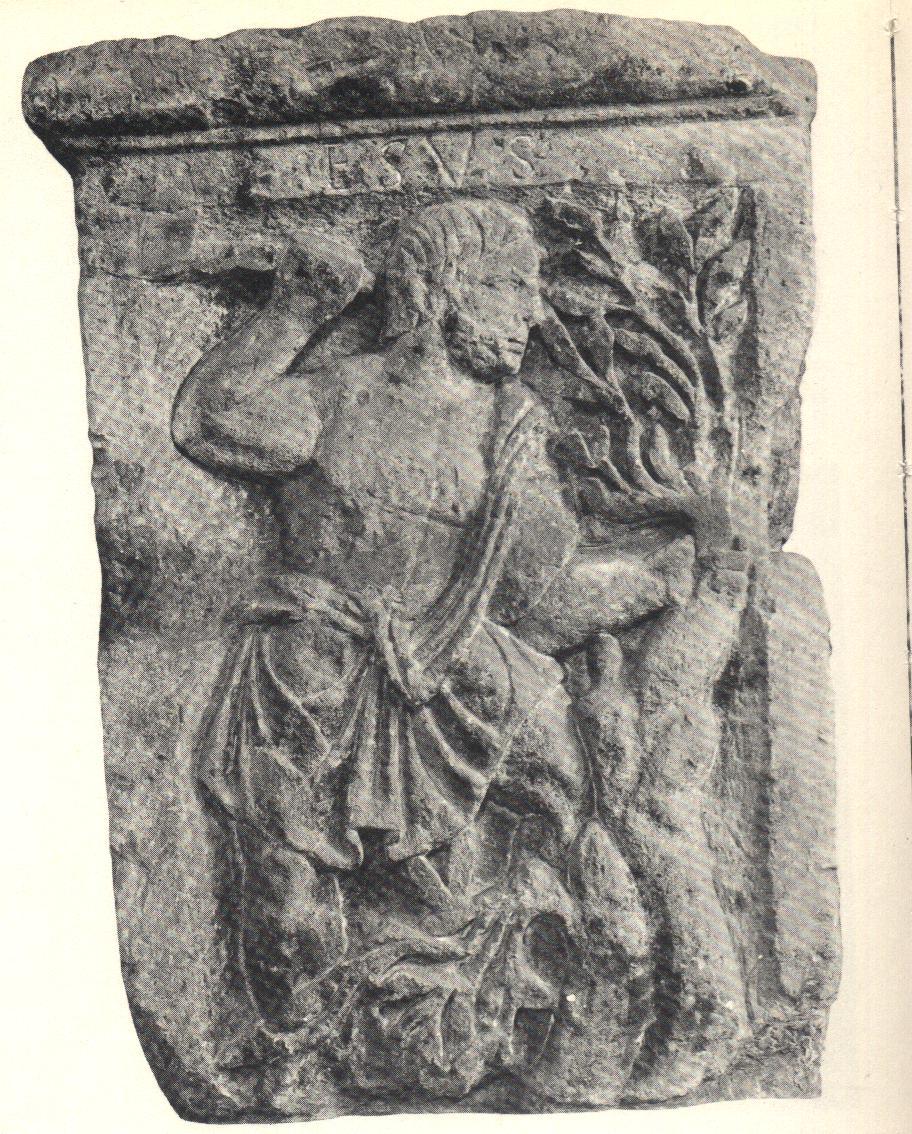
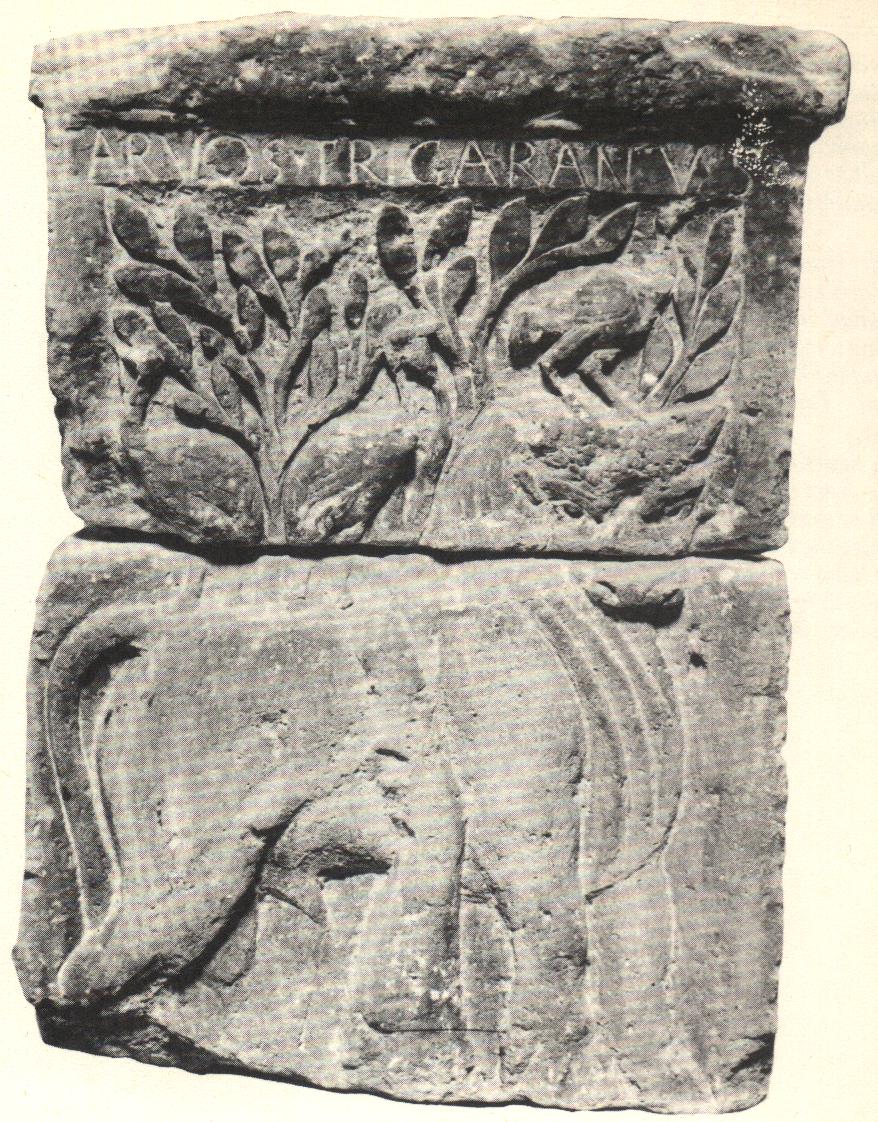
(Mac Cana, page 32, 33)
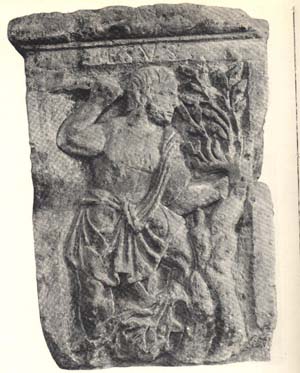
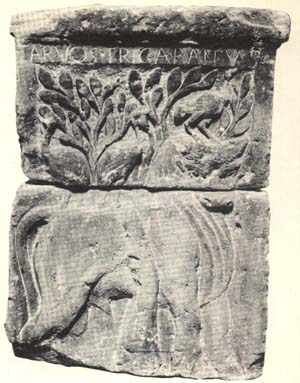 Reliefs
from a pillar dedicated to Jupiter by the 'Parisian mariners' between AD 14 and
37 and rediscovered in 1711 under the choir of the cathedral of Notre Dame in
Paris. One shows the god Esus cutting branches from a tree. In the
other there is a similar tree with a bull surmounted by three birds. It
bears the title Tarvos Trigaranus, 'The Bull with Three Cranes'.
That these two adjacent scenes belong together is confirmed by a relief from
Treves (page 35) in which a man, similarly dressed in short working tunic,
appears to be hacking the trunk of a tree in whose foliage are visible the head
of a bull and the same three birds. These three components, the sacred
tree, the divine bull and the triad of otherworld birds, are familiar features
of insular Celtic tradition, and obviously we have to do here wit some episode
from a myth. Unfortunately its precise content can only be
conjectured. Musee de Cluny, Paris.
Reliefs
from a pillar dedicated to Jupiter by the 'Parisian mariners' between AD 14 and
37 and rediscovered in 1711 under the choir of the cathedral of Notre Dame in
Paris. One shows the god Esus cutting branches from a tree. In the
other there is a similar tree with a bull surmounted by three birds. It
bears the title Tarvos Trigaranus, 'The Bull with Three Cranes'.
That these two adjacent scenes belong together is confirmed by a relief from
Treves (page 35) in which a man, similarly dressed in short working tunic,
appears to be hacking the trunk of a tree in whose foliage are visible the head
of a bull and the same three birds. These three components, the sacred
tree, the divine bull and the triad of otherworld birds, are familiar features
of insular Celtic tradition, and obviously we have to do here wit some episode
from a myth. Unfortunately its precise content can only be
conjectured. Musee de Cluny, Paris.
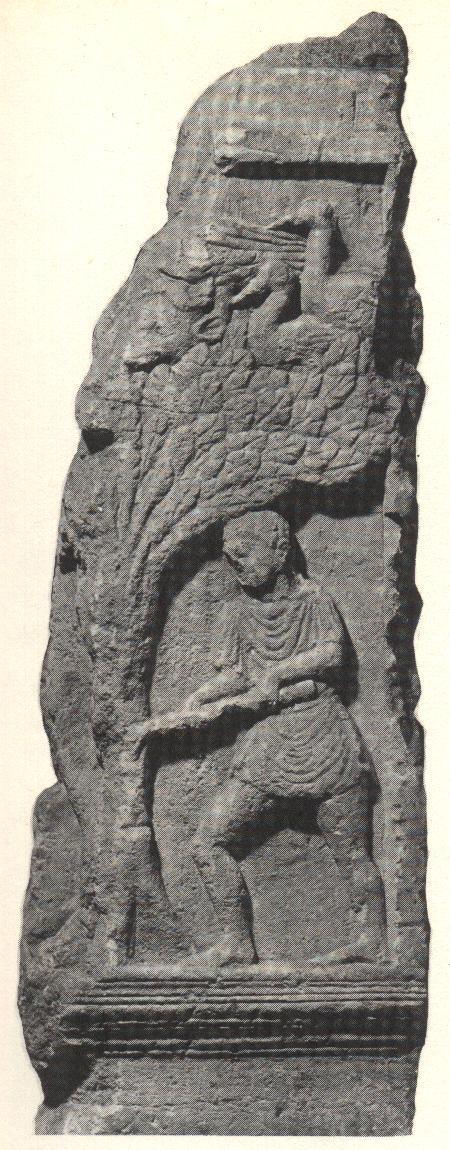
 (Mac Cana, page 35)
The
relief from Treves which corresponds to the Paris reliefs of Esus and Tarvos
Trigaramus. It shows a woodcutter attacking a tree on which repose three
birds and the head of a bull. Landes-museum, Trier.
Okay, so what do other people say about Esus? Keep in mind that this is
secondary info, and not necessarily reliable. What I plan to do is put stars
next to each entry detailing what I think their worth is (take that info or
leave it, it's up to you).
There was a sampling above with Mac Cana's stuff next to the pictures. What else does he have to say about Esus?
The following sources have info about Esus, and I'll quote and cite them as
best as I can:
Ellis, Peter. The Druids. Grand Rapids, MI: Wm. B. Eerdmans Publishing Co., 1994. (p. 127)
Lucan adds to our knowledge of Celtic gods by stating that Esus,
Taranis and Teutates were also worshipped. He refers to 'uncouth
Esus of the barbarous altars' who has to be propitiated by human
sacrifice. Esus appears in the guise of a muscular woodcutter on
a relief dedicated to Jupiter c.AD 14-37, rediscovered in 1711 under
the choir of Notre Dame cathedral in Paris. A similar depiction was
found from the same century at Trier.
Green, Miranda J. Dictionary of Celtic Myth and Legend. Thames & Hudson, March 1992.
(p. 93-94)
Esus The Roman poet Lucan described in a poem, the Pharsalia,
dating from the 1st c. AD, the last grate battle in the civil war between
Pompey and Caesar. In it, he alludes to the journey of Caesar's troops through
southern Gaul and their encounter with three Gaulish gods: Taranis, Teutates
and Esus (Pharsalia I, 444-6). Lucan describes this triad as cruel,
savage and demanding of human sacrifice: 'horrid Esus with his wild altars'.
In later commentaries on Lucan's poem, probably dating from the 9th c. from
Berne, Esus is mentioned as being propitiated by human sacrifice (see
SACRIFICE, HUMAN): men were stabbed, hung in trees and allowed to bleed to
death. The two commentators equate Esus with Mars and Mercury respectively,
but this may not pose as great a problem as it first appears, since the word
'Esus' is not so much a name as a title, meaning 'Lord' or 'Good Master'.
Whilst the implication of Lucan's description is that Esus was an important
and powerful Gaulish divinity, this is belied by the archaeological evidence
in which Esus may be traced to only two monuments. The more significant stone
forms part of the pillar dedicated to Jupiter by Parisian sailors in the reign
of Tiberius. The block from Paris was found with five others in 1711 on the
site of Notre-Dame. The Esus stone itself is inscribed with his name, and
beneath this is a depiction of a muscular god chopping at a branch of a willow
tree. On a juxtaposed scene is another willow, a bull and three cranes or
egrets, with the inscription 'TARVOSTRIGARANUS'. Essentially similar
iconography recurs on a 1st c. AD stone at Trier, where an unnamed woodcutter
attacks a willow in which repose three egrets and the head of a bull.
The symbolism of the two monuments, whilst not identical, is sufficiently
similar and idiosyncratic for it to be possible to identify the presence of
Esus on both. In addition to the image of the woodman, the willow, the marsh
birds and bull appear on the Paris and Trier images. The iconography is
obscure, but there is a natural association between bulls, birds, and willows:
egrets feed on parasites in cattle hide; they, like the willow, are
inhabitants of marsh or water margin, and egrets nest in willows. The
woodcutting scene is problematical in terms of interpretation. It has been
suggested that Esus prunes the tree for sacrificial purposes. It may be that
there is a cyclical imagery in the destruction and rebirth of the Tree of Life
in winter and spring: the birds may represent the soul in flight, perhaps the
soul of the tree itself; the bull could himself be a sacrificial beast.
Seasonal imagery may also be present in the symbiotic relationship enjoyed
between bull and birds, which are of mutual benefit to one another. Finally,
it should be recalled that trees are associated with Esus not simply in the
iconography buy also in the Berne commentaries which describe the fate of
Esus' sacrificial victims.
Mac Cana 1983, 29, 33; Zwicker 1934-6, 50; Dufal 1976, 26-7; 1961, 197-9; Ross
1967a, 279; Esperandier, nos. 3134, 4929; C.I.L. XIII, 3656.
MacCulloch, John A. Celtic Mythology. Academy Chicago Pub, February 1996. (p. 157-158)
They [the Setanii and Brigantes] had a well-known god, Esus, whom d'Arbonis
identifies with Cuchulainn; whence the story (of Cuchulainn) is of Gaulish
origin, perhaps taught by the Druids; and it was ultimately carried to Ulster,
where it was received with enthusiasm.* The identification rests on certain
figured monuments, in the persons, names, or episodes of which M. d'Arbois sees
those of the saga. On one altar Esus is cutting down a tree, while on the same
altar is figured a bull on which are perched three birds, this animal being
entitled Tarvos Trigaranos -- "the bull with three cranes" (garanus), unless the
cranes are a rebus for the three horns (karenos) of divine animals. On another
altar from Treves a god is cutting down a tree, and in its branches are a bull's
head and two birds -- a possible combination of the incidents on the other
altar. M. d'Arbois regards this as illustrating the Tain. Esus, the woodsman, is
Cuchulainn; his action depicts what the hero did -- cutting down trees to bar
the way of Medb's host; "Esus" is derived from words meaning "anger," "rapid
motion," such as Cuchulainn often displayed. The bull is the Brown Bull; the
birds are the forms in which Morrigan and her sisters appeared,** though these
bird-forms were those of the crow, not the crane; the personal names Donnotaurus
is found in Gaul and is equivalent of the Donn Tarb -- the "Brown Bull."***
*D'Arbois [b], pp. 25, 65 f.,RCel xx. 89 (1899).
**D'Arbois [b], pp. 63, RCel xix. 246 (1898), xxviii. 41 (1907); cf. S Reinach,
in RCel xviii. 253 f. (1897).
***Caesar, De bello Gallico, vii. 65; d'Arbois [b], p. 49, and RCel xxvii. 324
(1906).
MacKillop, James. A Dictionary of Celtic Mythology. Oxford University Press, November 2000.
Esus, Hesus. Important god of ancient *Gaul, known both from Latin commentaries and from archeological evidence; often mentioned in the company of the Gaulish gods
*Taranis and *Teutates. Although he testimony of Lucan (1st cent. AD) has been challenged as biased against the Gauls and contrived to pander to metropolitan prejudices, it cannot be ignored. He portrays an 'uncouth Esus of the barbarous altars'. Human sacrifices are suspended from trees and ritually wounded; unnamed priests read omens from the way the blood ran from the wounds. Ancient scholiasts linked Esus to both *Mercury and *Mars, the latter implying that he might be a patron of war. Depictions of Esus as a woodcutter have prompted much
imaginative speculation, but the
earlier suggestion of a link between Esus and *Cuchulainn now seems ill-founded. One temple features three symbolic representations of *egrets; he is also associated with the *crane.
Although Esus' cult was thought confined to Gaul, the discover of *Lindow Man, the body of an ancient human sacrifice found in Cheshire in 1984, implied to some commentators the propitiation of Esus in Britain. Although Esus was worshipped in many parts of Gaul, he appears to have been the eponymous god of the Esuvii of northwest Gaul, on the English Channel,
coextensive with the modern French Department of Calvados. In popular etymology his name is commemorated in the Breton town of
*Esse. See Waldemar Deonnna, 'Les Victimes d'Esus, Ogam, 10 (1958), 3-29; Paul-Marie Duval,
'Teutates, Esus, Taranis', Etudes Celtiques, 8 (1958), 41-58; Anne Ross, 'Esus et les trois
"Grues"', Etudes Celtiques, 9 (1960/1), 405-38.
de Vries, Jan. Keltische Religion. Stuttgart, Germany: W.
Kohlhammer, 1954.
p. 97: "Hesus Mars is placated thus: men are suspended in trees even until the parts of the leg have separated."
p. 97: "They are believed to be Hesus Mercurius, if indeed he is worshiped by sailors."
p. 98: "It can hardly be ascertained where he was worshipped. The just mentioned sources point, at any rate, to a not inconsiderably widespread distribution. That his cult flourished mainly in the area around Paris is at least likely.
Three clues offer themselves to the meaning of this deity: 1. his name 2. the kind of sacrifice offered to him 3. the ritual act on the altars from Paris and Trier. We will
examine them in turn.
The word "Esus" is not unknown in Gaulish. We find it in the personal names Esunertus, Esumagos, Eusmopas, Esugenus (n. 4. This name is found in Irish Eogan, in Welsh Ewein,
Owain); even simply as Hesus. Perhaps also the name of the Esuvii tribe belongs to it. The explanation of this word can be broken up further, however. Dom Martin seeks a connection with the Breton word (h)euzuz, meaning "terrible." Others have thought it from Italic aisus, esus, "God," and the Etruscan Erus or also from the Latin herus, "Lord, Master." On the other hand, Vendryes explains the name from esu, "good" (cf. Gk. eus and also archaic Indic asura); but we hardly get the impression of a good god from the Berne scholia. Others would like to derive it from the Indo-European root *is, "to desire;" then arguing the sense: the one who fulfills men's desires. Perhaps better might be the derivation from the root *eis, which means "energy, passion." These are, however, only possibilities, which prove one more time that one can't come far with etymology.
That the scholia refer to horrible sacrifices also give us few clues to the significance of the god. Already the expression membra digesserit can not be understood. Must one understand by it, "to tear up, to cup up?" Or do we rather have to deal here with a disposition of the limbs after the blood has flowed out? It is important that the sacrifice would be hung from a tree, because a tree likewise stands out as full of meaning in the pictured representations. The objection that we hear only seldom of hanging rituals among the Celts and that the chopping off of lime is completely unknown
[ed. note: begin p. 99] says little. What do we know about the bases of Celtic sacrifice? What the classical authors have told us of it is in any case terrible enough. If we consider the reports of these sacrificial practices reliable, Esus must seem to us to be a god of little friendliness.
Finally, the portraits from both altars. Two hat purpose does the god strike a tree? It seems to me completely erroneous to think of a simple forester god, and to connect Esus with clearing-work, or to see in him at all a manual laborer who provided the nautae of Paris with the necessary workforce for their ships. Likewise it is incorrect that the cutting down of trees would be regarded as a death, and then further to remind us of Maypole rituals. It seems even more to me that Esus in the picture is cutting the limbs of a tree; if one imagines that sacrifices for him were only just hung on the tree, once comes perhaps to the conclusion that god would have been shown here by the injury of a tree for the hanging-sacrifice.
We must admit, with W. Deonna, that the meaning of the myth is for us incomprehensible; perhaps the picture only refers to a single piece of the ritual. At any rate, I would like to assert that there can be not talk of a "rural" god of clearing-work. The relief of the blocks from Paris represents him in the same rank as Jupiter and Volcanus. The Berne scholiasts compare him with the great Roman god; it remains only questionable whether he is Mercury o Mars or perhaps neither of them. The Esus-complex has also been compared with Hercules, and it has been pointed out in that regard that figures of bas-reliefs with the name Smert� are themselvves found; one could consequently think of a Gaulish Herakles or Donar, thus of a god of physical strength.
But that will not explain the hanging-sacrifice. When one accordingly takes this into consideration, the comparison with Mercury gains special meaning. If the German Mercury is simply Woden-Odhin, this go stands in undoubted connection with an act of sacrifice by means of hanging. It can likewise be said of both gods that they are also gods who protect travel: Odhin is called:
[ed. note: obscured], thus "god of cargo;" he gives mariners good winds. The Paris altar was erected by nautae. On the other hand, one is reminded how cautious one must be with one's interpretation. Great gods are always ambivalent; their power extends into many areas of life. Odhin is not only a god of force, but of tricks and intrigues, of crafts and skillfulness. Exactly for these reasons could the mariners have worshipped him. The god to whom the hanging-sacrifice was offered was also, however, a cruel god. In that vein one could point to the name "Esus," if one accepts O'Rahilly's etymology; but also the interpretation of Vendryes deserves consideration, if one thinks that the name "the good god" is perhaps to be considered as only a euphemism.
All in all: the account of the hanging-sacrifice and the picture on the Paris altar sets out as the nearest course of assumption that Esus was a name for the head god of the Gauls and perhaps most likely to be compared to Mercury and the northern Germanic
Odhin.
What can I infer from these sources? Well, let's start with the pictures,
shall we?
Esus is represented with certainty only three times. You see those three
above. In the first representation, we see Esus represented as a bearded man
wearing a loose tunic of slightly togaish character and I find it interesting
that He isn't wearing trousers. The Gauls would have worn trousers, and I assume
that this representation, dated to 14 AD, is a Romanized representation.
Interestingly, the term applied to a man wearing only a tunic was nudus
in Latin, and thus we have a God who appears to do the work of a common man
(i.e. a woodcutter) being represented on the level of that common man.
It does seem that He is cutting down a willow tree with his hand-axe,
representing a possible connection with the breaking of barriers and the areas
between worlds (the willow tree stands at the place between the worlds of land
and water).
So now you want to know how I see him, hmm?
For now, you'll have to wait. I'll update soon. First I want to get the
scholar's works out of the way.
Back to the Patrons
Index.
Back to the Dedicant's
Index.
Email me!
 Reliefs
from a pillar dedicated to Jupiter by the 'Parisian mariners' between AD 14 and
37 and rediscovered in 1711 under the choir of the cathedral of Notre Dame in
Paris. One shows the god Esus cutting branches from a tree. In the
other there is a similar tree with a bull surmounted by three birds. It
bears the title Tarvos Trigaranus, 'The Bull with Three Cranes'.
That these two adjacent scenes belong together is confirmed by a relief from
Treves (page 35) in which a man, similarly dressed in short working tunic,
appears to be hacking the trunk of a tree in whose foliage are visible the head
of a bull and the same three birds. These three components, the sacred
tree, the divine bull and the triad of otherworld birds, are familiar features
of insular Celtic tradition, and obviously we have to do here wit some episode
from a myth. Unfortunately its precise content can only be
conjectured. Musee de Cluny, Paris.
Reliefs
from a pillar dedicated to Jupiter by the 'Parisian mariners' between AD 14 and
37 and rediscovered in 1711 under the choir of the cathedral of Notre Dame in
Paris. One shows the god Esus cutting branches from a tree. In the
other there is a similar tree with a bull surmounted by three birds. It
bears the title Tarvos Trigaranus, 'The Bull with Three Cranes'.
That these two adjacent scenes belong together is confirmed by a relief from
Treves (page 35) in which a man, similarly dressed in short working tunic,
appears to be hacking the trunk of a tree in whose foliage are visible the head
of a bull and the same three birds. These three components, the sacred
tree, the divine bull and the triad of otherworld birds, are familiar features
of insular Celtic tradition, and obviously we have to do here wit some episode
from a myth. Unfortunately its precise content can only be
conjectured. Musee de Cluny, Paris.