| Choosing Your Pair First you need to find a good breeder to buy your bettas from. You will be looking for the genes you want to reproduce or improve. Good finnage and color is important if you looking to breed show quality bettas. If this is just a little hobbie a pet store fish will be fine. They are cheaper and easier to get. Only problem is they are usually too old to breed. That doesn't apply to them all though. Another thing is pet store fish have crappy genes and therefore are not worth much. So its probably a better idea to go ahead and buy the better fish. When you buy your bettas be sure to get more than one male and female. This is because they may be stubborn and not want to breed. Bettas can be picky about who they breed with. Sometimes they just wont like eachother....ever. I hyave also had pairs that would only breed with eachother and no other. Maybe it's love...ha ha. When you choose your bettas be sure they look healthy and disease free. They should be active with a big appitite, and fins should be free of brown ragged edges and spots (good sign of fin rot). I recomend you read the disease section of my site so you will be familiar with symptoms. Do not buy the bigger fish. Sure they may be prettier but the big ones are usually the older ones. The smaller, younger, more active fish is exactly what you want. About 4 to 6 months old. Your male and female should be roughly the same size. If the male is smaller he will have trouble wrapping around the female. Same thing if she is too small. If your female is too big she may beat up your male too. This will probably happen anyway, but if she is not huge compared to him she may not hurt him too bad. If she is too small she may be the one getting hurt badly. |
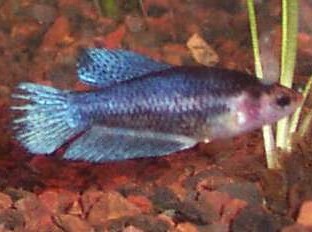
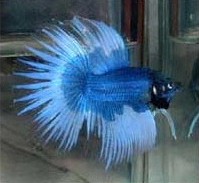
| How to Tell a Male and Female Apart Male bettas have longer flashier fins and are usually more brightly colored than the females. They also flare more and tend to be more aggressive than females. Female bettas have much shorter fins and are usually not as colorful, altho some females are. They often have a buldging bellys full of eggs and an ovipositor which appears as a white spot under their bellies, between their ventricals and anal fin. (Can you see it in the picture?). |
 |
 |
| ,jbkhg |
| ,jbkhg |