African Animals
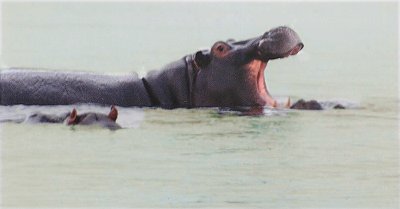 a Hippo in a river living her everyday life.
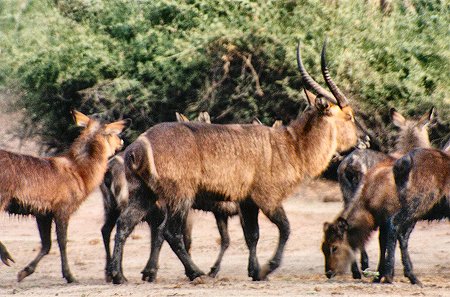 Bushbuck hanging out with their friends.
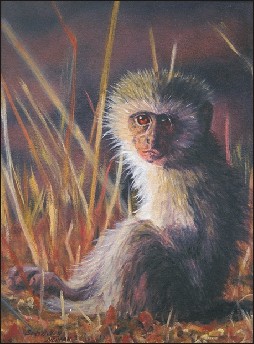 a baby Vervet.
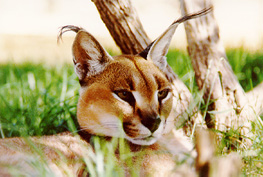 Caracal
are in the Lynx family and have been classified in the same genus as lynx (Lynx) and also with the other small cats (Felis). Caracals are known and called by many names which come from their many subspecies such as the African Caracal, Asian Caracal, African Lynx, Persian Lynx, Caracal Lynx or Desert Lynx. Some other more widely recognized members of the Lynx family include the North American Bobcat, the Canadian Lynx and the larger Siberian Lynx. This handsome cat has dense short reddish-brown fur. Under parts of the chin and body are white in color and Caracals have a narrow black line which runs from the corner of the eye to the nose. Although closely related to the Lynx, it is smaller in stature and has a much longer tail. Caracal is a Turkish word meaning "black eared". They are capable of tremendous aerial acrobatic jumps. Caracals have the claim to fame of being the "fastest of all the small cats".
Like the other lynx species, the Caracal possess a very unique distinguishing physical feature. Its ears are long, narrow and tipped with long black tufts of black hair on top of each ear. These notorious long "ear tufts" can be as long as 3 inches and actually serve an important purpose which helps insure the Caracals survival. In most cases, everything in nature has a purpose. In this case, not only do the ear tufts help direct sound waves into the animals ears, but they also help reduce noise created when the animals head disturbs low lying branches. This allows the Caracal to approach very close to its prey when hunting by helping silent the Caracal's approach which maximizes the probability of catching prey. In the wild, they are notorious bird hunters. They are so good at hunting birds that some African airports have been known to keep a few Caracals on the grounds as living scarecrows. The mere sight of a Caracal is enough to keep birds away. In case some of you have no clue on why birds are dangerous to airports; it is because bird impacts can cause engine failures.
Caracal
are in the Lynx family and have been classified in the same genus as lynx (Lynx) and also with the other small cats (Felis). Caracals are known and called by many names which come from their many subspecies such as the African Caracal, Asian Caracal, African Lynx, Persian Lynx, Caracal Lynx or Desert Lynx. Some other more widely recognized members of the Lynx family include the North American Bobcat, the Canadian Lynx and the larger Siberian Lynx. This handsome cat has dense short reddish-brown fur. Under parts of the chin and body are white in color and Caracals have a narrow black line which runs from the corner of the eye to the nose. Although closely related to the Lynx, it is smaller in stature and has a much longer tail. Caracal is a Turkish word meaning "black eared". They are capable of tremendous aerial acrobatic jumps. Caracals have the claim to fame of being the "fastest of all the small cats".
Like the other lynx species, the Caracal possess a very unique distinguishing physical feature. Its ears are long, narrow and tipped with long black tufts of black hair on top of each ear. These notorious long "ear tufts" can be as long as 3 inches and actually serve an important purpose which helps insure the Caracals survival. In most cases, everything in nature has a purpose. In this case, not only do the ear tufts help direct sound waves into the animals ears, but they also help reduce noise created when the animals head disturbs low lying branches. This allows the Caracal to approach very close to its prey when hunting by helping silent the Caracal's approach which maximizes the probability of catching prey. In the wild, they are notorious bird hunters. They are so good at hunting birds that some African airports have been known to keep a few Caracals on the grounds as living scarecrows. The mere sight of a Caracal is enough to keep birds away. In case some of you have no clue on why birds are dangerous to airports; it is because bird impacts can cause engine failures.
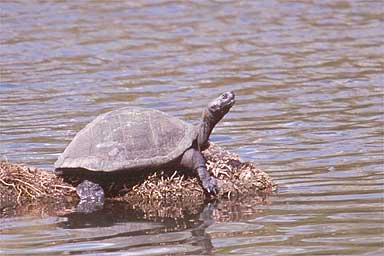 African Mud TurtleMud turtles are small semi-terrestrial turtles, and make excellent pets. Like many other turtles, mud turtles are omnivorous, and prefer damp, sandy, or muddy dwellings as their name suggests. Common mud turtles rarely grow to sizes beyond 5 inches, and are therefore easy to keep indoors, or outdoors. Like most other turtles and reptiles, mud turtles love to bask in the sun's rays
Mud turtles usually breed between March and May, and they can live to be over 50 years old, providing they can steer clear of predators. Mud and their close relatives the musk turtles (also known as stinkpots), can secrete a foul smelling fluid from their anal scent glands. Mud turtles raised in captivity may never even use this defense mechanism, as it is only used as a last resort against predators in the wild.
Male mud turtles are generally larger than the female of the species, and have larger heads and thicker tails.
Mud turtles are omnivorous, but in general they prefer to eat insects, tadpoles, and fish. Special turtle food will also do in captivity. As it is with other pet turtles, a large tank is recommended, and you must provide a sizeable dry land area so the turtle can rest, and enough clean (not muddy) water for it to be able to enjoy an refreshing swim. Because of their smaller size, mud turtles are easier to accommodate indoors; however, if you decide to set up your mud turtle's habitat outside the house, bear in mind that they, like the box turtle, like to hibernate. For this, the pen should have a sheltered and muddy area, as mud turtles will generally dig deep in the mud to hide during the winter months.
African Mud TurtleMud turtles are small semi-terrestrial turtles, and make excellent pets. Like many other turtles, mud turtles are omnivorous, and prefer damp, sandy, or muddy dwellings as their name suggests. Common mud turtles rarely grow to sizes beyond 5 inches, and are therefore easy to keep indoors, or outdoors. Like most other turtles and reptiles, mud turtles love to bask in the sun's rays
Mud turtles usually breed between March and May, and they can live to be over 50 years old, providing they can steer clear of predators. Mud and their close relatives the musk turtles (also known as stinkpots), can secrete a foul smelling fluid from their anal scent glands. Mud turtles raised in captivity may never even use this defense mechanism, as it is only used as a last resort against predators in the wild.
Male mud turtles are generally larger than the female of the species, and have larger heads and thicker tails.
Mud turtles are omnivorous, but in general they prefer to eat insects, tadpoles, and fish. Special turtle food will also do in captivity. As it is with other pet turtles, a large tank is recommended, and you must provide a sizeable dry land area so the turtle can rest, and enough clean (not muddy) water for it to be able to enjoy an refreshing swim. Because of their smaller size, mud turtles are easier to accommodate indoors; however, if you decide to set up your mud turtle's habitat outside the house, bear in mind that they, like the box turtle, like to hibernate. For this, the pen should have a sheltered and muddy area, as mud turtles will generally dig deep in the mud to hide during the winter months.
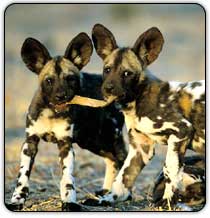 African Wild Dogs are the size of medium domestic dogs. Their Latin name, Lycaon pictus, means "painted wolf-like animal." Their coats are mottled in shades of brown, black and beige. They have large, rounded ears and dark brown circles around their eyes. The dogs differ from wolves and other dogs in that they have four toes instead of five. African wild dogs face a number of serious threats, including habitat loss, human persecution (hunting and poisoning), disease spread from domestic animals and isolated populations.
African wild dogs live and hunt in groups called packs. Packs typically include an alpha (dominant) male and female, their offspring and other related members. Historically, more than 100 dogs gathered in packs during spring migrations, but today the average pack of African wild dogs contains approximately 10 members. Unlike other canine species, packs of wild dogs frequently contain more male members than female members.
 Zebra
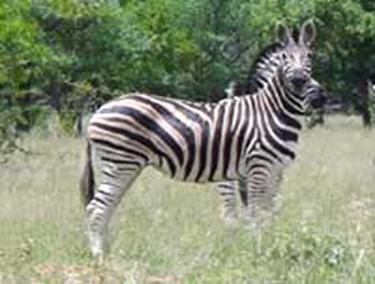
Black ground color with bold contrasting stripes continuing all the way down to hooves; rarely any shadow stripes, except occasionally and faintly on hindquarters. Seven to ten neck stripes; three to four vertical body stripes. Short, upright mane. Tail terminally haired. Shoulder height 50�; weight 500-600 pounds. These zebras live in stable family groups of up to 17 animals headed by a single stallion (Sometimes two stallions are part of the group, but one will be dominant). Mares stay with the group; offspring leave. Females establish a dominance hierarchy. During travel, group is led by the dominant female and her foal, followed by other females in their order of dominance. Members recognize each other by sight primarily, but also by voice and smell. Families maintain close bonds even during extended migrations with thousands of other zebra and wildebeest. The family will slow its pace to allow weak ones to keep up; they don�t leave them. The stallion is the rear guard when the family flees from a predator. Zebras are gregarious under conditions of abundant food or around water holes. Males have displays, including a sort of barking whinny, that seem to minimize aggression at such times. Males are not sexually mature until 5 to 6 years of age, although in zoos breeding may occur at 3 years of age. Until old enough to establish their own breeding groups, young males remain with their families or leave to form bachelor herds of 2 to 10 individuals. However, they retain good relationships with their fathers. Females have first estrous at 13-18 months but do not become fertile for another year. Young females have a characteristic stance during estrous which attracts nearby males who then attempt to abduct her. The abductor may have to fight her father to acquire her. She may be abducted by several males until she learns not to show estrous. This forceful removal from the family acts to prevent inbreeding.Under ideal conditions, a female may produce a foal every year. One young is born after a gestation of 361-390 days (about one year). Newborn has brown stripes and is short-bodied and long-legged. Weight 66-76 pounds; height 33�. Female guards her baby from other members of the herd when it is first born, perhaps giving it time to learn her pattern of stripes. Foals are very attached to their mothers; bond lasts until birth of next foal. Life span is up to 28 years.
Zebra
Black ground color with bold contrasting stripes continuing all the way down to hooves; rarely any shadow stripes, except occasionally and faintly on hindquarters. Seven to ten neck stripes; three to four vertical body stripes. Short, upright mane. Tail terminally haired. Shoulder height 50�; weight 500-600 pounds. These zebras live in stable family groups of up to 17 animals headed by a single stallion (Sometimes two stallions are part of the group, but one will be dominant). Mares stay with the group; offspring leave. Females establish a dominance hierarchy. During travel, group is led by the dominant female and her foal, followed by other females in their order of dominance. Members recognize each other by sight primarily, but also by voice and smell. Families maintain close bonds even during extended migrations with thousands of other zebra and wildebeest. The family will slow its pace to allow weak ones to keep up; they don�t leave them. The stallion is the rear guard when the family flees from a predator. Zebras are gregarious under conditions of abundant food or around water holes. Males have displays, including a sort of barking whinny, that seem to minimize aggression at such times. Males are not sexually mature until 5 to 6 years of age, although in zoos breeding may occur at 3 years of age. Until old enough to establish their own breeding groups, young males remain with their families or leave to form bachelor herds of 2 to 10 individuals. However, they retain good relationships with their fathers. Females have first estrous at 13-18 months but do not become fertile for another year. Young females have a characteristic stance during estrous which attracts nearby males who then attempt to abduct her. The abductor may have to fight her father to acquire her. She may be abducted by several males until she learns not to show estrous. This forceful removal from the family acts to prevent inbreeding.Under ideal conditions, a female may produce a foal every year. One young is born after a gestation of 361-390 days (about one year). Newborn has brown stripes and is short-bodied and long-legged. Weight 66-76 pounds; height 33�. Female guards her baby from other members of the herd when it is first born, perhaps giving it time to learn her pattern of stripes. Foals are very attached to their mothers; bond lasts until birth of next foal. Life span is up to 28 years.
 Elephant
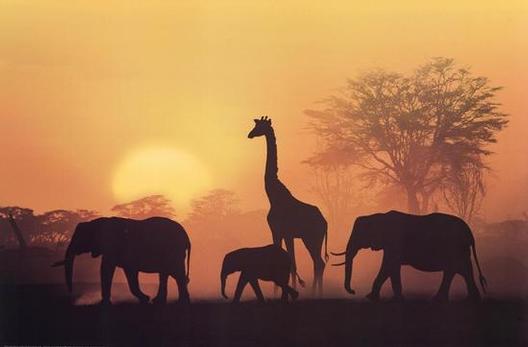
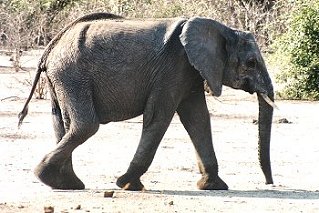
The adult male is much larger than the adult female. Head and body length including trunk: 19-24 feet. Shoulder height: 10-13 feet. Weight: 5.5 - 7 tons. Tail: 4 feet. Brownish gray skin has folds and may be one inch thick in places. The African Elephant has a marked dip between its fore and hindquarters giving a concave curvature to its back. Ears are large and fan-like. The trunk has two prehensile protrusions at the tip. Large tusks are present in both sexes. Elephants are digitigrade with pads of fibrous tissue to cushion toe bones. Elephants live in a complex matriarchal society normally composed of 8 to 15 related members and led by a dominant cow. Three or four generations of cows and calves spend their entire lives together with the exception of males, who leave the group at puberty. Groups of related families stay in fairly close range of each other and communicate often; these are called �kin groups�. In times of danger, kin groups will mass and form �clans� of 200 or more. Ongoing studies at Amboseli Research Center in Kenya indicate a complex bull dominance structure which determines mating success as well as every day life. Another primary mating factor is �musth�, a periodic hormonal cycle seen in both species. Physical manifestations in males include heavy secretions from temporal glands, high blood testosterone levels, urine dribbling (marking) and aggression. Cows seem to prefer a musth bull, but can successfully breed whether the bull is in musth or not. According to keepers our cows� oestrus cycles are roughly 15-16 week ones and last 3 days. Gestation is approximately 22 months. The birth is usually a single one; twins are born only 1.35% of the time. Birth weight is 175 to 250 pounds. The mother is often assisted by another cow during birthing. The calf can stand shakily and nurse (with mouth, not trunk) a few hours after birth. Mammary glands are located between the front legs. Calves will nurse well into their third year and are very dependent on their mothers for eight to ten years. Adolescence occurs at 12 to 14 years of age. Most physical growth is reached at 20, but growth continues throughout life. Top mental ability is at age 30 to 45. Death comes at 65 to 70 years of age when the last set of teeth wear out.
Elephant
The adult male is much larger than the adult female. Head and body length including trunk: 19-24 feet. Shoulder height: 10-13 feet. Weight: 5.5 - 7 tons. Tail: 4 feet. Brownish gray skin has folds and may be one inch thick in places. The African Elephant has a marked dip between its fore and hindquarters giving a concave curvature to its back. Ears are large and fan-like. The trunk has two prehensile protrusions at the tip. Large tusks are present in both sexes. Elephants are digitigrade with pads of fibrous tissue to cushion toe bones. Elephants live in a complex matriarchal society normally composed of 8 to 15 related members and led by a dominant cow. Three or four generations of cows and calves spend their entire lives together with the exception of males, who leave the group at puberty. Groups of related families stay in fairly close range of each other and communicate often; these are called �kin groups�. In times of danger, kin groups will mass and form �clans� of 200 or more. Ongoing studies at Amboseli Research Center in Kenya indicate a complex bull dominance structure which determines mating success as well as every day life. Another primary mating factor is �musth�, a periodic hormonal cycle seen in both species. Physical manifestations in males include heavy secretions from temporal glands, high blood testosterone levels, urine dribbling (marking) and aggression. Cows seem to prefer a musth bull, but can successfully breed whether the bull is in musth or not. According to keepers our cows� oestrus cycles are roughly 15-16 week ones and last 3 days. Gestation is approximately 22 months. The birth is usually a single one; twins are born only 1.35% of the time. Birth weight is 175 to 250 pounds. The mother is often assisted by another cow during birthing. The calf can stand shakily and nurse (with mouth, not trunk) a few hours after birth. Mammary glands are located between the front legs. Calves will nurse well into their third year and are very dependent on their mothers for eight to ten years. Adolescence occurs at 12 to 14 years of age. Most physical growth is reached at 20, but growth continues throughout life. Top mental ability is at age 30 to 45. Death comes at 65 to 70 years of age when the last set of teeth wear out.
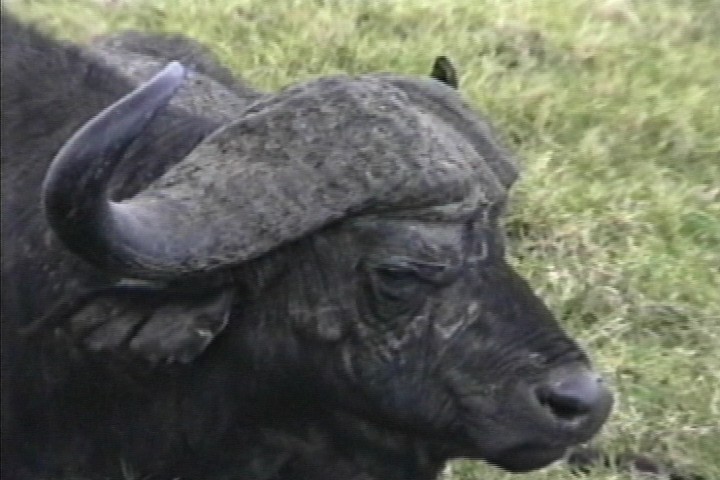 Cape Buffalo
The African, or Cape, buffalo is a member of the so-called "Big Five" group of animals, with the elephant, rhino, lion and leopard. Once popular trophies for hunters, these large and often dangerous animals have continued to capture the imagination. Buffaloes have earned a bad reputation from hunters and other people who come in close contact with them. They are unpredictable and can be dangerous if cornered or wounded. Though they have been known to ambush men and are often accused of deliberate savagery, they are usually placid if left alone. There is only one genus and one species of buffalo in Africa, but this single species has two different types: the large savanna buffalo and the much smaller dwarf forest buffalo. There are also several intermediate types. The buffaloes found in the forests of Kenya and Tanzania are the savanna type, however, and not the true forest buffalo, which occurs only in West Africa. Savanna buffaloes are large, heavy cowlike animals. They vary greatly not only in size, but in the shapes of their horns and color. Adults are usually dark gray or black (or even look red or white if they have been wallowing in mud of that color) and the young are often reddish-brown. The smaller forest buffalo maintains the red color even as an adult, although in western Uganda, many savanna buffaloes are also red or pale orange instead of black. Adults lose hair as they age. Both male and female buffaloes have heavy, ridged horns that grow straight out from the head or curve downward and then up. The horns are formidable weapons against predators and for jostling for space within the herd; males use the horns in fights for dominance.
Cape Buffalo
The African, or Cape, buffalo is a member of the so-called "Big Five" group of animals, with the elephant, rhino, lion and leopard. Once popular trophies for hunters, these large and often dangerous animals have continued to capture the imagination. Buffaloes have earned a bad reputation from hunters and other people who come in close contact with them. They are unpredictable and can be dangerous if cornered or wounded. Though they have been known to ambush men and are often accused of deliberate savagery, they are usually placid if left alone. There is only one genus and one species of buffalo in Africa, but this single species has two different types: the large savanna buffalo and the much smaller dwarf forest buffalo. There are also several intermediate types. The buffaloes found in the forests of Kenya and Tanzania are the savanna type, however, and not the true forest buffalo, which occurs only in West Africa. Savanna buffaloes are large, heavy cowlike animals. They vary greatly not only in size, but in the shapes of their horns and color. Adults are usually dark gray or black (or even look red or white if they have been wallowing in mud of that color) and the young are often reddish-brown. The smaller forest buffalo maintains the red color even as an adult, although in western Uganda, many savanna buffaloes are also red or pale orange instead of black. Adults lose hair as they age. Both male and female buffaloes have heavy, ridged horns that grow straight out from the head or curve downward and then up. The horns are formidable weapons against predators and for jostling for space within the herd; males use the horns in fights for dominance.