- The second model, that of Orthodox Christianity, among other religions, is that of an all powerful, all knowing, fully conscious, morally perfect diety (or pantheon of dieties) that predate man, and who reward those who do good in life and punish those who do evil, in the afterlife. One whom the worshipper prays to, for help.
This raises difficult philosophical issues immediately, the most obvious of which is the question of evil. How can such a being allow innocent people to suffer, or even be killed, while doing nothing to keep the guilty from doing them harm?
The defense that the being(s) in question doesn't inflict the harm, but merely allows it to happen, would, in effect, hold the deity to a lower ethical standard than that expected of those he supposedly provides moral guidance to. True, the deity, unlike the worshipper, would know for sure that the victim had better to look forward to, down the road. However, what would one think of an adult who allowed a child to be harmed in his presence, even if he knew that the harm would not be irreversible, if we knew that the adult could prevent the harm with little to no expenditure of effort?

|
We are also left with the question, in the case of most faiths, of why it is, if the deity is real, no mention was made of the faith's deity or deities prior to a particular point in history, or why worship of that diety ceased after some time? Why is it, for example, that the God of Israel, who so thoroughly objects to the worship of other deities (in the view of most Christian denominations), was silent for so many centuries before the advent of Judaism?
Some might say that those who lived before that time weren't ready for the worship of God, but what sort of readiness is needed? Personal worthiness? As the Christian scriptures themselves indicate, all fall short of the glory of God. None of us, in that view, who have ever live or ever will live, could every be worthy of God's grace, except perhaps for Jesus, and maybe St. Mary, if you believe that she was without sin, as the Roman Catholic Church teaches. As for conceptual readiness, Christian missionaries have won many converts in cultures tending to be no more sophisticated, philosophically, than those of pre-Christian, or even pre-Judaic antiquity. If the headhunter of today is ready for salvation, why wasn't Aristotle?
Are we to believe that he couldn't have understood the Christian faith? Or that if he could, that he would have been alone in this? The ancients weren't kind enough to understand a religion of love, perhaps? Yet, surely their culture was no harsher than some of those of the recently pre-Christian population of New Guinea, home now to many of the most devoted Christians alive.
Another question, is why one would pay to an omniscent being? Doesn't He already know what you're going to ask for, before you formally ask for it? Then why does He need to hear the request? For that matter, why does an omnipotent being, who is in no way dependent on our cooperation, concerned with our level of faith, when He decides to which degree he will grant our requests?
Would a kind and loving father, on seeing that His child was afraid - either that the father was no more, or had ceased to care enough to help His children through their troubles - turn His back on the child in peevish spite, or try a little harder to reassure His child that He did indeed care? What would we think of the maturity and decency of the father who chose the first option? Yet this very same mentality, condemned in the finite worshipper, is attributed without a second thought to the infinite, and all just God!
Some will speak of a coming (a long time coming) "Kingdom of God", a state of affairs in wish all suffering and injustice is banished from the world, and God's will defines the reality that people confront. If this, however, is so desirable, why does the omnipotent God wait, when He could make it all reality with a thought, in an instant? Also, while the God in question is claimed to be morally perfect, and all knowing, the morality of that diety, as recorded in His scriptures, often seems to evolve in time?
|
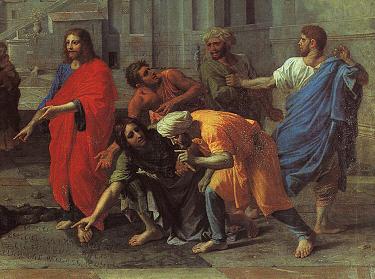
For example, in the Torah (the books of Genesis, Exodus, Leviticus, Numbers and Deuteronomy in the Bible), we have Moses initiating a campaign of genocide against the native population of Canaan, killing the children as well as the adults - hardly the sort of behavior that would sit well today in any Christian or Jewish congregation. Commandments are given to exclude members of certain ethnic groups from the worship of the Lord, and to execute people by stoning for the commission of adultery. Yet, later in the Jewish canon, we are told that the temple in Jerusalem is to be "a temple for all nations". If one is a Christian, one will see Jesus, the Lord, in one's scriptures, overturning the law regarding stoning. The harshness of the Law is every moderated, as the Law becomes more humane.
If God is changing His mind, then how does one resolve this contradiction? The argument has been offered, that the actions we see earlier in the Bible that strike us as being so reprehensible, were not so viewed at the time. This will explain the willingness of a human, with his finite perspective, to accept them. But, how does one explain their acceptance by a god who, presumably, would transcend the limitations of the thinking at the time?
Click to continue.