|
|
|
and instantly be in touch with me if I am online!
the author is a member of
|
Maori -- Origin of New Zealand
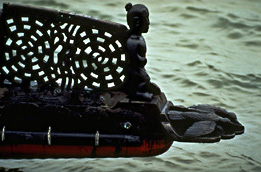
The Maori first came to New Zealand around 950 A.D. Legand has it that Kupe, a brilliant navigator, guided by the stars, set sail from his Polynesian homeland of Hawaiki. He and his people arrived at the North Island in 10 canoes. When he first sighted the land, it appeared as if a white voluminous cloud stretched over the land as far as the eye could see. Kupe named it Aotearoa -- Land of the Long White Cloud -- which is still the Maori name for New Zealand today.
Scientific evidence about the origin of Maori
Tracing the ancestries of groups of people from their genes often helps to confirm what was already suspected from archaeological or linguistic research. Now, a DNA study of Maori New Zealanders has confirmed something else: an oral history. New Zealand was the last big landmass to be settled by humanity. The archaeological evidence suggests that the first residents arrived a mere 800 years ago and that they came from the Society or Marquesas Islands in eastern Polynesia. According to the Maori�s own tradition, their ancestors were not accidental migrants. They deliberately set sail for New Zealand in a fleet of eight to ten canoes, and probably arrived some time in December. Various academics, however, have cast doubt on this version of history, suggesting instead that New Zealand was colonised by anything from a few castaways in a single canoe to 500 settlers arriving over the course of several generations. To resolve the debate, Rosalind Murray-McIntosh and her colleagues at Massey University, in Wellington, studied the DNA of a group of modern Maori. They looked at DNA from their subjects� mitochondria (these are the energy-generating components of cells, and have their own genes, separate from those in the cell nucleus). Mitochondrial DNA contains a region that is particularly prone to mutation, and studying this allows the relationship between living people to be worked out by looking at which mutations they have in common. Dr Murray-McIntosh and her colleagues examined mitochondrial DNA from 54 women. Using a computer, Dr Murray-McIntosh modelled the growth of these populations over 30 generations (corresponding to the 800 years of human habitation). By varying the size of the starting group, she was able to test what number of ancestors was most likely to have given rise to the genetic pattern seen today. According to these calculations, the founding group of settlers contained between 50 and 100 women, with 70 being the most likely number. Because mitochondrial DNA , unlike nuclear DNA , is passed only from mother to offspring, it gives no direct evidence for the number of men. But presumably there were at least 150 individuals in the founding group. The big sea-going canoes of the Polynesians could accommodate ten to 20 people each, so this estimate suggests that the ancestors of the Maori may well have arrived in the legendary eight to ten canoes.---- excerpt from The Economist Aug, 1998 � |




 E-mail Me: