
In
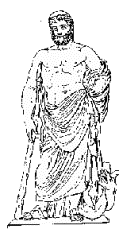
Greek mythology, Aesculapius (Aesclepius,
Asklepios; Latin: Aesculapius),
son of Apollo, often referred to, as the god of medicine or healing was a Greek
healer who became a Greek demigod, and was a famous physician. Aesculapius was
usually represented standing, dressed in a long cloak, with bare breast; his
usual attribute was a staff with a serpent coiled around it. His mother, the
nymph Coronis, a princess of Thessaly died when he was an infant. Aesculapius
was the most important among the Greek gods and heroes who were associated with
health and curing disease. Apollo is said to have entrusted the child's
education to the Centaur, Chiron. who taught Aesculapius the arts of healing.
Aesculapius, when grown, became so skilled in surgery and the use of medicinal
plants that he could even restore the dead to life. Hades, ruler of the dead,
became alarmed at this and complained to Zeus, who, fearing that he might render
all men immortal, killed Aesculapius with a thunderbolt. Among the children of
Aesculapius the best known are his daughters Hygeia and Panacea.
Asclepius,
or Aesculapius as he was known to the Romans, was revered as a divinely inspired
physician. Shrines and temples of healing known as Asclepieia were erected
throughout Greece where the sick would come to worship and seek cures for their
ills. Harmless serpents were kept in these temples of healing, lovingly tended
by Asclepiu's daughter Hygeia, the personification of health. Snakes were held
sacred by Asclepius and he himself was thought to sometimes appear in the form
of a snake. Patients who saw snakes in their dreams believed that the god of
healing himself had come to their aid. The ancient symbol of Aesculapius knotted
wooden staff around which a mystical snake is coiled. The staff of Aesculapius
with a coiled serpent became the traditional symbol of medicine.
Today it represents the modern medical profession, and is a
symbol of health and wisdom. In the Holy Bible, Moses held up a serpent on a
staff as an example of Christ, to heal the Jews.
Numbers
21 ‘
5And
the people spake against God, and against Moses, Wherefore have ye brought us up
out of Egypt to die in the wilderness? For there is no bread, neither is there
any water; and our soul loatheth this light bread. 6And the LORD sent
fiery serpents among the people, and they bit the people; and much people of
Israel died. 7Therefore the people came to Moses, and said, We have
sinned, for we have spoken against the LORD, and against thee; pray unto the
LORD, that he take away the serpents from us. And Moses prayed for the people. 8And
the LORD said unto Moses, Make thee a fiery serpent, and set it upon a pole: and
it shall come to pass, that every one that is bitten, when he looketh upon it,
shall live. 9And Moses made a serpent of brass, and put it upon a
pole, and it came to pass, that if a serpent had bitten any man, when he beheld
the serpent of brass, he lived.’
St.
John 3 ‘14And
as Moses lifted up the serpent in the wilderness, even so must the Son of man be
lifted everlasting life.up: 15That whosoever believeth in him should
not perish, but have eternal life. 16For God so loved the world, that
he gave his only begotten Son, that whosoever believeth in him should not
perish, but have everlasting life.’
WHO
Emblem with the
Aesculapius
Caduceus of Hermes
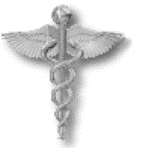
The
modern winged staffs, or caduceus (Greek Kerykeion meaning ‘Heralds Wing’),
showing twin snakes around a single slim staff (wand of Hermes), was the staff
of Hermes, or Mercury, in Greek and Roman mythology. It was a symbol of heralds
and commerce, and is NOT the traditional symbol of medicine. It is however found
today in various styles in medical, veterinary, chiropractic and dental symbols.
(Hermes was also the god of thieves.) The correct symbol - the staff of
Aescalapeus, has one serpent, instead of two.