Communication
Introduction
"Communication" stems from the Latin word meaning "common". It is the process of making common. “Language” is the vehicle used to communicate meaningful thoughts through a message. “Message” stems from the Latin word meaning “to send”.
Simply,
the source uses a language to package or encode his meaningful thoughts.
He then sends that code to the receiver.
Using the same language, the receiver decodes the message to derive its
contents. When both the source and the receiver share the meaningful
thought contained in the message, communication is complete.
Meaningful
Thought
A
thought exists in the mind by virtue of its meaning. The meaning defines the thought so that it can be “seen” (understood). Until it has at least
an outline, it remains at best, only a shadow—a vague awareness that
“something is out there, somewhere”. One
cannot “possess” a meaningless thought anymore than one can take hold of a
shadow. But, as a thought takes on
more meaning, it has substance and can be grasped.
As
a physical illustration, water exists in the air around us.
Most of the time, we are oblivious to its presence.
Occasionally, however, it increases in density, heightening our awareness
of its presence. Although the water
remains invisible, we see and feel the effects of high humidity.
Becoming more substantial, it makes a visible appearance as a cloud or
fog.
But, when it becomes so definite that it loses all of its nebulous
qualities, we see it as rain. At
that stage, we can actually handle it.
In
comparison, we remain oblivious to innumerable facts or thoughts around us.
As we feel the effects of these truths, our awareness increases.
But, whatever is out there remains obscure until it becomes delineated.
As it becomes more clearly defined, we begin to grasp the thought.
And, once we have it in our "hands", we possess it and can use it in much
the same way that man uses science to enhance life.
The
Quest
Man
is innately inquisitive. Even
infants seek knowledge of their surroundings by touching and tasting.
Instinctively, they communicate their findings using sound.
As communication skills develop, they seek information from others. They question everything in an effort to understand the
cause-and-effect relationship.
Indeed,
many parents have unwittingly tried to quench their children’s thirst for
fulfilled knowledge. Their attempts
often include words such as, “because I said so”.
But, to insist that someone simply accept a thought as truth is to deny them
the riches of actually possessing knowledge through understanding.
In
contrast, animals explore their surroundings in search of physical comfort and
pleasure rather than for understanding. Lacking
the ability to reason, animals simply react to stimuli.
A wolf has no interest in understanding the reason that his chosen den
varies in comfort level. All he
wants is a comfortable, dry den. Consequently,
he may spend his life wandering from place to place searching in vain for
a consistently comfortable home.
However, man does possess the unique ability to
reason. His faith or beliefs
determine his responses to stimuli. Acting
on his faith, he proves the validity of his beliefs.
Using his proven beliefs to test the validity of other thoughts, his
faith gradually becomes wisdom. Wisdom
is the understanding that defines thought.
That definition gives mental substance or visibility to the thought.
Definition removes the mystery of the “something, somewhere,” by
manifesting the invisible. Once the
thought is manifested or revealed, it can be possessed and applied in other
areas.
And, equipped with both the desire and the ability to
understand, man is also compassed about with a great cloud of understanding.
Yet, he remains as oblivious to it as to the water vapor that surrounds
his physical body. Comparable to humidity, when a thought increases in substance
(meaning, definition), man becomes more aware of its presence until he
can mentally see (understand) and take hold of (possess).
When man actually receives understanding, he can put it
in his storehouse, increasing his wealth of knowledge.
As
a result, man gradually rises above his circumstances.
As he gains understanding, he reverses roles with his environment.
He escapes the tyrannical rule of fear induced by unknown environmental
stimuli. Instead, he produces the
stimuli to which the environment must respond, progressively taking full dominion.
Meanwhile,
his growing arsenal of understanding enables him to foresee environmental
changes, prepare accordingly and divert disaster. This increases his favor with men, who desire to share the
benefits, if not the actual knowledge.
Unfortunately, man tends to have difficulty defining
his environment. Too often, he
directs his conquest toward other men. Desiring to control them, he fails to
recognize that his immediate world is his own body. The physical body is
merely his habitation; his true identity is the inner being that cannot be
diminished by physical amputations.
Indeed, all that is in the world is its own cravings. For all that is in the world, the lust of the flesh, and the lust of the eyes, and the pride of life, is not of the Father, but is of the world.(1 John 2:16) Man rules over his environment when he rules over his own body rather than being ruled by it. When he succeeds in that conquest, all other things fall into order. He will be content in whatever situation he finds himself. He ceases to compete for or withhold things other men want.
Establishing Contact
The first step in communication is to
establish contact. Contact gets the
receiver’s attention by triggering a sensory detector.
Man has five sensory detection modes: hearing, seeing, touching,
smelling, tasting.
Several variables deserve consideration.
First, multi-sensory signals compensate for possible short-circuited or
low sensitivity detectors. Second,
omni-directional signals require lower intensities to avoid injury to either detectors or receivers. Third,
even moderate intensity levels can be destructive over long periods of time.
Therefore, multi-sensory, omni-directional, or continuous signals
necessitate lower intensity. Conversely, stronger signals require more focus and shorter duration.
Response
Unfortunately, establishing contact does not
guarantee that successful communication will follow. Success depends upon the receiver’s response.
Of the four possible responses to a signal, only one results in
successful communication.
In
the first possible response, the receiver detects the signal but dismisses
it as meaningless. He may perceive it as
foolishness, coincidence, or imagination, etc. Even if he appreciates it
as a source of pleasure, the value is short-lived; he will begin to take it for granted
and seek other pleasures. Regardless,
deeming the signal as
meaningless, he allows the signal to be snatched away from his attention.
Nothing results from the original signal.
In
the second possible response, the receiver detects the signal and
recognizes that it is meaningful. Optimistically,
he anticipates obtaining its meaning and endeavors to decode the signal.
Focusing intently on the signal, he becomes aware of an overall pattern.
He reaches a stage equivalent to seeing and feeling the effects of
humidity. But, lacking patience and diligence, he abandons the hope of
ever discovering the signal's meaning. Thus, he falls away from the
pursuit. Nothing results from the original signal.
In
fact, a strong desire for closure may prompt him
to provide a meaning out of his own imagination or to accept someone else’s
word. While the latter may be
accurate, it is only another signal to the receiver until it becomes clearly
defined in his mind. It, too, must
become mentally visible and finally grasped in order for him to possess it.
Without possession, nothing can be added to his storehouse.
Deceiving himself that he is increased with goods, he hoards signals
devoid of substance. Nothing
results from the original signal.
In the third possible response, the receiver detects the signal, recognizes that it is meaningful, and diligently pursues its meaning until the signal begins to take on substance. He distinguishes the overall pattern as well as sequencing within the pattern. But, at a stage equivalent to seeing a cloud or fog, pride emerges. Impressed with his own ability to see, his focus moves to self. That shift in focus inhibits further clarity, causing him to prematurely conclude that he has seen all that one can see.
Although he has only a hazy glimpse, he presents it to others as conclusive. When questions arise, he delves into his own imagination for answers, thus expanding his false perception. Relishing the attention and esteem of others, he turns his attention to widening his circle of followers. As long as his circle consists of those who do not hunger for understanding, he continues to deceive himself and others.
However,
the errant teachings will eventually reach such magnitude that his foundational
glimpse cannot support them. To avoid collapse, serious investigation must
stop. In an effort to silence those who question his authority, he will attempt
to discredit them. That failing, restrictive measures will be taken.
Eventually, he will close his circle to those unwilling to be deceived.
His original glimpse will remain buried under layers of man’s understanding.
It will not be fruitful. Nothing results from the original signal.
In
the fourth and last possible response, the receiver detects the signal, recognizes
that it is meaningful, and diligently pursues its meaning until the signal becomes
clearly visible. Undaunted by
outside taunts, and refusing to be confined by any circle of man’s
understanding, he will not rest until he obtains.
The more clearly he sees, the more open he desires his circle to be. He has nothing at stake because it is neither his signal nor his language. He is a seeker like anyone else. His sole desire is to obtain the riches of knowing the signal’s meaning and application. He welcomes any questions or other investigative prodding because he desires surety. Acknowledging his own inadequacy, he esteems any input from others as worthy of investigation.
Finally, having patiently endured until complete manifestation, he takes hold of the signal's meaning. He reaches the stage equivalent to water vapor condensing and falling as rain that can be handled. Not only can he fill his own storehouse until it overflows, but he can also give to others. The original signal is fruitful. Communication is successful. The receiver shares the understanding of the signal with its source.
Sound Languages
Of man's five sensory modes, sound offers the most versatility. The receiver need not be particularly close to the source nor even attentive. African drums, military bugles and even school bells are some of the sound languages used to make contact with the inattentive at minor distances.
Each sound language begins with singular sound signals. Sound languages develop by combining these basic sounds sequentially and/or simultaneously. Sequential combinations indicate relative position of one sound to another. Simultaneous combinations produce blends or new sound signals.
Practical or Pretty?
The practical value of a sound language does not depend on a multiplicity of sounds. For example, Morse code uses only one sound. That one sound has only two durations—short and shorter. Using only sequencing and only one variation of single sound, Morse code can relay virtually any idea. But, although Morse code excels in practical functionality, it is anything but pleasant to the ear.
In contrast, instrumental music begins with six basic sounds. (Keyboards only appear to have more than six because there are keys to produce sound blends.) The player can vary the tone, intensity, and duration of each sound. And, every conceivable combination can also vary in tone, intensity, and duration as well as tempo. Multiple instruments and multiple kinds of instruments offer greater variation. Moreover, instrumental music utilizes both sequential and simultaneous combinations. Infinite in possibilities and beauty, instrumental music excels in conveying feeling. Nevertheless, it is an abysmal failure at directing that feeling toward any specific idea.
The Perfect Sound Language
The perfect sound language needs both the capacity to express any thought as well as the associated feelings. It would be a beautiful combination of practical melody and meaningful harmony. Unfortunately, Morse code cannot be configured to work well with instrumental music. Man just cannot produce the perfect sound language outside of himself.
However,
man can produce the perfect sound language out of his own being.
Man can sing words, expressing any thought and varying his intonation to
express his associated feelings in beautiful unity.
Man’s own voice is the necessary instrument; the breath of his own life
gives life to his words, beautifully conveying his own feelings concerning his
thoughts. While appropriate instrumental
accompaniment can enhance the life and beauty his message, inappropriate
accompaniment can actually destroy it, corrupting it into a
different message.
The Great Musician
God is the master of the perfect sound language. God sent His Word because He wants us to know Him. Knowing Him is eternal life. And this is life eternal, that they might know thee the only true God, and Jesus Christ, whom thou hast sent. (John 17:3) Jesus Christ is God's Word. And he was clothed with a vesture dipped in blood and his name is called the Word of God. (Rev. 19:13) God wants to share (make common, commune) His thoughts and feelings with us. For that reason, He has encoded them into His perfect Word (message) and sent it to the world.
In order to receive the contents of that message, man must use the same sound language to decode the signal to discover the thought and the meaning it represents. Although the signals (words) look exactly like the ones that man uses to communicate, it is an entirely different language.
First, God is a spirit, and man is of the earth. Even though they use the same signals, they mean entirely different things. God uses the signals to speak of spiritual things. Man uses them to speak of earthly things. He that cometh from above is above all: he that is of the earth is earthly, and speaketh of the earth: he that cometh from heaven is above all. (John 3:31) Until man understands the spiritual language, he cannot know what God's message is. But the natural man receiveth not the things of the Spirit of God for they are foolishness unto him: neither can he know them, because they are spiritually discerned. (1 Cor. 2:14)
For this reason, God has equipped us with a spiritual mind so that we can understand what His Word means. For who hath known the mind of the Lord, that he may instruct him? But we have the mind of Christ. (1 Cor. 2:16)
However, having the mind of Christ is of no avail if man insists upon leaning to his own understanding. Trust in the LORD with all thine heart, and lean not unto thine own understanding. (Prov. 3:5) In order to benefit from the mind of Christ, man must LET it be or operate in him. Let this mind be in you, which was also in Christ Jesus. (Php. 2:5)
Man cannot receive the Word of God, who is Christ Jesus, until he has the meaning of the signal. Communication is complete when man shares or has in him the same thought and meaning that God has and sent in His message. God sent His Word. Communication is complete when the same sound that was sent also reverberates in man. Then, there is communion or communication. God and man share in common the same sound message.
The Great Luthier
First, a luthier makes and repairs stringed instruments. The master luthier creates all stringed instruments, continuing his work until each is perfect. He also perfectly restores all stringed instruments, even those that seem beyond redemption. He does all of this for His pleasure. His pleasure is having His thought return to Him in full resonation of feeling. That is, to have His complete message (thought and associated feeling) return to Him as it was sent--in the perfect sound language (song).
Just
as man's handiwork crafts musical instruments, so does God's. But, God
accomplishes His handiwork by speaking; the work of His hands is the work of His
Word. And, just as man performs delicate work with his fingers
cooperatively working as a whole hand, God performs His work with portions of
His Word working together as a whole.
The Making of a Stringed Instrument
The luthier's work can be divided into four main phases: destruction, division, assimilation, and judgment. The construction requires both plant and animal material. Both must pass through these four phases.
Destruction: The plant, specifically a tree, passes through the destruction phase first. Because the wood must dry naturally and thoroughly, the luthier begins by cutting down a tree or large branch. While it is drying, he proceeds to other tasks. Because the stump remains alive and can regenerate, the tree does not suffer total destruction.
However, the destruction phase means certain death for the animal which must be skinned and disemboweled. The luthier uses the skin to make glue and the intestines to make strings. Although glue can be obtained from any skin, luthiers generally use sheep intestines to make strings. Sometimes, however, they use horse, mule or ass intestines.
Division: The luthier carves the wood, removing the excess to achieve the perfect hollow and shape, detailing such parts as the bridge, frets, saddle, etc. Then, using progressively finer grit, the luthier sands all of his work to a perfect finish.
However, the animal parts require preliminary soaking. The luthier soaks the skin to remove any attached blood or flesh. Then, he boils the skin to clarify and remove impurities. He also cleans the intestines, removes any fat, and soaks them before scraping off the external membranes.
Assimilation: First, the luthier assembles the wooden pieces, joining them with the glue derived from the animal skin. Then, he seals the wood by rubbing in flax seed oil, generally known as linseed oil.
Next, he takes the animal intestines which have been stretched, equalized and dried. He twists these together to make cords of various thickness. He completes assimilation by attaching these cords or strings to the new instrument.
Judgment: The luthier plucks the strings to produce the first sound. The first sound is an unpleasant twang. He has created a harp. "Harp" is derived from a word that means "twang". 1
Specifically, when the Master luthier holds the new instrument in His hand, God’s fingers (parts of His Word) touch the musical instrument (man). The instrument responds with a sound. The Master luthier begins making necessary adjustments until each string responds with the desired sound. He plucks; He listens; He corrects. Then, the instrument is ready to play.
The Master Musician
The Master musician can now send His sound message, the song of His heart. Knowing that the instrument can do nothing of itself to receive the message, He puts his hand to it and causes it to receive the message.
God's hand is His Word. The skill is wisdom. When the song in God's heart echoes from within the chamber or sound hole of the instrument, communication is successful. The promise has been fulfilled. And ye shall know the truth, and the truth shall make you free. (John 8:32)
During the tuning process, the Master's perfect touch meets the imperfect instrument. The resultant sound is a mixture of good and evil spoken from the heart of the instrument. The Master patiently continues making adjustments until His perfect hand meets the perfect instrument. Only then does the instrument speak the perfect sound.
The perfect sound is the decoded or rightly divided message. It is the song of Moses and of the Lamb. And they sing the song of Moses the servant of God, and the song of the Lamb, saying, Great and marvellous are thy works, Lord God Almighty, just and true are they ways, thou King of saints. (Rev. 15:3) The perfected instruments understand that no one escapes the phases of destruction, division, assimilation or even judgment for that is the way God makes all things beautiful. He hath made every thing beautiful in his time: also he hath set the world in their heart, so that no man can find out the work that God maketh from the beginning to the end. (Ecc.3:11)
In review, the voice is the
perfect instrument. The voice can
convey not only the thought or idea, but also the speaker’s feeling about it.
And, the voice uses both the visible (vocal cords, mouth, tongue,
teeth, etc.) and the invisible (breath) working together to produce
sound.
Innately focused on the
physical creation, man cannot understand God’s message because He speaks of
spiritual things. Therefore, God
changes man’s thinking so that he can receive God’s complete message.
This change is an evolutionary progression.
Even as a psaltery without understanding, when man comes to fear God, he will begin to give or tithe of himself in the hope of coming to understanding. I will sing a new song unto thee, O God, upon a psaltery and an instrument of ten strings (tithe) 3( &click on "strings") will I sing praises unto thee. (Ps. 144:9) This stage is similar to detecting a signal and believing it means something.
Gradually, the yielded psaltery evolves into a percussion instrument such as a tabret. "Tabret" is contracted from a word meaning "beat, play upon, drum".4(click on word origin) As the signal begins to take on substance, this man will be tested and tried or "beaten".
This is the second response to detecting the signal, discussed earlier. And these are they likewise which are sown on stony ground; who, when they have heard the word, immediately receive it with gladness; 17 And have no root in themselves, and so endure but for a time: afterward, when affliction or persecution ariseth for the word's sake, immediately they are offended. (Mark 4:16-7)
This period of tribulation or afflictions begins immediately after receiving the signal and believing that one can understand its meaning. But call to remembrance the former days, in which, after ye were illuminated, ye endured a great fight of afflictions. (Heb. 10:32) These afflictions serve to build spiritual muscles through resistance training.
Next, having endured affliction, the tabret evolves into a pipe. "Pipe" comes from a word meaning "to wound (fatally), bore through, pierce, bore".5(click on word origin) This is a stage of dying to self or being crucified. It is the response stage in which man must resist pride in his own ability to understand and also resist the lust for man's esteem.
The piercing or boring serves to empty man of his innate physically-oriented mind of death. For to be carnally minded is death; but to be spiritually minded is life and peace. (Rom. 8:6) When man is disemboweled of his old way of thinking, his bowels are cleaned, stretched taut and dried in the sun. No longer relying upon his own sound language which speaks of earthly things, man's carnal mindedness ceases. The last enemy that held him captive to the darkness and death of his own understanding, is finally destroyed. The last enemy that shall be destroyed is death. (1 Cor. 15:26) His mind is as clear water, purified of his own preconceived notions. Having poured out the strong drink of his own carnal understanding, his mind is ready to become spiritually focused--filled with the new wine of God's meaning. This new wine or understanding is much sweeter and mellower than the old wine or old understanding.
Now that his old way of thinking serves as catgut strings in a new instrument, man begins to receive God's complete thoughts into his new heart. From there, it will resonate back again. Man has become a new creature, a new instrument, a harp or twang.
Significantly,
the harp is the first instrument that can detect a sweet, gentle signal, receive
it into the bowels and respond in kind--sweetly, gently. It only needs to
grow in its ability to do so. That growth is the tuning process, the
tightening of the strings.
At this point,
the old heart has been cut out or circumcised.
That which hindered receiving God’s message into the heart is gone.
Yet, the instrument remains incomplete until the sound hole is filled
with sound vibrations of God’s Word. As
God fingers the strings, moving them with parts of His Word, the strings vibrate
with His touch. A resultant buzz or
twang indicates a loose string failing to conduct the vibrations into the heart
of the instrument. The distortion
is unacceptable, “deemed
contrary” to perfection or condemned.
Gradually,
adjustments will continue until the heart of the instrument responds with an
accurate account of the message that touched the strings.
That response is the song of its heart or prophecy. And
I fell at his feet to worship him. And he said unto me, See thou do it
not. I am they fellowservant, and thy brethren that have the testimony of
Jesus: worship God: for the testimony of Jesus is the spirit of
prophecy. (Rev. 19:10).
As long as the
strings need adjustment, they will transmit that need to the heart of the
instrument. As a result, the
resounding message will differ from the Word that touched the strings.
It will be a false message, another gospel.
As we said before, so say I now
again, if any man preach any other gospel unto you than that ye have
received, let him be accursed. (Gal. 1:9) Therefore,
the tuning process will continue until the faulty song or false prophecy is
corrected. Growth is complete when the heart speaks God’s thought with God’s
meaning. But
speaking the truth in love, may grow up into him
in all things, which is the head, even Christ.
(Eph. 4:15)
Thus, speaking the truth in love requires completing the process of spiritual evolution. After that thou shalt come to the hill of God, where is the garrison of the Philistines: and it shall come to pass, when thou art come thither to the city, that thou shalt meet a company of prophets coming down from the high place with a psaltery, and a tabret, and a pipe, and a harp, before them; and they shall prophesy: (1 Sam. 10:5)
The Song of Moses--A Symphony
"Symphony" combines two words, "sym" and "phonos," meaning "together" and "sound". Therefore, "symphony" means "sound together". Playing a symphony requires not only many instruments, but an orchestra.
An orchestra is more than just many
instruments. Its form distinguishes an orchestra from other musical
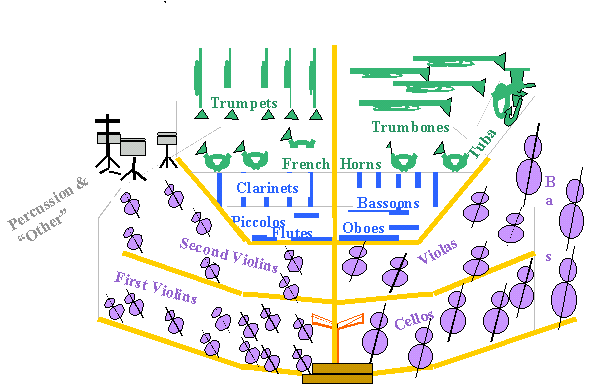
groups. For instance, a full strength orchestra has at least 100
instruments divided into four families: percussion,
brass, woodwinds,
and strings. The following diagram
illustrates the arrangement that marks a symphony orchestra.
Note that the more evolved the family, the closer it is to the Conductor (root of the tree, base of the menorah).
Also noteworthy, is that the wind instruments, both brass and wood, require the player to position his mouth around the reed or mouthpiece. This position is called "embouchure," derived from the French word, "boucher," meaning "to kiss". The Hebrew word for "kiss" means "to put together", "to be equipped with," or "to handle" and comes from a word meaning "to be kindled".6 (click on word origin)
Consequently, when God puts His mouth on wind instruments to blow, He kisses them. Because God is a consuming fire, His lips kindle a fire in the instrument. For our God is a consuming fire. (Heb. 12:29) It is this fire that consumes death or carnal mindedness. For to be carnally minded is death...(Rom. 8:6)
However, God's plan is not just to kindle a fire or merely kiss the instrument, but to bring it to perfect refinement. His "embouchure" will actually take the reed into His mouth, consuming or swallowing it up. He will continue the fire until the instrument evolves into a twanging harp. So when this corruptible shall have put on incorruption, and this mortal shall have put on immortality, then shall be brought to pass the saying that is written, Death is swallowed up in victory. (1 Cor. 15:54)
While the Consuming Fire holds the reed in His mouth, His breath fans the refining fire. God's breath is brimstone.7 Using His mouth and His breath, God destroys man's focus on creation by revealing the Creator. He reveals the Creator through His Word. His Word said: I am come to send fire on the earth; and what will I, if it be already kindled? (Luke 12:49) The fire is already kindled by those who simply believe God's Word is beautiful and full of hope and mercy for all, even though they do not understand it.
Thus, instead of shrinking back in fear of judgment, they seek it. They embrace the Word in hope, voluntarily drawing closer to the fire. Not waiting to be kissed, they kiss. Kiss the Son, lest he be angry, and ye perish from the way, when his wrath is kindled but a little. Blessed are all they that put their trust in him. (Ps. 2:12)
Indeed, John the Baptist immersed people in a lake of water but prophesied that One would come to immerse them in a lake of fire. I, indeed, baptize you with water unto repentance: but he that cometh after me is mightier than I, whose shoes I am not worthy to bear: he shall baptize you with the Holy Ghost, and with fire. (Matt. 3:11) Some will kiss; some will wait to be kissed.
Eventually, the refining process will be complete. The instrument, which is man's voice, will finally be tuned to perfection. When man no longer responds to God's signal with his own thoughts and meanings, it is finished. Man has successfully decoded God's message. Man knows the truth and is finally set free from the darkness of his own (mis-)understanding.
At that time, the fire of judgment goes out because it has consumed all that can be consumed. Words are wood. A wholesome tongue is a tree of life: but perverseness therein is a breach in the spirit. (Prov. 15:4) Wood that endures enormous time and pressure petrifies into stone. When man's own words of wood turn into ashes, that which remains is stone. Stone cannot burn; therefore the fire goes out. Where no wood is, there the fire goeth out so where there is no talebearer, the strife ceaseth. (Prov. 26:20)
Indeed, God promised that the strife would cease. And the Lord said, My spirit shall not always strive with man, for that he also is flesh: yet his days shall be an hundred and twenty years. (Gen. 6:3) It was a blessed promise, but the natural man saw it as a threat because he could not decode God's language to understand what He meant. It was the same promise as: And ye shall know the truth, and the truth shall make you free. (John 8:32)
Even though only two or three witnesses are needed to establish a word, scripture specifically states 12 times that God's mercy endures forever.
1. Let Israel now say, that his mercy endureth for ever.(Ps. 118:2)
2. O give thanks unto the LORD; for he is good: because his mercy endureth for ever. (Ps.118.1)
3. For the LORD is good; his mercy is everlasting; and his truth endureth to all generations. (Ps. 100:5)
4. Praise ye the LORD. O give thanks unto the LORD; for he is good: for his mercy endureth for ever. (Ps. 106:1)
5. O give thanks unto the LORD, for he is good: for his mercy endureth for ever. (Ps.107:1)
6. O give thanks unto the LORD; for he is good; for his mercy endureth for ever. (1 Chron. 16:34)
7. And with them Heman and Jeduthun, and the rest that were chosen, who were expressed by name, to give thanks to the LORD, because his mercy endureth for ever; (1 Chron. 16:41)
8. It came even to pass, as the trumpeters and singers were as one, to make one sound to be heard in praising and thanking the LORD; and when they lifted up their voice with the trumpets and cymbals and instruments of musick, and praised the LORD, saying, For he is good; for his mercy endureth for ever: that then the house was filled with a cloud, even the house of the LORD; (2 Chron. 5:13)
9. And when all the children of Israel saw how the fire came down, and the glory of the LORD upon the house, they bowed themselves with their faces to the ground upon the pavement, and worshipped, and praised the LORD, saying, For he is good; for his mercy endureth for ever. (2 Chron. 7:3)
10. And the priests waited on their offices: the Levites also with instruments of musick of the LORD, which David the king had made to praise the LORD, because his mercy endureth for ever, when David praised by their ministry; and the priests sounded trumpets before them, and all Israel stood. (2 Chron. 7:6)
11. And when he had consulted with the people, he appointed singers unto the LORD, and that should praise the beauty of holiness, as they went out before the army, and to say, Praise the LORD; for his mercy endureth for ever. (2 Chron. 20:21)
12.
And
they sang together by course in praising and giving thanks unto the LORD;
because he is good, for his mercy endureth for ever toward Israel. And
all the people shouted with a great shout, when they praised the LORD, because
the foundation of the house of the LORD was laid. (Ezra 3:11)
Still, the natural man insists that a time will come when God's mercy shall end. Because he is in darkness, the natural man sees only the night and its tears, forgetting that morning always comes and brings light. For his anger endureth but for a moment; in his favour is life: weeping may endure for a night, but joy cometh in the morning. (Ps. 30:5)
Importantly, instruments at each level of spiritual evolution comprise the orchestra. They have not all received the same signals, nor do they all respond with the same sound. Rather, their harmony stems from understanding the signals which they have received.
Indeed, all of the instruments do not even play at the same time or even play the same notes. But, their individual parts work together for the whole song. That unity stems from knowing that God does not condemn, but saves the condemned.
Until man can decode at least some of God's Word, he cannot have its meaning. But, if he simply believes that God is love, he will kiss the Son, kindling the fire that destroys his own negative thoughts. He will begin to "see" God's thoughts and purpose concerning him. For I know the thoughts that I think toward you, saith the LORD, thoughts of peace, and not of evil, to give you an expected end. (Jer. 29:11)
Whether unified by simple faith in God's love or by having already received understanding, the orchestra shares the same mind because it shares the same love. Fulfil ye my joy, that ye be likeminded, having the same love, being of one accord, of one mind. (Phil.2:2) Focusing on that love unites the orchestra in one song of praise and thanksgiving, regardless of depth of understanding. It came even to pass, as the trumpeters and singers were as one, to make one sound to be heard in praising and thanking the LORD; and when they lifted up their voice with the trumpets and cymbals and instruments of musick, and praised the LORD, saying, For he is good; for his mercy endureth for ever: that then the house was filled with a cloud, even the house of the LORD; (2 Chron. 5:13)
Moreover, this unity fosters patience. As long as there are psalteries yet to evolve, the orchestra continues. That is good because the symphony is beautiful. The Conductor works all the instruments together, harmoniously. He even uses an occasional sounding brass and tinkling cymbal for good. Though I speak with the tongues of men and of angels, and have not charity, I am become as sounding brass, or a tinkling cymbal. (1 Cor. 13:1)
If, however, all instruments evolve into stringed instruments, the orchestra will change its form. Without those four families of instruments, the symphony orchestra changes to a stringed orchestra. The music becomes softer and flows gently. That, too, is good.
Indeed, with his new mind, man can see only good. He is confident that the Conductor hears the overall sound and that it is beautiful. He relies upon the Conductor's expertise to produce a sound from each instrument at just the right moment. He knows that he cannot hear the whole orchestra as the Conductor does. Each member of the orchestra hears the closest members louder than the others. Those in the percussion section probably have the most difficulty remembering that the Conductor knows what He is doing and is doing it well.
