Reflexology
Lew Connor and Linda McKim
Our feet connect us with the Earth. They are our
foundation; yet an awareness of them is often literally the
farthest thingfrom our minds. This article approaches the feet
with appreciation and understanding of their integral
relationship to the whole being.
Learn to give a complete reflexology treatment for its
therapeutic value as well as the pure relaxation. And if you have
never paid attention to your feet, you can look forward to
developing a new relationship with yourself.
"Early man roved over plains, through forests, and
stepped on sharp objects which pressed into his feet, reaching
the tiny electrical reflexes, furnishing a natural massage. . .
The electrical shock stimulated the portion of the body for which
that part of the foot was responsible, and the body as a whole
was in rhyd-un with the universe"
Mildred Carter,
Helping Yourself with Foot Reflexology
AROUND 1913 Dr. William Fitzgerald in-
troduced Zone Therapy to the United States. He found that
pressure on certain reflex points brought about a more normal
functioning of body organs and frequently a decrease or cessation
of pain. Actually, he rediscovered a practice which has its roots
in ancient Chinese acupressure. Since then, many people have
adopted and modified his ideas. Each has his or her own approach
to the subject, which has come to be known as Reflexology; it is
up to you, as a student of the healing arts, to pick the approach
that best suits you. We offer here an approach that our
experiences have shown to be effective.
Why Does Reflexology Work?
Reflexologv refers primarily to reflex points on the feet and
hands, but there are many other usable reflex points throughout
the body.
There are several theories on how reflexology works. Some say
that each of the 72,000 nerve endings on each foot connects to a
different body area; in massaging those Illustrated by Marlynn
Amann, Lew Connor nerve endings, we send a stimulation to a
corresponding body area. Others say that we are activating energy
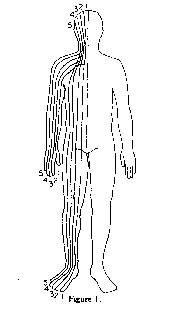
points along meridian lines as in acupressure. Dr. Fitzgerald's
zone theory divides the body into ten zones, five on each side
(see Figure 1). Each zone has its own nerve-stimulation pattern,
so that when a pressure is applied at a reflex point on that
zone, a stimulation is sent to a corresponding organ or gland on
that zone. A large gland or organ which overlaps zones will also
have reflex points on all the zones it ektends into. We feel that
all these ideas have validity, but are only a part of the total
healing process, which involves the body, mind, and spirit.
We are all affected by our environment, and for many of us
that means stress, tension, and worry. A combination of any of
these can cause imbalances, which we usually experience as some
sort of symptom, such as colds, flu, or headaches. We continually
find that specific reflex points during these times are congested
and painful, and very often they feel as if there are grains of
sand under the skin. These grains are composed mostly of uric
acid or calcium crystals.
When our bodies are out of balance, we do not metabolize our
food correctly. By-products of incomplete metabolism include uric
acid and excess calcium, which crystalize around nerve endings in
the feet and other areas in the body. These crystals cause a
blockage around the nerves and cut down on normal stimulation of
glands and organs.
Reflexology can assist the body by relaxing it and stimulating
the blocked nerve endings, thereby stimulating sluggish glands
and organs to regain their normal functioning. The crystals
around the nerve endings can be crushed, so that they are
reabsorbed by the blood and lymph system and excreted out of the
body. Used frequently, reflexotogy can give the body a general
toning to enhance vitality and one's sense of well-being. It is
also a wonderful gift to give to a friend.
Suggested Techniques for a Foot
Reflexology Massage
First make your friend comfortable, in a position
where the spine is straight. Reclining chairs or massage
tables are best and easy to work with, but not always
available; so be imaginative. Try to have a pillow under
the person's knees so the legs are not locked straight.
Next, sit in a comfortable position yourself, facing the
soles of the person's feet. Before massaging someone's
feet, make sure that your thumbnails are clipped and
filed so that you don't inflict discomfort. Also, check
with the person to make sure there are no problem areas
on the feet, such as rashes, cuts, warts or bruises. If
so, avoid these areas, so that they are not further
irritated.
|
|
|
Now introduce yourself
to each foot, one at a time, by generally rubbing,
stroking, kneading, and massaging it. Relax the person by
doing this for about a minute on each foot, and by
requesting that the person take a few deep breaths to
relax his or her body. Each of us has our own techniques
for relaxing someone, and you will soon develop your own
style.
The first area to approach is the
solar-plexus reflex. The solar plexus itself is a major
nerve center located in front of the diaphragm and behind
the stomach. It is often called the "abdominal
brain," since it fires off many fine threadlike
nerves to the entire abdominal area, including the
diaphragm and adrenal glands.
|
The reflex to the solar plexus is therefore an excellent area
to massage for relief of tension, stress, fright, anger, or
nervousness. working this reflex area first provides overall
relaxation, and increases the person's receptivity to your
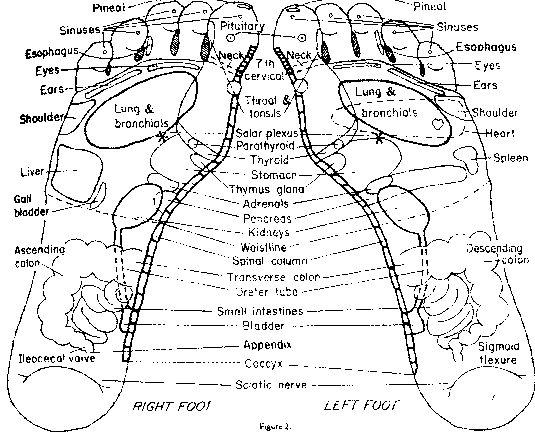
massage. The solar-plexus reflex is located just below the ball
of the foot, about in the center (see Figure 2). There is a
crevice-like area that vour thumb will fit nicely into. Take hold
of both feet, place the pads of your thumbs in these areas, and
slowly begin to apply pressure. Ask the person to focus his or
her breaching into the area where you are pressing. Use a
medium-strong pressure, one that is not uncomfortable for either
of you.
During this time, you can coordinate your breathing with your
friend's by inhaling and exhaling simultaneously with him or her.
This will help relax you both, and aid in establishing an energy
connection. You can also visualize yourself as being a channel
for healing energy that flows through your hands 'into his or her
feet. A sigh or deep exhalation often signals that the person is
beginning to relax.
|
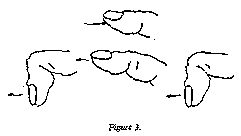
The actual massage movements are
mostly done with the thumb. By using the end of the thumb
(Figure 3), you can maintain a steady pressure and crawl
across the foot if you flex and extend the thumb by
bending the joint closest to the thumb nail. The other
fingers can be nesting on the top of the foot while the
thumb crawls across the sole. Put the fingers of the
other hand between the top of the foot being massaged ind
the fingers of the hand doing the massage. This prevents
the fingers of the actively massaging hand from digging
in to the top of the foot. It also helps to stabilize the
foot.
|
| By using this massage technique, you can
have pin-point control in order to isolate the painful
points of the foot, and to more easily break up the
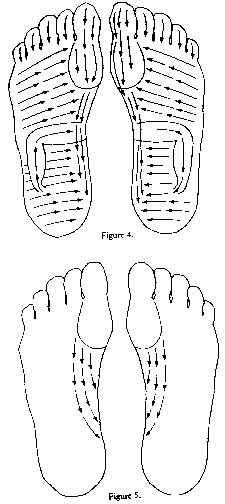
crystal deposits. You will find that by moving the thumb
only in a forward direction, you will cover the foot more
thoroughly than if you tried moving it backward across
the sole as well (see Figure 4). After the solar-plexus
reflex, the next area to massage is the toe area
(corresponding to the head). Next, work down the foot,
going from the outside toward the inside. On the outside
edge of the foot, halfway between the heel and the toes,
you can fuid a bump caused by the fifth metatarsal bone.
This is the indicator of where the waist can be found.
Draw an imaginary line across the sole. Above the line
will be the glands and organs located above the waist.
This line also indicates where the transverse colon is
located (figures 2 and 4). When working the colon reflex,
start at the ileocecal-valve reflex on the right foot
(the entrance to the large intestine) and work up to the
waistline, then across the foot to the instep. Change
feet and continue on the waistline of the left foot,
working from the instep out toward the side of the foot;
then work dows. the side of. the sole of the foot until
about even with the ankle. Finish by working in toward
the center of the floot. The colon reflex is worked in
this way to follow the flow of elimination in the colon.
Massage a little on one foot, then switch to the same
area on the other foot in order to keep a nice balance
when doing the massage. After massaging both feet from
outside to inside, covering the entire sole, work the
adrenals, kidneys, urethra tube, and bladder by massaging
from toe to heel (Figure 5). To work the spine, begin
about halfway down the outside of the big toe and follow
the bone that creates the arch. Don't massage directly on
the bone itself, but on the underside, continuing down
until about even with the ankle.
|
|
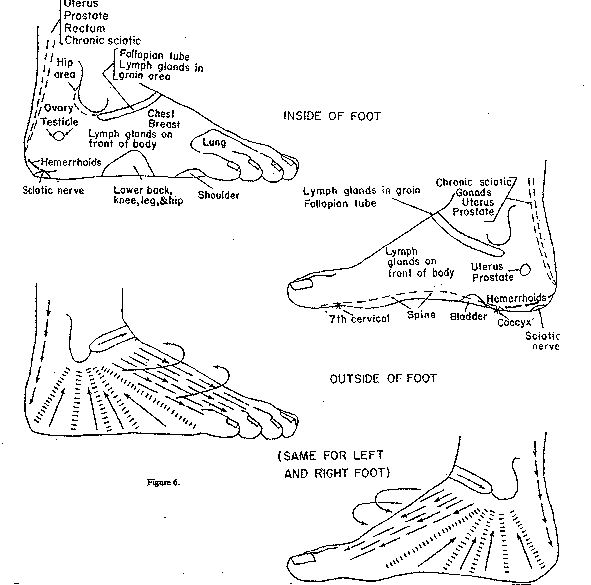 |
Massaging the top of the foot is easy.
Start at the outside heel and massage around to the
inside heel (Figure 6} reflexes located between the toes
are especially important. This area corresponds to the
thoracic lymphatic ducts, which are located under the
clavicle between the shoulders and neck, The lymph system
plays a major role in removing toxins from within the
body, and working the lymph reflexes stimulates this
action. In order to drain the lymph system via the
reflexes, place the index fmger on top of the foot,
between the tendons and bones, about I" to 2"
away from the web of the toes. With the thumb on the
bottom of the foot, squeeze the thumb and index finger
together and with a squeeze/release/squeeze motion,
massage toward the web. Repeat this motion with all the
webs of the toes. Following this, gently stroke the feet
to finish the massage.
During the massage, whenever we find a spot that is
extremely tender, we massage it for about a minute, then
return to it a couple of times during the massage. We
massage tender areas with a pressure that just borders on
pain. Excessive pain creates undue body tension, and one
of the aims of this massage is to keep the person
relaxed.
|
Usually we massage the feet for about an hour. However, if a
person is very ill or toxic and in a stage of heavy elimination
already, we do not want to release too much toxic waste at any
one time, so we work on them lightly and only for a short period
of time each session (five to ten minutes). We then try to work
on them often, about every three to four hours if they are
acutely ill, or daily with a more chronic condition.
Sometimes people feel tired or rundown the day after receiving
a reflex massage. This indicates that the body is eliminating
blocked toxic material, which is released first into the
bloodstream before being eliminated. We encourage people to cat
lightly and to drink a lot of liquids to aid the body in the
process of elimination. Eating pure natural food that has not
been sprayed or injected with chemicals, additives, or hormones
is essential for good nutrition, and is a strong complement to
natural healing methods such as reflexology. A little processed
food goes a long way in causing organ or glandular malfunctions.
Often during reflexology treatments, people will ask what
areas of the body tender reflexes are related to. There are three
things we suggest you not de in response.
- Don't diagnose. Even if you know from
your experience that a tender area that you are massaging
is related to a specific organ, don't tell the person
what it is. Just say that your massage is intended to
relax the body so that it may heal itself. Thoughts and
words have a force that is manifestable. If you tell
someone they have "thyroid trouble," that might
just be negative enough to start them imagining, and
guess what? They may develop "thyroid trouble."
- Don't prescribe; that means anything.
Even telling someone to take a glass of water every day
is prescribing. So be careful.
- Never treat for a specific ailment. If someone comes to
you and says they have a colon problem, don't go to the
colon area and say that working on this area will cure
it. Reflexology aids the body in healing itself.
And remember that in most states only M.D.s have the
license, according to law, to prescribe, diagnose, and treat.
If during the massage your hand gets heavy, cramped, or
uncomfortable, it may be an indication that you are absorbing
negative energy. Stop and shake your hands; this rids them of any
unwanted energy, and relaxes them as well. It is also helpful to
wash your hands in cool water when you finish the massage.
Remember to always keep your shoulders and neck relaxed while
massaging someone. The looser you are the more effective you will
be and the more relaxed your client will become. Massage with
love and walk in balance.
Suggestions for Further Reading
Deviki Berkson, The Foot Book: Healing with the Integrated
Treatment of Foot Reflexology. Funk and Wagnalls, 1977.
Mildred Catter, Helping Yourself With Foot Reflexology. Parker
Publishing, 1969.
Eunice D. Ingham, Stories the Feet Have Told. Ingham
Publishing (Box 8412, Rochester, NY 14618).
Eunice D. Ingham, Stories the Feet Can Tell. Ingham
Pubfishing.
LEW CONNOR and LINDA MCKIM are Co-Directors of the
Reflexology Institute of California.
Another Foot Reflexology Chart
Hand Reflexology Chart
Tongue Chart