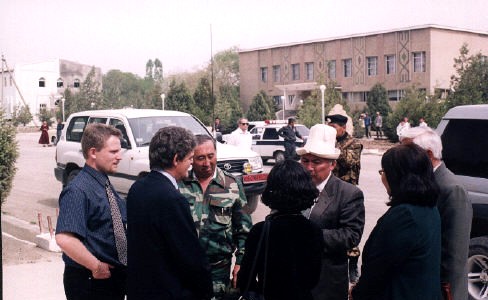
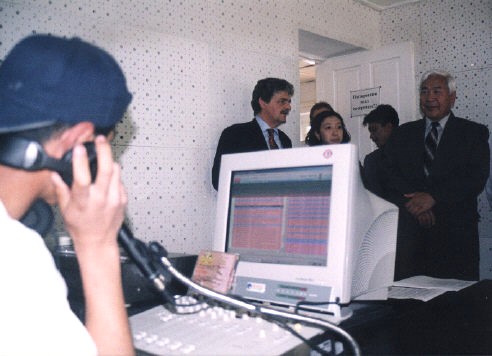
Radio Salaam, a new youth radio station in the Kyrgyz Republic, was opened on April 12th, 2001 in the city of Batken. The station is supported by UNICEF, Foundation for Tolerance International and Internews Kyrgyz Republic.
Good
news from Batken
By
Chris Schuepp*
When people in the Kyrgyz
Republic hear the name of the 11,000-citizen town of Batken, they associate it
with islamic fundamentalist, civil war and instability. Since the Islamic
Movement of Uzbekistan (IMU) first tried to cross Kyrgyz territory in 1999,
the Batken region has a reputation of instability and violence. The armed
rebels came back in 2000 and seem to have plunged the whole Ferghana Valley
into turmoil and fear.
Now, for the first time in
years, good news reaches the rest of the region from Batken. Good news, that is
exactly what the staff of the newly opened radio station Radio Salaam in
Batken want to do. “We want to fill the information vacuum, we want to inform,
educate and entertain the young generation here” says Maksuda Aitieva, the
editor-in-chief of the station. Radio Salaam was set up by UNICEF, the NGO
Foundation for Tolerance International (FTI) and Internews Kyrgyz Republic. The
idea to start radio broadcasting in Batken came from FTI who have a field
office in the small Kyrgyz town in the far southwest of the mountainous country
and anticipated a need for professional information and entertainment.
FTI-Director Raya Kadyrova approached the local UNICEF representative with the
idea and found out that UNICEF was ready to fund media projects in the Kyrgyz
Republic. “We were in the right place at the right time – and we had the right
ideas” says Kadyrova at the opening presentation in Batken on April 12th,
2001. It still took months and months of proposal writing and fine-tuning
between FTI and UNICEF to combine the interests of the two NGOs to a sound
project narrative. Internews Kyrgyz Republic was identified as the ideal
partner to facilitate technical needs and to do training seminars for the journalists.
It
is not easy to start projects in the Batken regions nowadays as only a handful
of international organizations are willing to invest in the shaky border
region. Civil society building projects are few, the latest US Embassy’s travel
warning for the Kyrgyz Republic “cautions U.S. citizens to avoid all travel to areas
of Kygryzstan south and west of the provincial capital of Osh” and flight
connections from Bishkek operate on a once-a-week basis unless they are
cancelled on short notice, which is frequently the case. Batken is thus very
remote and it takes a 3 ½ hour ride over bumpy roads from Osh in a
4W-Drive jeep or 6 hours by bus to reach the area surrounded by Tajikistan in
the South and Uzbekistan in the North. The administrative city of Batken has a
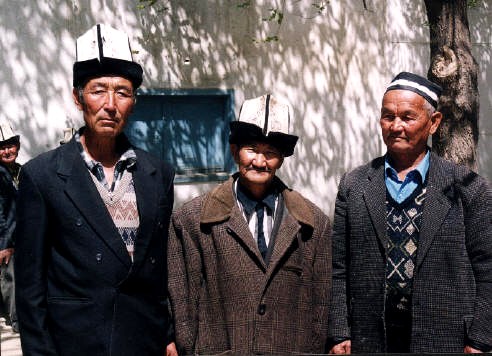
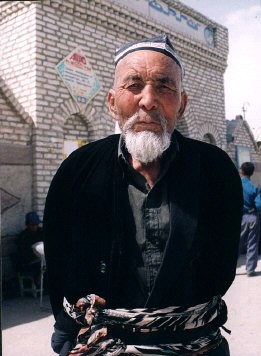
mere population of 11,000, 99 percent of which are ethnic Kyrgyz. Men wear the
traditional Kyrgyz felt hats called Kalpak which distinguishes them from
the Uzbek tupeteika you see while passing the enclave of Sokh half an hour
before you get to the dusty streets of Batken. Arriving in Batken the outsider
cannot imagine a rebel army overrunning this seemingly peaceful place. The
locals are friendly and open and answer questions about the threat coming from
the Tajik mountains with clear determination: “We are not afraid of them. But
we don’t want them here either. We want to live in peace with everybody. I am
65 years old but if I have to, I will become a sniper and fight them off to
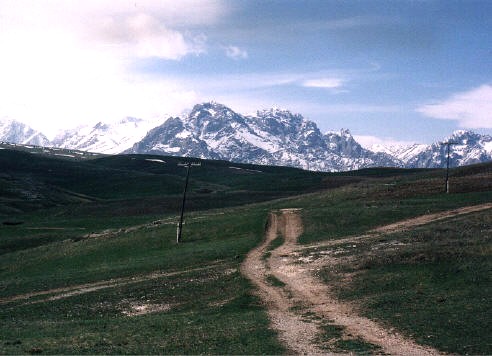
protect our city”, says a local man while pointing to the mountain range to the
South.
It’s
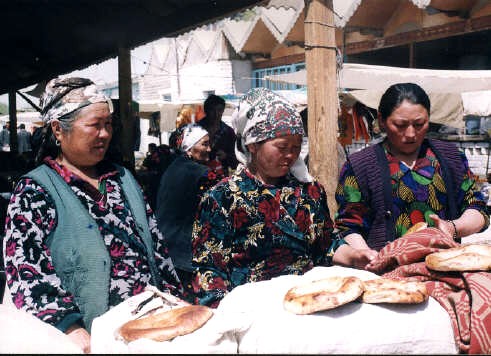
a sunny day in Batken, which is nothing special. There are 320 days of sunshine
in the region every year. The climate is perfect for agriculture and the fruit
on the market is abundant and is regarded the best in the whole country. Mamat
Aibalaev, the governor of Batken, mentions this while hosting the official
guest at the opening presentation for Radio Salaam. Aibalaev has ambitious
plans for his home-region. “In five to ten years we will have the best hotels
in the Kyrgyz Republic. We will have tourists from all over the world coming to
see our mountains, drink our wine and enjoy the sunshine and the hospitality of
the people. We also have natural gas and oil here and are negotiating contracts
with two Russian companies at the moment to exploit these resources. The German
company Thyssen might be interested in building a bottle-factory here because
we have 400 tons of grapes that we cannot use for making wine every year just
because we do not have enough bottles. If we succeed in attracting foreign
investors, we will be able to cut the prices for airline tickets to Bishkek by
half and we will once again be linked with the rest of the country.”
Asked about the IMU and the incursions
that happened in 1999 and 2000 and the threat of another one coming up soon,
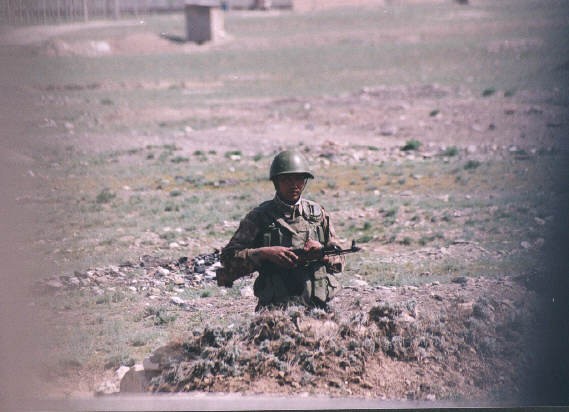
Aibalaev replies: “We have 10,000 contracted soldiers in the region, we have
helicopters, the best equipment possibly available in this part of the world.
We face approximately 2-3,000 rebels coming from Tajikistan. Let me tell you,
we are prepared, we will shoot them on the border just like birds.”
And he might be right, too. Last year,
the Kyrgyz government spent the equivalent of thirty million US dollars, about
thirteen percent of the country's entire budget for the military in Batken.
This year's defense budget has already been raised by more than two million
dollars in anticipation of new fighting. These measures are supposed to bring
stability, but they have also brought a new, formerly unknown problem to the
region. With 10,000 soldiers based in the mountains close to the city,
prostitution and reckless drinking are on the rise in the administrative
center. “It has become a real problem here lately”, says Bruno de Cordier,
UNDP’s southern coordinator who has lived in Batken for six months now. “The
soldiers are young, they have been away from home for a long time and they
drink a lot, get violent and do not want to live without contact with females.
But of course, it’s hard for them to get in touch with the local girls, so they
turn to prostitutes. This is also the case in some of the areas North of
Batken, where truck drivers take advantage of the bad economic situation of the
local population while detouring the Uzbek enclave of Sokh on the way to Osh.
And there is not very much we can do about it.”
Maybe Radio Salaam offers an answer to
this problem, too. The radio station targets young people between the ages of
12-25. Although the radio staff only numbers seven young people from Batken,
the number of volunteers has skyrocketed in the first two months of the
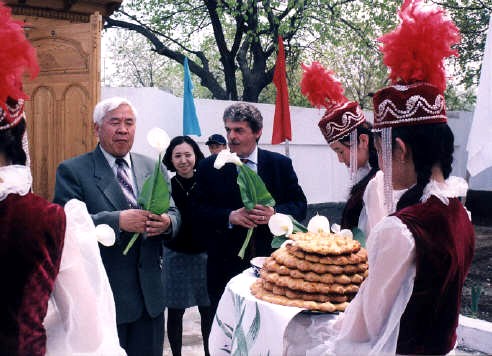
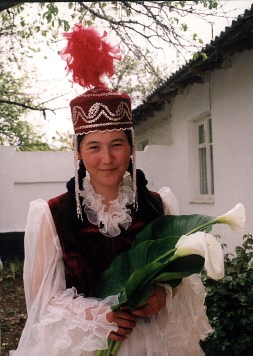
station’s existence to more than 40. Young local girls present flowers to the
official guests at the presentation while others wearing Radio Salaam T-shirts
ride their donated bicycles across town to raise public awareness for the
station broadcasting 18 hours every day in Russian and Kyrgyz on 105 FM. “I am
very grateful for this station. Since they went on the air, I have seen more
smiling faces than in the last two years together, there is this team-spirit
that has to be seen to be believed”, explains Arstan Khojaev, the mayor of
Batken. “The radio station is not only producing news locally, they also send a
signal out to the rest of the country saying: We are alive, we are part of the
Kyrgyz Republic, and we want to hear and be heard like anybody else, too. Radio
Salaam really means good news for us.”
* Chris Schuepp is Country Director for Internews Network in the Kyrgyz
Republic