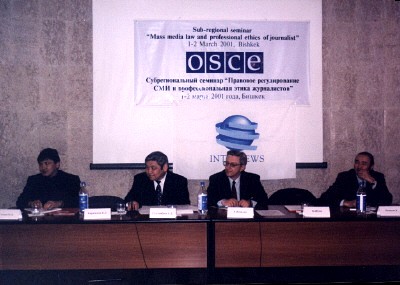
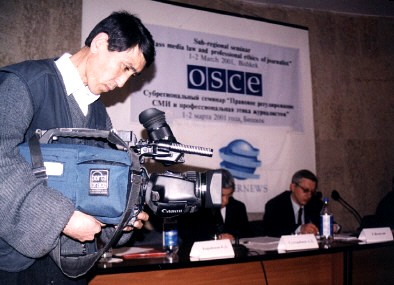
The OSCE office in Bishkek and Internews Network organized a conference for journalist from Kyrgyzstan, Tajikistan and Uzbekistan on March 1st and 2nd. Here are some pictures and the presentation I made.
OSCE conference presentation
March 2nd, 2001
By Chris Schuepp, Internews Network
The duties of a journalist
First of all, let me say
that I am happy to be part of this conference and to be around such a good
group of open-minded and professional journalists from three Central Asian
countries. I have been involved with the media in Central Asia for three years
now, first through my journalism studies at the University of Dortmund in
Germany and now through my work with Internews here in Bishkek.
We have already talked a lot
about the rights of journalists and that we should do everything to defend
these rights against anybody who wants to diminish the amount of freedom that
journalists in this region and elsewhere deserve to have. When talking about
“Professional ethics”, we are not talking about journalists’ rights anymore
that much, but about their duties and obligations. Journalists do have a lot of
rights, but they also do have a number of duties that they have to live up to
if they want to serve the public in a professional way.
One of these duties, and I
think the central one of all the duties, is to report facts. To be honest, to
do good research and not to spread rumors or to announce things they have no
proof for. Sometimes there is very fine line between a fact and a rumor, or a
fact and a commentary. Let me give you a short example that doesn’t have much
to do with journalism, but which will show you exactly what I mean when I talk
about the fine line between a fact and an assumption:
In Germany, as you might
know, we have lots and lots of laws. One of these laws is the insult law -
another one is the law on freedom of thoughts and freedom of speech. If you,
for example, have an encounter with a police officer and he is giving you
troubles, you can say to him: “You are an idiot!” or you can say: “I think
you’re an idiot!” If you say the first, “You are an idiot!” then you might have
a problem, because you state his possible stupidity as a fact. If the police
officer is smart, he will file a law suit against you and you will have to pay
a fine, unless, of course, you can prove that he is an idiot, that what you
said is a fact. He might be an idiot after all, but YOU have to prove that, and
you will have a very hard time doing so. In the other case, when you say “I
think you are an idiot!”, the policeman will not be successful with a law suit.
You are completely on the safe side as what you did was just saying what you
think. And this is protected as freedom of thought and freedom of speech in the
constitution. You are not stating any facts with this, you just say what you
think and he has no means of challenging your thoughts.
What does this mean for a
journalist now? The devil is in the detail – it matters not only what you say
or what you want to say, but HOW you say it. The difference between “You are an
idiot!” and “I think you are an idiot!” is minimal in terms of the meaning that
you get across to the policeman. But the small word “I think” is the detail
that in this case distinguishes between a fact and an assumption. If you say
something, print something, broadcast something, you are responsible for your
actions. You have to provide the proof for your words. If you can’t, then it’s
better not to say anything. If you can, you will be protected by the law and
you should have no problems whatsoever.
Another very important point
is, that on the encounter with the policeman, you are talking one-to-one and
your assumption that the officer might be an idiot will not become public. As a
journalist, you have to take into account that your words reach a big audience
and that you do not act as a private person but as a journalist. Your personal
assumptions should not play a role in your work. Saying “I think you are an
idiot!” is an assumption, it is your very personal perception of the police
officer. It is, in a way, a commentary. And commentary does not belong in a
journalist’s report unless it is clearly and openly marked as a commentary. So,
in this case, as long as you don’t have the proof that the policeman really is
an idiot, you should not go public with your thoughts.
Let’s turn away from the
police officer again: Probably the most important duty of a journalist, a
professional journalist, is to do proper research, to gather facts and to
report on these facts with accuracy and outspokenness. If you do your job
right, if you try to get all the information possible and if you produce this
information to the public in a non-biased, objective manner, then the law is on
your side and it will protect you from anybody who is opposed to the facts you
are giving. A journalist’s job is it o be a mirror of reality and to spread the
information gathered to the public. It is not your job to spread rumors, to
publish things that might be true, or might be wrong. If you stick to the
objectives of professional journalism, you will always find a way to say things
that are important, because they are true.