| Castle Defenses |
|---|
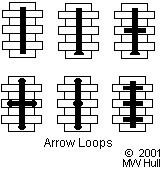
| Arrow loops allowed defenders to fire their arrows from cover. They were less than 2 inches wide, and 3 to 12 feet long.
|
|
Almost all drawbridges were made of wood. The drawbridge had ropes and pulleys attached where the guards would haul up one end of the platform by pulling on the ropes. Sometimes chains were used instead of rope because it afforded greater strength, and the chain would last longer.
|
|
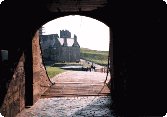
Placing the gatehouse near a moat, keep, or other tower gave it added protection. The first gatehouses were small square towers with doorways at the middle of the bottom storey. The first floor had residential quarters and had machinery to operate portcullis. The 2nd floor stored weapons.
|
|
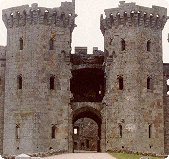
| Medieval moats were trenches filled with water to prevent direct contact with the castle's walls. They were very effective specially from the XIV to the XV century. Moats were dug to prevent diggers; making their work impossible. Moats also slowed down the progression of an invading army, if a castle's wall was to fall, the moat would noticeably slow down the invaders.
|
| Medieval Weapons, Armor, and Seige Weapons |
|---|
| The blade of a sword was made out of iron. The handle was made mosty out of wood with leather, fish skin, or metal wiring wrapped around it.
|

|
| The halberd's long wooden pole and pike measure a full 84 inches making this one of the tallest and most menacing weapons ever wielded by medieval knights and barbarians.
|

|
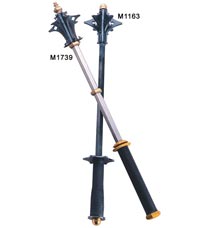
| Black Shafted Mace is made of iron with leather wrapped handle and brass decorative touches. The Black Shafted Mace has a thinner shaft that provides better balance and quickness - a much quicker swing. The overall length of the mace is 22in, weighing approximately 2lbs 10oz.
|
|
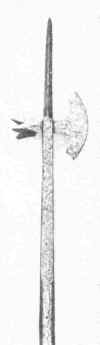
| A poleaxe is a knightly staff weapon, its head being an axehead, usually balanced by a hammerhead, and surmounted by a steel spike. The shaft was protected by steel checks and the hand by a steel rondel. Used from the fifteenth century for foot combats and for war.
|
|
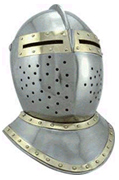
| Helmets are considered as one of the most universal forms of armor specially designed to offer a defensive covering for the head, face and sometimes the neck from the cutting blows of swords, spears, arrows and other weapons. The typical helmet is a hardened-metal shell with an inner liner.
|
|
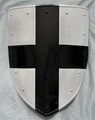
| Shields tools of defense. They may even be called a part of an armor. The shields are held in the hand and used to ward off the blows. Shields were made of a broad piece of a rigid material, metal or wood or even hard leather. They can be strapped to the arm or held in hand.
|
|
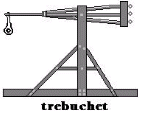
| The basic design of a trebuchet was a long arm pivoting on an axle at the summit of a high frame. The shorter end of the long arm had containers of dirt and rock weighing tons for a counterweight. It flung huge rocks or bulders at a long range.
|
|
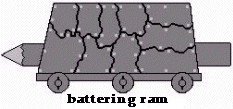
| A battering ram was sometimes used. It had a sharpened end, and the object was to break away stones to achieve some kind of breach in the walls. Its primary use was against doors.
|
|
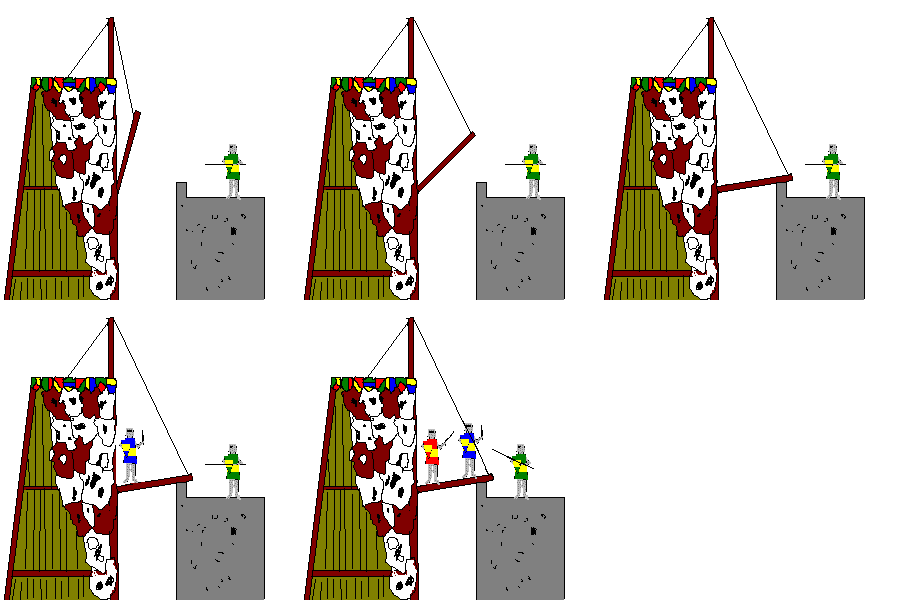
| The Belfry was a large structure on wheels that could be pushed up to the castle walls. Ladders inside the Belfry allowed attackers to climb to the top under cover and get into the castle. Castle owners prevented this type of attack by piling dirt and rocks up against the castle walls so that the Belfry, which was on wheels, could not be pushed near to the castle.
|
|
| Witches |
|---|
In the Middle Ages witchcraft was feared throughout Europe. People thought that magic was an illusion created by the devil and was associated with worship of the devil. Some say that there are two different kinds of magic: Black Magic and White Magic. Black magic was associated more with the devil and had satanic symbols. People thought that witches caused harm to society by causing accidents, bad luck, illnesses, or death. Witches got a lot of blame if someone fell ill of unknown causes. White magic had Christian symbolism that had more to do with nature and herbs. White magic was believed to be used for such spells as love, health, good luck, and wealth. Astrology and alchemy, which is about making potions such as turning metal into gold and searching for a cure for deadly illnesses, are considered to be a part of magic.

| 
|
| Witchcraft was hated mostly by the Christians and their church. They considered them as diabolical and evil. As always they thought that witches had to do with the devil. Not soon after, the Christian church started a campaign to get rid of witches and started the witch hunt. It lasted for over 75 years. The witches went on trial for heresy and witchcraft. They wanted to get rid of them so they burned them at stake if found guilty. Some other punishments were banishment, imprisonment, and mutilation, but mostly execution. Almost everyone that was accused was tortured and beaten until they confessed. Many people gave their lives to false confession. Almost 80% of the people accused were women. It was believed that the devil succumbed people who weren�t strong enough to resist him and thought women were not as strong as men.
| 
|