Information For First Time Owners
In New Zealand you can expect to pay between $600.00 and $1200.00 for a boxer puppy,
I am talking about a New Zealand Kennel Club registered puppy from a reputable breeder.
Most people who show and breed their dogs are breeding to a standard that they are judged by at shows usually by overseas judges.
When a breeder is successful in the show ring this indicates that the dogs they are breeding are up to the standard required, and of their peers around the world.
Usually a lot of consideration for conformation (structure), temperament and health go into a mating to produce a litter.
From that litter only one, or occassionally two, puppies will end up in the show ring, the rest of the litter will go to pet homes.
These pet puppies also have the benefit of the knowledge and care of their breeder and their owners should have the support of the breeder throughout the life of the puppy, this is sort of an explanation of what you can expect for the money you pay, we charge the same price for a pet as for a show puppy.
Some breeders also have contracts that could restrict you from breeding or showing or require you to have your puppy speyed/neutered.
We don't have such formal contracts preferring to have a relationship with an owner where we can advise on such matters.
Contracts are sometimes a safeguard on both sides though. There are of course good breeders and otherwise.
You can expect to get your puppy at around eight weeks of age, not earlier. This is the best age for a puppy to go to a new home as the puppy begins to bond to his people and surroundings about then.
At the early stages you will have to complete toilet training your puppy, this will have begun with your breeder and is relatively easy, and also tolerate a biting period as he won't have learnt to mouth yet.
They have needle sharp little teeth and it is important that young children understand that puppy doesn't mean to hurt, and how to deal with puppy when he becomes over excited and bites a bit hard.
It is also important that puppy has a safe place of his own that he can go to sleep without being interrupted.
I consider this very important because if puppy doesn't get enough sleep he could become bad tempered and snappy.
A boxer is the ideal family pet but can be quite dominant. It is important that you are the boss from day one and don't allow puppy to get out of control.
Puppy socialisation classes are great and basic obedience is a good idea. Find yourself a good vet and enquire about classes, sometimes vets run them but if not I can give you a contact for your local Kennel Club they may be able to help out there.
Your puppy should also have had his first innoculation before joining your family, (read about updates on innoculation protocols from Dr Jean Dodds a highly qualified and respected authority in the US, and also info on canine vaccination from some vets in the UK) - these are overseas articles, in NZ we don't vaccinate against Rabies, we generally vaccinate against Parvo, Canine Distemper, Kennel Cough and Hepititas. You will need to complete the course before puppy is fully protected and able to go out and about. We now make sure that puppy has his first innoculation at 8 weeks before he leaves for his new home and then 1 or 2 repeats as recommended 3 - 4 week intervals and then a final vaccination 1 year later. Some Vets recommend yearly or 2 yearly boosters this is of course up to each individual to decide for their canine companion but it is becoming controversial whether these boosters are required. It is important to take your dog to the vets once a year for a check up and to pick up any problems that may have developed over the year. I believe that it is important to have a healthy dog able to fight any disease or illness that he comes in contact with (not just a select few) and this is why I advise raw feeding ( here is an article that started me thinking!)
You should also be advised about worming - there are some natural foods that help I use a little dessicated coconut in the food sometimes and I also use Malcolm Harker's wormer, found under 'Pets'.
Boxers are not a dog for shutting out in a kennel day and night, they need to be part of the family and respond so well to love and attention. They are clean and love warmth particularly in the winter time. However when they are young it is not a good idea to leave them alone in the house they will be destructive if they get bored. I think it is important to have a warm kennel with a good sized run where you can leave him and know he will be safe and comfortable, maybe while you are at work or even when visiters arrive that don't like dogs (believe it or not there are some people out there that don't appreciate boxer kisses). Dogs should always have fresh water available at all times.
One of the most important requirements is adequate fencing around your property. We recommend 6 foot high for a boxer and it will need to be secure. You will need to feed your baby four times a day for the first few weeks and gradually reducing the number of meals as puppy grows bigger and can eat more food at each meal - your breeder should give you a diet sheet with examples of what puppy is used to eating and the times. An adult boxer usually is fed once or twice a day. You will also need to think about what you want to feed your puppy. There are all sorts of alternatives from expensive nuts such as Eukanuba, pet rolls and cans from the supermarket to raw, natural foods. I strongly believe in natural feeding ie raw meat and bones with leftover veges etc. all my dogs are fed naturally and are very strong and healthy - nuts are convenient but are not what a dogs natural digestive system is set up for. Boxers can get skin problems and digestive problems and I believe these are strongly related to the unnatural foods with additives that they are fed. Anyway if you want to go natural I am happy to help out with advice there. The average life of a boxer should be around 10 - 12 years, some say that anything over nine is a bonus. Some lines have greater life expectancy than others. Main diseases affecting the boxer are heart disease causing much reduced life expectancy and a specific heart disease to Boxers called Boxer Cardiomyopathy this causes sometimes apparently normal boxers to collapse and die at very young ages - it is hard to detect and can't be ruled out by by normal heart testing. Hip Dysplasia causing pain and arthritis, and sadly Boxers tend to be prone to cancer. Some lines do have heart problems and the best advice I can give you here is to find out as much as you can about the parents, grand parents etc. in the lines of any puppy you may be looking at. Most good breeders are aware of these problems and are careful not to carry lines affected. Cancer of course is unpredictable.
In my experience there is no specific difference in temperament between dogs and bitches. They are like children they have individual personalities, we have had soft smoochy girls and stronger dominant girls. We have also had the same in boys. Males are no less clean than females either in tact or neutered. We found when our children were young that the dogs ammended their behaviour depending on who they were with i.e. rough and tumble with our son and soft and cuddly with our younger daughter. Males grow to be slightly larger than females and of course you have seasons to contend with in bitches. If you don't want to show or have puppies then speying is reccommended, seasons require that a bitch is out of the way of any male dogs for about 3 weeks and happen every 6 to 9 months, there is also a little blood involved etc. It is thought that speying a bitch will reduce the incidence of some forms of cancer. Males will wander if they are not appropriately fenced (actually so will females). When choosing a puppy observe the Mum with her puppies (if you can) and watch her temperament with strangers and your kids. If you can see the Dad too that would be an advantage. If litters are brought up with a lot of human contact they are more likely to be social and adaptable than puppies raised away from family life and noises and contact.
Brindle has gone through a stage of being popular - it is also dominant so a lot of breeders are breeding predominantly brindle. Reds have again become popular and now there are quite a few breeders breeding reds. I would suggest that once you have decided on what sex you want that you put your name down with several breeders as the Boxer seems to be very popular and most reputable breeders have waiting lists.
A good place to see a few different Boxers is at a dog show. If you would like I could give you details of any shows coming up in your area. I should add that the dogs you see winning at a dog show should be good examples of the breed but a judge can only judge what he sees before him, it is also important for you to look into background and history of lines.
|
|
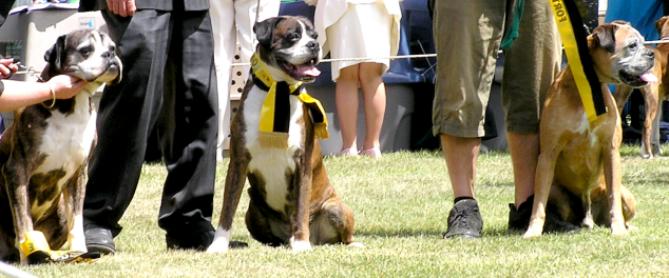 Fortress We Will Rock You, Ch Fortress Stormbringer and Fortress Nick Of Time receiving their Grand Veteran awards at SIBC, this pic is of 3 of 6 surviving littermates at 10.5 years of age. 2005
|
|
|