|
|
||
05/06/04 |
     
|
The Basics of Nuclear Chemistry
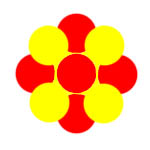
This lesson is designed to give someone with little background in nuclear chemistry a primer on it. The lesson does use elementary ideas such as the atomic theory of matter, so you should be familiar with these concepts. This lesson will not cover many topics in great detail for such analysis requires a lot of math that the is outside the scope of this lesson. Much as molecules are composed of discrete atoms, nuclei (the plural of nucleus) are composed of discrete particles. The nucleus of an atom is composed of one or more protons (weighing about 1.00727646 amu) and very frequently neutrons (weighing about 1.00866492 amu). Protons have a charge of +1 while neutrons have no charge. Protons and neutrons are collectively called nucleons. A nuclear physicist would probably argue with this statement, for technically this applies only to "matter," not "antimatter." This distinction, related to the charges of particles, is fascinating but will not be discussed further, for it is not relevant to a basic understanding of this topic. It is commonly known that "opposites attract." Conversely, like charges repel. It would therefore seem that the nucleus should shatter instantly, for all the protons would repel each other. Clearly, there is a force acting to oppose the electromagnetic force that would otherwise destroy the nucleus. The major force involved is the strong nuclear force. The strong nuclear force acts over extremely short distances and serves to oppose repulsive electromagnetic forces. We will return to this force during our discussion of radioactivity. There is another force, far weaker, that is aptly named the weak nuclear force. The weak nuclear force acts over relatively short distances and helps to stabilize the nucleus. According to something called the electroweak theory, the weak nuclear force is actually a manifestation of the electromagnetic force. Much of this is speculation based on solutions to mathematical functions, however, and still causes a debate among physicists. We will return to the weak nuclear force during our discussion of radioactivity as well. It is important to note that neither of these two fundamental forces actually affect nucleons directly. They actually affect the particles (some of which have not been experimentally shown to exist) that compose all hadrons (of which protons and neutrons are included). This discussion of quantum physics could get very complicated very quickly, so we will leave it here. Often, the nucleus is pictured as a bundle of protons (red) and neutrons (yellow) fused together. More correct, however, is a "fuzzy" model, since (for reasons we will not go into in this lesson) it is impossible to know with complete certainty the locations of the protons and neutrons:
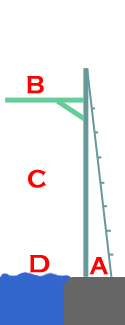
Earlier, we mentioned the existence of the nuclear forces that act to hold a nucleus together, in spite of the strong tendency for protons to repel each other. A quantity known as binding energy can be measured, and is related to the stability of nuclei. Before we can discuss this concept, however, we must learn (or review) some basic principles of physics. Energy is a quantity assigned to a system. It is defined as the capacity of the system to do work. Without delving into the early portions of a course in classical physics, it is difficult to describe these rather nebulous terms. The best way to understand what we are talking about is to use an example: In Figure 2, we see a scientist's conception of a diving board, with a
number of points labeled.
Point A is at ground level, and a diver standing at the base of the ladder is at rest (he is not moving and will not start moving spontaneously). He can do no work: he cannot change the velocity of any other object (in layman's terms, by merely standing there, he is not causing anything to move). He has no potential energy (energy capable of some day being harnessed to do something), and no kinetic energy (energy resulting from his own movement). As the diver climbs the ladder, he becomes capable of doing work (falling, if he lets go). He acquires potential energy, thanks to the energy is he expending to climb the ladder. Also, since he is moving, he has a small amount of kinetic energy (i.e. it would require work to stop him). As the diver jumps off the board, and reaches point C, his potential energy decreases. However, his kinetic energy has gone from zero (at point B) to a nonzero value. Specifically, in accordance with the Law of Conservation of Energy (which states that energy is neither created nor destroyed), that nonzero value for kinetic energy is equal to the amount by which his potential energy has decreased. At point D, the diver strikes the water. He has no potential energy, but possesses kinetic energy equal to his potential energy at point B. As he slows down in the water, his kinetic energy is transferred to the water molecules around him and is also converted into heat (a byproduct of all energy changes). Thus, his potential and kinetic energies are both returned to zero. Don't worry if this doesn't make sense; this summarizes several days (or perhaps even weeks) of an elementary physics class. All the math has also been omitted, which makes it a little hard to comprehend ideas such as the Law of Conservation of Energy. The reason for this discussion was to introduce the idea of spontaneity, a recurring theme in thermodynamics (the branch of physics dealing with ideas such as these). Note that the diver's movement occurred spontaneously when the potential energy of the system (the diver and the Earth) decreased. Energy (in the form of chemical energy used by the diver's muscles) was needed to cause movement when the potential energy of the system increased. In chemical systems, the situation gets a little more complicated, but the same principles apply. Now, we can return to our discussion of nuclear binding energy. Two protons repel each other, and, if held in place, are thus at the state of lowest potential energy when separated by an infinite distance. In nuclei, the opposite occurs, and there is a great deal of potential energy stored in their mutual electromagnetic repulsion. Since holding protons and neutrons together is not energetically favorable, energy must be used to counteract the potential energy that would otherwise spontaneously push the nucleons apart (just as energy must be used to raise the diver to the diving board against the force of gravity). This energy is called binding energy. Binding energy is a measure of the total energy used to counteract the mutual electromagnetic repulsion of the nucleons in an atom's nucleus. Where does this energy come from? Atoms do not eat, as the diver does, nor do they use sunlight as plants do. In fact, both of these processes extract energy (through complex biochemical reactions) from bonds that hold entire atoms to each other. So, again, where does this energy come from? When one closely observes a chart of the isotopes (not merely a periodic table), one notices something odd. 4He (a helium isotope made up of two protons and two neutrons) has a listed mass of about 4.00260324 amu. In the section on nuclear composition we noted the masses of protons and neutrons. One would expect that an isotope composed of two protons and two neutrons would have a mass equal to the sum of the masses of two protons and two neutrons on their own. Let us see:
The mass of 4He actually is less than that of the masses of the nucleons summed. Where is the missing mass? Enter Albert Einstein. Perhaps the most famous equation in all of modern history is the ubiquitous "Einstein Equation," E = mc2. This states that energy (in this case, something called energy of existence), in Joules, is equal to the mass (in kilograms) of a particle or object times the velocity of light (in meters per second), squared. In our problem, m will be the missing mass, found by subtraction:
That's the first hurdle to finding binding energy. Now we must convert atomic mass units (amu) to kilograms. To do this, we must know that one amu equals about 1.66053873 x 10⁻²⁷ kg. Using dimensional analysis:
This is an amazingly small number. But to get energy, we must still multiply it by c2. An exact value for c (defined by SI) is 299,792,458 m/s. So:
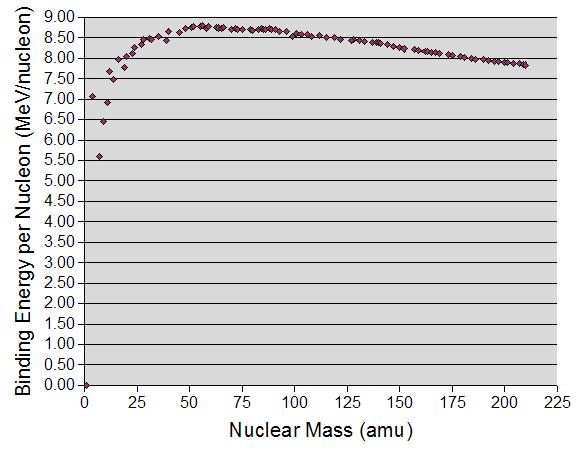
This is still a small number, but is significant. One watt (W) is one Joule per second (J/s). Many people have 60 W light bulbs in their houses. This means that to operate the bulb for one second, 60 J of energy are needed. Some math (not shown) tells us that the binding energy from about 13,730,833,182,616 (a little under 14 trillion) atoms of 4He could power a 60 W light bulb for one second. That's a lot of atoms! Using a bit of gas chemistry (not shown), we realize that this number of atoms at room temperature and typical pressure at sea level would occupy a volume of only 5.49 x 10⁻⁷ mL! We couldn't even see a volume that small! When one considers how many atoms of various elements are available, it becomes clear that if the energy of the nuclei could be harnessed to perform useful functions, there would be no shortage of energy. In fact, as we shall later see, this is the basis of nuclear power plants. Binding energy can be calculated using the equation E = mc2. It is useful to note that most of the time, binding energy is expressed as electron volts (eV). One eV is defined as the amount of energy needed to move an electron through a potential difference of one volt, but that is not really important to our discussion. What is important is a conversion factor: 1 J = 6241457005723417000 eV. Note that to simplify things, MeV are often used. 1 MeV = 1,000,000 eV. Our discussion of binding energy is not quite yet over, however. Of even greater use to nuclear chemists and physicists than the binding energy of a nucleus is the binding energy per nucleon. Binding energy per nucleon, as the name implies, is found by dividing the binding energy of a nucleus by the total number of nucleons that compose it. When one graphs binding energy per nucleon against atomic mass, a curious graph, shown in Figure 3, results.
See how around the vicinity of iron-56 (56Fe) the graph turns around (in math, we say there is a critical point)? Iron-56 is probably the most stable isotope, in terms of nuclear stability. The reason for this is the amount of energy that must be put into the nucleus to break apart the nucleons; movement in either direction (increasing or decreasing atomic mass), uses energy, so neither process is spontaneous. This idea, and the graph in Figure 3, will return once again in the sections on nuclear fission and fusion. Before we can discuss those topics, however, we must discuss several connected topics, starting with... Radiation takes three general forms, designated by Greek letters: alpha (α), beta (β), and gamma (γ). The first two forms are actual particles while the third is an electromagnetic wave. Alpha (α) particles are identical to 4He nuclei. They consist of two protons and two neutrons mutually bound. It is important to recognize that though identical to helium nuclei, alpha particles need not (and, indeed, usually do not) originate from helium atoms or ions. Beta (β) particles are "physically" indistinguishable from electrons. However, beta particles are of a much higher kinetic energy. It may be helpful to think of beta particles as arrows. An arrow in a quiver is physically identical to an arrow flying towards a target. However, the arrow in the air has a far greater kinetic energy. Beta emission is commonly written β- to denote the negative charge. Gamma (γ) rays are not material particles at all. They are a form of electromagnetic radiation, similar to visible light and UV. Gamma rays can be thought of as extremely high energy light. Each of the above forms of radiation has distinct properties. Alpha particles convey the most energy, followed by beta particles, and finally by gamma rays, which are relatively low in energy. However, alpha particles are easily stopped (the outer layer of dead skin cells in humans stops virtually all alpha particles). Beta particles are also relatively easily stopped. Gamma rays are said to be highly penetrating, requiring thick blocks of lead or concrete to stop. It is for this reason that the third form of radiation tends to be the one with the most negative health effects. There are other types of radiation (for example, positron emissions), but these are the major types. As we earlier stated, when a nucleus decays (changes), radiation is released. But are all three major forms of radiation released during any change? The simple answer is, no. To understand why, we must first understand the source of radiation in the nucleus. Where might an alpha particle come from? The simple (and correct) answer is that an alpha particle is ejected from a nucleus when the nuclear forces are unable to hold the hold glob of neutrons and protons together. A group of two protons and two neutrons, if released, is an alpha particle. It should be evident that the most significant effect of alpha emission (the release of alpha particles) is a rapid reduction in atomic mass. Remember how we said that very large nuclei tend to be unstable? Alpha decay helps to alleviate "mass-related stress." To understand beta emission we must create a model of a neutron. A neutron can be thought of as a proton and an electron put together. The charges cancel each other, and the mass of a neutron is slightly larger than that of a proton. This is an oversimplification, but will work for our purposes. Thus, it is conceivable that a neutron could decay into a proton and an electron. This is essentially what happens during beta emission. When a neutron splits, the resulting proton will remain part of the nucleus while the electron is ejected at a velocity close to the speed of light, and is then named a beta particle. The net result of all this is that the atomic mass stays the same (electrons have negligible mass, after all), while the atomic number actually increases. So, for example, if a 9Li nucleus underwent beta decay, the resulting isotope would be 9Be (the next element on the periodic table). Gamma emission isn't quite so clear-cut. Since gamma rays do not consist of particles, there is no change to the mass or number of an isotope when gamma emission occurs. This means that when 235U (the well-known uranium-235) undergoes gamma decay, the result is 235U. Gamma emission merely allows excess energy in the nucleus to be dissipated. This is something akin to cooling: when a piece of metal is warm, its atoms are moving rapidly, but it is still an identifiable metal. When one cools the metal, its atoms slow and [kinetic] energy is dissipated, but the identity of the metal remains the same Nuclear decay (nuclear reactions) can be modeled with equations, very similar to how chemical reactions can be modeled with equations. Nuclear equations are merely an expansion of chemical equations, discussed in the lesson on stoichemometry. When representing types of decay, we use the Greek symbols as we would chemical symbols. We also write out symbols with isotope notation, when appropriate. For example, in equations, instead of merely writing α for an alpha particle, we write 24 α. Likewise, instead of U for uranium, we might write 92235U, if U-235 was the isotope in which we were interested. Beta emission is written either as β- or e-. We shall use β- for clarity, since e- appears frequently in half-reaction equations and reactions in aqueous solutions (don't worry about this if this doesn't mean anything to you). Just as chemical equations must be balanced, so must nuclear. This leads us to a general rule: In nuclear equations, mass must be constant on both sides of the equation. Let us now consider a popular sample nuclear reaction, the alpha decay of 235U. First, we write the initial isotope and an arrow: 92235U --> We know that this is alpha decay, so there must be a an alpha particle on the right: 92235U --> 24 α The mass is not the same on both sides (obviously). First, there are not enough protons on the right. We remedy this by writing the appropriate resulting isotope on the right. In this case, it is a thorium isotope: 92235U --> 24 α + 90231Th This lends itself to another general rule: When beta emission is not occurring, the sum of all the "A" values on one side of the equation must equal the sum of all the "A" values on the right. The same is true for the "Z" values. Let us now consider another sample reaction, the beta decay of lithium-9. First, we write the initial isotope and an arrow: 39Li --> Since this is beta decay, there must be a beta particle on the right: 39Li --> β- We note that since only electrons are released, atomic mass must remain constant. We use "X" to represent an as-of-yet unknown element: 39Li --> β- + A9X Finally, we know that in beta decay a neutron "becomes" a proton. Thus, "A" must go up by one. This tells us that "A" equals four, meaning that the result of the reaction is a beryllium isotope: 39Li --> β- + 49Be For our last example we shall consider gamma emission. Gamma emission generally occurs after alpha or beta emission, for it acts to reduce the energy of the nucleus after such a change. It is conceivable, for example, that the thorium product from our first example could undergo gamma emission. The equation would thus be as follows: 90231Th* --> 90231Th + γ Note that the asterisk (*) means that the preceding isotope's nucleus is in an excited state, lending itself to gamma emission. This is our notation; various authors use different notations. Using what we know of nuclear stability factors, we can guess which isotopes will spontaneously transmute (change into another element) or give off some form of radiation. Using data on nuclear decay, we can trace isotopes through decay series. However, we know nothing about the rate at which these processes occur. For example, the entire decay series outlined in the previous section takes more than 700 million years to complete, while other series occur so quickly that they could not be timed with a stopwatch! One way (and the most common way) to describe the rate of decay of an isotope is to use the concept of half-life. The half-life of an isotope is the amount of time that passes before one-half of a sample of the isotope decays. From this definition, it follows that after two half-lives, one-fourth of the original sample of an isotope will remain. After three, there will be one-eighth, and so on. It is important to realize that half-lives are statistical in nature, and cannot be applied to a lone atom or ion. This means that even though it may take more than 700 million years on average for one-half of a sample of 235U to decay, we have no way whatsoever of knowing precisely when an individual atom of 235U will decay. In fact, the decay of individual atoms of radioisotopes is considered to be truly random, and is the basis for extremely refined random number generators. Let's try a practice problem:
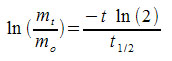
Let us now create a mathematical generalization regarding half-lives and sample sizes: Where mo is original sample size (mass), mt is sample size (mass) at time t after decay begins, t1/2 is half-life, and "ln" defines the natural logarithm function, the following relationship regarding radioactive decay (or any process involving a half-life) hold true: |
|
Practice Exercise 3: Solution: We first recognize that we are solving for half-life,
the variable t1/2. We thus rearrange the generalized
expression as follows: Substituting, we find t1/2 =~ (-136.35)(.693) / ln(2.1 / 7.4) =~ 75 days. |
Were controlled decay (by radiation emission) the only way that nuclei can change, radioisotopes would still be useful, but not nearly as useful as they are in light of their ability to change in two other very important ways: fission and fusion.
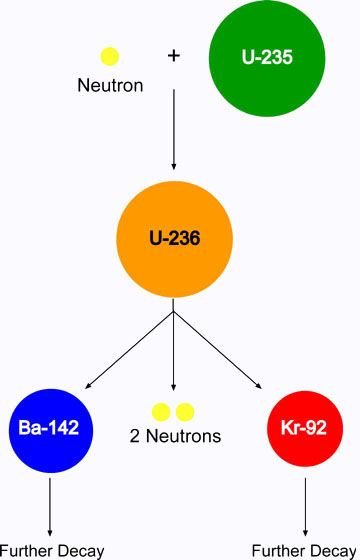
Figure 6: A basic diagram of nuclear fission. Uranium is used as fissile material. Isotopes are named using their symbols.
It is possible to introduce new nucleons (especially the neutron, which due to its neutral charge can relatively easily penetrate the atom) into nuclei. When a neutron, for example, is added to a heavy, naturally unstable (read: radioactive) element such as uranium-235, the neutron further destabilizes the nucleus. In this case, though, procession through a decay series alone is not enough to quickly stabilize the nucleus. The nucleus instead undergoes a process known as fission, and the element that is fragmented is called the fissile material or the fuel.
Nuclear fission is the process by which an unstable nucleus fragments into two or more pieces, each of which may be stable or may decay or fission itself.
Note that fission is both a noun and a verb (i.e. an atom can fission or can undergo fission).
Why is this process useful? As the nucleus breaks apart, binding energy is dissipated, heating up the surroundings. This is the principle behind electrical generators that are driven by steam heated by nuclear fission. Much more energy is released much more quickly by nuclear fission than by nuclear decay.
Uranium-235 undergoes fission when struck by a neutron, as stated. A simple diagram of what this looks like is shown in Figure 6. Note that
For fission to to be self-sustaining, which it often is, lone neutrons must be emitted in addition to the resultant elements.
These lone neutrons can then go on to induce fission of other atoms, as explained in the following section on chain reactions.
Fission only occurs when relatively heavy isotopes are used. When very light isotopes, such as hydrogen, are struck against one another, the reverse of fission can occur: fusion.
Nuclear fusion is the process by which light nuclei combine to form a more stable heavier nucleus. The most commonly observed fusion process is the combination of two hydrogen isotopes (usually not just "plain" hydrogen, 1H) to form helium or other heavier isotopes.
It is energetically favorable (meaning that energy is released), since medium-weight atoms tend to have a higher per-nucleon binding energy than extremely light atoms. Since many fusion reactions exist or are hypothesized, no image of fusion is shown. The reader may have heard of phrases such as "cold fusion," (as in the very, very scientifically inaccurate action film "Chain Reaction"), and how this is something of a holy grail in experimental physics. What this phrase refers to is fusion at or near room temperature. Presently, in order to move hydrogen atoms at speeds fast enough to induce fusion (and to get around a number of other scientific problems), experimental fusion reactors must operate at temperatures often in excess of that of the surface of the sun, and consequently must be contained with elaborate vacuum systems and magnetic containment fields à la the warp drive in Star Trek. The generation of these containment systems uses up as much, if not more, energy than is released by fusion. Until recently, it appeared that a practical fusion reactor, desired because it theoretically could generate more energy than a conventional fission reactor without producing any of the undesired radioactive waste, could not be created. However, in recent years major strides have been made in both plasma physics and engineering that have allowed experimental reactors to essentially break even, meaning that they produce just enough energy to contain themselves. Thus there is hope that, given additional research, we might eventually derive an actual energy profit from fusion, though this is likely many decades in the future.
We also know that fusion is what drives stars such as our sun. Were it not for fusion, the sun would not "operate" and life could not exist on Earth!
As was tacitly implied in the previous section, a neutron source is needed to start a fission reaction. If new neutrons needed to be constantly added to the reactor, nuclear fission would not be nearly as lucrative as an efficient energy source. Fortunately, as also stated, neutrons are frequent byproducts of fission. These neutrons are ejected from fragmenting nuclei at high enough velocity that they can in turn promote fission and can keep the reaction running without the input of additional neutrons.
A closer inspection of Figure 6 reveals that for every one neutron initially put into the system, two neutrons are ejected. Thus the U-235 fission reaction is not only self-sustaining, given an excess of fuel, but is actually self-promoting. Think about it this way: one neutron is absorbed by one atom, and among other products, two neutrons are released. After the first "generation," two neutrons are present. Each of these then bombards another atom, each releasing two neutrons. After two generations, then, four neutrons are present. Each of these can bombard an atom, releasing a total of eight neutrons. This doubling after each "generation" is characteristic of exponential growth. Specifically, the number of neutrons present after n generations, if one neutron was used to being the reaction, equals 2n. After ten generations, one neutron will have been "amplified" to 1024 neutrons. After 1000 generations, the neutron yield will be 1.07 x 10301! In reality, though, such reactions are not entirely efficient and the fuel will run out at some point. Nonetheless, we say that
Useful nuclear fission reactions proceed as chain reactions, in which the reaction rate (or number of fissions per unit time) increases almost exponentially. This is due to the release of multiple neutrons for every neutron used up.
Even given the limitations imposed by the penultimate sentence above, it is clear that if energy is released during each fission reaction, and if each neutron causes one fission reaction, the energy released will increase exponentially. This is the basis for both nuclear reactors and nuclear weapons, as explained below.
Uncontrolled nuclear chain reactions can, with the proper design and geometry, cause a catastrophic explosion as nuclei break apart at ever-increasing speeds. This is exactly the principle behind nuclear weapons. In conventional nuclear weapons (such as those dropped on Japan), high explosives are used to start such a fission chain reaction. In thermonuclear weapons (i.e. "H-bombs"), a conventional nuclear weapon is detonated in order to ignite a fusion chain reaction. Since fusion releases even more energy than fission, it is even more devastating.
Fortunately, peaceful applications of nuclear chain reactions exist. The most common application is that of the nuclear reactor. Nuclear reactors (when connected to an electric generator) are used to power some parts of the United States and many parts of Europe, where the reactors are more advanced. The basic idea behind a reactor is a controlled chain reaction. A chain reaction is permitted to proceed, but control rods made of neutron absorbing material (i.e. lead, boron, cadmium, hafnium, etc.) are strategically placed in the reaction vessel (the core), preventing uncontrolled fission. A moderator (i.e. water or graphite) is used to slow down neutrons so that a higher, constant number continue the reaction. Some modern reactors are designed with fuel rods (the part of the reactor containing fissile material) that contain additives such as zirconium hydride, which have a property called a negative temperature coefficient, meaning that as the temperature rises, the fission reaction begins to slow. Such reactors cannot melt down, and are said to be inherently safe.