Hacienda Luisita
May 2005
Little by little, I'm trying to see all of the Philippines. Last week, on my way to the USA from Cebu, I stopped off in Manila so I could travel up to Tarlac Province in North Luzon.
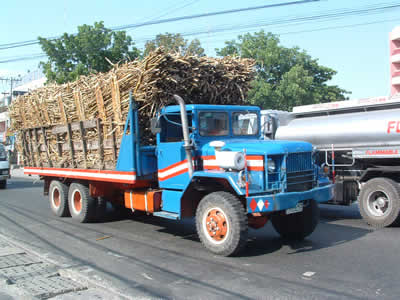
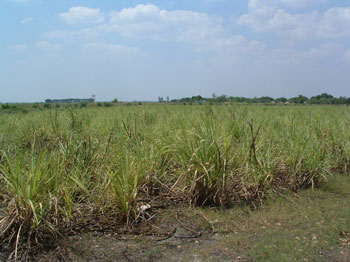
The busy MacArthur Highway (named after Gen. Douglas MacArthur) which traverses Tarlac, is full of heavily-loaded sugar cane trucks. Where do they all come from?
 |
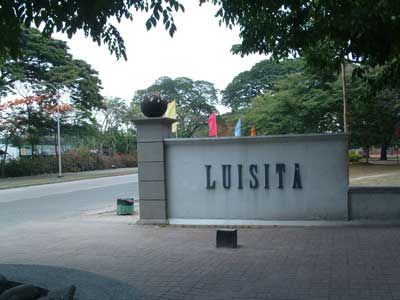 |
The sales agents inquired about the whereabouts of my Filipina wife, and offered to sell me a beautiful residential lot ready for immediate construction priced from only 750,000 Pesos ($13,888 Dollars.)
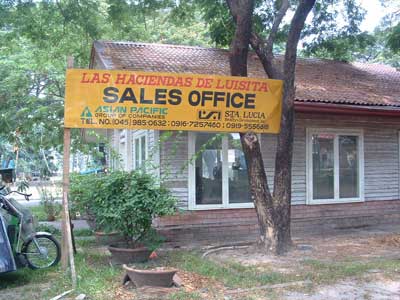 |
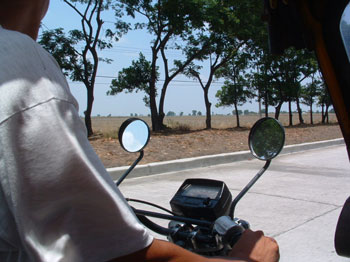
The sales agents suggested I tour the Hacienda and look at some of the available lots....but upon discovering that I hadn't brought my car ("You're riding a JEEPNEY?!?"), they suggested it might be better if I were to come back another time.
 |
 |
 |
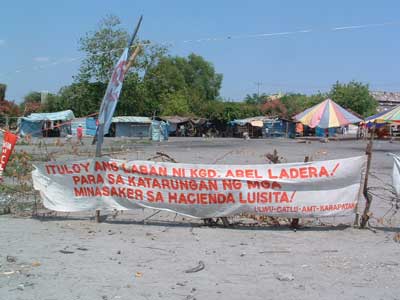
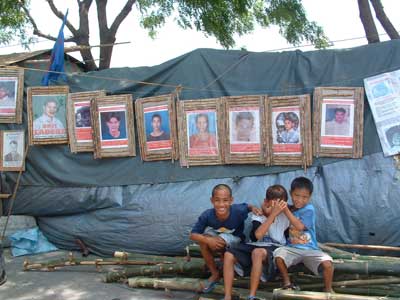
"ITULOY ANG LABAN NI KGD ABEL LADERA PARA SA KATARUNGAN NG MGA MINASAKER SA HACIENDA LUISITA!"
("CONTINUE THE FIGHT AND STRUGGLE OF ABEL LADERA FOR JUSTICE THE FARM WORKERS OF HACIENDA LUISITA!")
 |
Excerpt from an article in LabourStart online journal November, 2004:
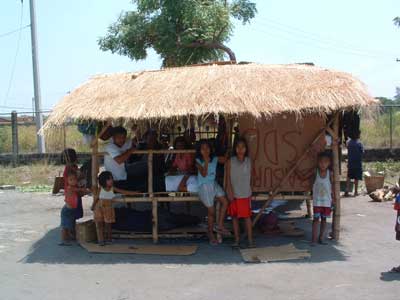
"In a violent strike dispersal in Hacienda Luisita last November 16, 2004, 14 people were killed, including two children aged 2 and 5 years old who died from suffocation from teargas lobbed by the police and army dispersal teams. One of the victims was allegedly strangled after being shot and his dead body hanged in the factory’s gate. At least 35 people were reported to have sustained gunshot wounds, 133 were arrested and detained, hundreds were wounded and another hundred still missing. The carnage is a gruesome reminder of the infamous Mendiola Massacre and Lupao Massacre, which also arose from the peasants demand to own their land.
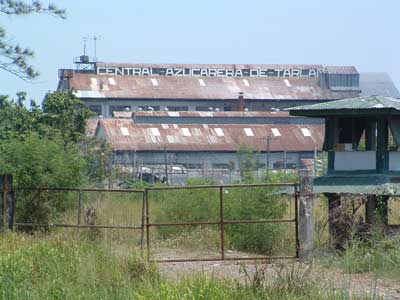
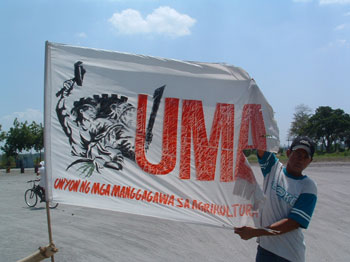
"More than 5,000 sugar mill workers and sugarcane farmers of Hacienda Luisita went on strike last Nov. 6. Members of the Central Azucarera de Tarlac Labor Union (CATLU) barricaded the factory's Gate 2 while members of the United Luisita Workers' Union (ULWU) simultaneously locked up the mill's Gate 1. CATLU is the employees union while ULWU is the farmworkers union.
"The strike arose from the deadlock in the negotiations for a collective bargaining agreement (CBA) between CATLU and Hacienda Luisita, Inc. (HLI) and the illegal dismissal of 327 farm workers belonging to ULWU last Oct. 1. Among those illegally dismissed were ULWU president and vice president, Rene Galang and Ildefonso Pingul, respectively, and eight other union officers.
"On its part, CATLU demands a P100 (US$ 1.78) salary increase and hospitalization benefits. But the Central Azucarera de Tarlac (CAT) management said that it can only provide a measly P12 wage hike and a P12,000 bonus. Series of negotiations ensued between CATLU and the management but the latter stood pat on its decision thereby resulting in a deadlock.
"More than the issue of wage and jobs, land distribution, land distribution remains to be the major demand of Hacienda Luisita workers. The workers, led by ULWU, are calling for the scrapping of the Stock Distribution Option (SDO), which the Cojuangcos used to purportedly escape land distribution to its tenants under the Comprehensive Agrarian Reform Program (CARP). Ironically, it was then Pres. Corazon Cojuangco Aquino, whose family owns the Hacienda, who signed the CARP law in 1987."
Complete articleMore articles on the massacre:
Manila Times
Philippine Headline News Online
Bulatalat
Manila Times editorial
 |
 |
 |
 |
 |
 |
 |
 |
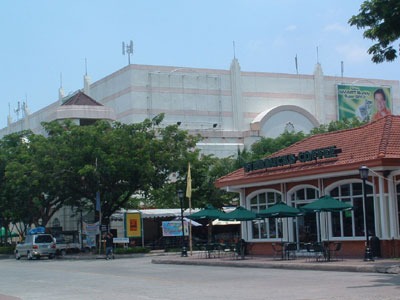
I saw a map showing planned development within the hacienda: the proposed North Luzon Expressway will run right through the middle of the hacienda (it's nice to have friends in high places) and will be surrounded by residential subdivisions and industrial parks. These have much higher profit potential than an industry such as sugar where global prices have dropped and the workers have shown a disinclination to continue living as slaves.
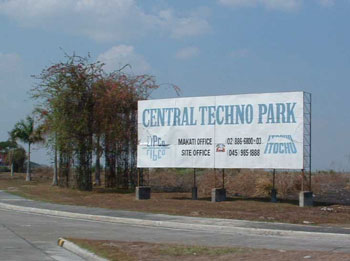
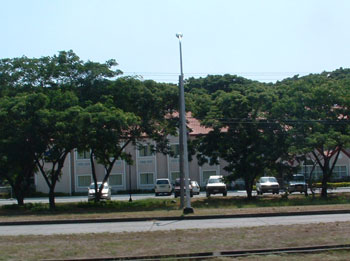
A land use plan (LUP) was prepared in 1996 outlining the planned comprehensive land conversion of the entire Hacienda Luisita into a commercial and industrial complex. According to the Bulatlat online journal, The Hacienda Luisita Land Use Plan shows that the family of former President Corazon Cojuangco-Aquino plan to convert all its agricultural lands in Tarlac into commercial, industrial, residential and recreational parks. Getting ready for the full-blast conversion, several parts of the hacienda have already been converted to alternative uses since 1989: the Luisita Industrial Park 1 (120 hectares), the Aqua Farm and Homesite Phases I and II (50 hectares), the Luisita Business Park (20 hectares), the recently-converted Luisita Industrial Park 2 / Central Techno Park (500 hectares).
If the plan is fully implemented, more than 5,000 sugar farmers stand to lose their jobs and worse, their right to Hacienda Luisita as farm beneficiaries under the Comprehensive Agrarian Reform Program (CARP).
Interestingly, in 1986 newly-seated President Corazon Aquino announced that land reform for millions of landless farmers would be the central platform of her new government. Yet while she presided over passage of the landmark CARP land reform law, she pointedly excluded from the process her own family estate of Hacienda Luisita. For many, this exposed the hollowness of her commitment to promoting progressive social change in the Philippines.
Earlier, when I had been invited to tour the Las Haciendas de Luisita Homesites, I noticed that one of the five villages was named Corazon. The President who trumpeted land reform has an exclusive residential subdivision named after her, on the family estate which was intentionally excluded from land reform....the true legacy of "People Power" in the Philippines.
 |
 |
 |
 |
 |
It's important to keep local security forces well-equipped in order to assure that the Hacienda Luisita Land Use Plan gets implemented without bothersome interference.
Update 2007
In 1988 then-President Corazon C. Aquino launched the Comprehensive Agrarian Reform Law (CARP) as “the centerpiece program” of her administration. She initially vowed to place her family’s 6,443 hectare Hacienda Luisita under the land reform.
In 1989 her government allowed Hacienda Luisita to adopt the so-called Stock Distribution Option (SDO) under which the 5,000 HLI (Hacienda Luisita Incorporated) workers obtained shares of stock in the company instead of individual titles to the hacienda land. This was widely viewed as an attempt to skirt the CARP redistribution of the hacienda.
In December 2005 the Presidential Agrarian Reform Council (PARC) and Agrarian Reform Secretary Nasser Pangandaman issued an order revoking the SDO agreement, instead directing that the hacienda land be parceled amongst the tenant farmers. Critics interpreted this as a politically-motivated slap at Cory Aquino for having called on President Arroyo to resign following the "Hello Garci" election scandal.
In June 2006, the Supreme Court reversed the PARC order by issuing a temporary restraining order (TRO) against the PARC plan to parcel out Hacienda Luisita to farmer-beneficiaries.
In March 2007, the Supreme Court ruled that sugar lands remained within the coverage of the Comprehensive Agrarian Reform Program (CARP.) In response, the Cojuangco family petitioned the court to honor the stock distribution option (SDO) scheme at the hacienda.
As of June 2007, the legal case surrounding the property in still in limbo. The Cojuangco family continues to run the hacienda while the workers who have been tilling the land for years still have nothing.
Main page of Chris In the Philippines 3