 |
| Teachers and Students at Furukawa High School |
|
| During my time in Japan, I have had plenty of time to reflect on the Japanese concept of the student-teacher relationship, and of how school is run in general. Of course, I have only visited a few schools over here, and I was raised in a "middle class" public school system in the States, so of course my opinions will be biased. But overall, I have found that teachers in Japan seem to take a much more active role in the lives of their students than in America. I have heard many times that, not only is it the teacher's responsibility to educate, but also to mold students into the types of people who will make a useful contribution to Japanese society, and learn to live in "peace" with those around them. It seems that school is a "socializing machine", with the goal of sending out into the world responsible young Japanese men and women who understand that they are an integral part of a larger community. The behavior of students outside of class is of great interest to their school. I have heard teachers say that many times if a student behaves badly, and people know what school that student is from, they will "lose respect" for that school and think that it does not do a good job educating children. Students are routinely reminded that their behavior, both good and bad, directly affects their school's reputation, and people will just as quickly blame a school for a student's shortcomings as they will the parents, or the students themselves. |
| Things I Have Noticed in the Japanese Education System 1) There are entrance exams for Junior and Senior High schools, and for colleges. If you fail the test, you cannot enter that particular school during that year. There are (as far as I know) no interviews or essays as part of the application procedure. 2) Students in (at least my) high school have a "home room" teacher, who meets with the class every day to take attendance, go over announcements, etc. That "home room teacher" is most directly responsible for taking care of those students. 3) Teachers do not have rooms. Teachers move from class to class, while the students stay put in one room. 4) Class size is always around 40 students. We have space for eight classrooms for each grade at my school. We only have around 240 1st year students, but instead of having 8 classes of around 30 students each, the school lets go of teachers, and has only 6 classes filled to the 40 person maximum. 5) The school year is almost one calendar year long, with graduation (at my school) in the middle of a weekday. The number of mothers at graduation FAR exceeded the number of fathers last year. 6) Students (and most teachers, too) stand in very orderly rows, separated by their classes, at assemblies. 7) While this is not the case at every school, at my school there are only two student-use computers. There are almost 900 students at Furuko. 8) Our school rules effectively prohibit students from enrolling in driver's certification classes, or obtaining a license. My teachers are always amazed when I tell them my school back home has a student parking lot. 9) Students are expected to enroll in only one club each year, with whom they meet regularly after school. There are no "sports seasons" like we think of in America. |
 |
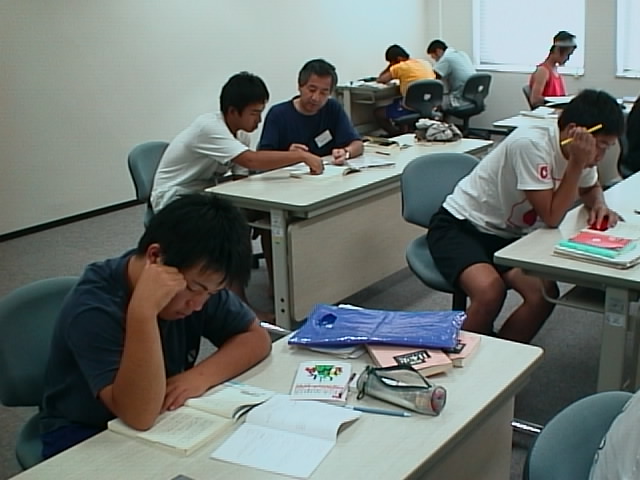 |
| (Moriya Sensei helps a student with his English lesson during the summer "Training Classes".) |
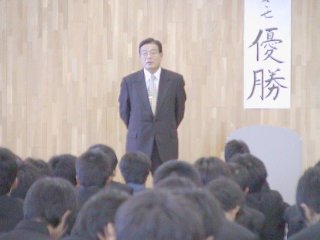 |
| (Our school Principal addresses potential Furuko students who chose to attend the school's "open house".) |
|
|
| Take me BACK! Main Miyagi JET Furukawa city, Miyagi Furukawa H.S. Friends More Links |
 |
|
 |
|