 |
| Oral Communication A - Teaching English at Furuko |
|
| Teaching English in Japan is quite an experience. The whole system of English Education over here is worth a really good look, but I don't want to go into it - and besides I couldn't offer anything but my own random ideas and takes on the whole thing. Suffice it to say, most students devote about 6 years to the study of English (in junior and senior high schools), and yet most seem to have difficulty in actually using it competently. In my humble opinion (and in the opinion of most every other ALT I have spoken to), the main reason for this lack of communicative ability stems from the fact that the majority of students' studying takes the form of grammar drills and reading practice. I'm guessing that amost all universities (and most high schools) use an "English Proficiency" section in their entrance tests, and rarely if ever do these sections contain listening and speaking components. It seems that it is for these tests alone that teachers (at least at my school) prepare their students, hence a general lack of speaking ability by most young Japanese. I believe that the JET Program and "OCA" were developed to help combat these problems, at least from the point of view of Japan's Ministry of Education. |
| At my school, students begin by studying basic English, and then move on in the higher grades to studies which focus on reading and writing skills. "OCA", or the class which focuses on the communication-side of English, is only taught to first-year students. Apparently, there is not enough time to cover everything that teachers deem "essential to passing entrance exams", AND lessons of OCA in 2nd and 3rd year classes. Would my teachers like to do more OCA, but feel bound by exam-preparing responsibilities? I think so - but still, at the time of my writing this I have spent less than 20 hours in the classroom since February, when the teachers switched positions and I received new teachers to teach with (JTEs). My contract calls for me to be at school for 35 hours each week... |
| I paid a visit to some of the "regular" English classes a few weeks ago. Immediately, I was struck by how much this class resembled one where Latin is the focus. English was being taught as if it were a dead language! All instruction was in Japanese, grammar points were reviewed and drilled, and each English sentence was read and then painstakingly translated. OCA is supposed to be the antithesis of this type of class. With the focus being on communication, and (at least for me) NOT on 100% student comprehension, topics should cover things like "how to ask for directions", "how to buy something", or "how to invite a friend" - NOT on the correct usage of the past-perfect tense. In OCA classes, Common expressions should be introduced, and students should have a chance to actually SPEAK and LISTEN to natural English. I believe that in order for students to become comfortable with English, they need to USE English. And, watching themselves succeed in communicating would (you would think) provide the students with positive reinforcement to continue their studies. Its a lot easier to learn about something you enjoy, so if we can make English classes as enjoyable as possible... |
 |
 |
 |
 |
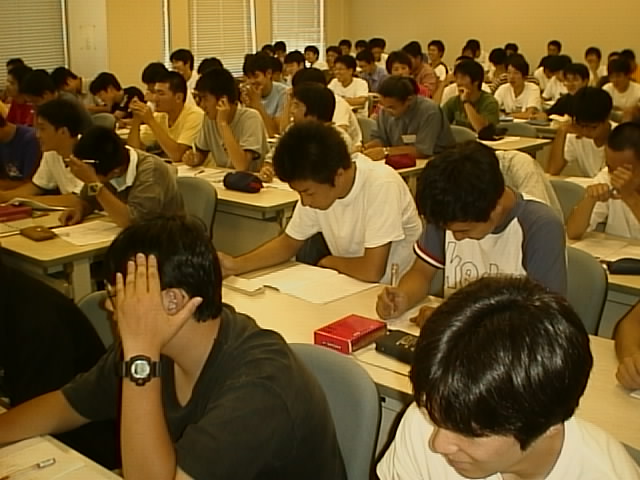 |
| (Students hard at work... during the summer.) |
 |
|
|
| Take me BACK! Main Miyagi JET Furukawa city, Miyagi Furukawa H.S. Friends More Links |
 |
|
 |
|
 |
| (What a wave!) |